Nothing on the Railroad Could Tell That the Bridge Had Moved
At 2:45 in the morning on September 22, 1993, six barges pushed by the towboat MAUVILLA came out of the fog into a side channel of the Mobile River called the Big Bayou Canot, and struck a CSX railroad bridge. The bridge moved 38 inches. The rails bent with it and did not break.
Transcript
Finding number one
N1
NTSB/RAR-94/01 · Big Bayou Canot · adopted Sept. 19, 1994 · p. 59. View the original.
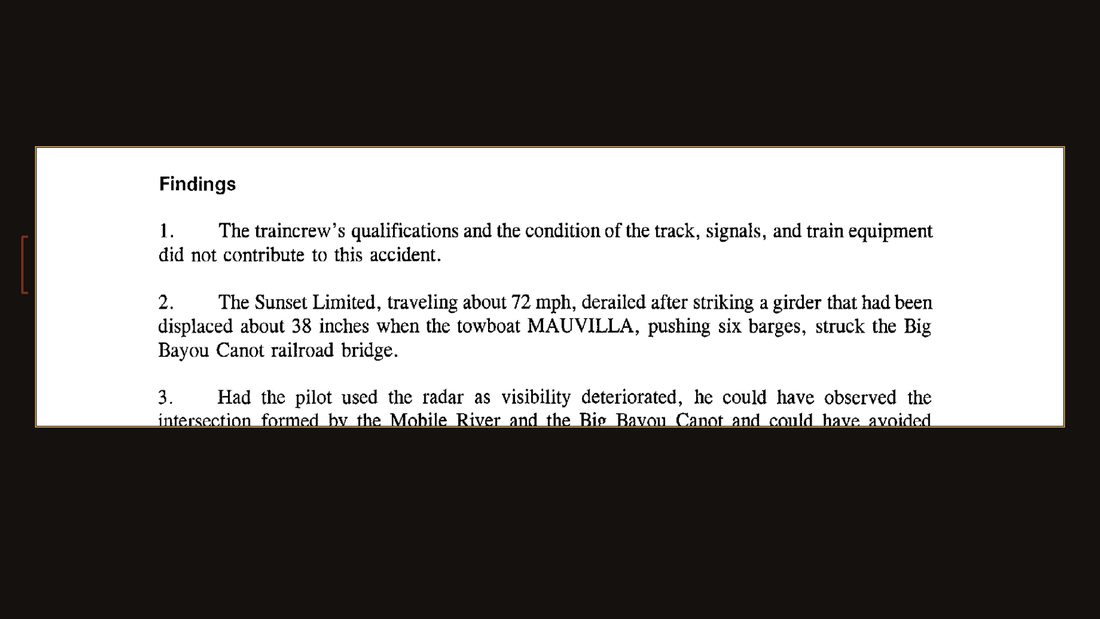
This is the first finding of a federal investigation into the deadliest accident in the history of Amtrak.
N2
NTSB/RAR-94/01 · Big Bayou Canot · adopted Sept. 19, 1994 · p. 59. View the original.
The train crew's qualifications, and the condition of the track, the signals, and the train equipment did not contribute to this accident.
N3
NTSB/RAR-94/01 · Big Bayou Canot · adopted Sept. 19, 1994 · p. 59. View the original.
That is not a defense of the railroad. It is the whole problem, written down in one sentence on page fifty-nine.
N4
NTSB/RAR-94/01 · Big Bayou Canot · adopted Sept. 19, 1994 · p. 15. View the original.
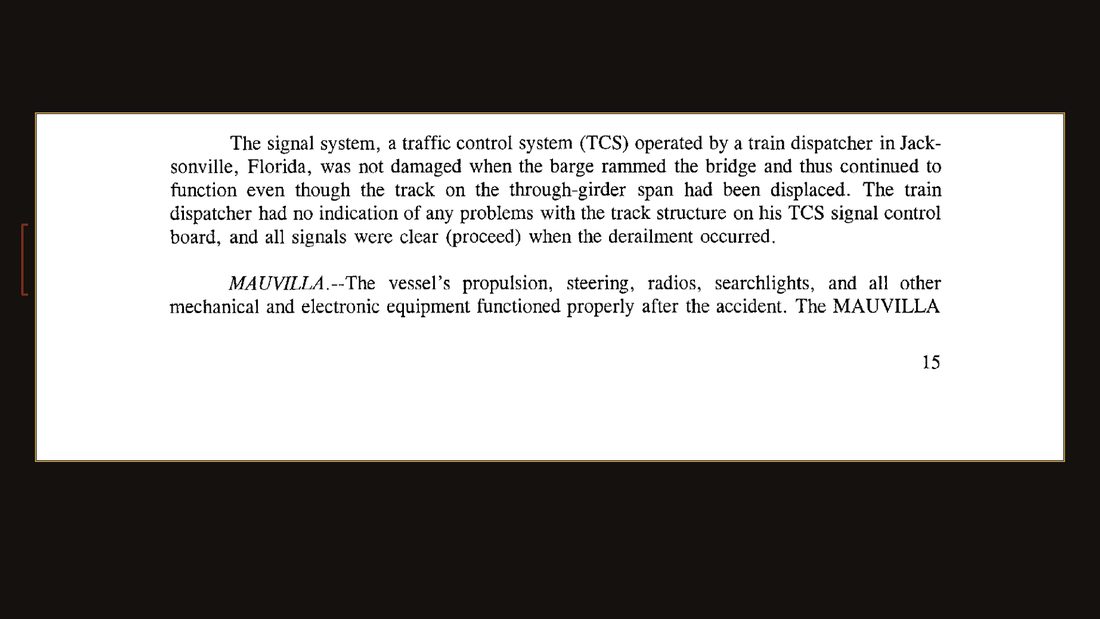
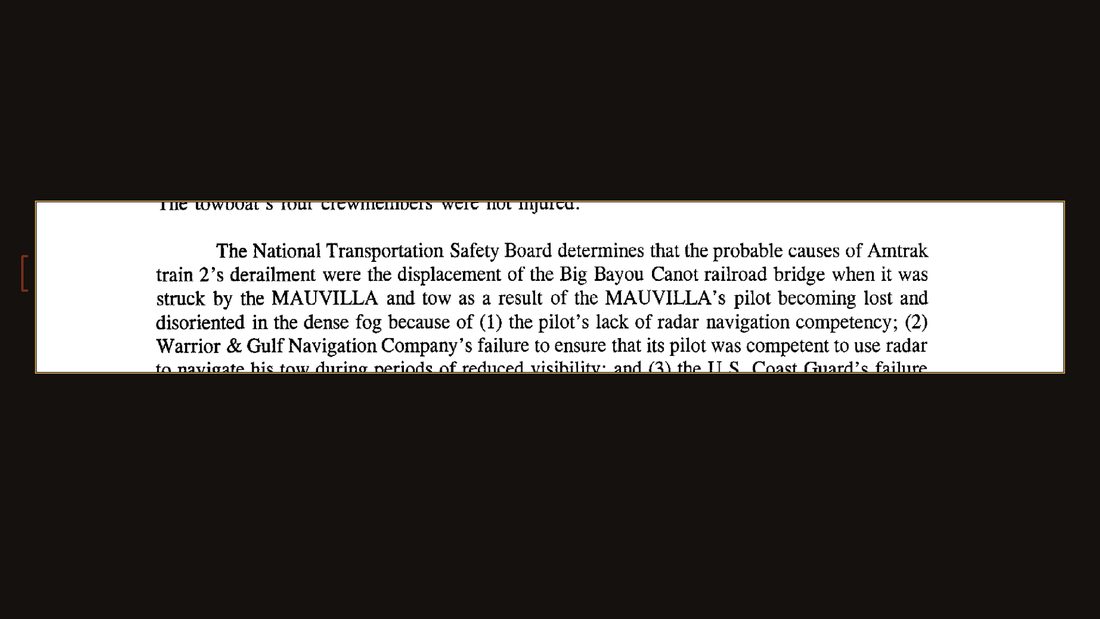
Everything on that railroad worked exactly the way it had been designed to work.
And forty-seven people died anyway.
N5
NTSB/RAR-94/01 · Big Bayou Canot · adopted Sept. 19, 1994 · Executive Summary. View the original.
This is the record of what a machine cannot notice.
Foggier and foggier
N6
NTSB/RAR-94/01 · Big Bayou Canot · adopted Sept. 19, 1994 · p. 1. View the original.
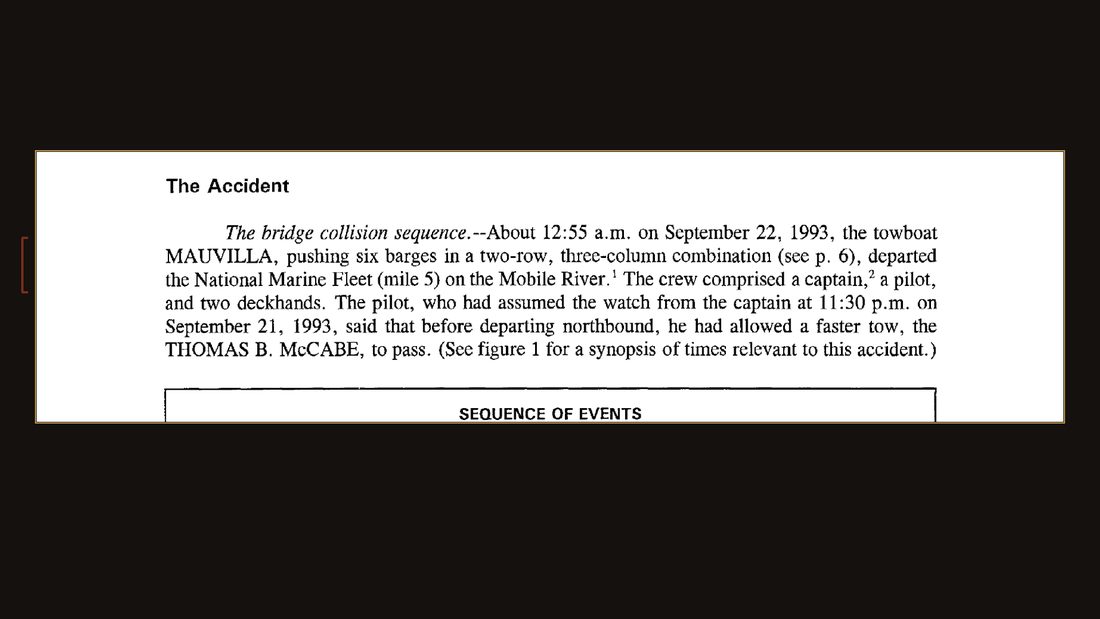
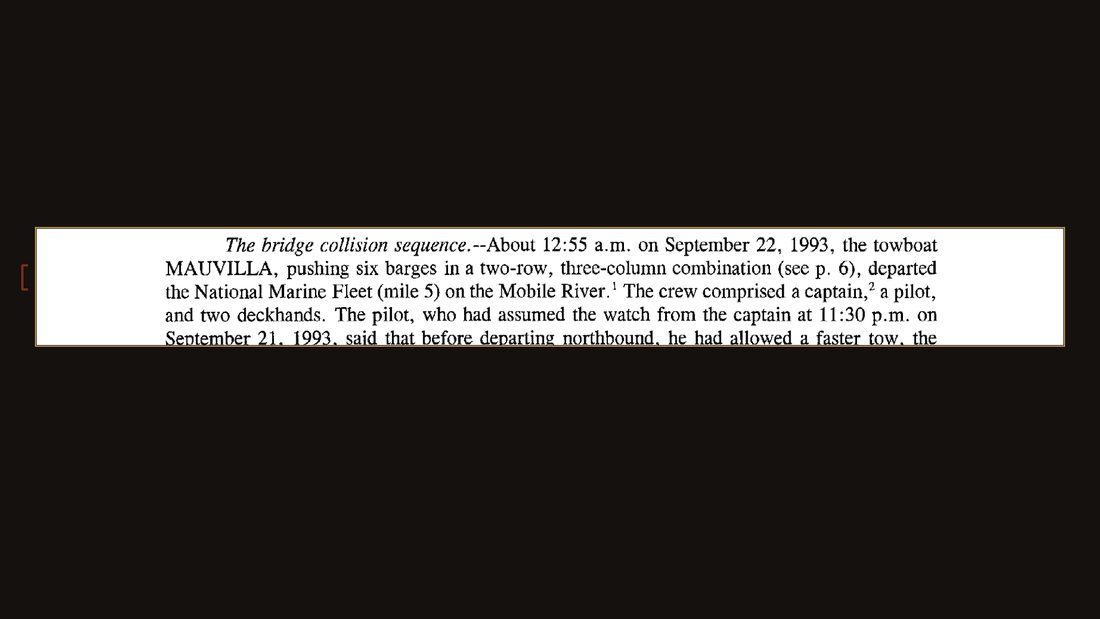
Just after midnight on the twenty-second of September, nineteen ninety-three, a towboat named the Mauvilla left a barge fleet on the Mobile River.
N7
NTSB/RAR-94/01 · Big Bayou Canot · adopted Sept. 19, 1994 · p. 1. View the original.
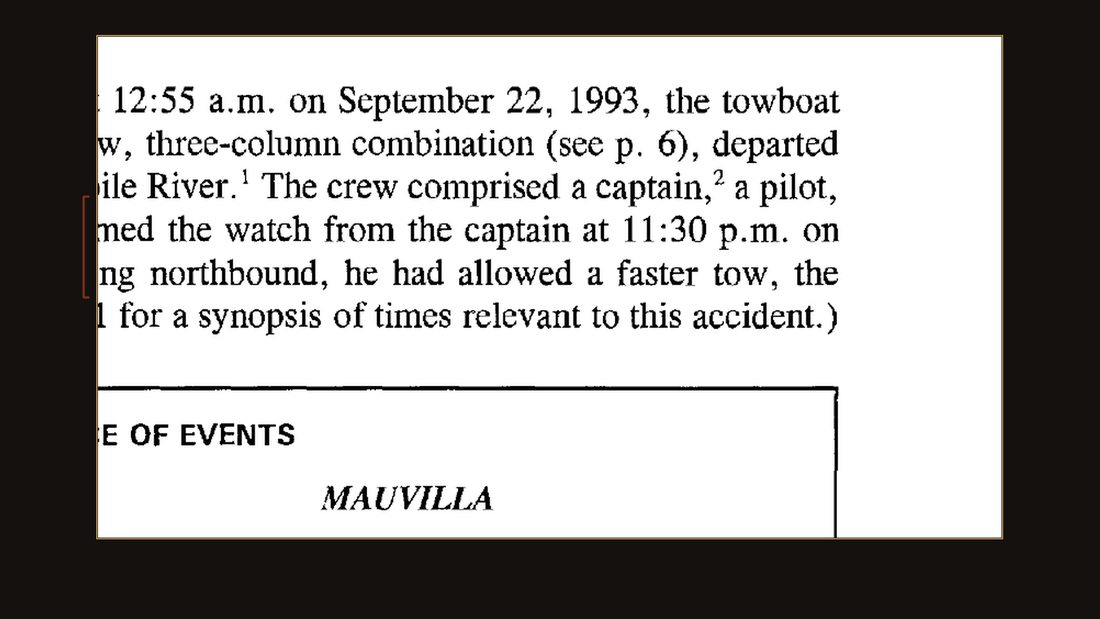
She was eighty-five feet long and she was pushing six barges, in two rows of three.
N8
NTSB/RAR-94/01 · Big Bayou Canot · adopted Sept. 19, 1994 · p. 1. View the original.
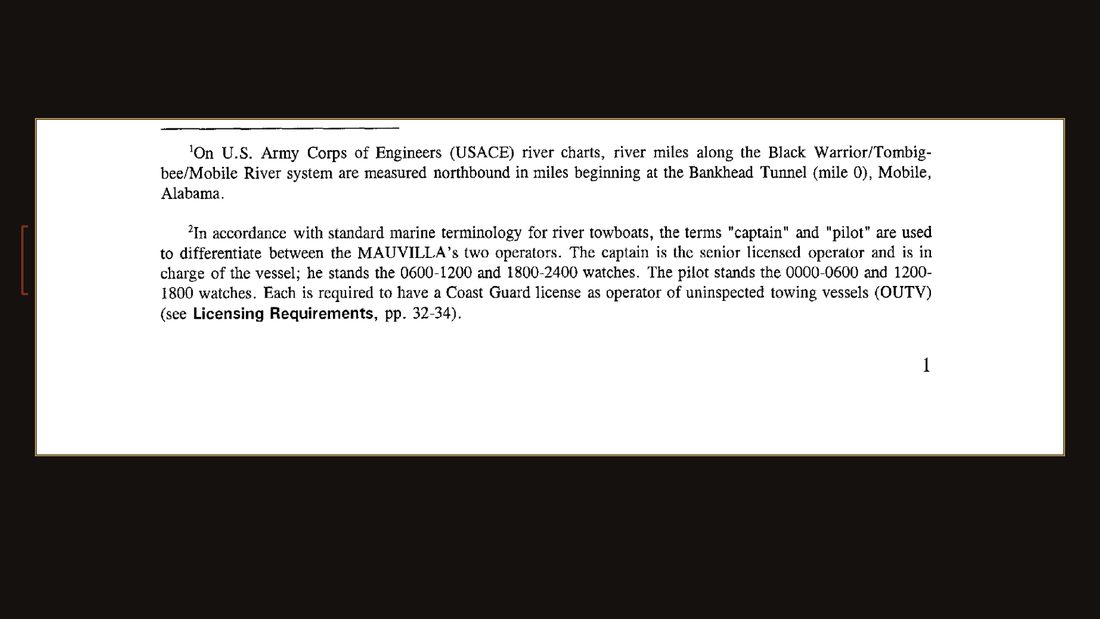
Four men aboard. A captain, a pilot, and two deckhands. The pilot had the watch.
N9
NTSB/RAR-94/01 · Big Bayou Canot · adopted Sept. 19, 1994 · p. 1. View the original.
The National Transportation Safety Board never prints his name in this report, and neither will this video. He is the pilot.
N10
NTSB/RAR-94/01 · Big Bayou Canot · adopted Sept. 19, 1994 · p. 2. View the original.
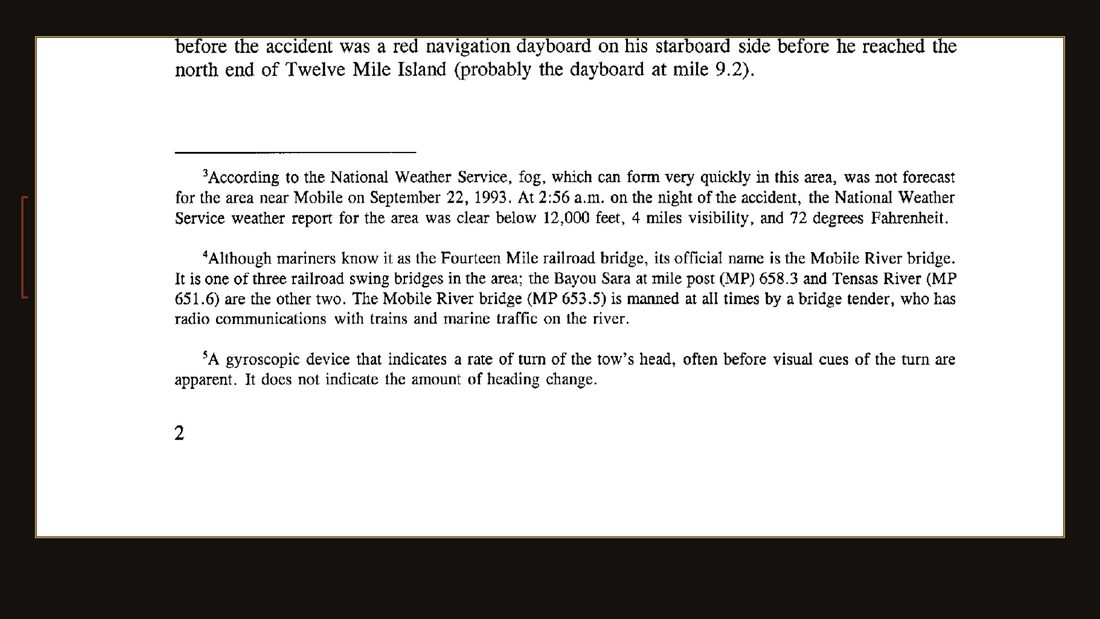
Fog was not forecast that night. The weather report at the time of the accident called for four miles of visibility.
Fog formed anyway. It does that on this water. Quickly.
N11
NTSB/RAR-94/01 · Big Bayou Canot · adopted Sept. 19, 1994 · p. 2. View the original.
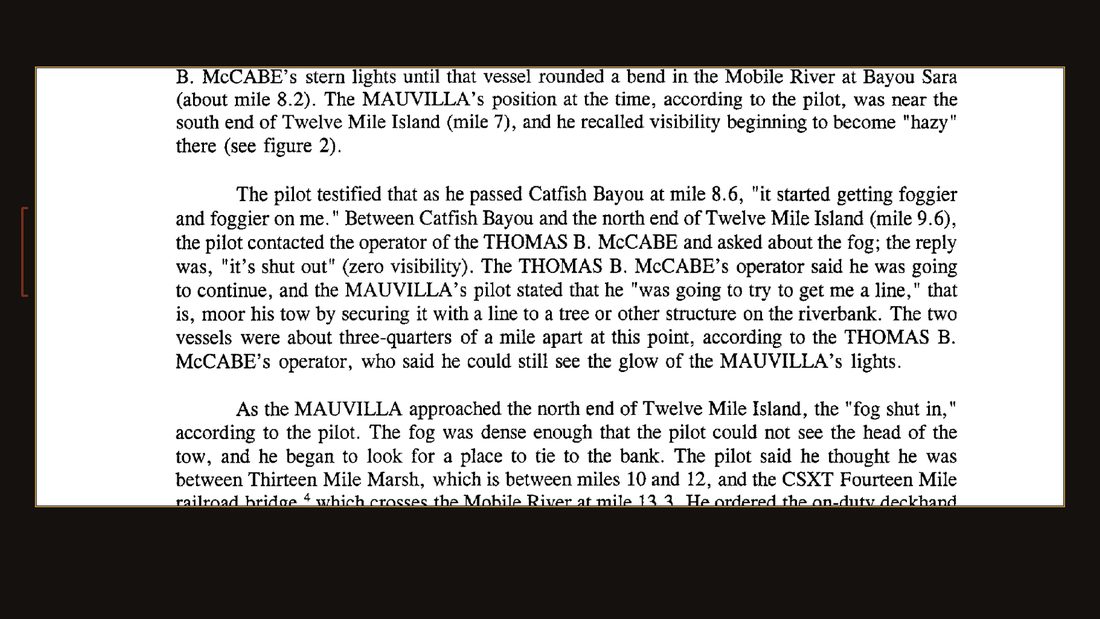
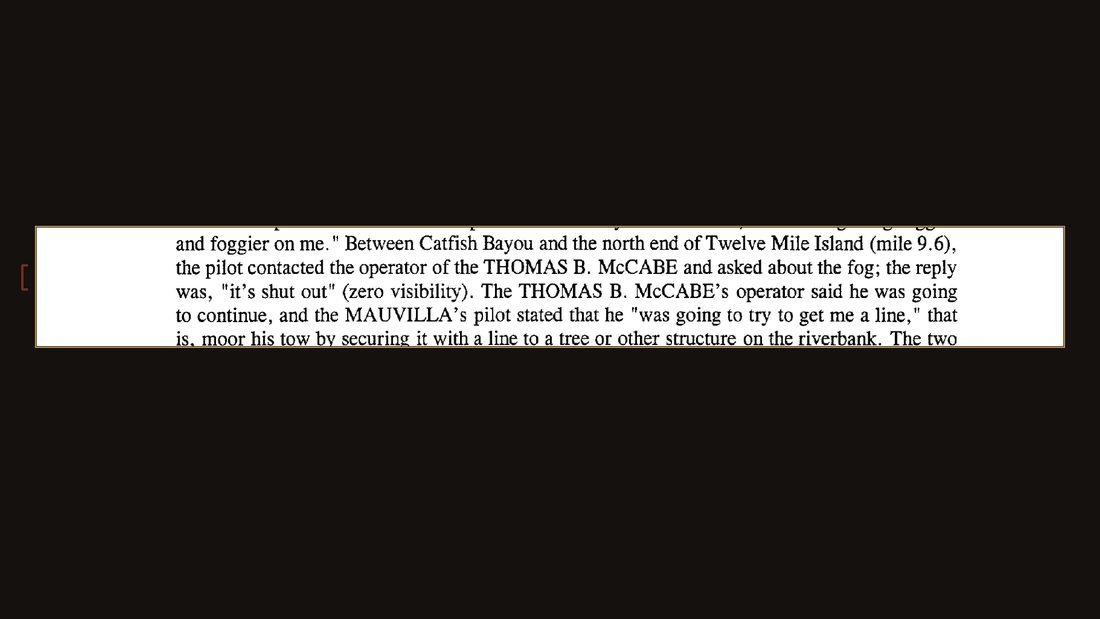
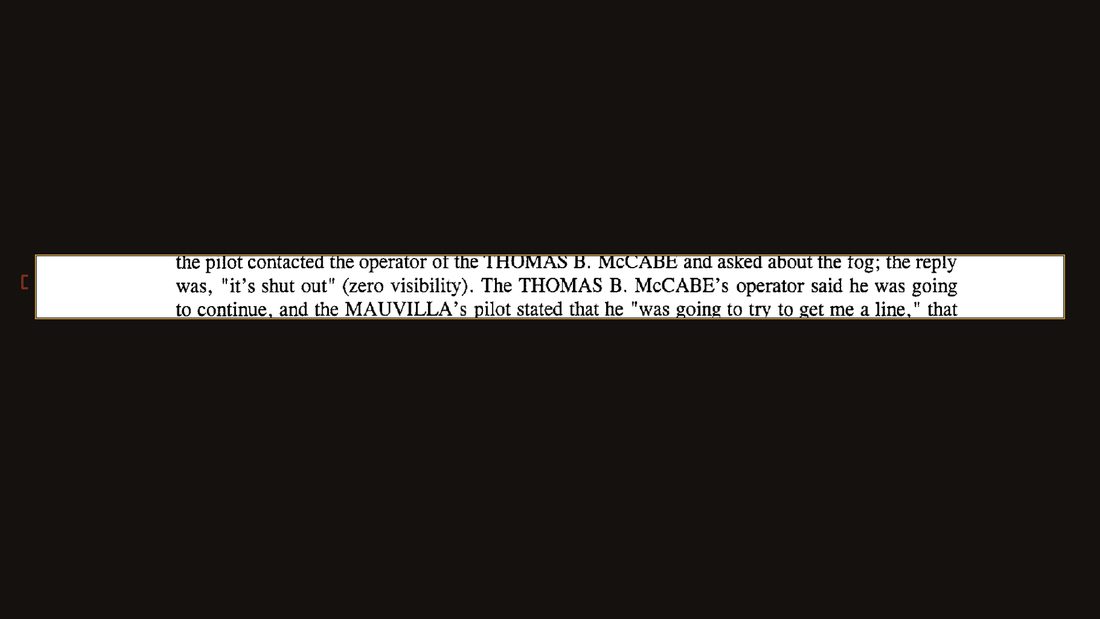
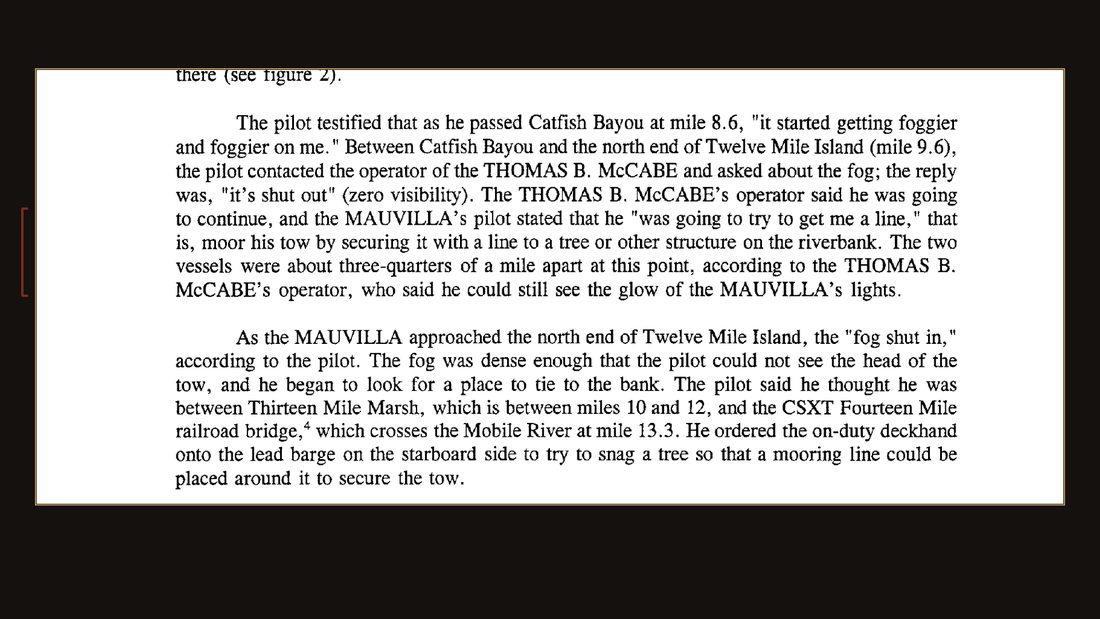
The pilot's own testimony. As he passed Catfish Bayou, quote, it started getting foggier and foggier on me.
N12
NTSB/RAR-94/01 · Big Bayou Canot · adopted Sept. 19, 1994 · p. 2. View the original.
He called another towboat ahead of him and asked about the fog. The answer came back in two words.
N13
NTSB/RAR-94/01 · Big Bayou Canot · adopted Sept. 19, 1994 · p. 2. View the original.
It's shut out. Zero visibility.
N14
NTSB/RAR-94/01 · Big Bayou Canot · adopted Sept. 19, 1994 · p. 2. View the original.
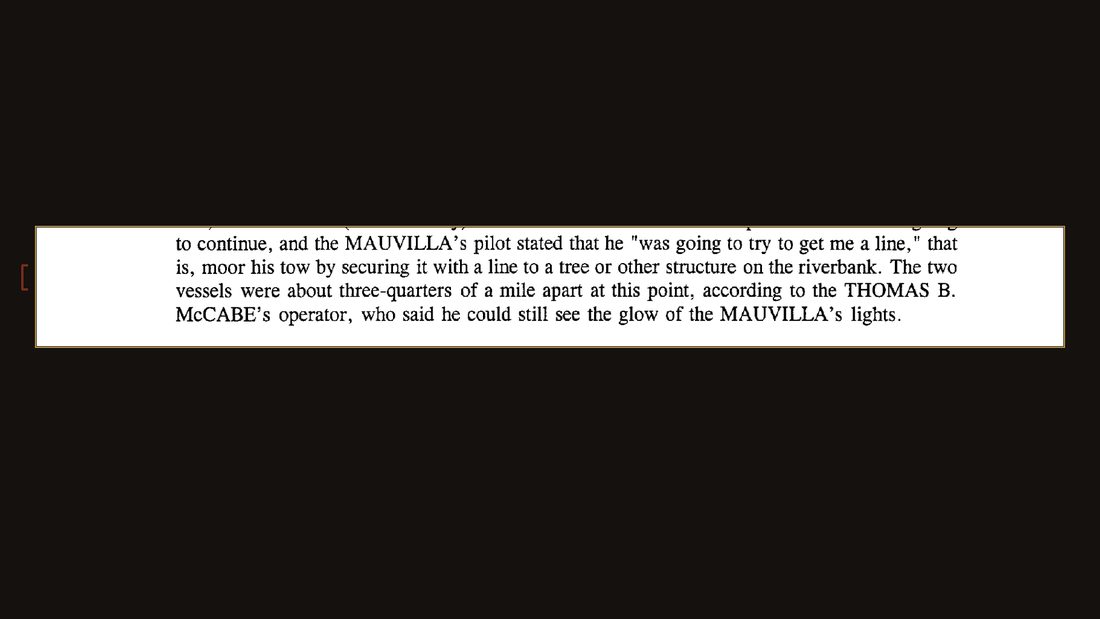
The other operator kept going. The pilot of the Mauvilla decided to tie up and wait it out.
N15
NTSB/RAR-94/01 · Big Bayou Canot · adopted Sept. 19, 1994 · p. 2. View the original.
That was the right decision. On this river you tie a line around a tree on the bank and you stop.
N16
NTSB/RAR-94/01 · Big Bayou Canot · adopted Sept. 19, 1994 · p. 2. View the original.
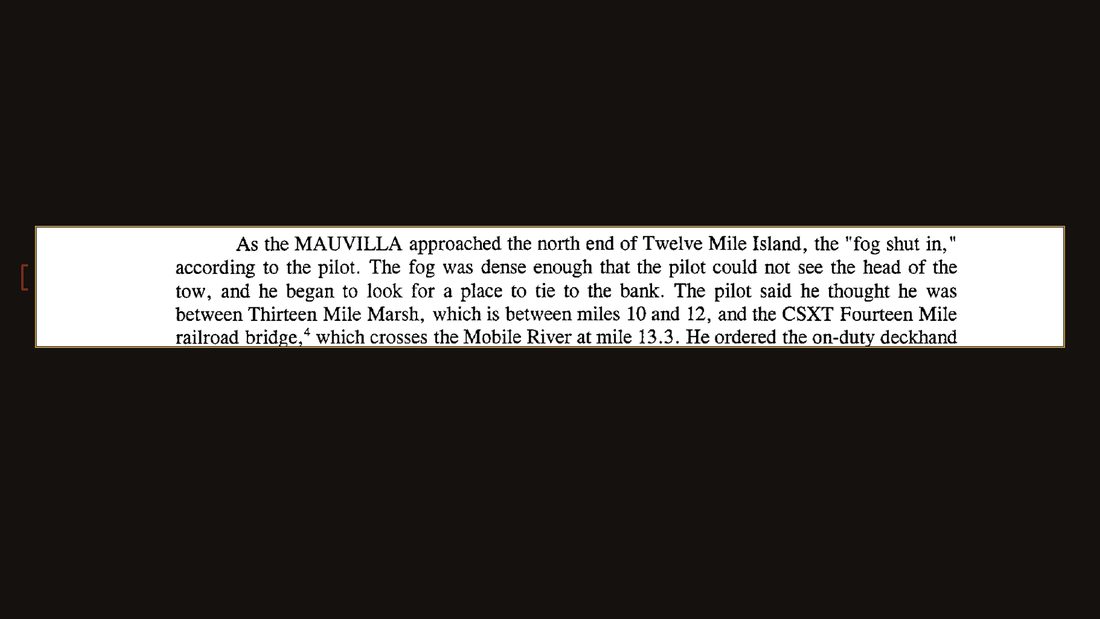
He could no longer see the head of his own tow. It was more than four hundred feet in front of him.
N17
NTSB/RAR-94/01 · Big Bayou Canot · adopted Sept. 19, 1994 · p. 2. View the original.
He sent a deckhand forward onto the lead barge with a searchlight to snag a tree.
N18
NTSB/RAR-94/01 · Big Bayou Canot · adopted Sept. 19, 1994 · p. 2. View the original.
Two attempts. Neither caught. The pilot could not see the man he had sent out there.
N19
NTSB/RAR-94/01 · Big Bayou Canot · adopted Sept. 19, 1994 · p. 2. View the original.
So he ordered him back, afraid the deckhand would be hurt or would go over the side in the fog.
Every decision in that sentence is a decent one. Hold on to that.
The wrong water
N20
NTSB/RAR-94/01 · Big Bayou Canot · adopted Sept. 19, 1994 · p. 2. View the original.
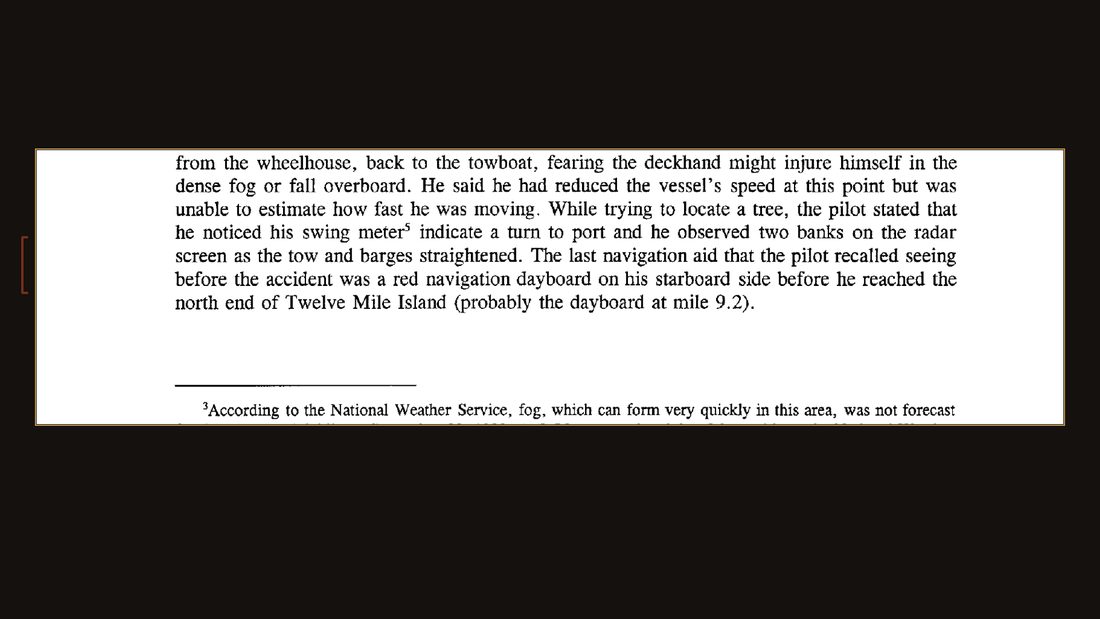
While he was looking for that tree, something happened that he noticed and did not understand.
N21
NTSB/RAR-94/01 · Big Bayou Canot · adopted Sept. 19, 1994 · p. 2. View the original.
His swing meter showed the tow turning to port. Two banks appeared on the radar screen as the barges straightened out.
N22
NTSB/RAR-94/01 · Big Bayou Canot · adopted Sept. 19, 1994 · p. 4. View the original.
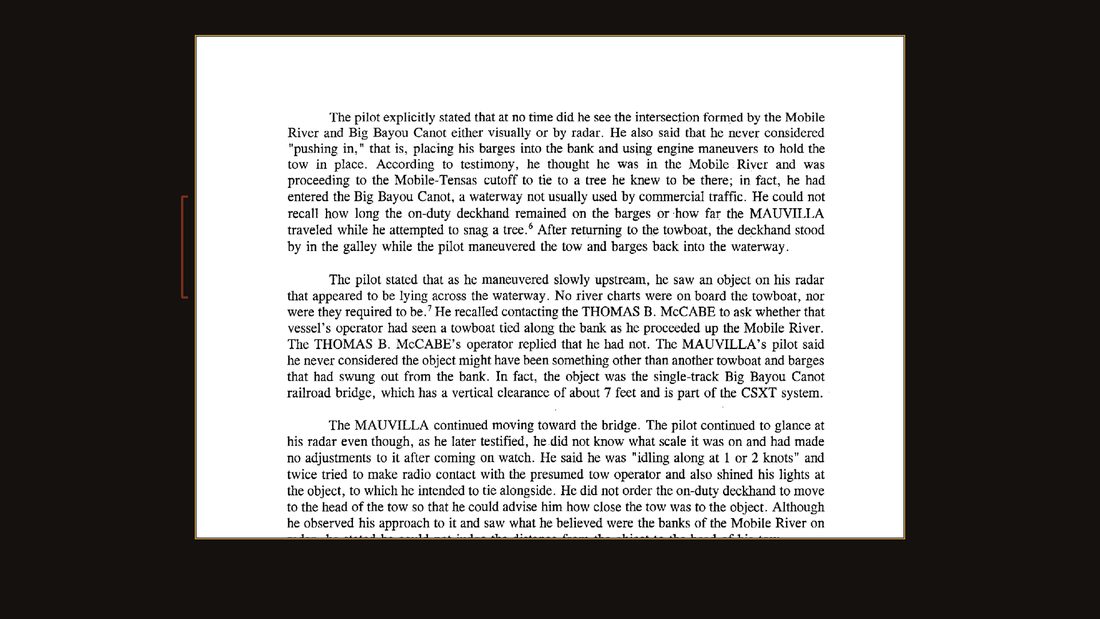
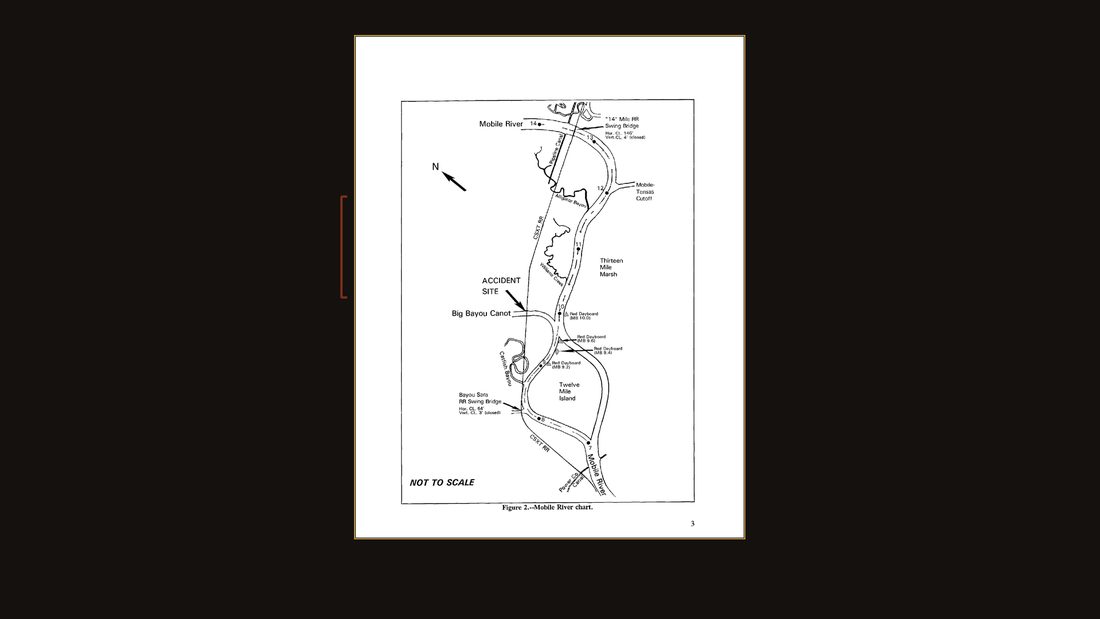
He had turned out of the Mobile River and into a side channel called the Big Bayou Canot.
N23
NTSB/RAR-94/01 · Big Bayou Canot · adopted Sept. 19, 1994 · p. 3. View the original.
Here is the geography. The Safety Board printed it as figure two.
N24
NTSB/RAR-94/01 · Big Bayou Canot · adopted Sept. 19, 1994 · p. 43. View the original.
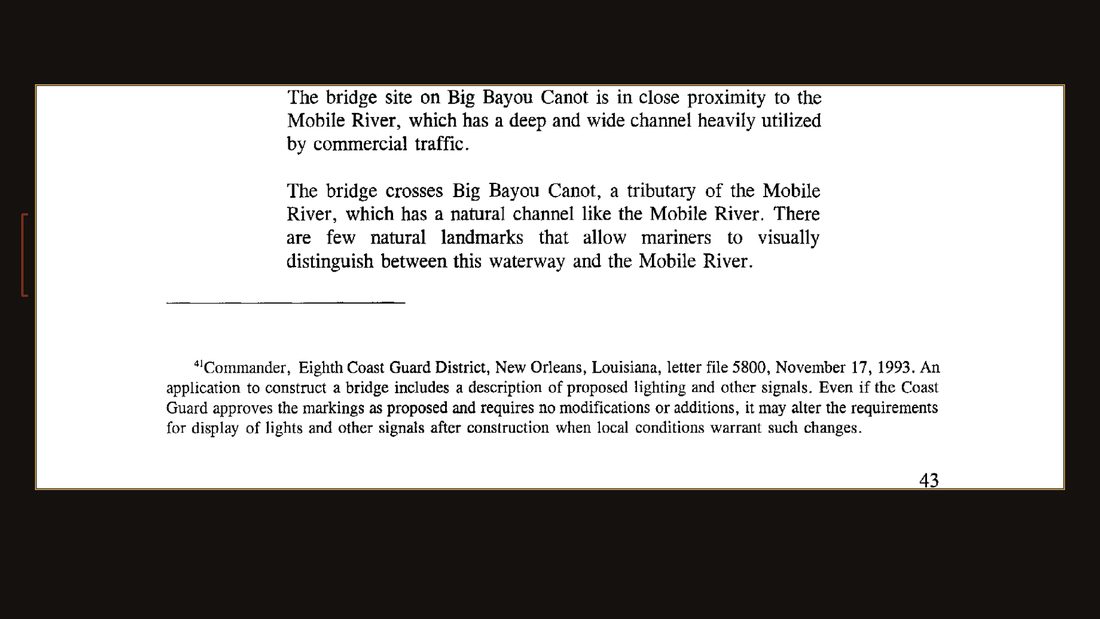
The bayou leaves the river and runs west, and it is a natural channel, and it looks like a river.
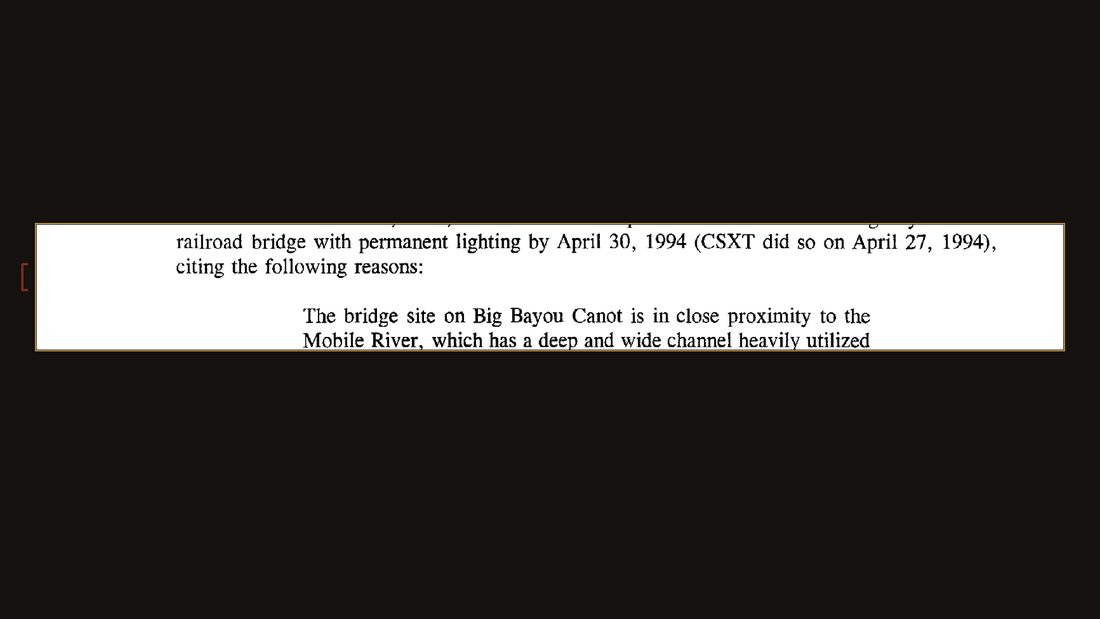
N25
NTSB/RAR-94/01 · Big Bayou Canot · adopted Sept. 19, 1994 · p. 43. View the original.
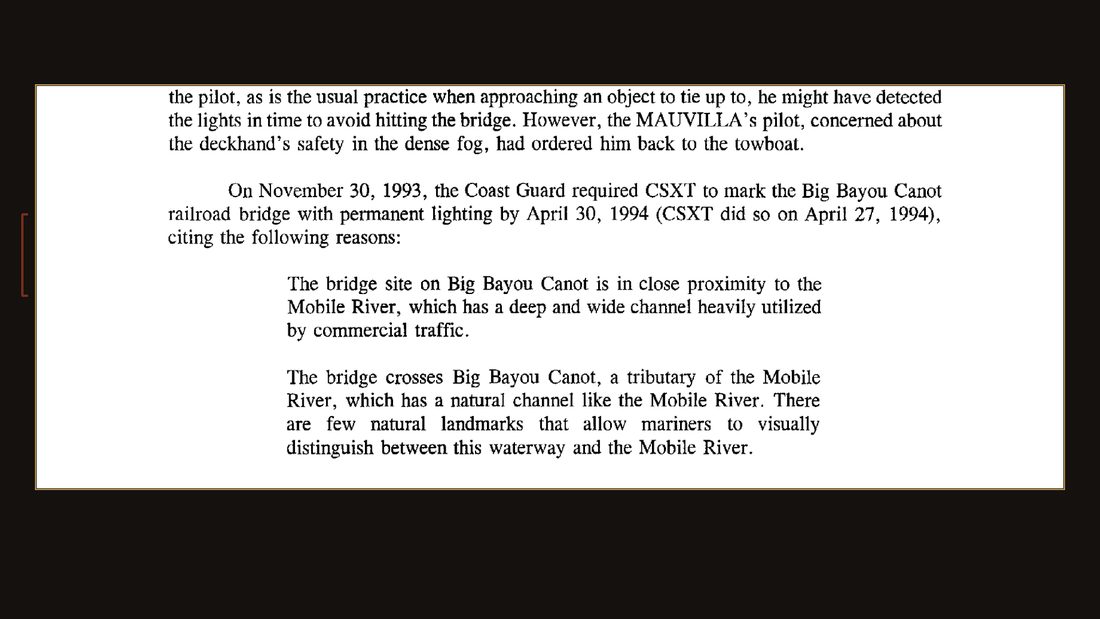
The Coast Guard would put this in writing two months later.
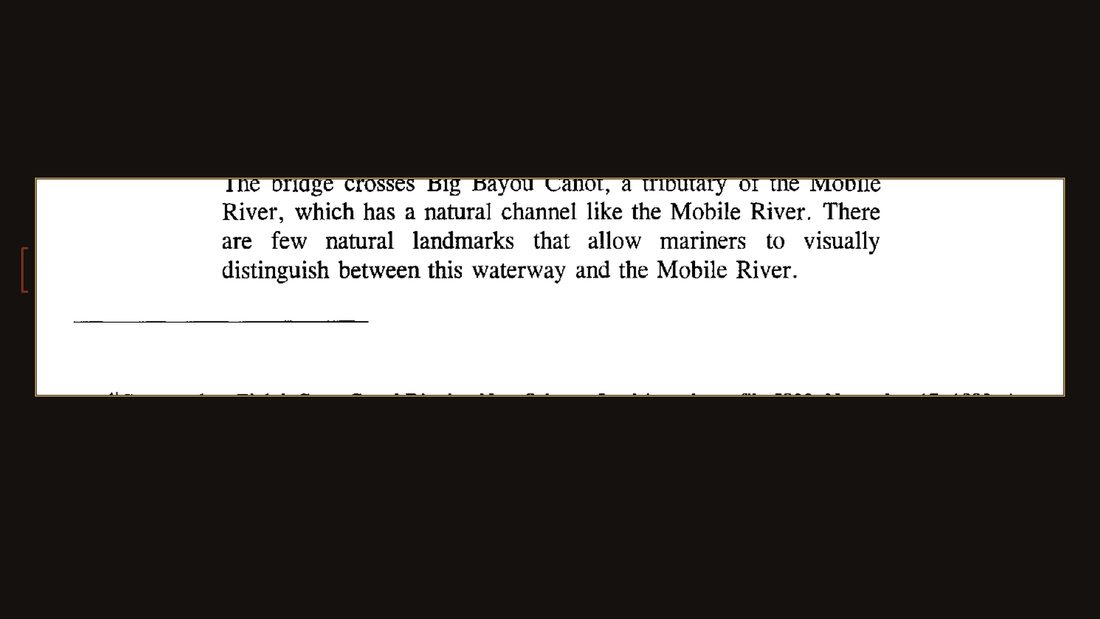
N26
NTSB/RAR-94/01 · Big Bayou Canot · adopted Sept. 19, 1994 · p. 43. View the original.
There are few natural landmarks that allow mariners to visually distinguish between this waterway and the Mobile River.
N27
NTSB/RAR-94/01 · Big Bayou Canot · adopted Sept. 19, 1994 · p. 44. View the original.
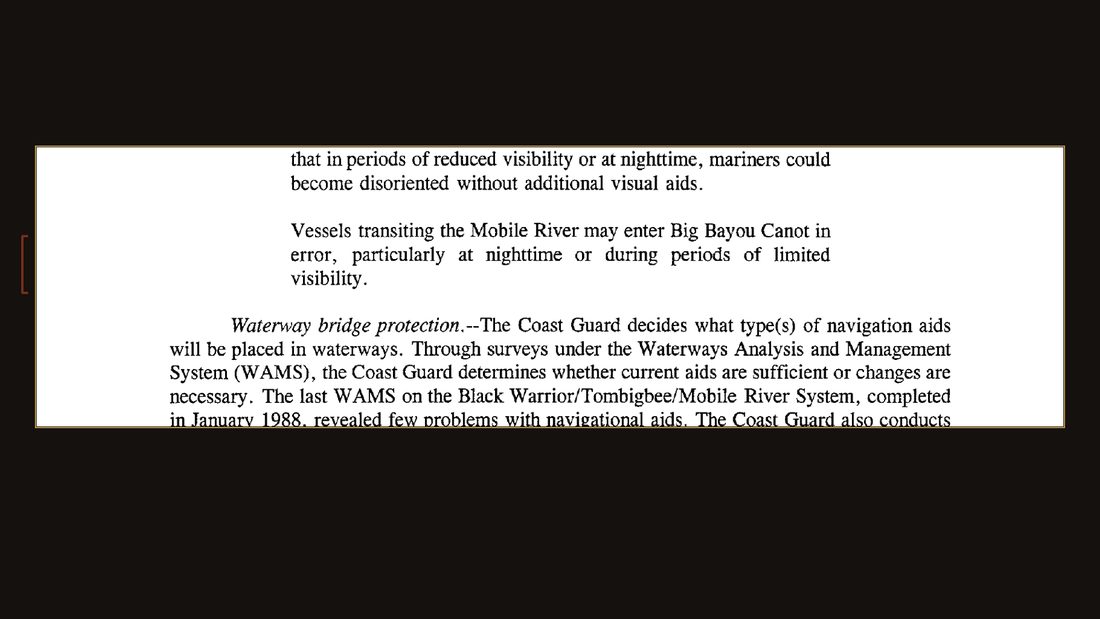
And: vessels transiting the Mobile River may enter Big Bayou Canot in error.
N28
NTSB/RAR-94/01 · Big Bayou Canot · adopted Sept. 19, 1994 · p. 43. View the original.
That is the Coast Guard, in November of nineteen ninety-three, describing a hazard it had not marked.
N29
NTSB/RAR-94/01 · Big Bayou Canot · adopted Sept. 19, 1994 · p. 44. View the original.
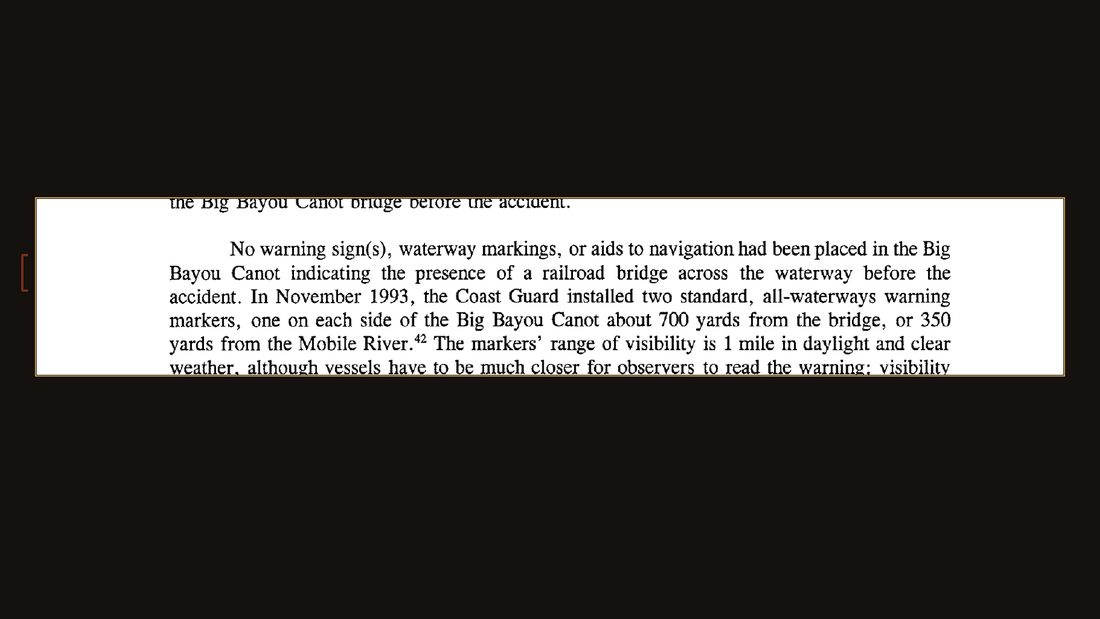
No warning sign. No waterway marking. No aid to navigation of any kind in that bayou.
N30
NTSB/RAR-94/01 · Big Bayou Canot · adopted Sept. 19, 1994 · p. 4. View the original.
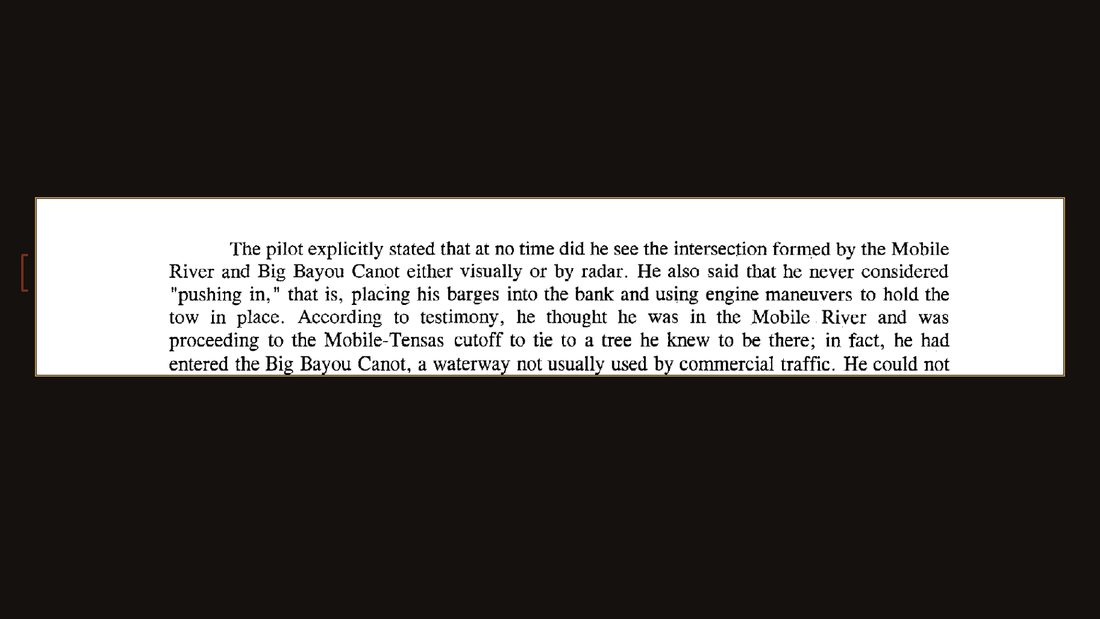
The pilot's own words: at no time did he see the intersection, visually or by radar.
N31
NTSB/RAR-94/01 · Big Bayou Canot · adopted Sept. 19, 1994 · p. 4. View the original.
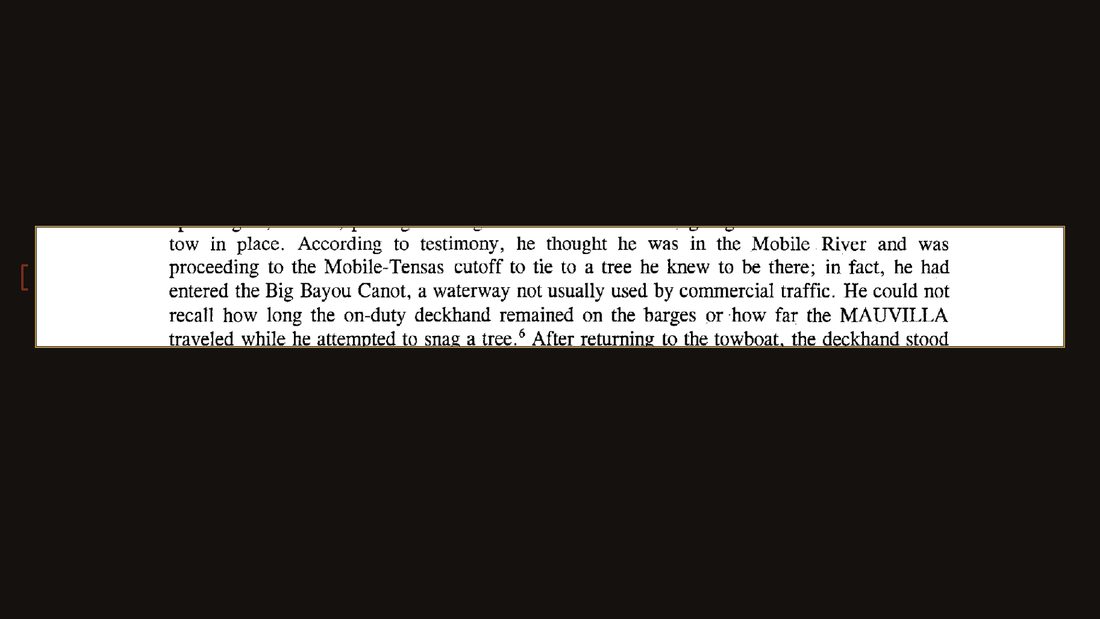
He believed he was still on the river, heading for a cutoff where he knew there was a tree.
A bump at 2:45
N32
NTSB/RAR-94/01 · Big Bayou Canot · adopted Sept. 19, 1994 · p. 4. View the original.
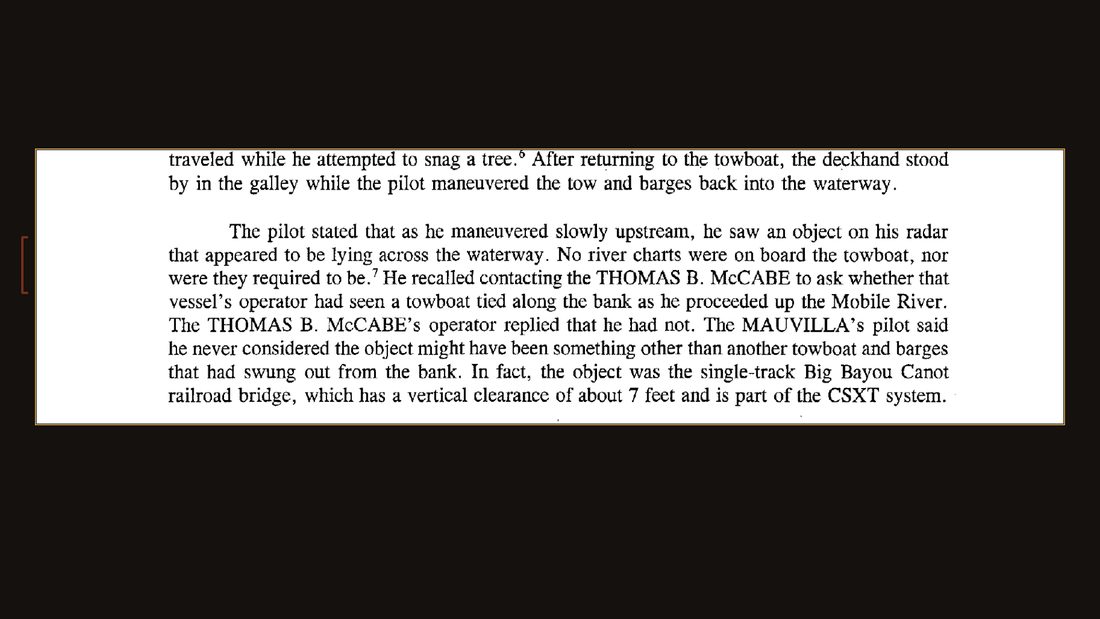
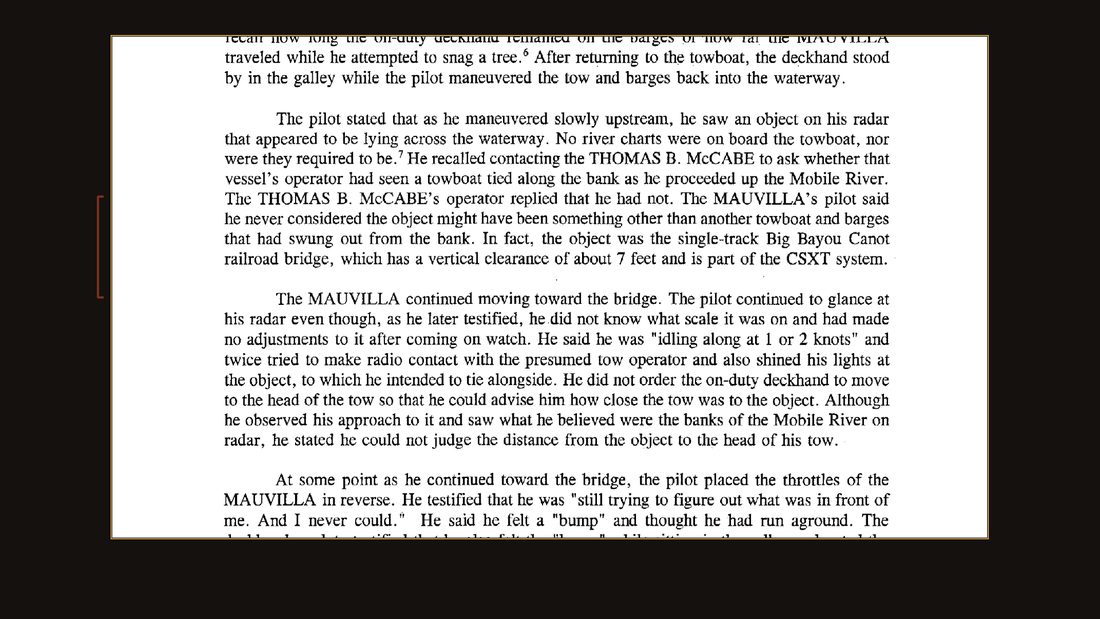
Then an object appeared on his radar, lying straight across the water in front of him.
N33
NTSB/RAR-94/01 · Big Bayou Canot · adopted Sept. 19, 1994 · p. 4. View the original.
He assumed it was another towboat with barges that had swung out from the bank.
N34
NTSB/RAR-94/01 · Big Bayou Canot · adopted Sept. 19, 1994 · p. 4. View the original.
He never considered that it might be anything else. He decided to tie up alongside it.
N35
NTSB/RAR-94/01 · Big Bayou Canot · adopted Sept. 19, 1994 · p. 4. View the original.
It was a railroad bridge.
N36
NTSB/RAR-94/01 · Big Bayou Canot · adopted Sept. 19, 1994 · p. 4. View the original.
A single-track bridge belonging to CSX Transportation, with a vertical clearance of about seven feet above the water.
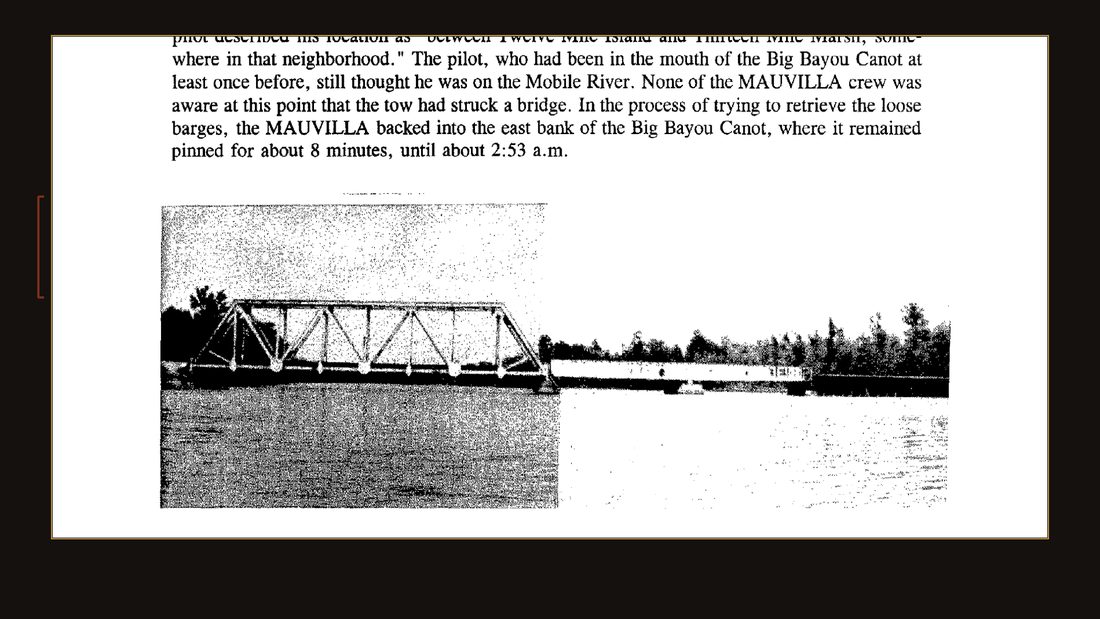
N37
NTSB/RAR-94/01 · Big Bayou Canot · adopted Sept. 19, 1994 · p. 5. View the original.
This is the last photograph taken of it. A routine inspection, before.
N38
NTSB/RAR-94/01 · Big Bayou Canot · adopted Sept. 19, 1994 · p. 4. View the original.
He kept glancing at the radar. He testified he did not know what scale it was set to.
N40
NTSB/RAR-94/01 · Big Bayou Canot · adopted Sept. 19, 1994 · p. 4. View the original.
He idled forward at one or two knots. He tried the radio twice. He shone his lights at it.
N41
NTSB/RAR-94/01 · Big Bayou Canot · adopted Sept. 19, 1994 · p. 4. View the original.
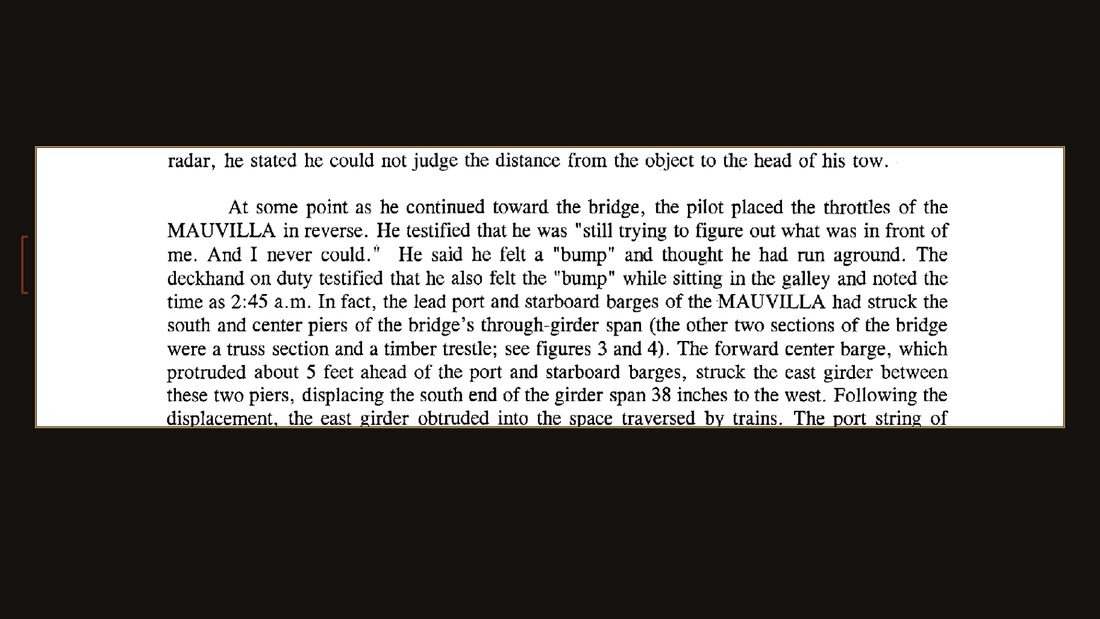
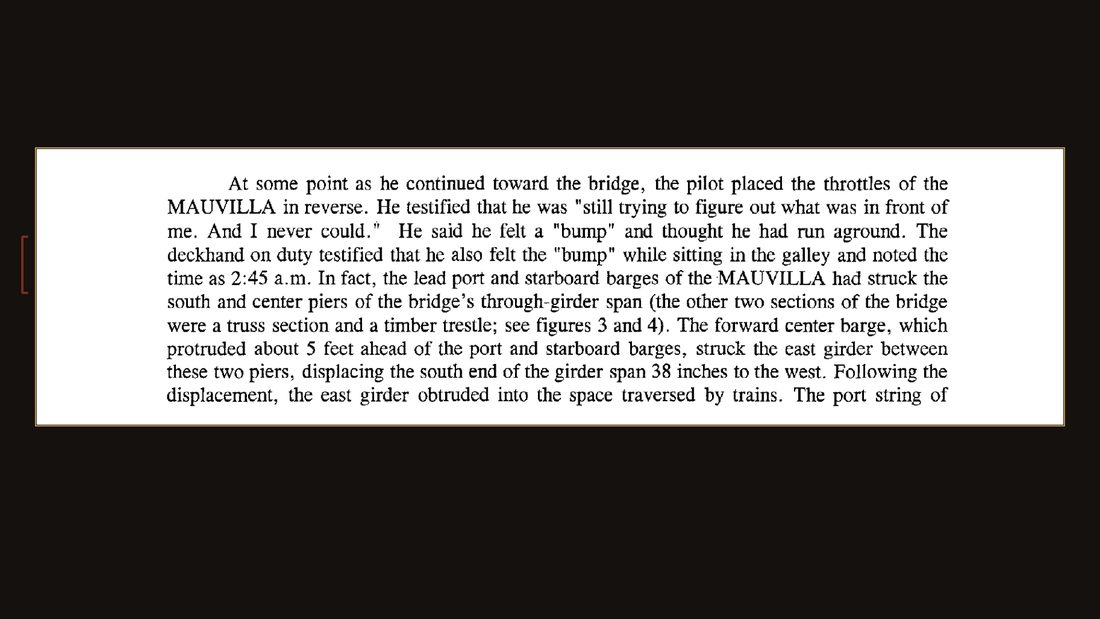
Then he put the throttles in reverse, and gave the Safety Board the sentence this entire episode turns on.
N42
NTSB/RAR-94/01 · Big Bayou Canot · adopted Sept. 19, 1994 · p. 4. View the original.
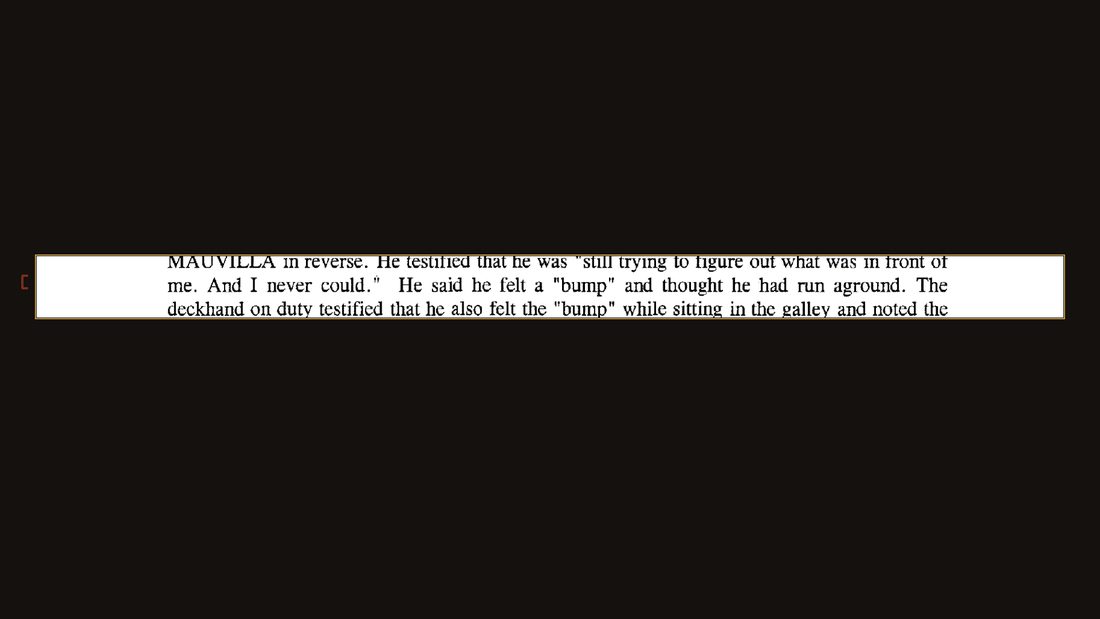
I was still trying to figure out what was in front of me. And I never could.
N43
NTSB/RAR-94/01 · Big Bayou Canot · adopted Sept. 19, 1994 · p. 4. View the original.
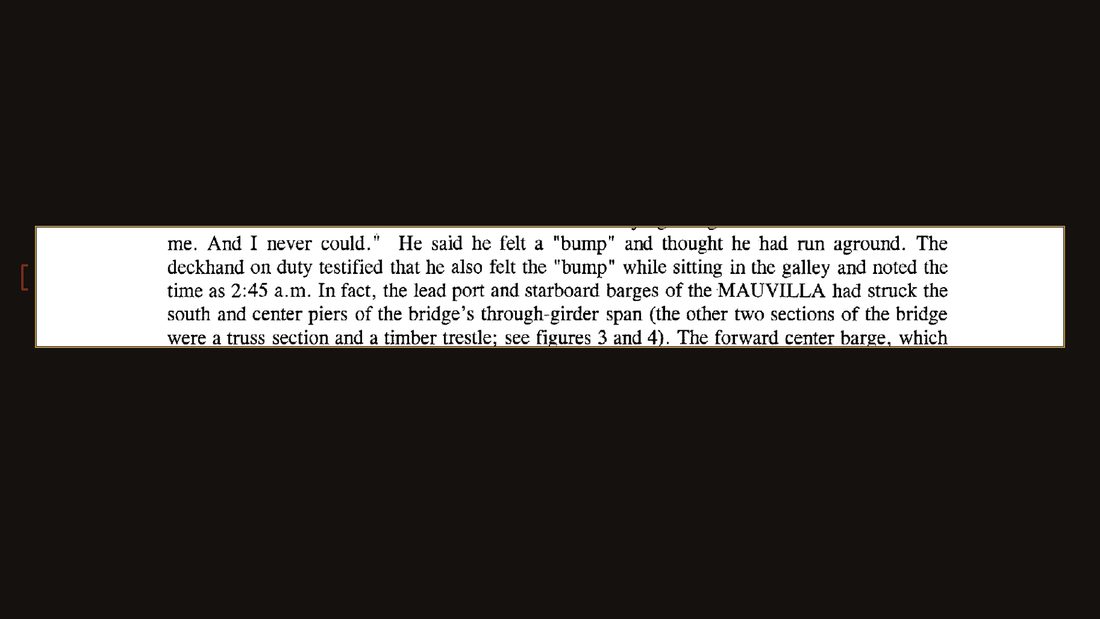
He felt a bump. He thought he had run aground.
N44
NTSB/RAR-94/01 · Big Bayou Canot · adopted Sept. 19, 1994 · p. 4. View the original.
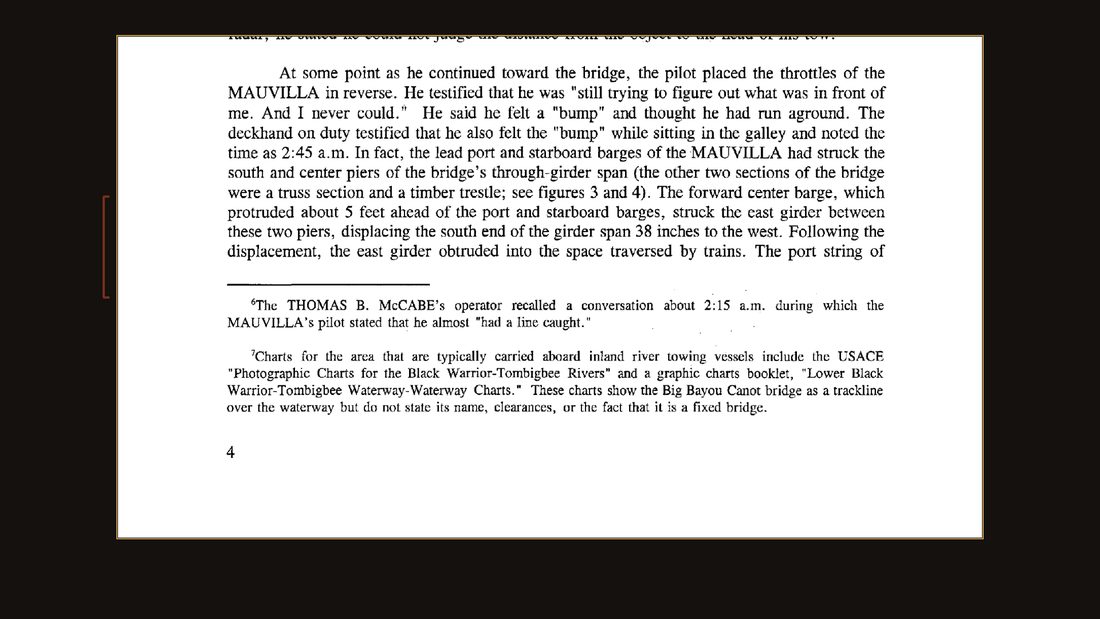
The deckhand felt it too, sitting in the galley, and noted the time. Two forty-five in the morning.
N46
NTSB/RAR-94/01 · Big Bayou Canot · adopted Sept. 19, 1994 · p. 4. View the original.
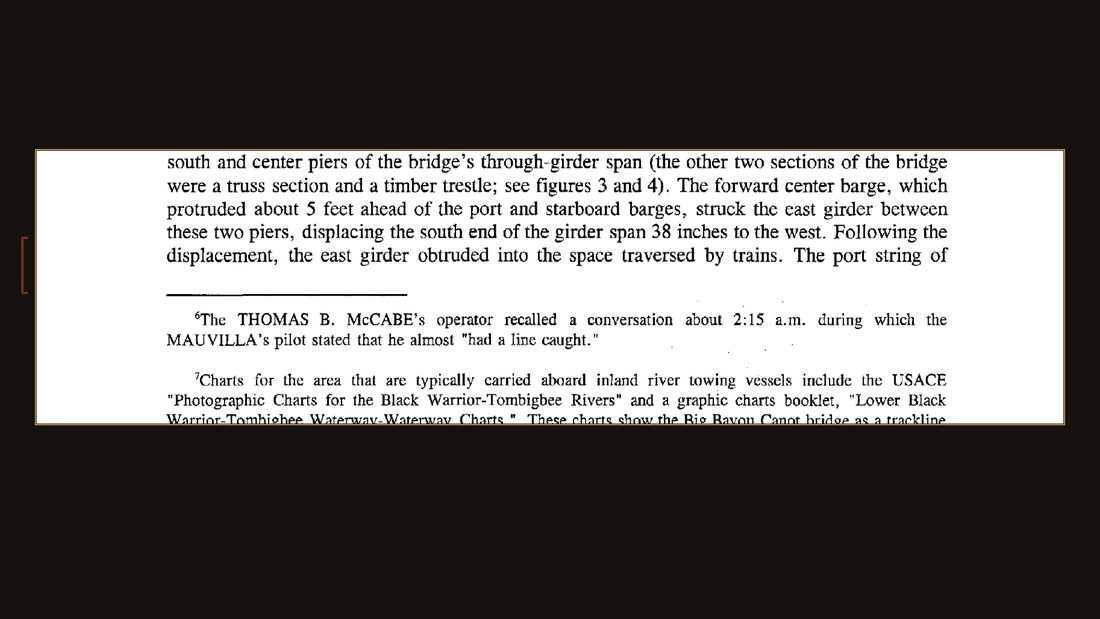
Two of the lead barges struck the piers. The center barge, which stuck out about five feet further ahead, struck the girder between them.
N47
NTSB/RAR-94/01 · Big Bayou Canot · adopted Sept. 19, 1994 · p. 4. View the original.
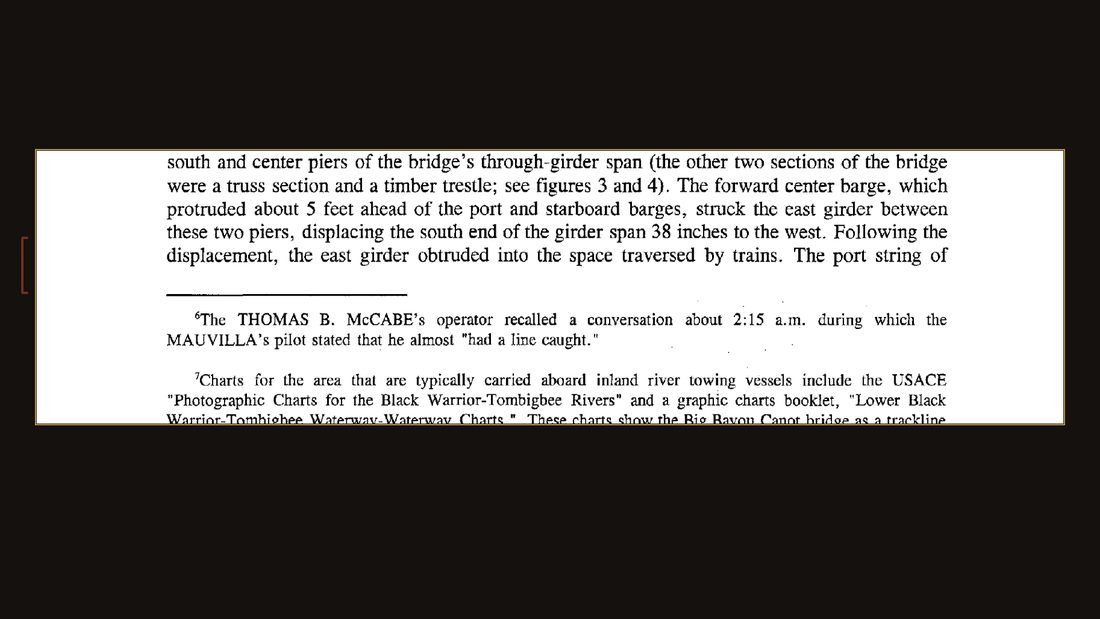
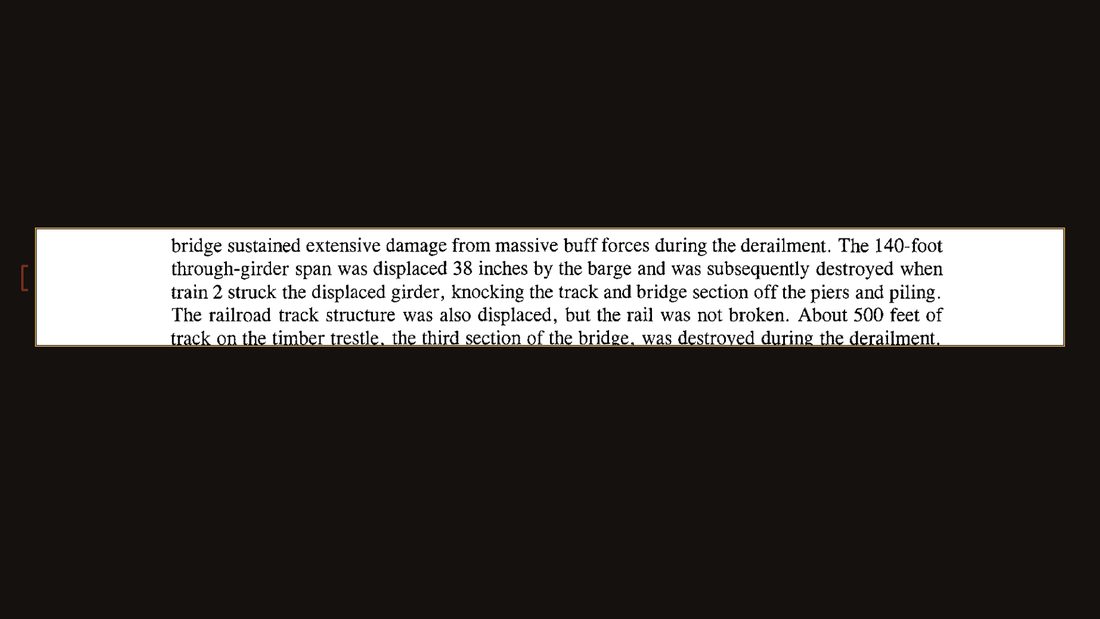
And displaced the south end of that girder span thirty-eight inches to the west.
N48
NTSB/RAR-94/01 · Big Bayou Canot · adopted Sept. 19, 1994 · p. 4. View the original.
The girder now stuck out into the space that trains travel through.
Eight minutes
N49
NTSB/RAR-94/01 · Big Bayou Canot · adopted Sept. 19, 1994 · p. 5. View the original.
Nobody on the towboat knew a bridge had been hit.
N50
NTSB/RAR-94/01 · Big Bayou Canot · adopted Sept. 19, 1994 · p. 5. View the original.
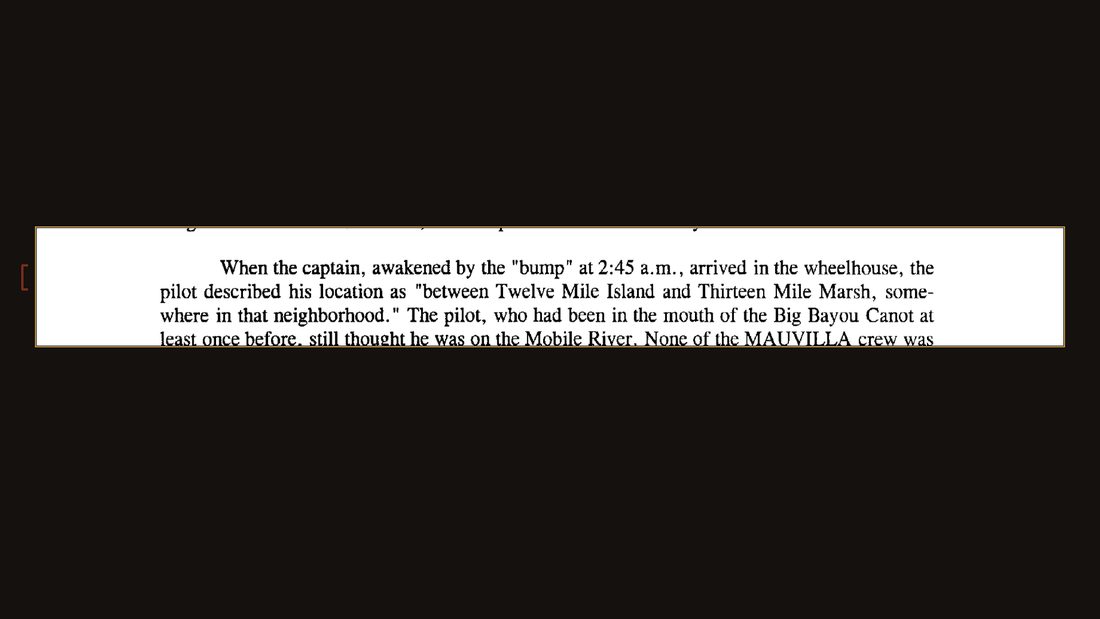
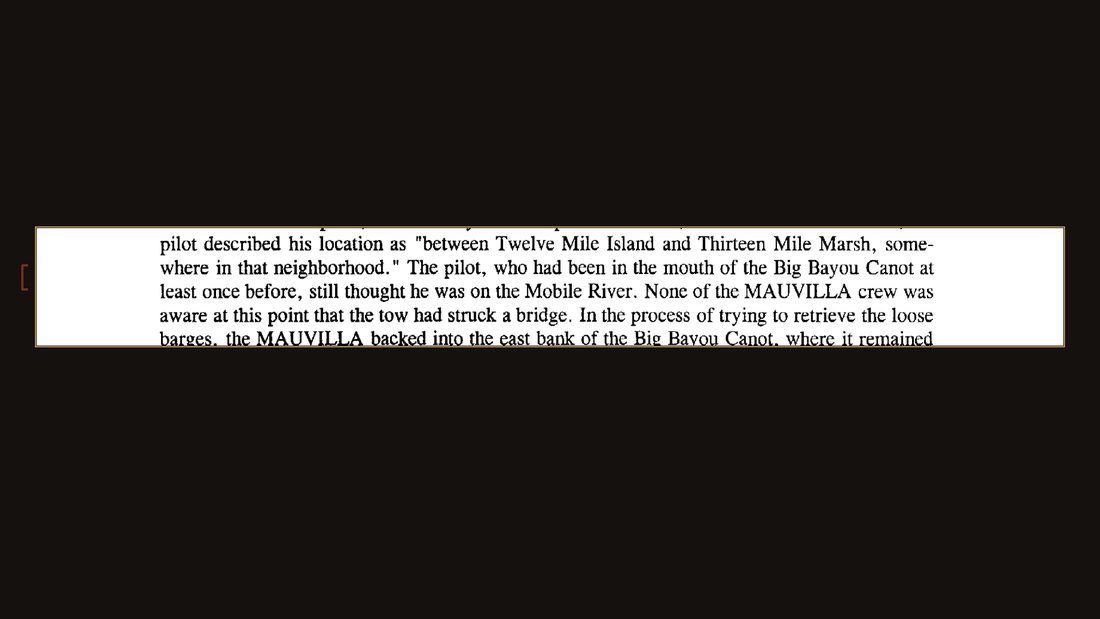
The captain woke up from the bump and came to the wheelhouse. The pilot told him where he thought they were.
N51
NTSB/RAR-94/01 · Big Bayou Canot · adopted Sept. 19, 1994 · p. 5. View the original.
Somewhere between Twelve Mile Island and Thirteen Mile Marsh, in that neighborhood. He was in neither.
N52
NTSB/RAR-94/01 · Big Bayou Canot · adopted Sept. 19, 1994 · p. 5. View the original.
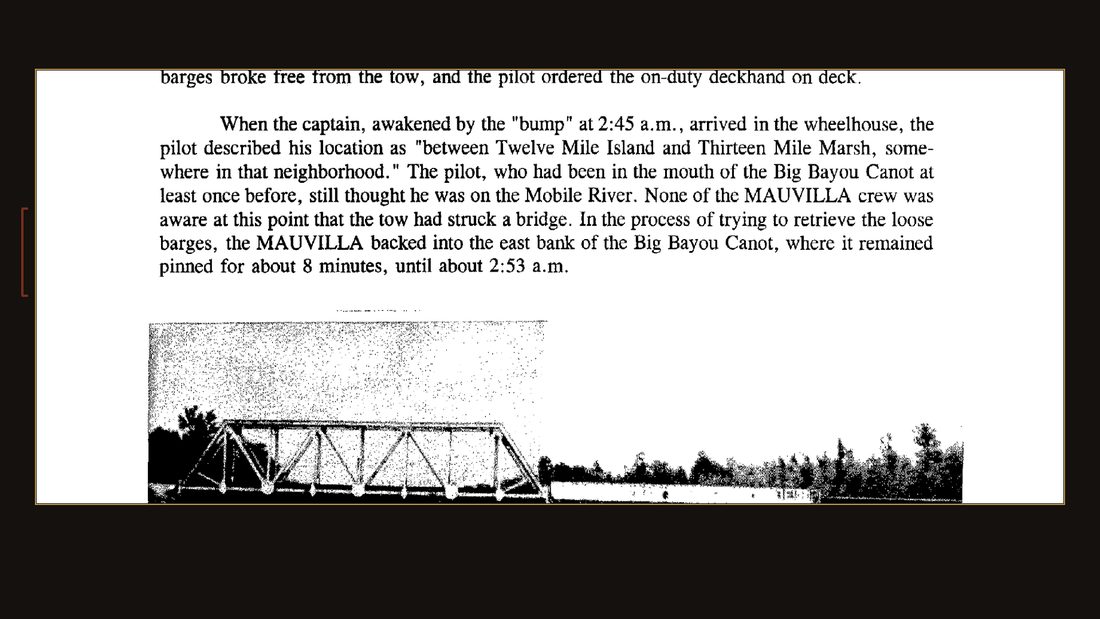
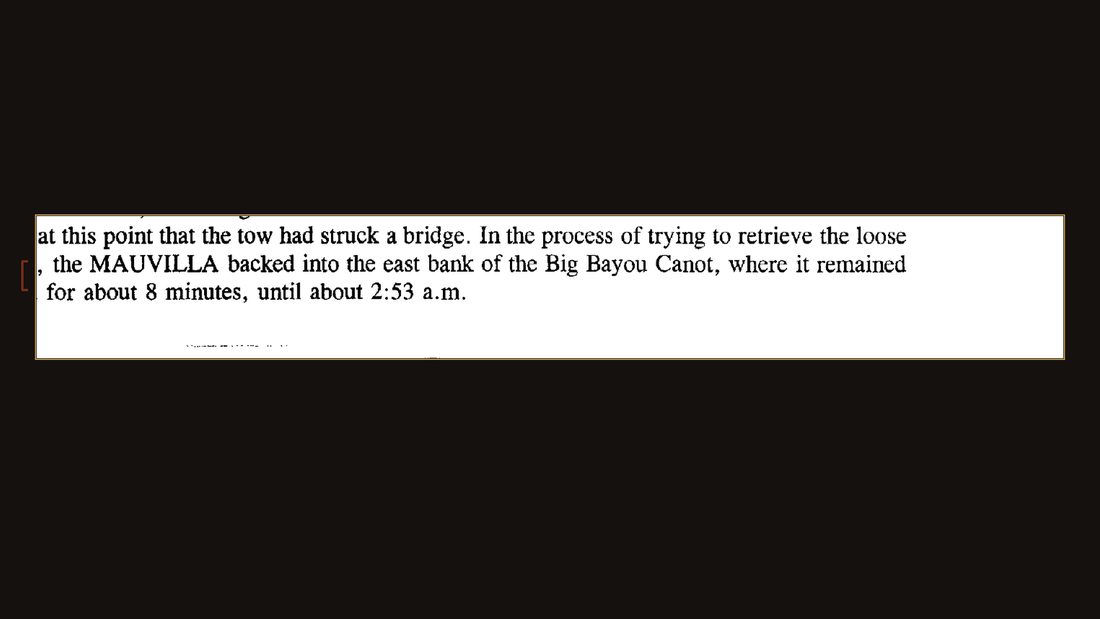
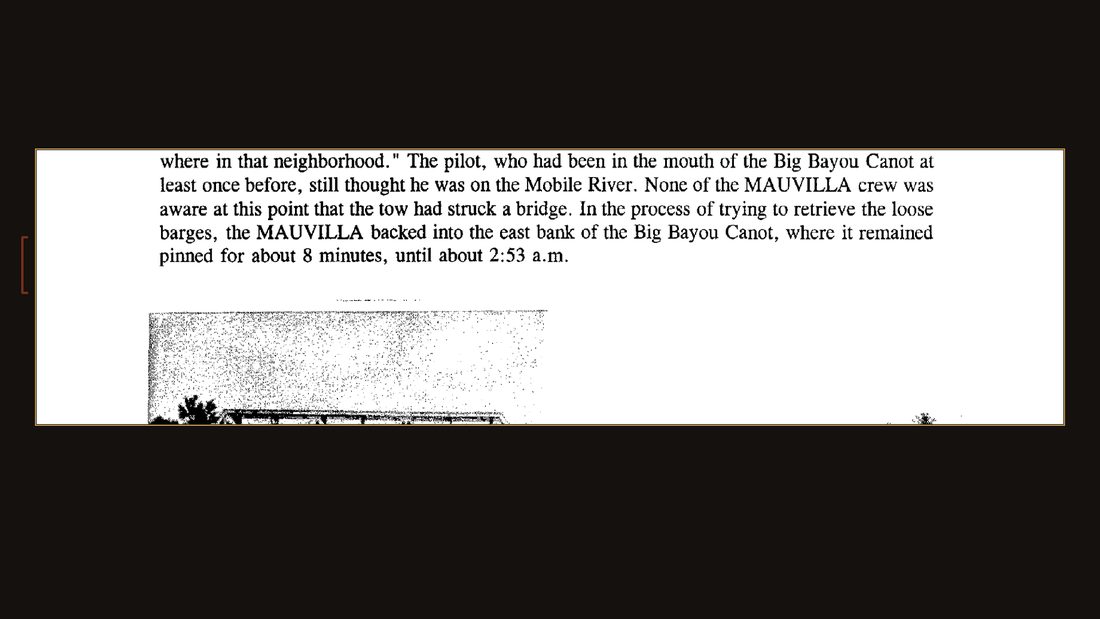
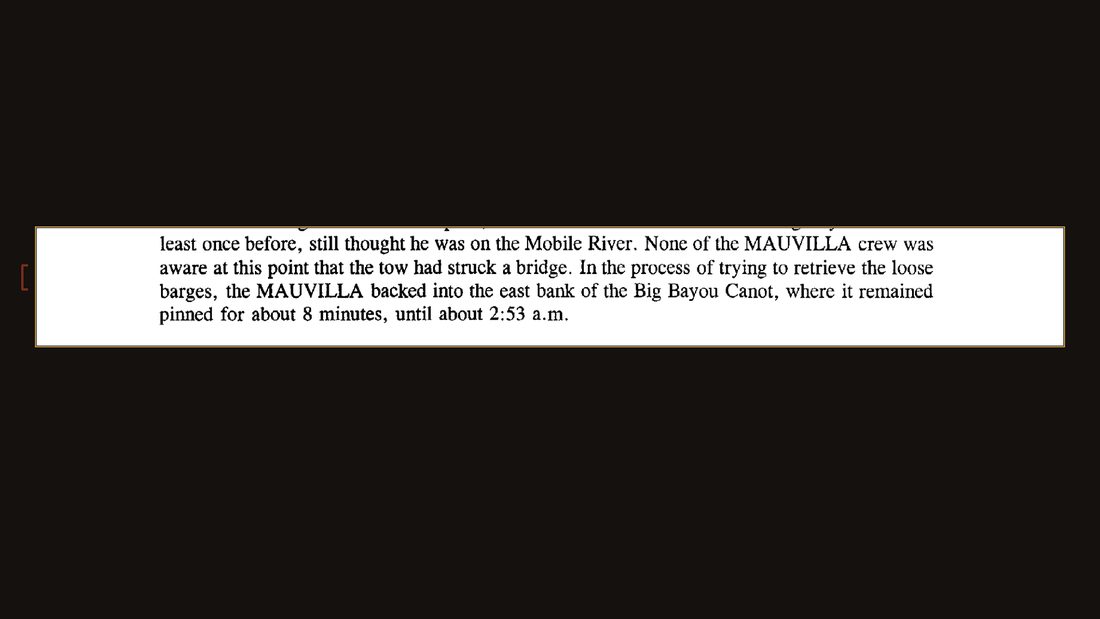
Barges had broken loose. Trying to recover them, the Mauvilla backed into the east bank of the bayou and stuck there.
N53
NTSB/RAR-94/01 · Big Bayou Canot · adopted Sept. 19, 1994 · p. 5. View the original.
She stayed pinned against that bank for about eight minutes.
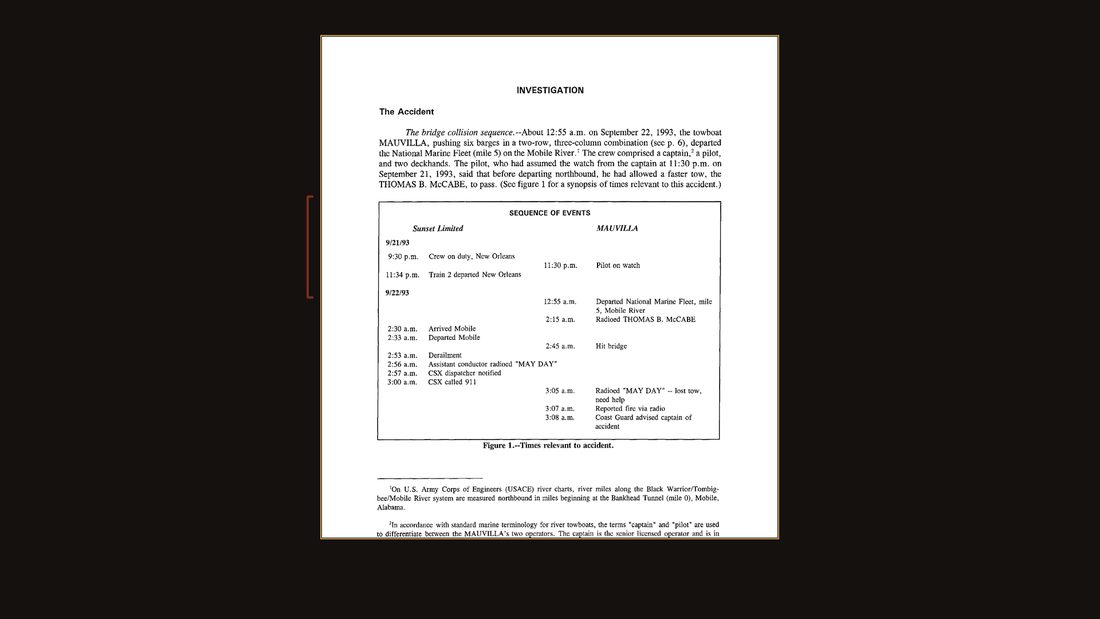
This is the entire margin. Eight minutes, and nobody on earth knows the bridge has moved.
N54
NTSB/RAR-94/01 · Big Bayou Canot · adopted Sept. 19, 1994 · p. 1. View the original.
Those same eight minutes were being crossed by a train with two hundred and twenty people on it.
Clear
N55
NTSB/RAR-94/01 · Big Bayou Canot · adopted Sept. 19, 1994 · p. 5. View the original.
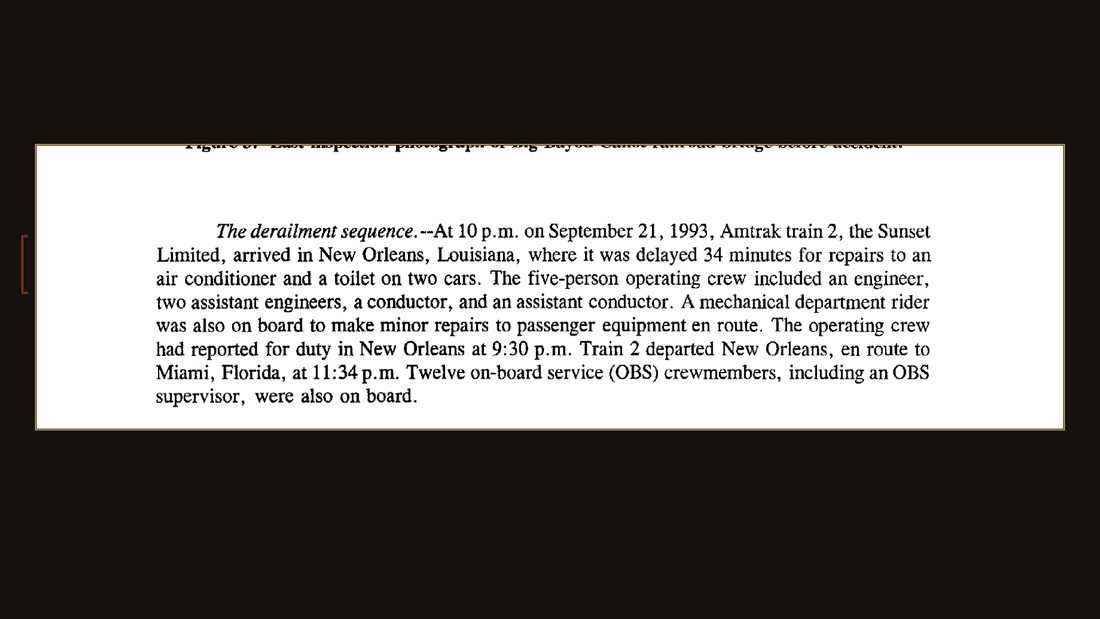
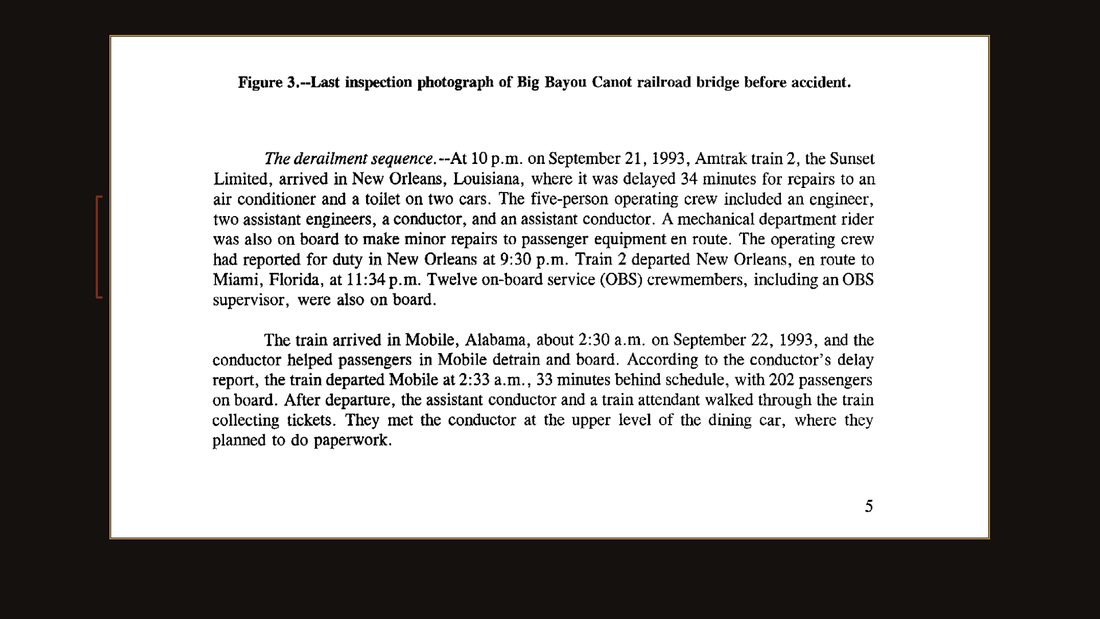
Amtrak train two. The Sunset Limited, Los Angeles to Miami.
N56
NTSB/RAR-94/01 · Big Bayou Canot · adopted Sept. 19, 1994 · p. 5. View the original.
She had left New Orleans thirty-four minutes late, held up for repairs to an air conditioner and a toilet.
N57
NTSB/RAR-94/01 · Big Bayou Canot · adopted Sept. 19, 1994 · p. 5. View the original.
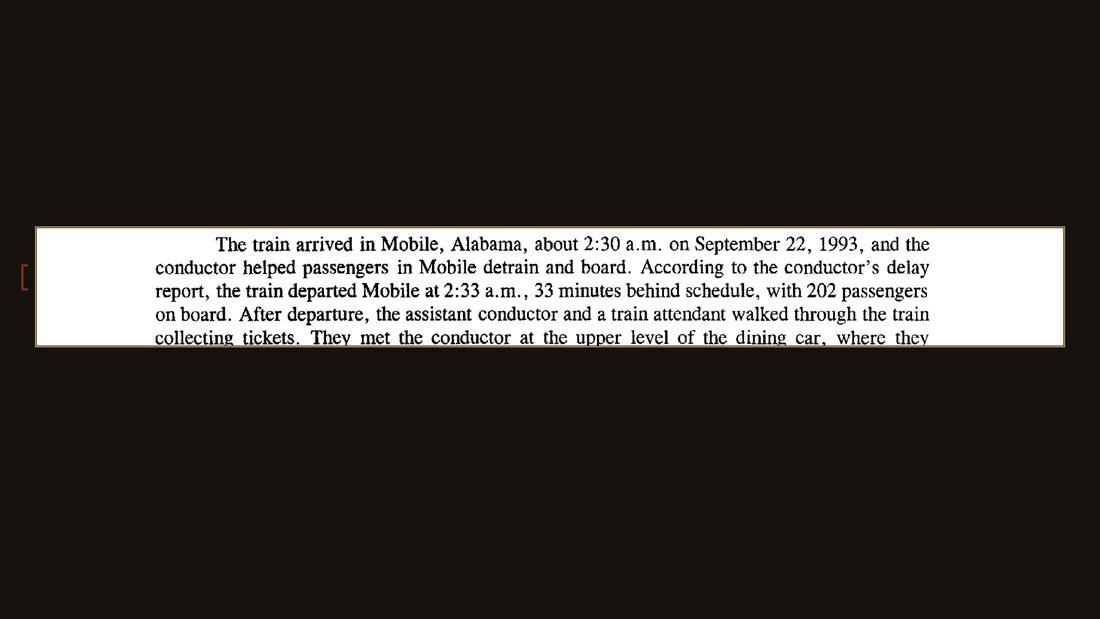
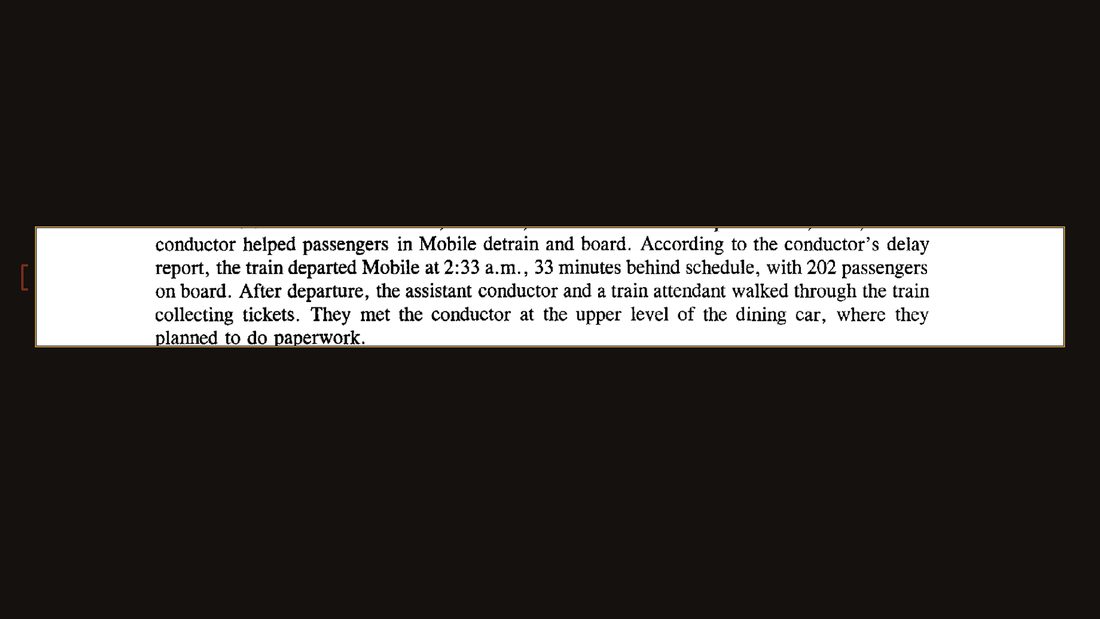
She stopped at Mobile at half past two in the morning. The conductor helped people off and on.
N58
NTSB/RAR-94/01 · Big Bayou Canot · adopted Sept. 19, 1994 · p. 5. View the original.
She left Mobile at two thirty-three with two hundred and two passengers aboard.
N60
NTSB/RAR-94/01 · Big Bayou Canot · adopted Sept. 19, 1994 · p. 7. View the original.
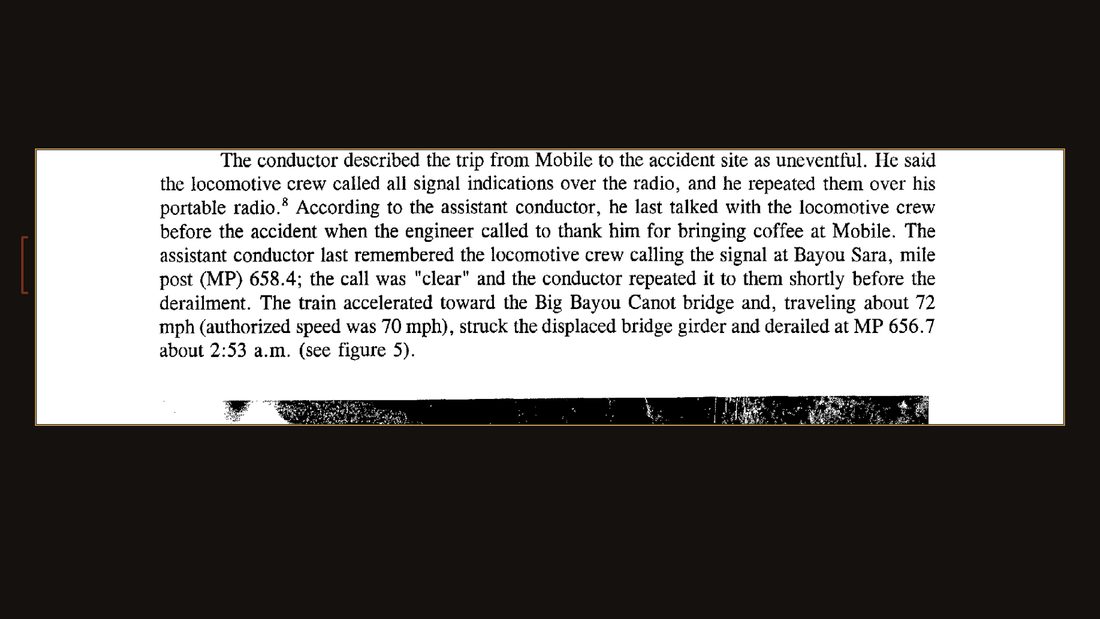
The conductor described the run from Mobile as uneventful.
N61
NTSB/RAR-94/01 · Big Bayou Canot · adopted Sept. 19, 1994 · p. 7. View the original.
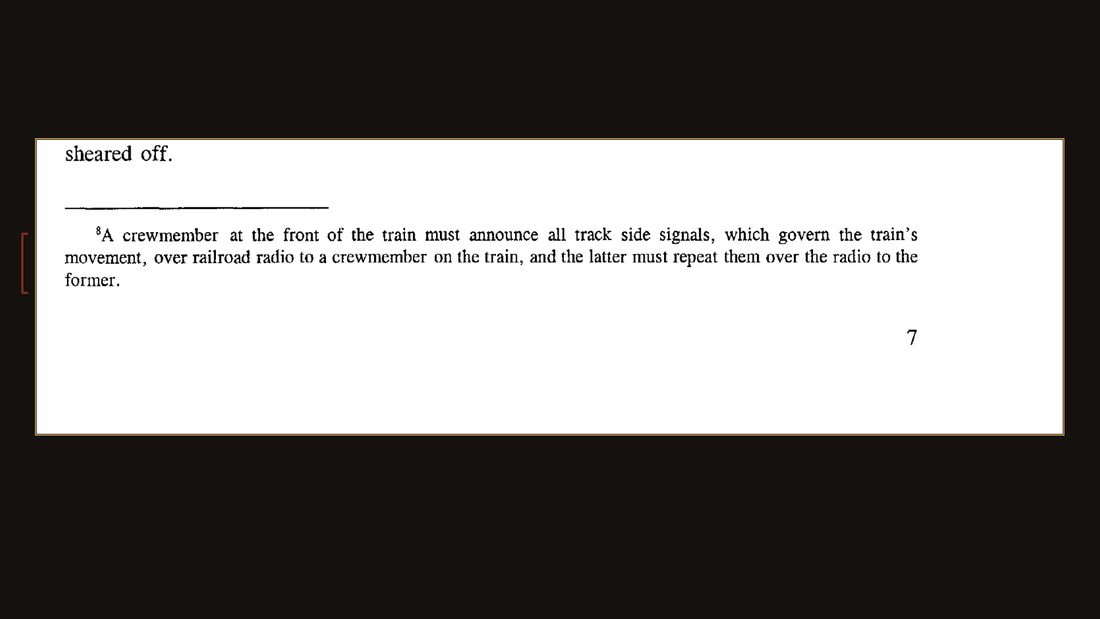
The locomotive crew called every signal aloud over the radio, and the conductor repeated each one back.
N62
NTSB/RAR-94/01 · Big Bayou Canot · adopted Sept. 19, 1994 · p. 7. View the original.
The last signal he remembered them calling was at Bayou Sara, one and seven tenths of a mile back.
N63
NTSB/RAR-94/01 · Big Bayou Canot · adopted Sept. 19, 1994 · p. 7. View the original.
The call was clear.
N64
NTSB/RAR-94/01 · Big Bayou Canot · adopted Sept. 19, 1994 · p. 7. View the original.
The train accelerated. Seventy-two miles an hour, in seventy mile an hour territory.
N65
NTSB/RAR-94/01 · Big Bayou Canot · adopted Sept. 19, 1994 · p. 7. View the original.
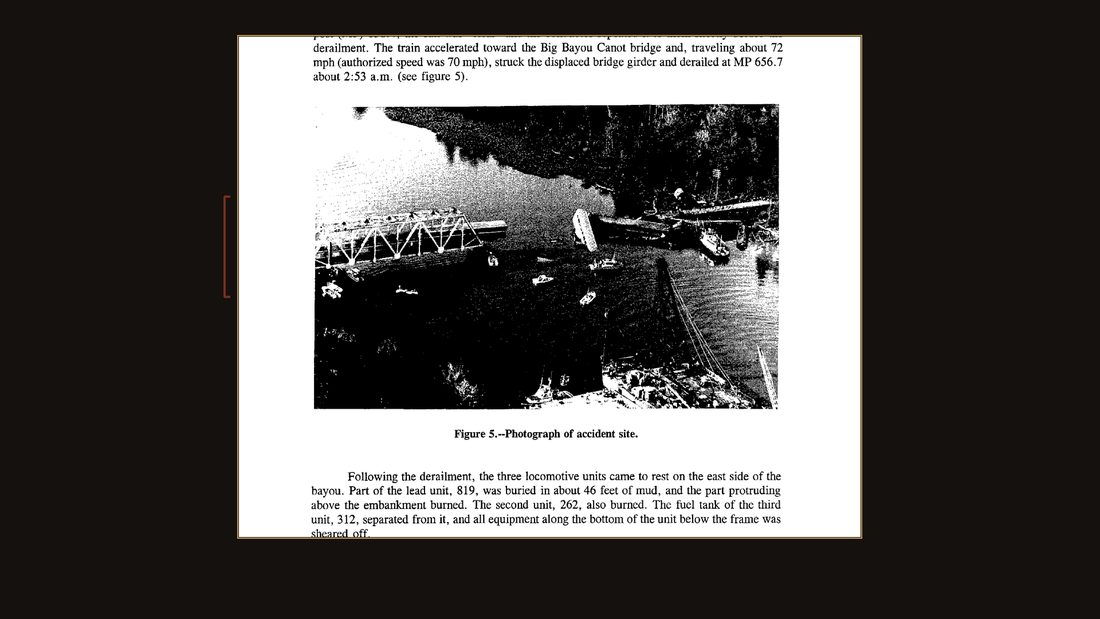
At two fifty-three in the morning she hit the girder.
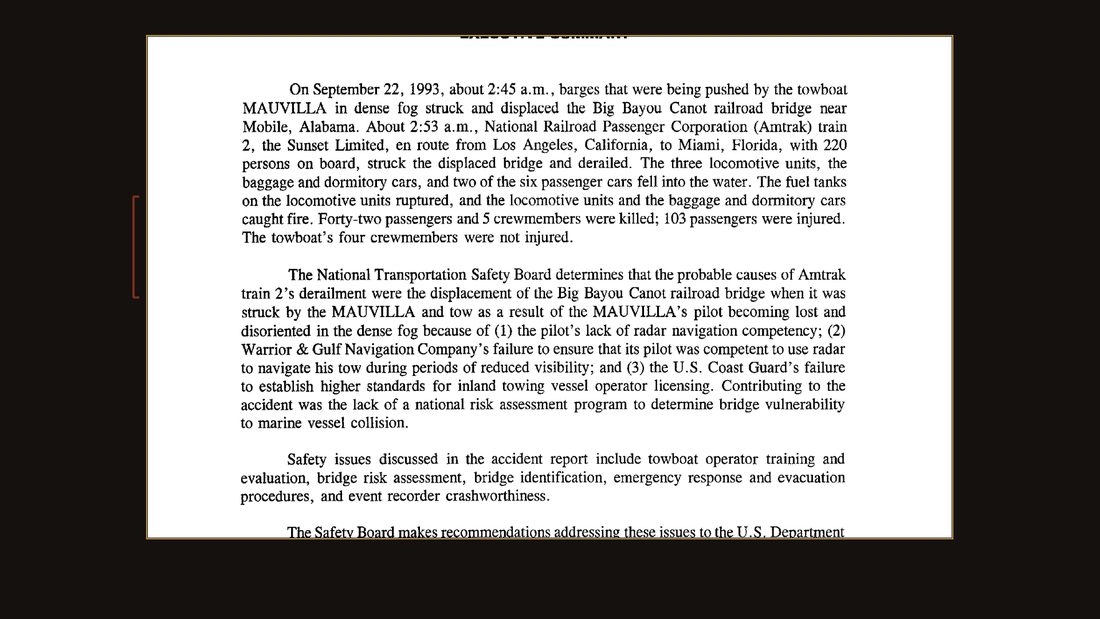
N66
NTSB/RAR-94/01 · Big Bayou Canot · adopted Sept. 19, 1994 · Executive Summary. View the original.
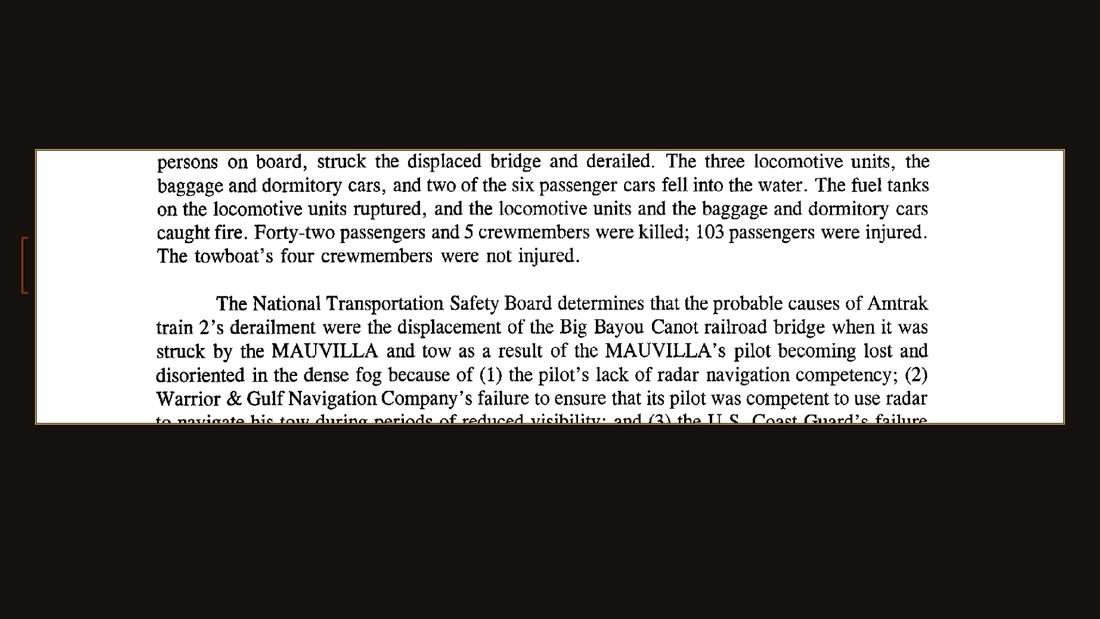
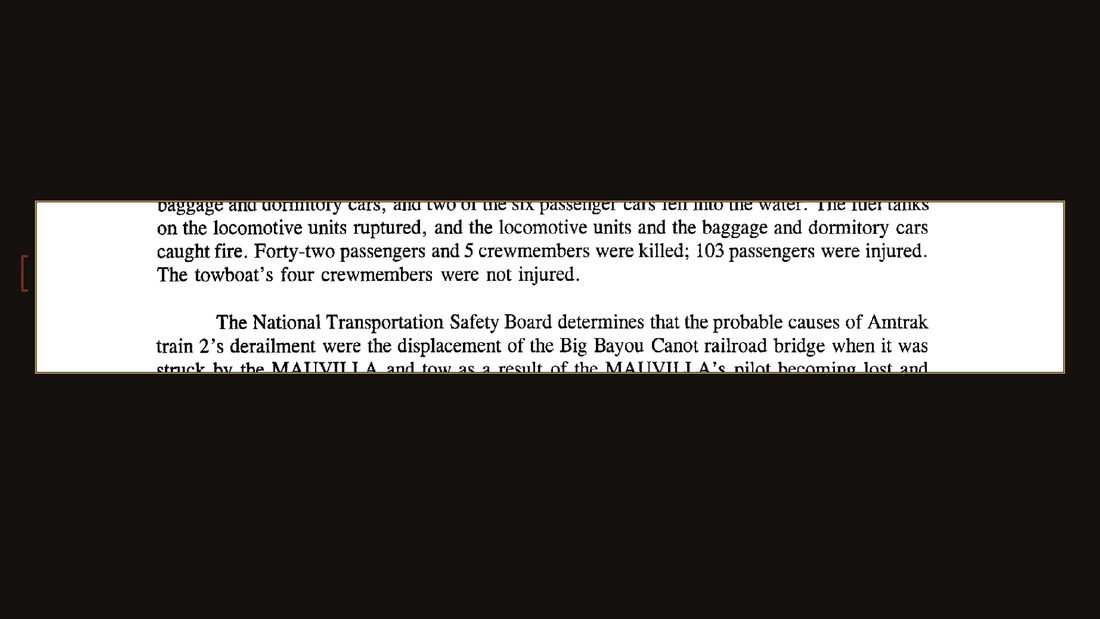
Three locomotives, the baggage car, the dormitory car and two of the six passenger cars went into the water.
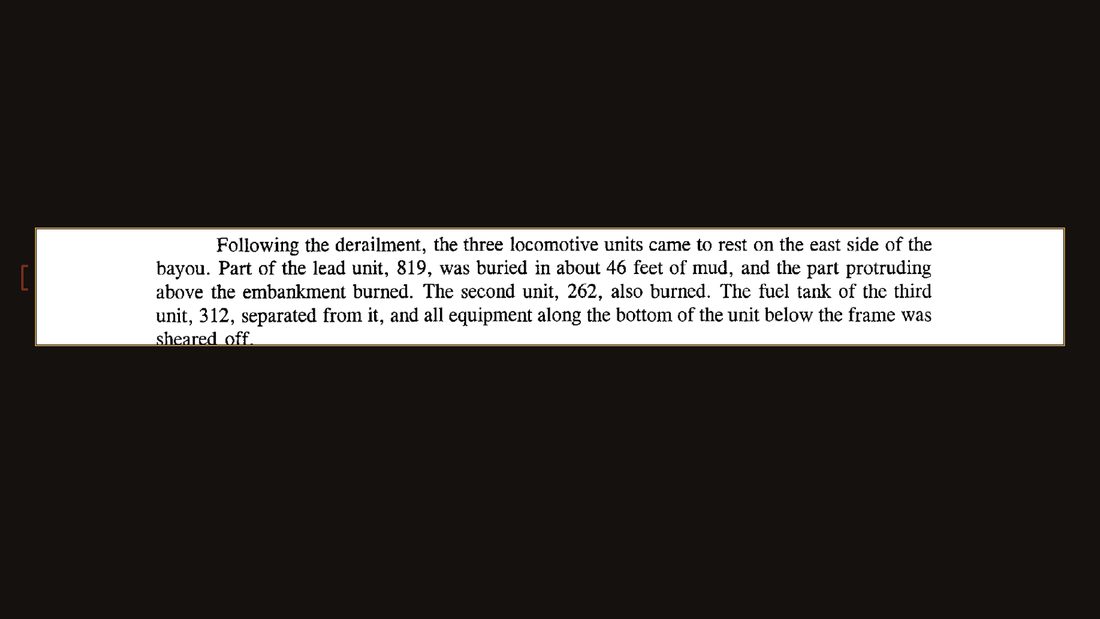
N67
NTSB/RAR-94/01 · Big Bayou Canot · adopted Sept. 19, 1994 · p. 7. View the original.
The fuel tanks ruptured and burned. The lead unit ended up buried in about forty-six feet of mud.
N68
NTSB/RAR-94/01 · Big Bayou Canot · adopted Sept. 19, 1994 · p. 7. View the original.
This is the Safety Board's photograph of the site.
N69
NTSB/RAR-94/01 · Big Bayou Canot · adopted Sept. 19, 1994 · Executive Summary. View the original.
Forty-two passengers and five crew members were killed. One hundred and three passengers were injured.
N70
NTSB/RAR-94/01 · Big Bayou Canot · adopted Sept. 19, 1994 · Executive Summary. View the original.
The four men on the towboat were not hurt.
N72
NTSB/RAR-94/01 · Big Bayou Canot · adopted Sept. 19, 1994 · p. 15. View the original.
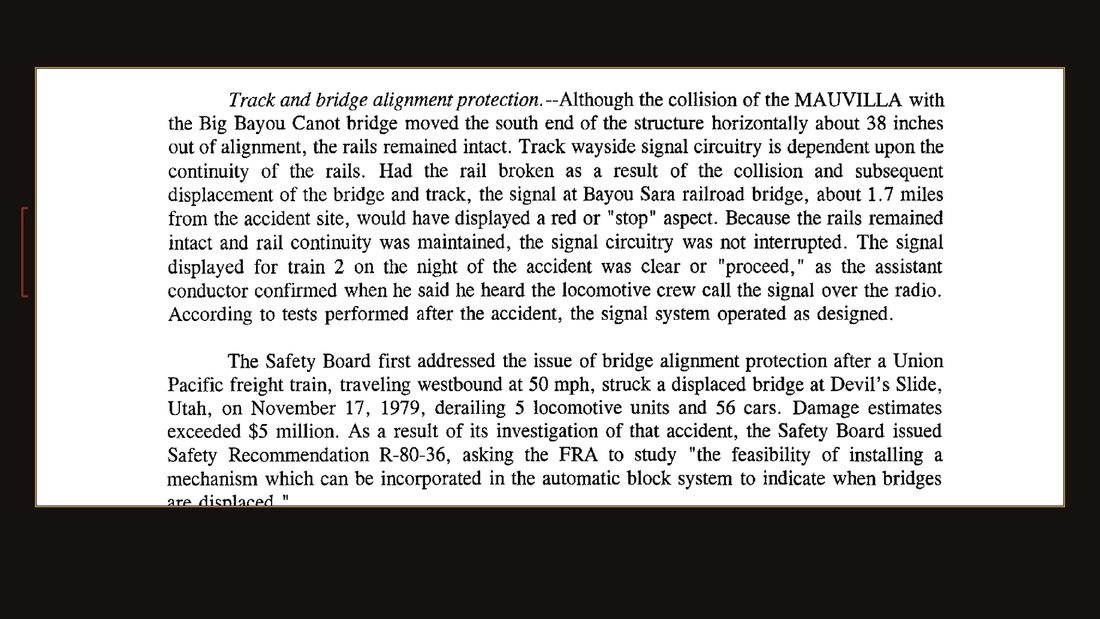
The bridge had moved thirty-eight inches out of alignment.
N73
NTSB/RAR-94/01 · Big Bayou Canot · adopted Sept. 19, 1994 · p. 41. View the original.
And the signal one and seven tenths of a mile back was showing clear.
What the circuit could see
N75
NTSB/RAR-94/01 · Big Bayou Canot · adopted Sept. 19, 1994 · p. 15. View the original.
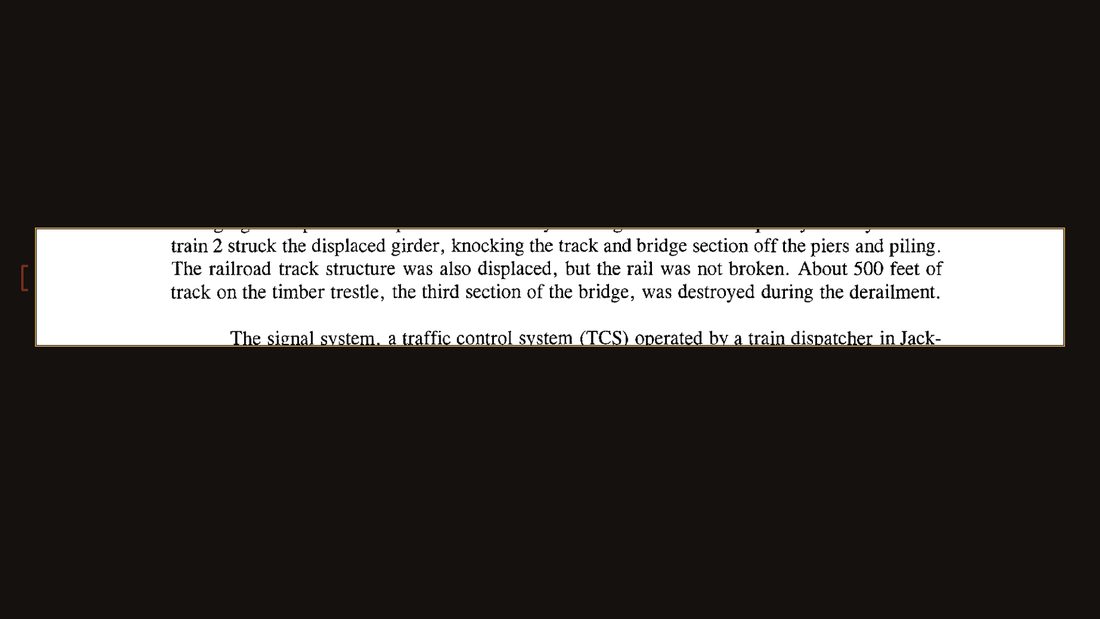
The rails did not break.
N76
NTSB/RAR-94/01 · Big Bayou Canot · adopted Sept. 19, 1994 · p. 41. View the original.
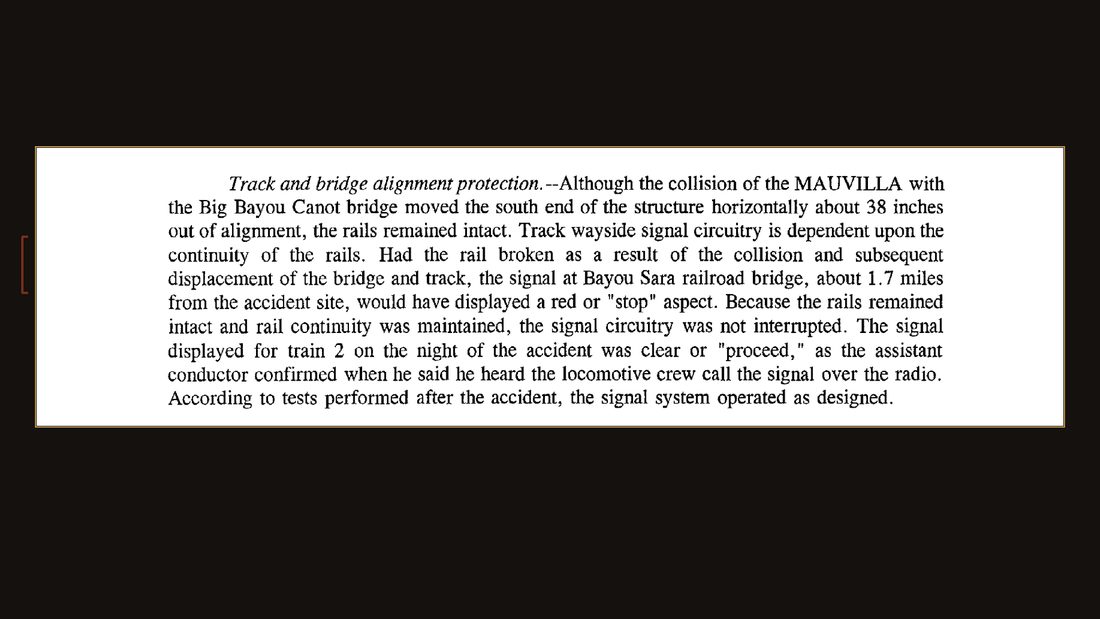
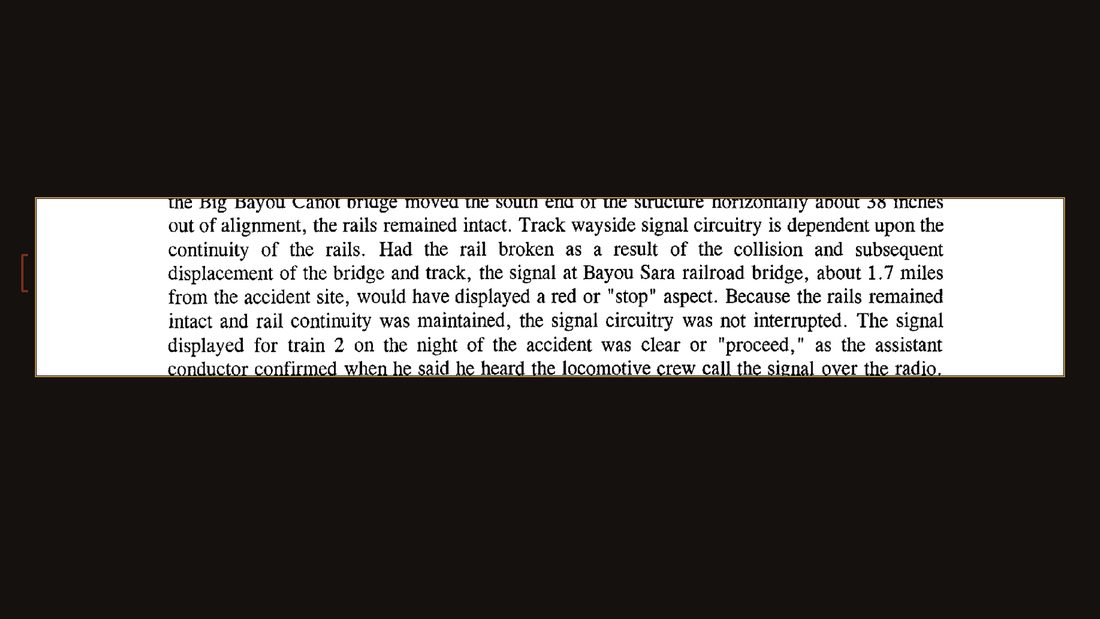
A wayside signal system works by running a low current through the rails themselves. The rail is the wire.
N77
NTSB/RAR-94/01 · Big Bayou Canot · adopted Sept. 19, 1994 · p. 41. View the original.
Break the rail and you break the circuit, and the signal behind it goes red. That is the entire safety principle.
N78
NTSB/RAR-94/01 · Big Bayou Canot · adopted Sept. 19, 1994 · p. 15. View the original.
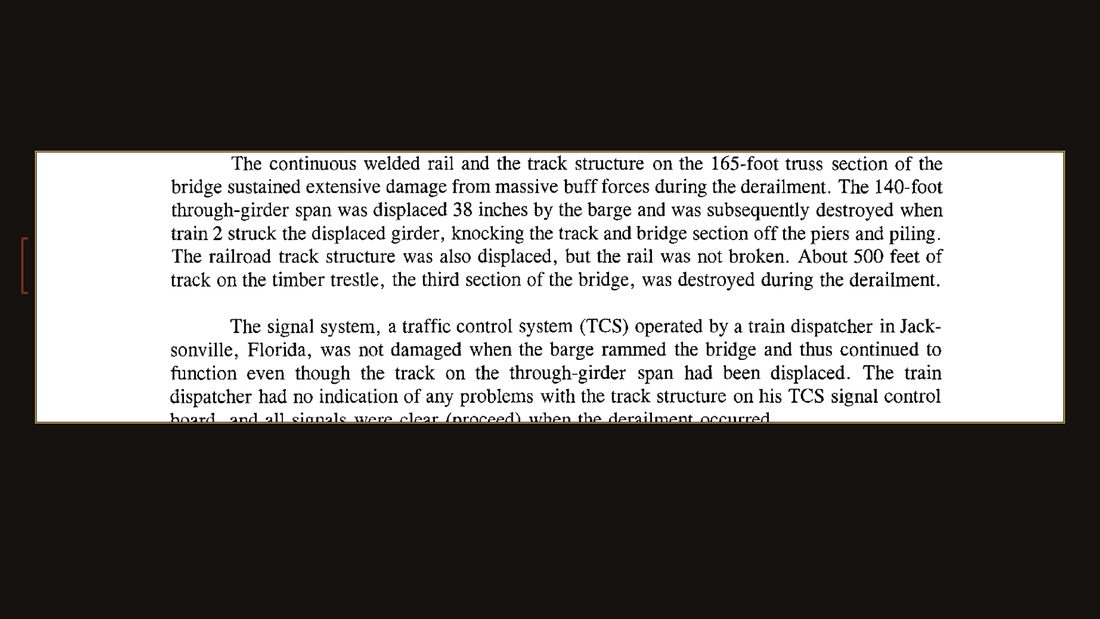
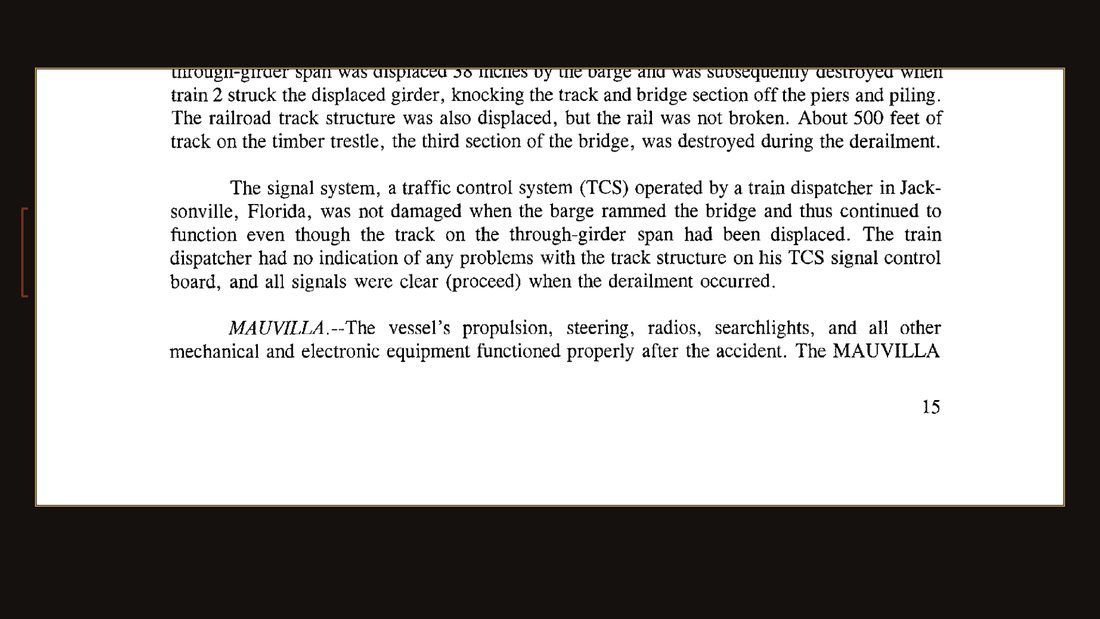
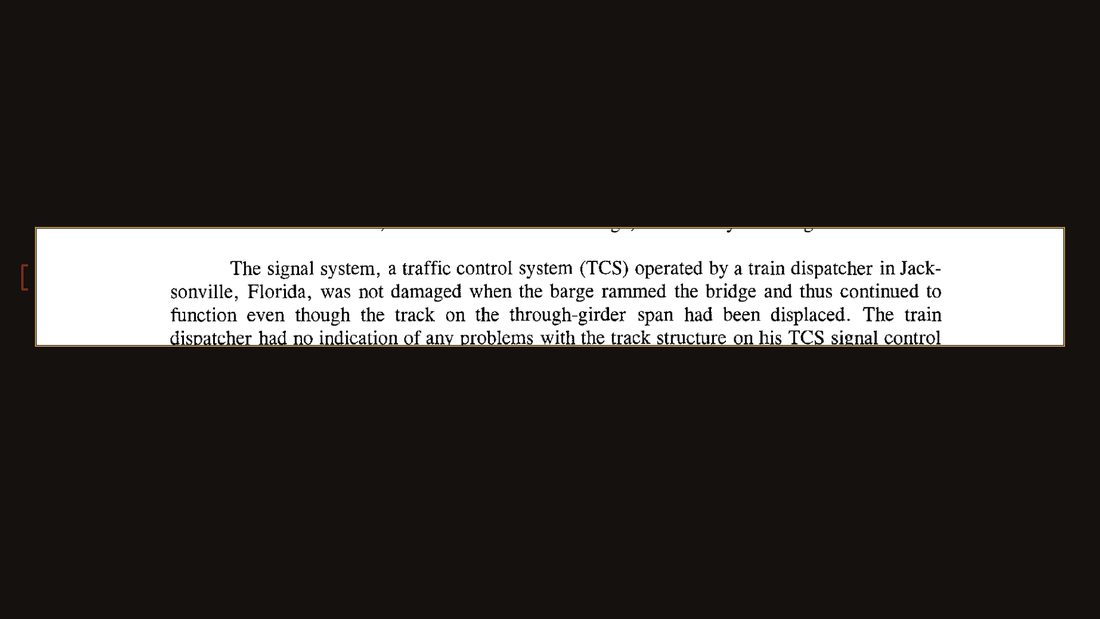
The barge moved the bridge sideways. The track went with it. The steel bent and stayed whole.
N79
NTSB/RAR-94/01 · Big Bayou Canot · adopted Sept. 19, 1994 · p. 41. View the original.
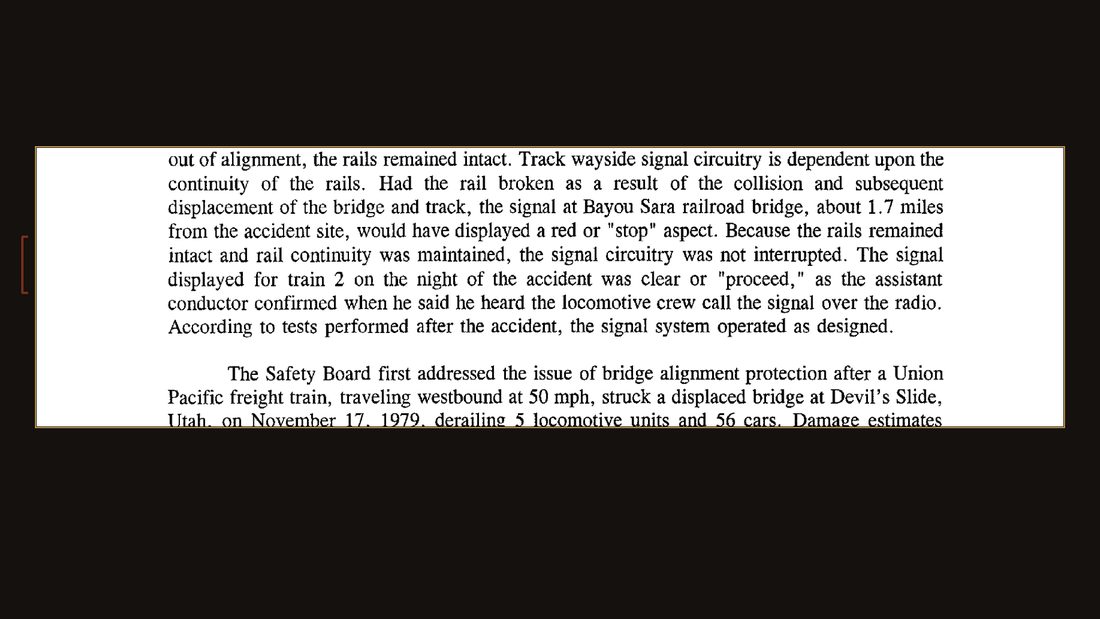
Because the rails remained intact and rail continuity was maintained, the signal circuitry was not interrupted.
N80
NTSB/RAR-94/01 · Big Bayou Canot · adopted Sept. 19, 1994 · p. 41. View the original.
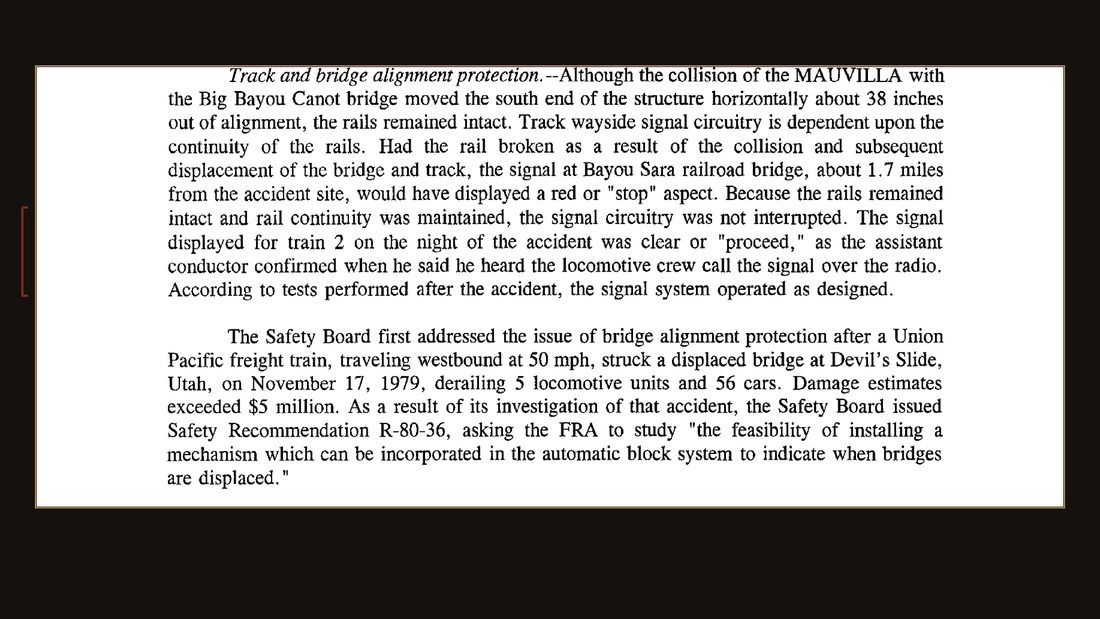
The signal displayed for train two on the night of the accident was clear, or proceed.
N82
NTSB/RAR-94/01 · Big Bayou Canot · adopted Sept. 19, 1994 · p. 41. View the original.
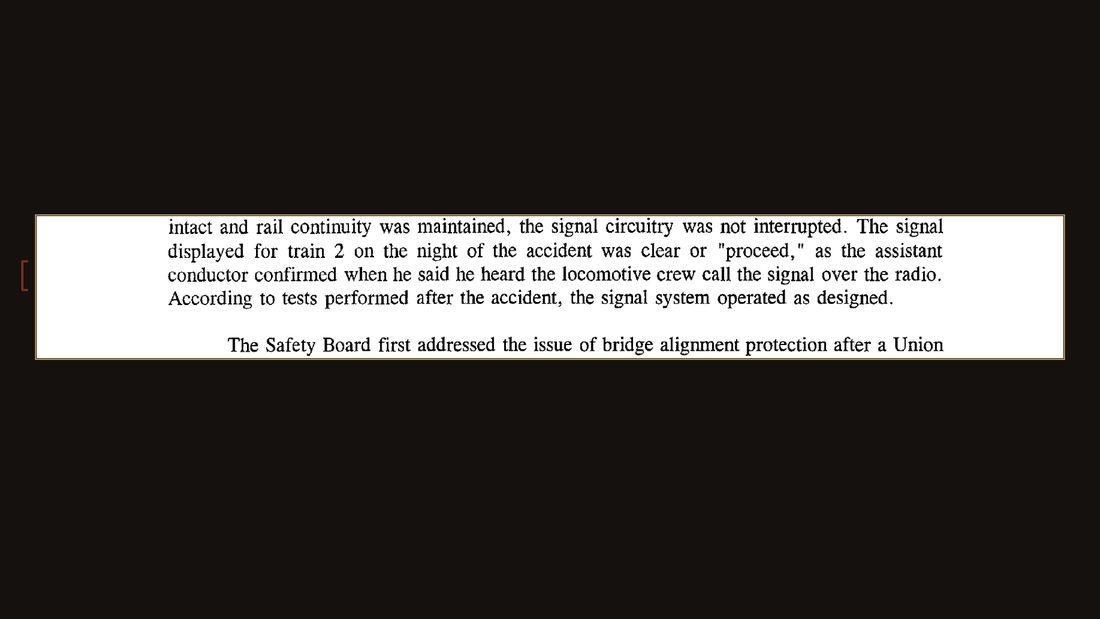
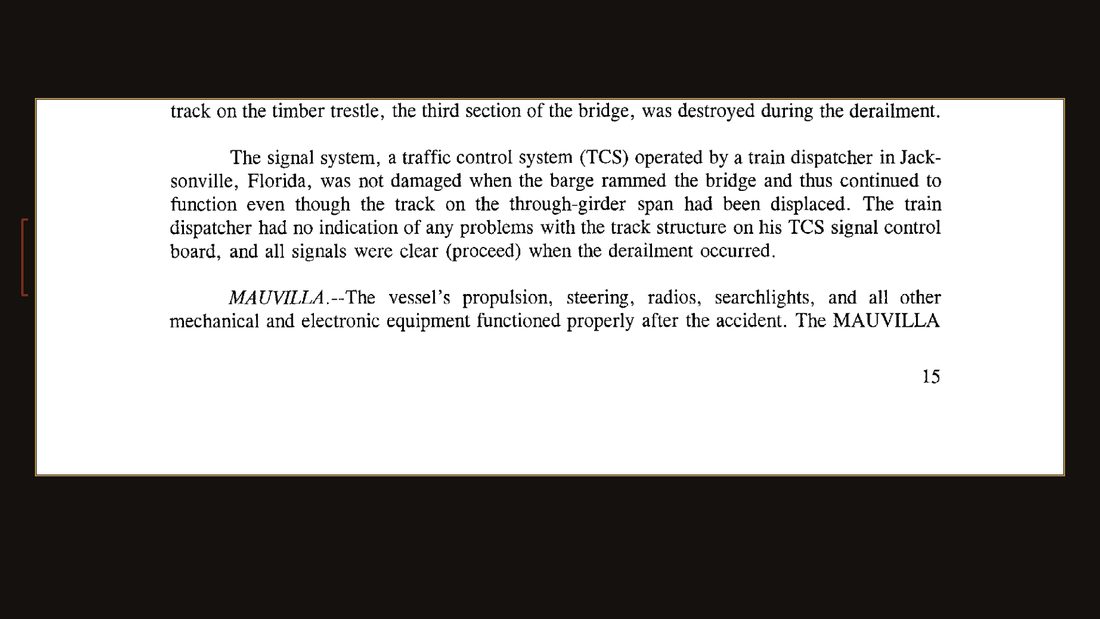
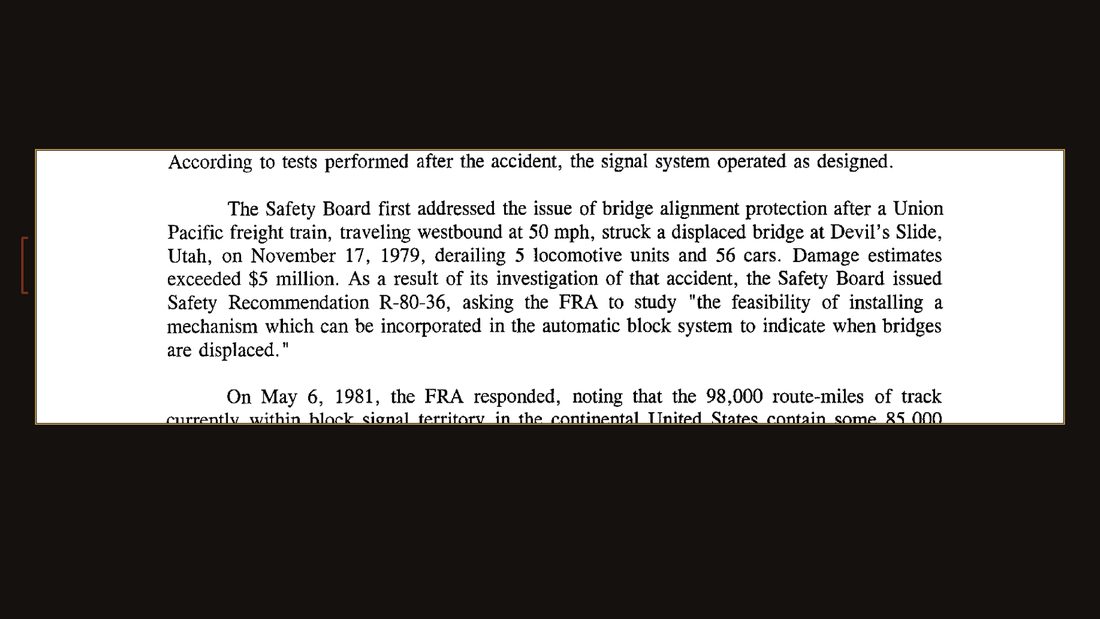
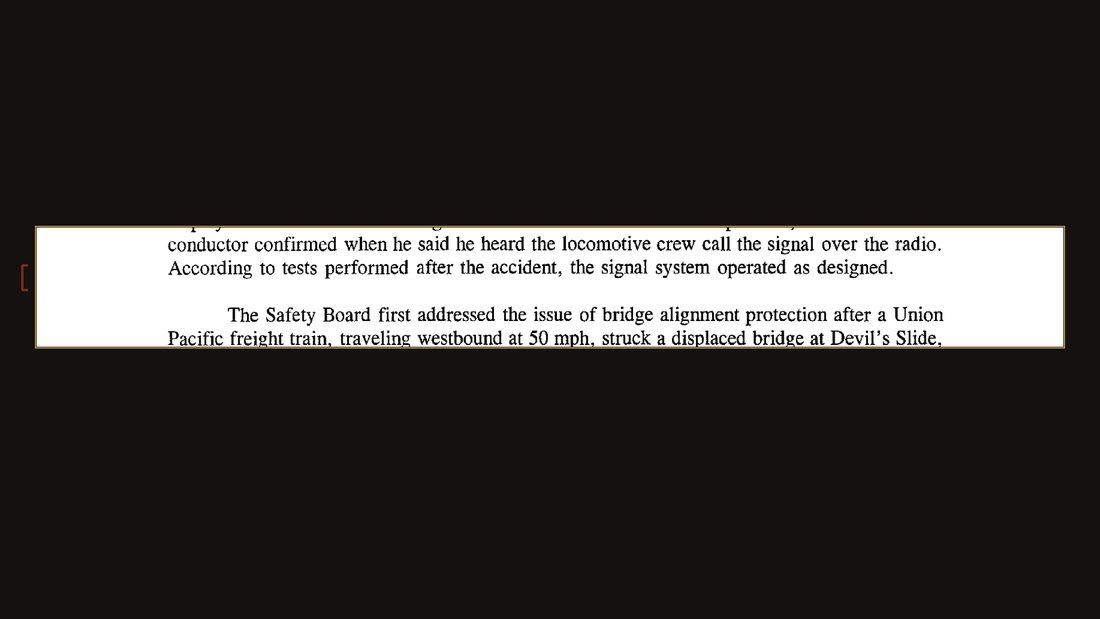
According to tests performed after the accident, the signal system operated as designed.
N83
NTSB/RAR-94/01 · Big Bayou Canot · adopted Sept. 19, 1994 · p. 15. View the original.
It was never broken. It was answering a different question than the one that mattered.
N84
NTSB/RAR-94/01 · Big Bayou Canot · adopted Sept. 19, 1994 · p. 15. View the original.
It could tell you whether the rail was continuous. It could not tell you whether the rail was where you left it.
Devil's Slide
N85
NTSB/RAR-94/01 · Big Bayou Canot · adopted Sept. 19, 1994 · p. 41. View the original.
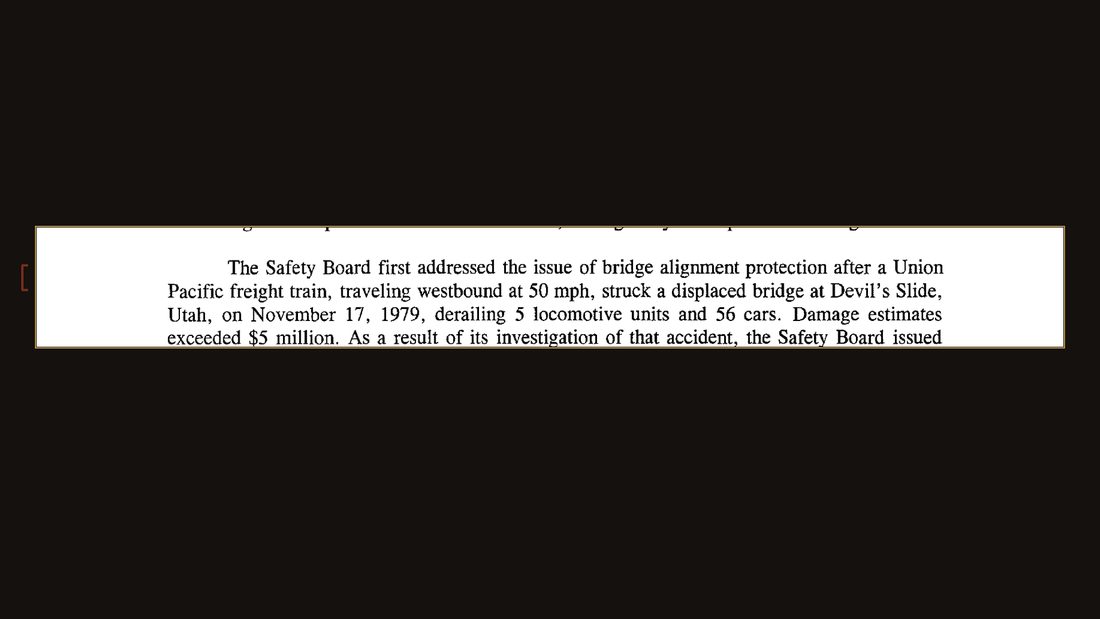
Somebody had noticed that. Fourteen years earlier.
N86
NTSB/RAR-94/01 · Big Bayou Canot · adopted Sept. 19, 1994 · p. 41. View the original.
November seventeenth, nineteen seventy-nine. Devil's Slide, Utah.
N87
NTSB/RAR-94/01 · Big Bayou Canot · adopted Sept. 19, 1994 · p. 41. View the original.
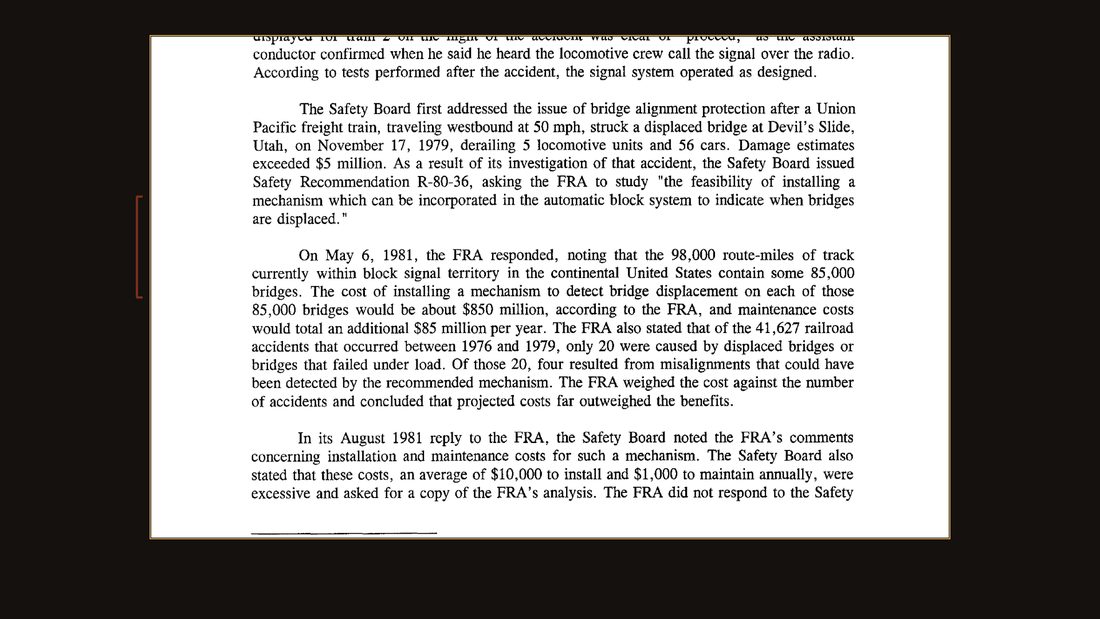
A Union Pacific freight train doing fifty miles an hour struck a displaced bridge and derailed five locomotives and fifty-six cars.
N88
NTSB/RAR-94/01 · Big Bayou Canot · adopted Sept. 19, 1994 · p. 41. View the original.
Damage over five million dollars. No passengers on a freight train.
N89
NTSB/RAR-94/01 · Big Bayou Canot · adopted Sept. 19, 1994 · p. 41. View the original.
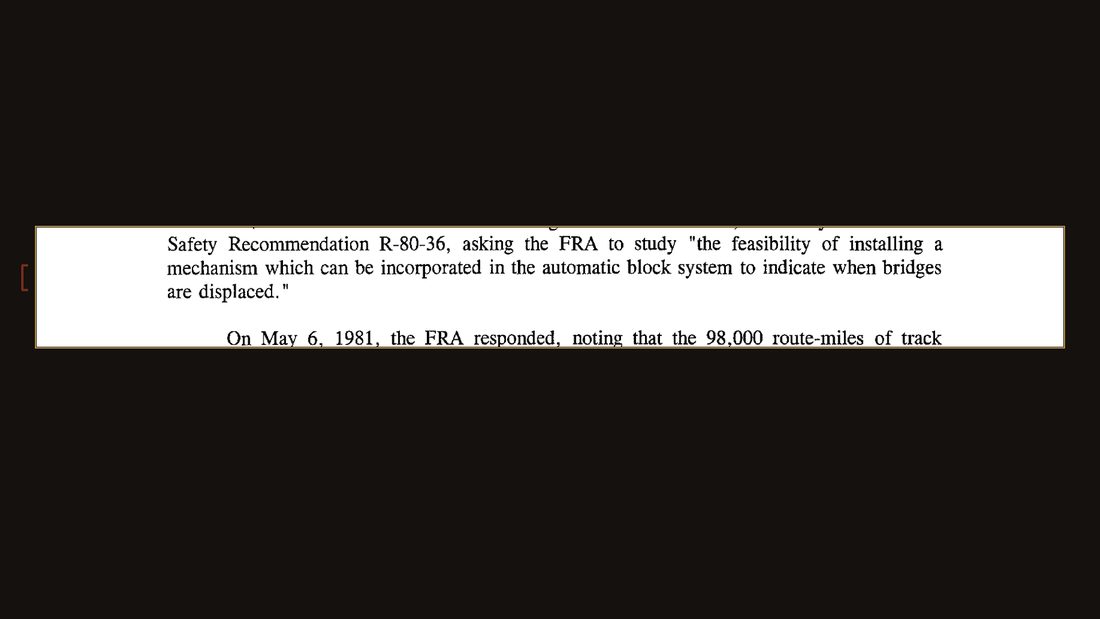
Out of that wreck the Safety Board issued Safety Recommendation R-eighty dash thirty-six.
N90
NTSB/RAR-94/01 · Big Bayou Canot · adopted Sept. 19, 1994 · p. 41. View the original.
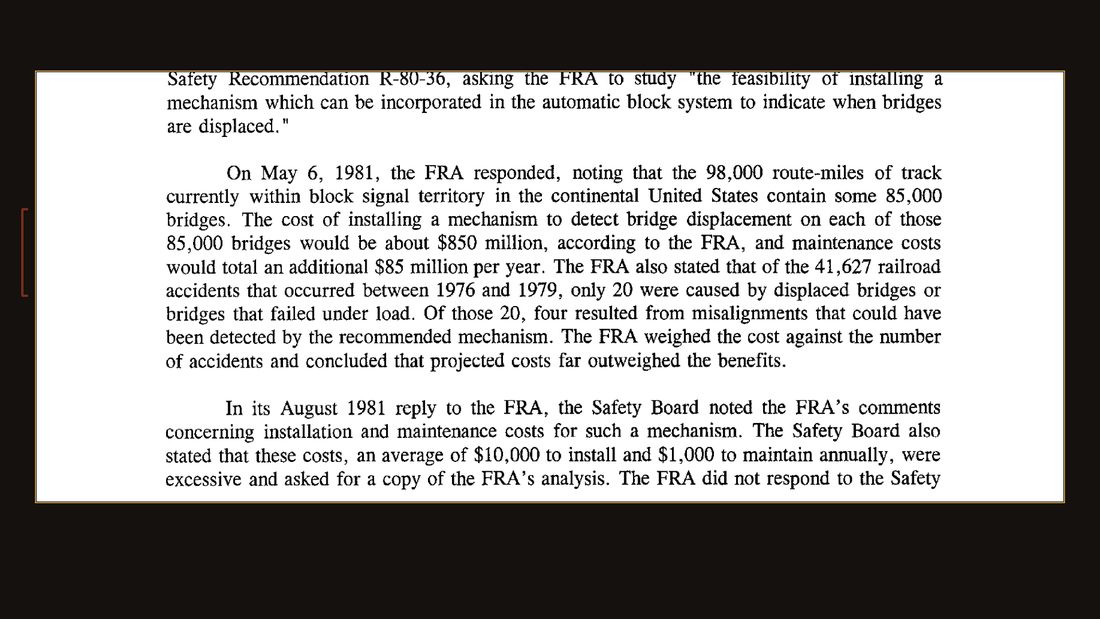
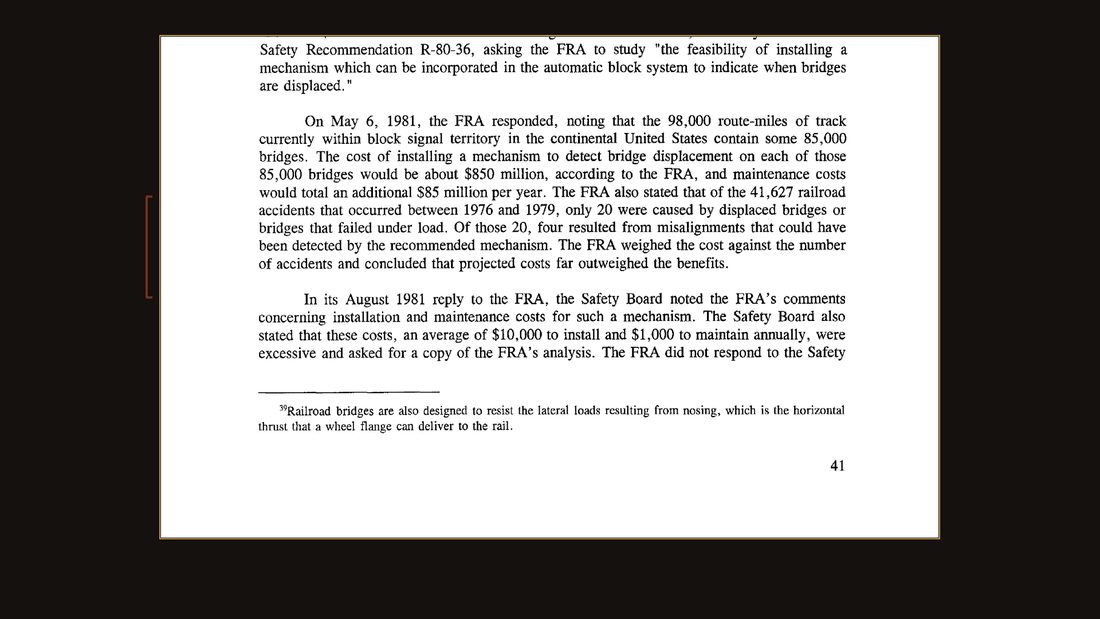
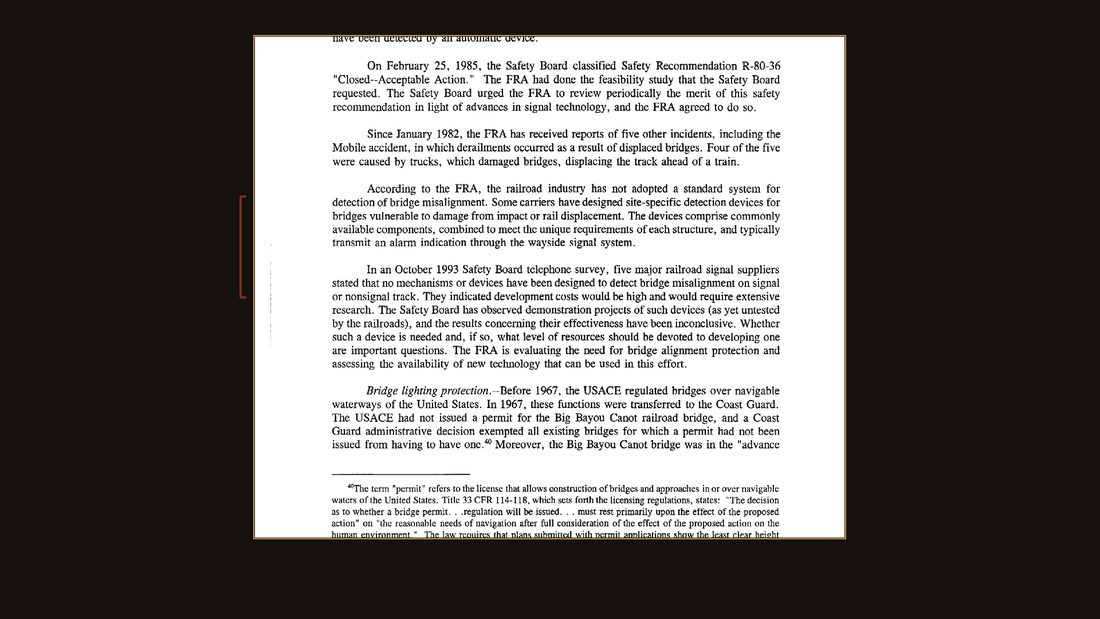
It asked the Federal Railroad Administration to study the feasibility of installing a mechanism which can be incorporated in the automatic block system to indicate when bridges are displaced.
N91
NTSB/RAR-94/01 · Big Bayou Canot · adopted Sept. 19, 1994 · p. 41. View the original.
That is it. That is the whole request. Study whether a signal system could be made to notice a bridge that has moved.
Eight hundred and fifty million
N92
NTSB/RAR-94/01 · Big Bayou Canot · adopted Sept. 19, 1994 · p. 41. View the original.
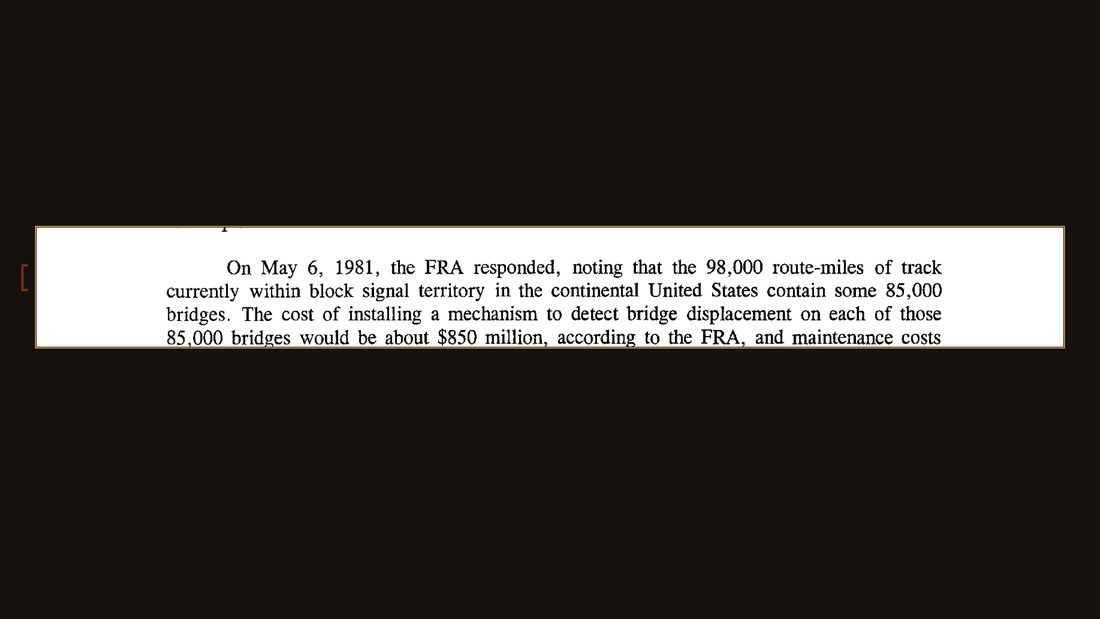
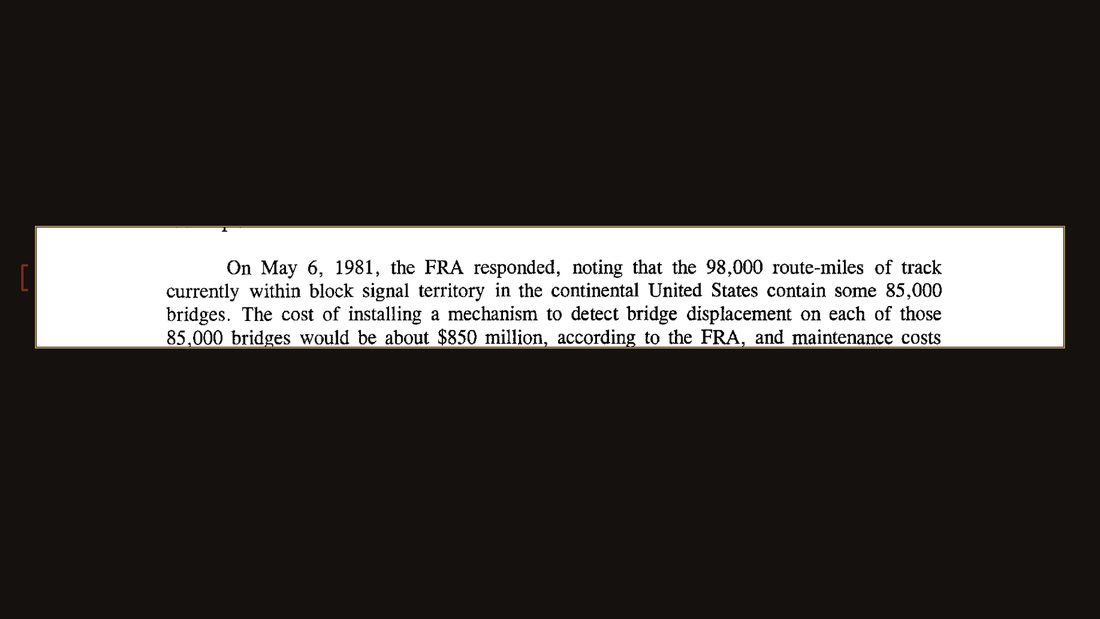
The FRA answered on the sixth of May, nineteen eighty-one.
N93
NTSB/RAR-94/01 · Big Bayou Canot · adopted Sept. 19, 1994 · p. 41. View the original.
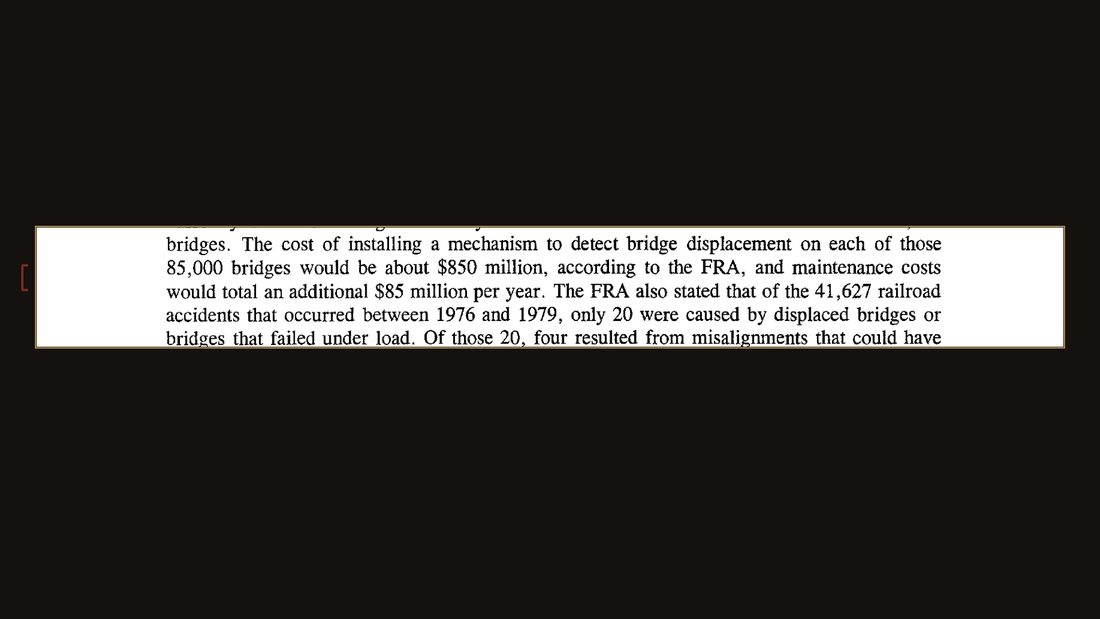
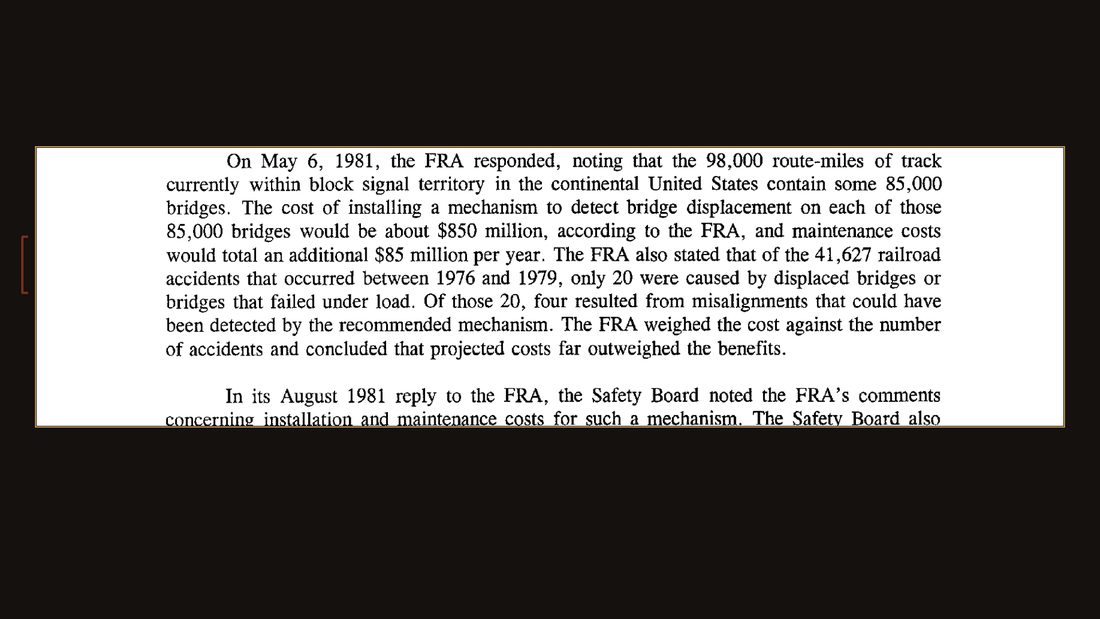
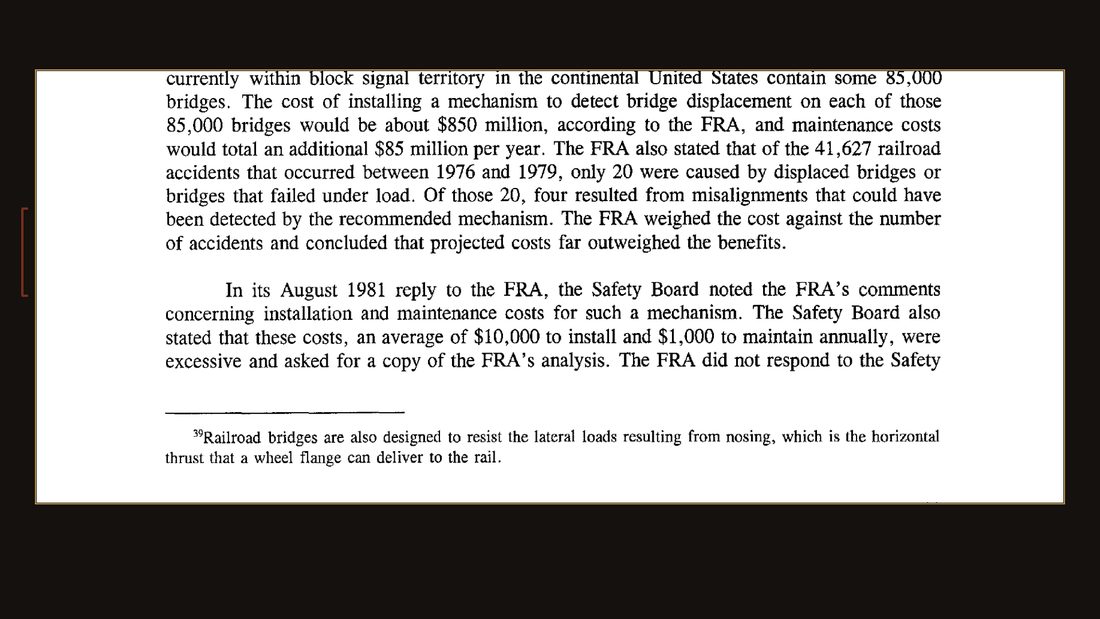
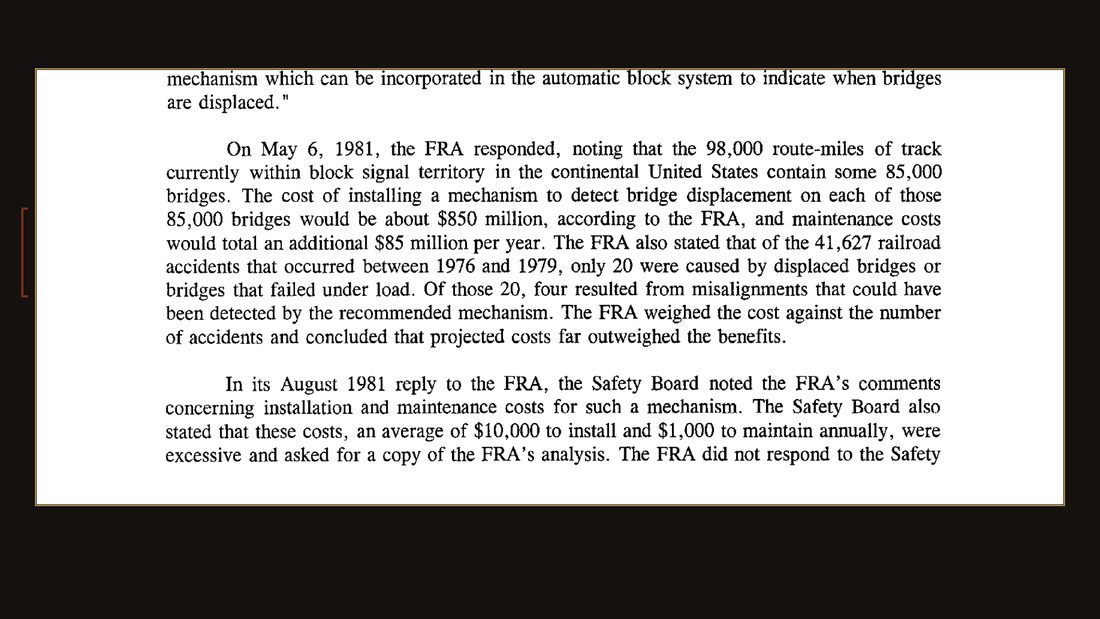
Ninety-eight thousand route-miles of track sat inside signal territory in the continental United States.
N94
NTSB/RAR-94/01 · Big Bayou Canot · adopted Sept. 19, 1994 · p. 41. View the original.
Those route-miles contained some eighty-five thousand bridges.
N95
NTSB/RAR-94/01 · Big Bayou Canot · adopted Sept. 19, 1994 · p. 41. View the original.
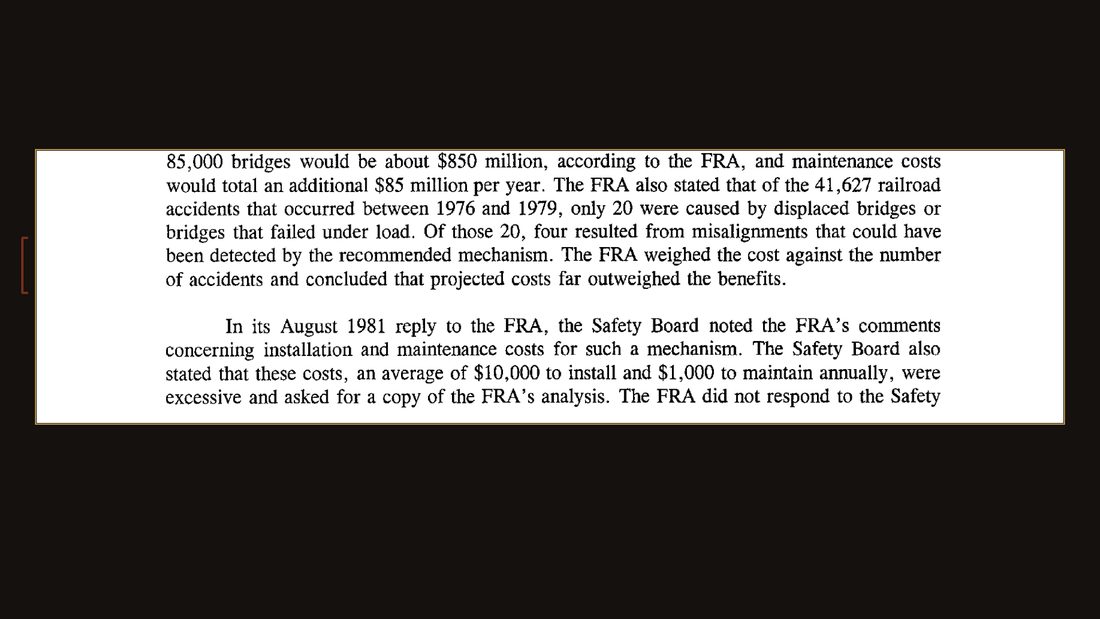
Installing displacement detection on every one of them would cost about eight hundred and fifty million dollars.
N96
NTSB/RAR-94/01 · Big Bayou Canot · adopted Sept. 19, 1994 · p. 41. View the original.
Plus eighty-five million dollars a year to maintain.
N98
NTSB/RAR-94/01 · Big Bayou Canot · adopted Sept. 19, 1994 · p. 41. View the original.
Of the forty-one thousand six hundred and twenty-seven railroad accidents between nineteen seventy-six and nineteen seventy-nine, only twenty were caused by displaced bridges or bridges that failed under load.
N99
NTSB/RAR-94/01 · Big Bayou Canot · adopted Sept. 19, 1994 · p. 41. View the original.
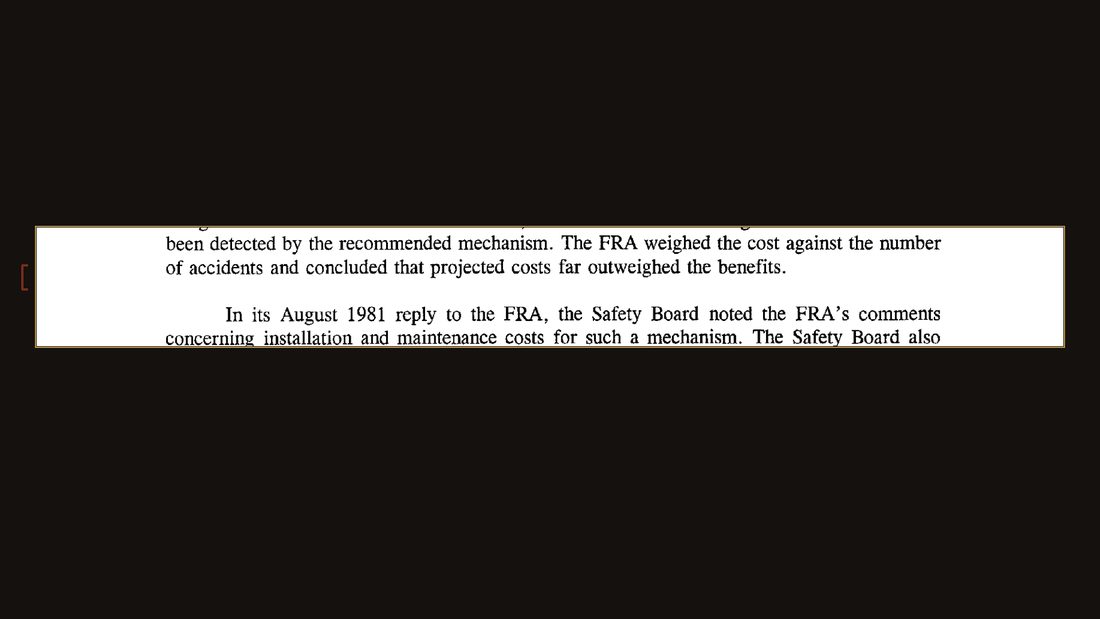
Of those twenty, four resulted from misalignments that the device would have caught.
N100
NTSB/RAR-94/01 · Big Bayou Canot · adopted Sept. 19, 1994 · p. 41. View the original.
The FRA weighed the cost against the number of accidents and concluded that projected costs far outweighed the benefits.
N101
NTSB/RAR-94/01 · Big Bayou Canot · adopted Sept. 19, 1994 · p. 41. View the original.
That is a defensible calculation. It is also the only calculation anybody ran.
Closed, acceptable action
N102
NTSB/RAR-94/01 · Big Bayou Canot · adopted Sept. 19, 1994 · p. 41. View the original.
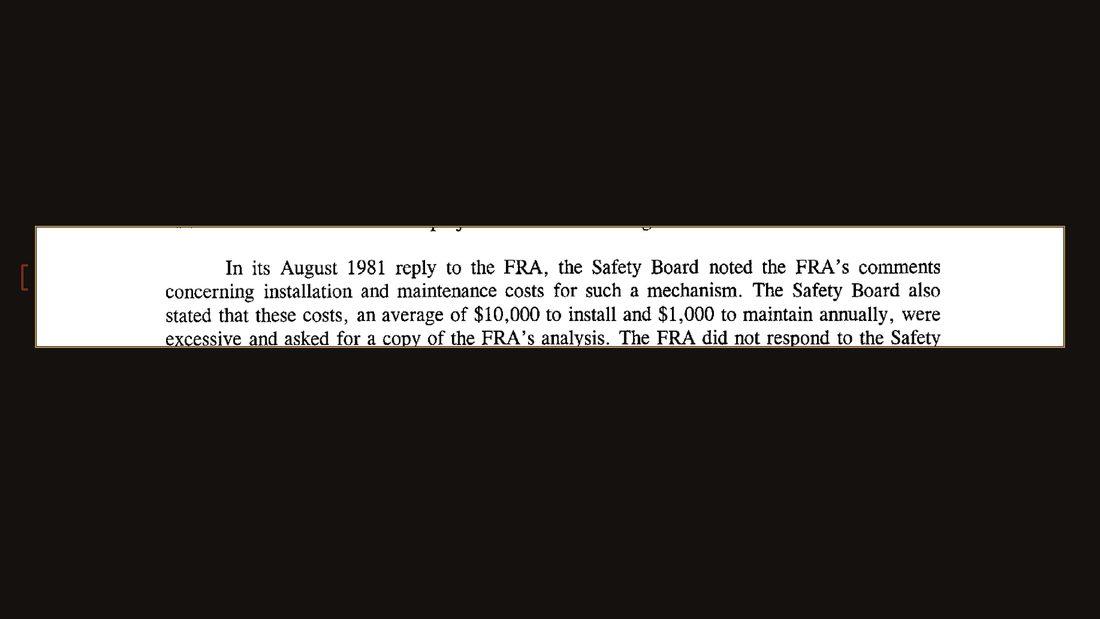
The Safety Board wrote back in August of nineteen eighty-one and questioned the arithmetic.
N103
NTSB/RAR-94/01 · Big Bayou Canot · adopted Sept. 19, 1994 · p. 41. View the original.
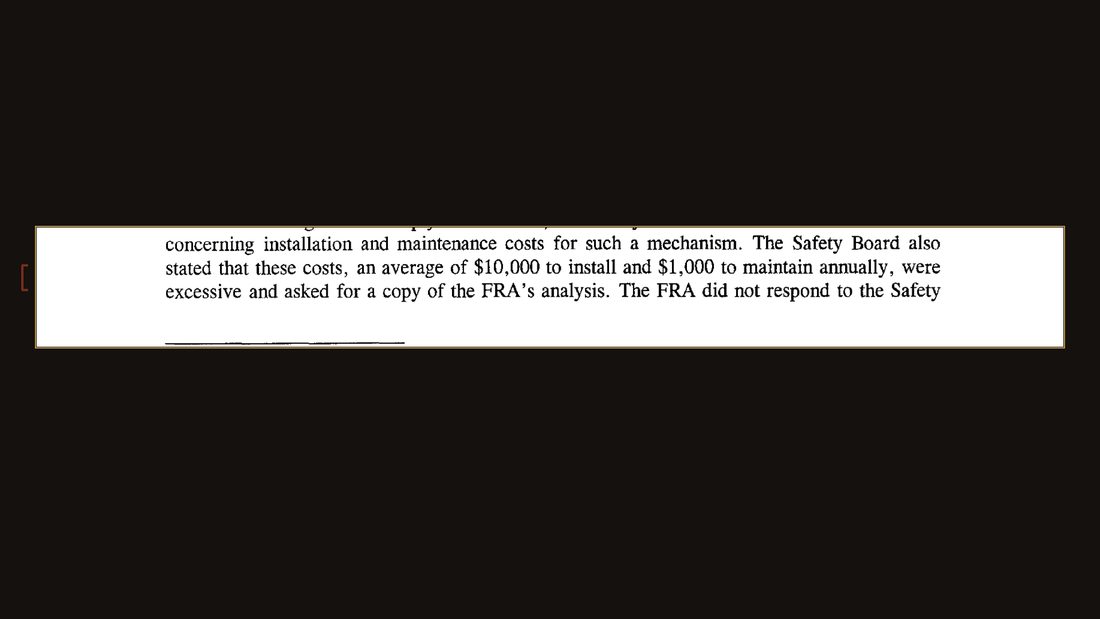
Ten thousand dollars to install one and a thousand dollars a year to maintain it struck the Board as excessive.
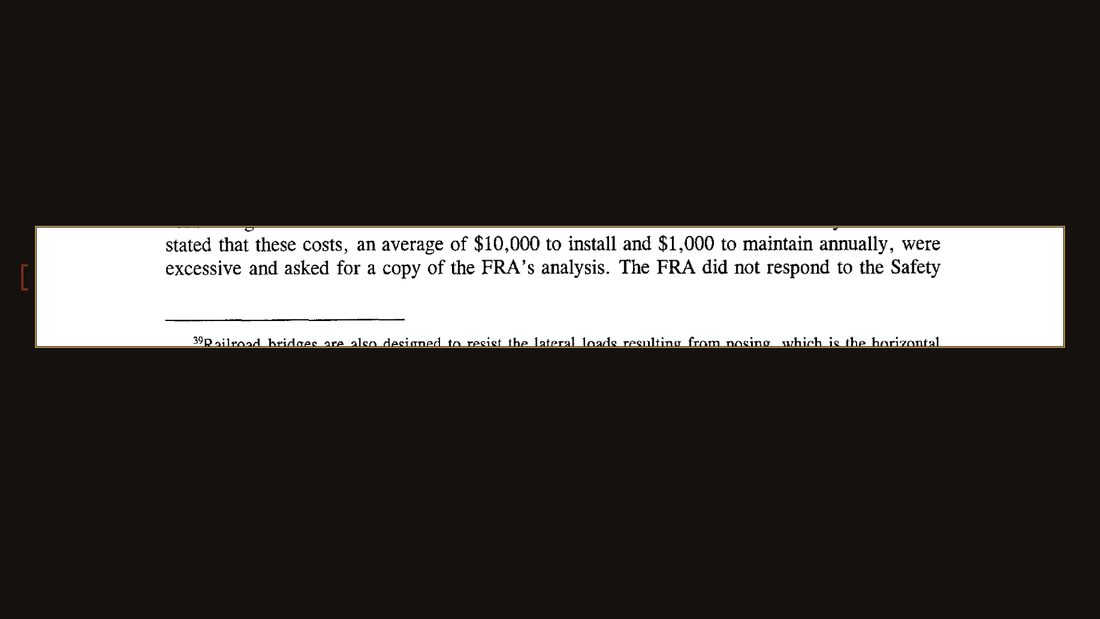
N104
NTSB/RAR-94/01 · Big Bayou Canot · adopted Sept. 19, 1994 · p. 41. View the original.
So the Board asked the FRA for a copy of its analysis.
N105
NTSB/RAR-94/01 · Big Bayou Canot · adopted Sept. 19, 1994 · p. 41. View the original.
The FRA did not respond to the Safety Board's request.
N106
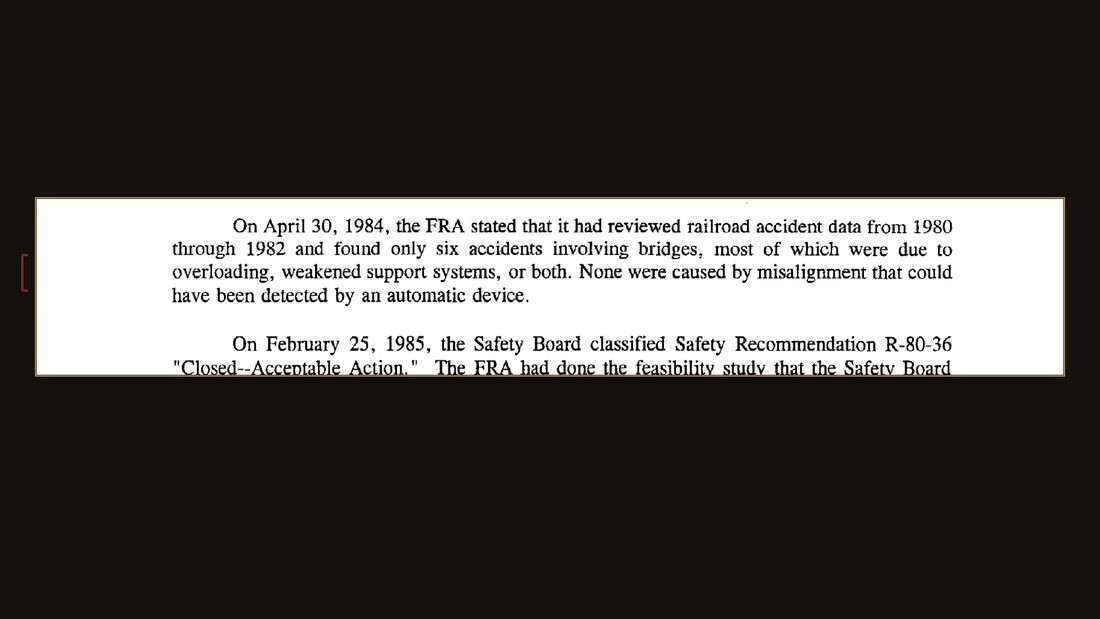
NTSB/RAR-94/01 · Big Bayou Canot · adopted Sept. 19, 1994 · p. 42. View the original.
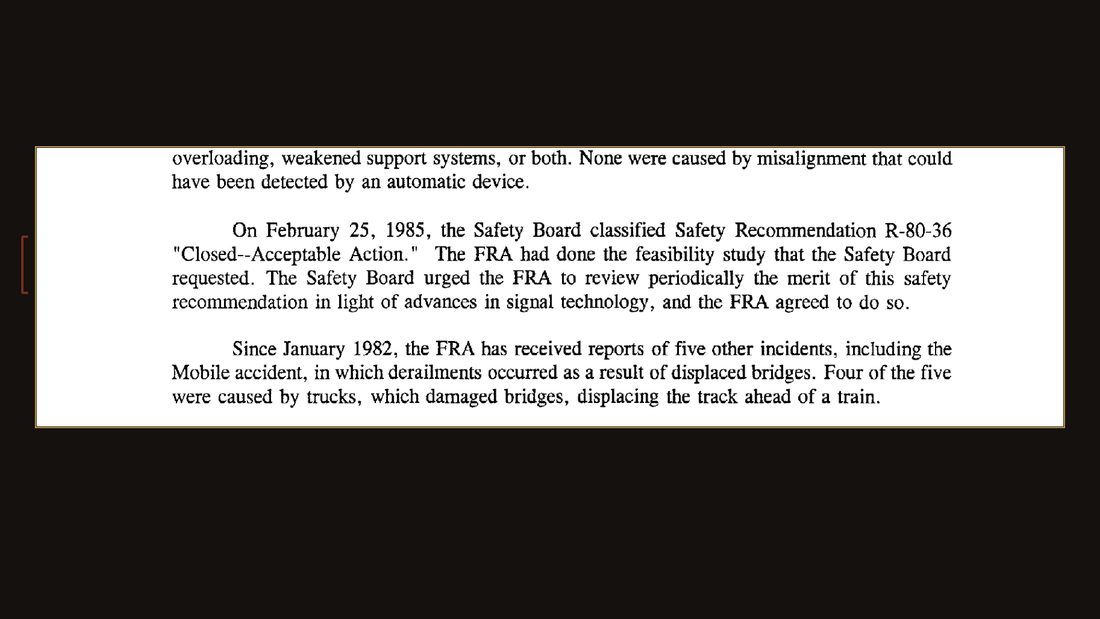
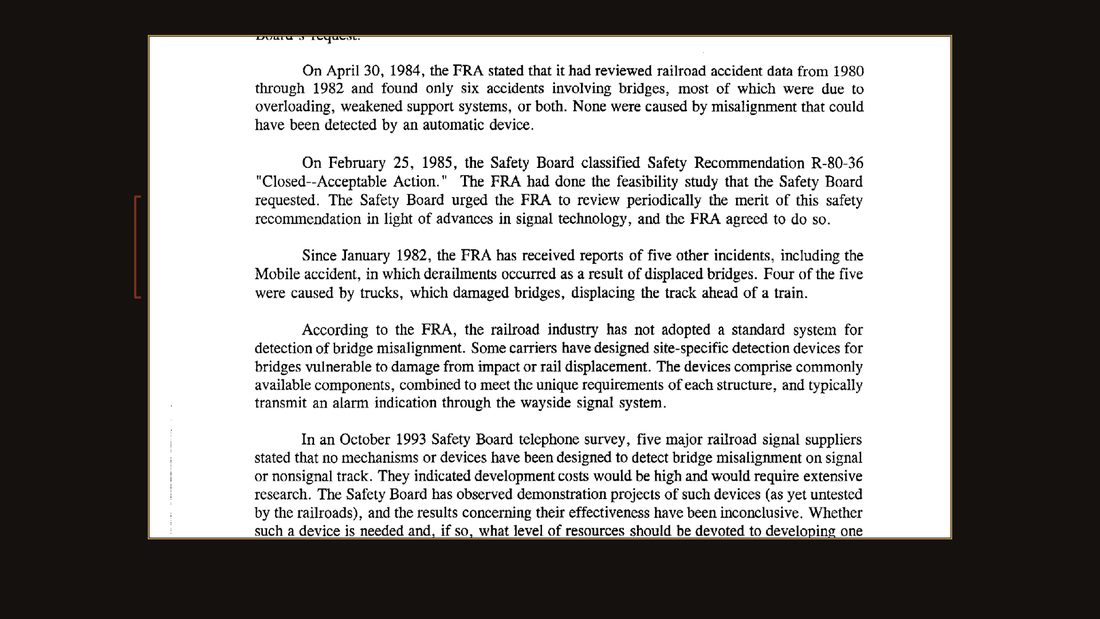
Three years later the agency reported it had looked at nineteen eighty through eighty-two and found six bridge accidents, none of them detectable by a device.
N107
NTSB/RAR-94/01 · Big Bayou Canot · adopted Sept. 19, 1994 · p. 42. View the original.
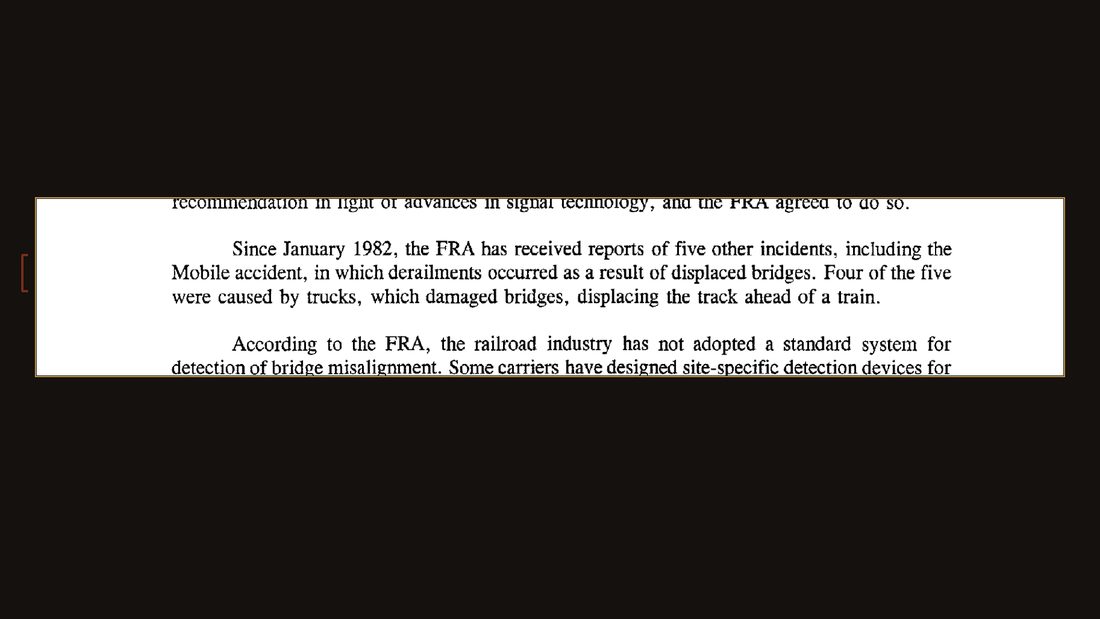
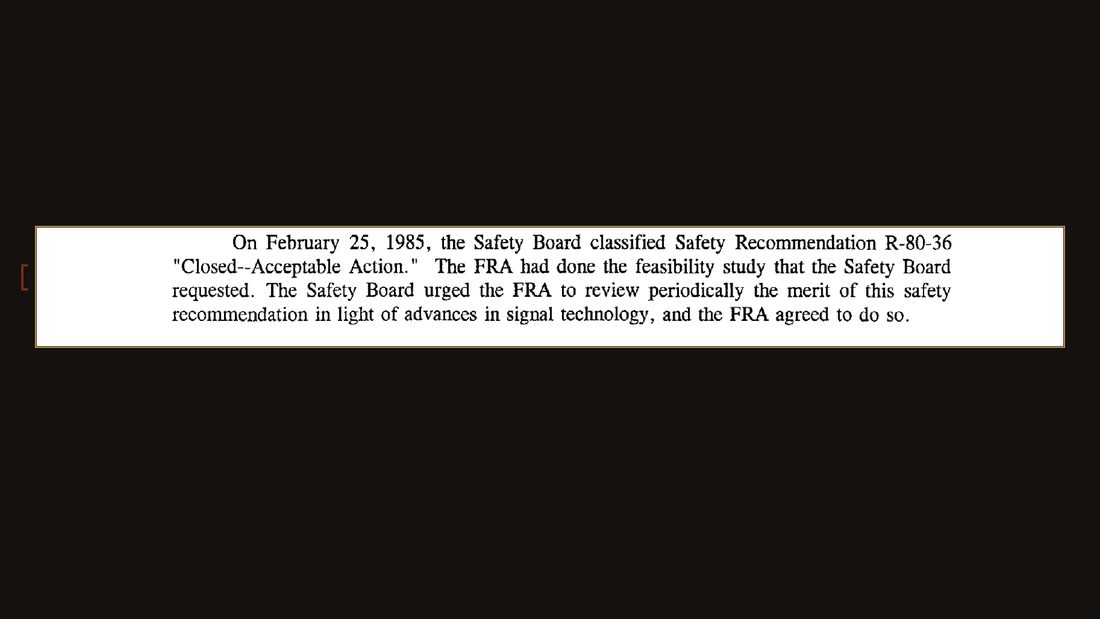
On the twenty-fifth of February, nineteen eighty-five, the Safety Board closed the recommendation.
N108
NTSB/RAR-94/01 · Big Bayou Canot · adopted Sept. 19, 1994 · p. 42. View the original.
Closed, acceptable action. The Board asked the FRA to revisit it periodically as signal technology improved. The FRA agreed to.
N109
NTSB/RAR-94/01 · Big Bayou Canot · adopted Sept. 19, 1994 · p. 42. View the original.
That file had been shut for eight years, seven months and twenty-eight days when the Sunset Limited left Mobile.
The scope of knowledge
N110
NTSB/RAR-94/01 · Big Bayou Canot · adopted Sept. 19, 1994 · p. 32. View the original.
Now go back to the towboat, because the same shape shows up there.
N111
NTSB/RAR-94/01 · Big Bayou Canot · adopted Sept. 19, 1994 · p. 32. View the original.
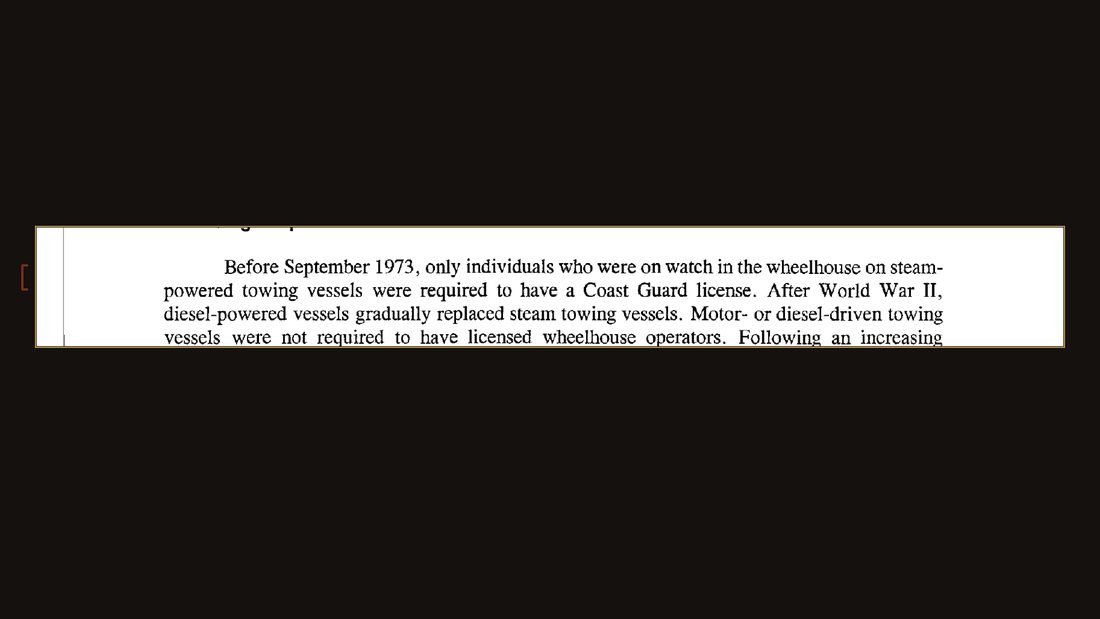
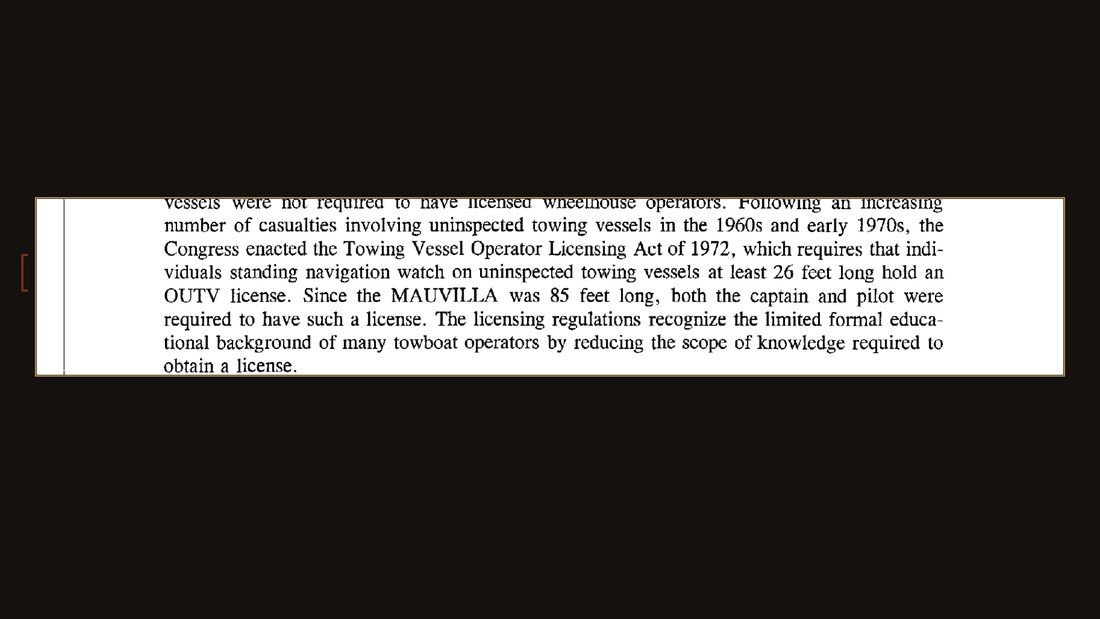
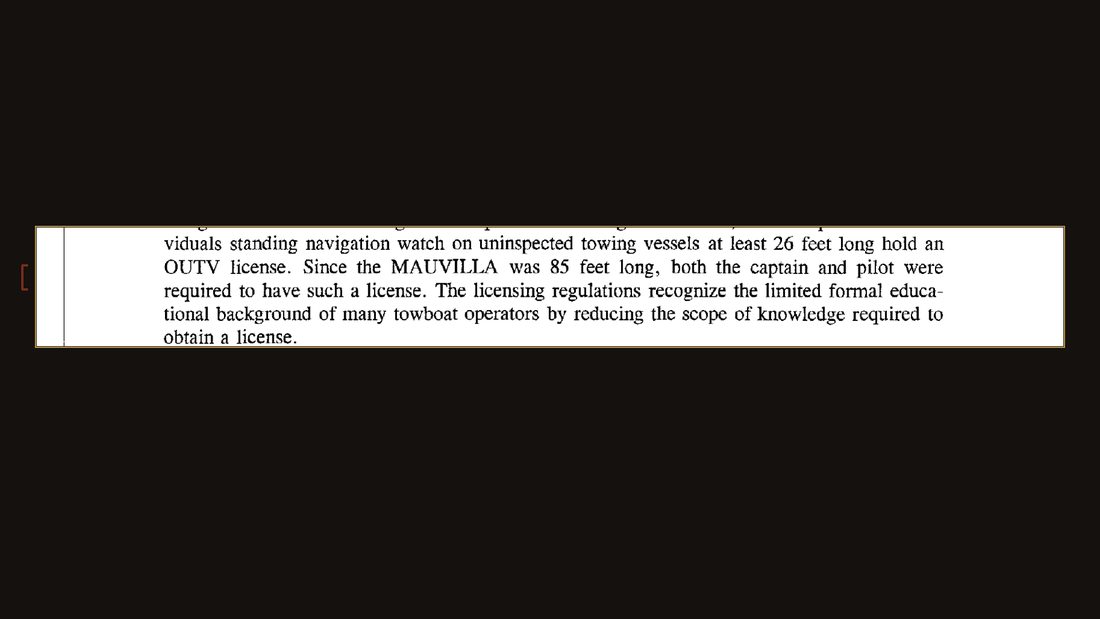
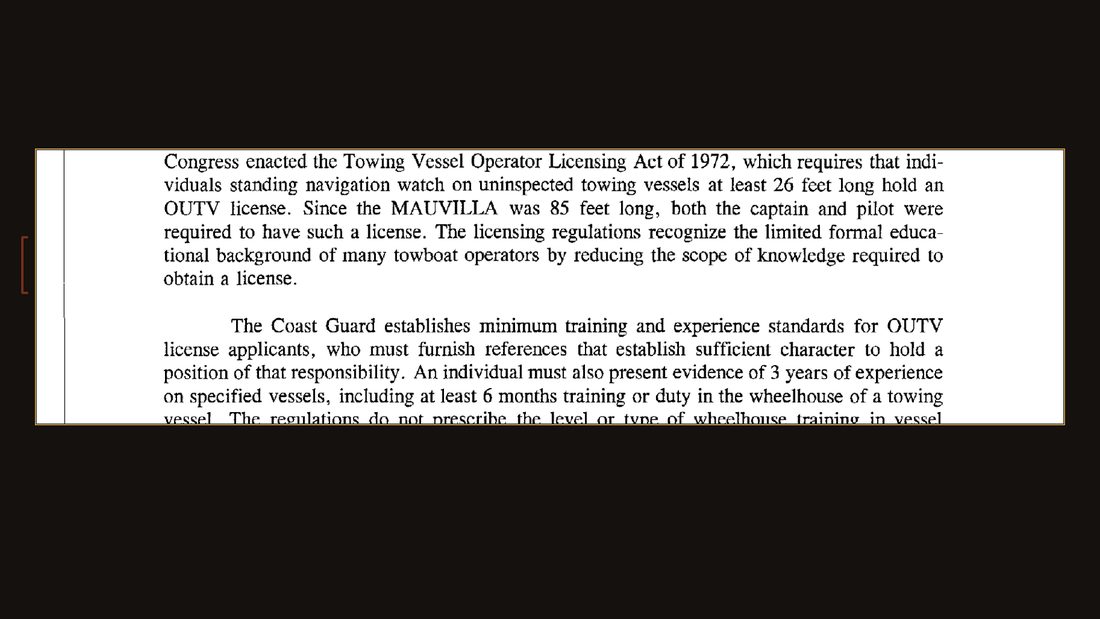
Since nineteen seventy-two, anyone standing a navigation watch on a towing vessel over twenty-six feet has needed a federal license.
N112
NTSB/RAR-94/01 · Big Bayou Canot · adopted Sept. 19, 1994 · p. 32. View the original.
The Mauvilla was eighty-five feet. Both her captain and her pilot held one.
N113
NTSB/RAR-94/01 · Big Bayou Canot · adopted Sept. 19, 1994 · p. 32. View the original.
Read the next sentence in the government's own report slowly.
N114
NTSB/RAR-94/01 · Big Bayou Canot · adopted Sept. 19, 1994 · p. 32. View the original.
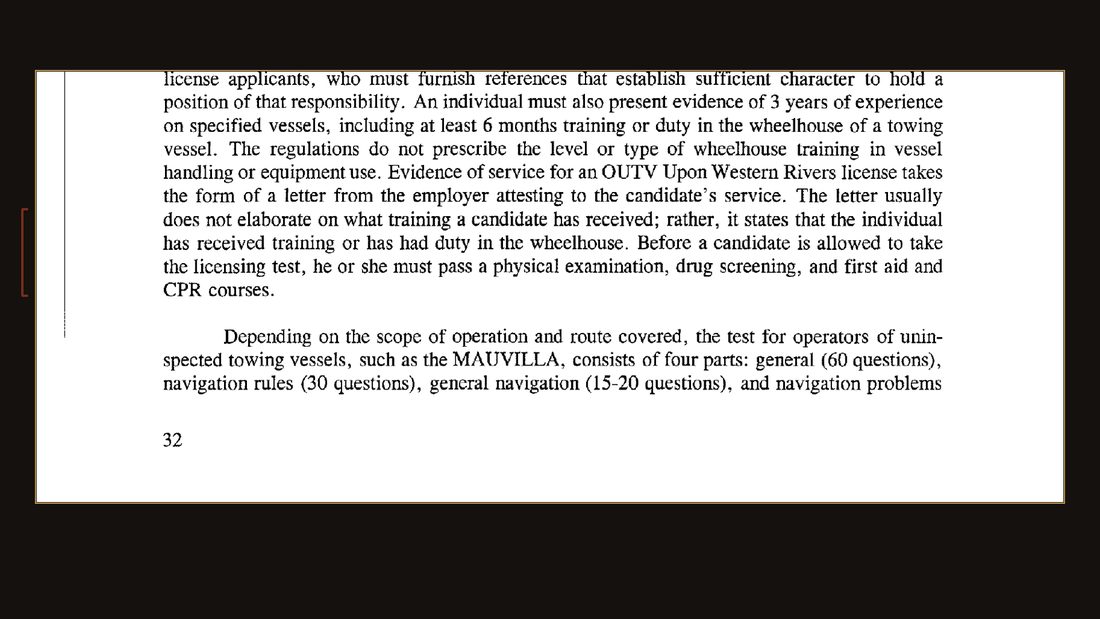
The licensing regulations recognize the limited formal educational background of many towboat operators by reducing the scope of knowledge required to obtain a license.
N115
NTSB/RAR-94/01 · Big Bayou Canot · adopted Sept. 19, 1994 · p. 32. View the original.
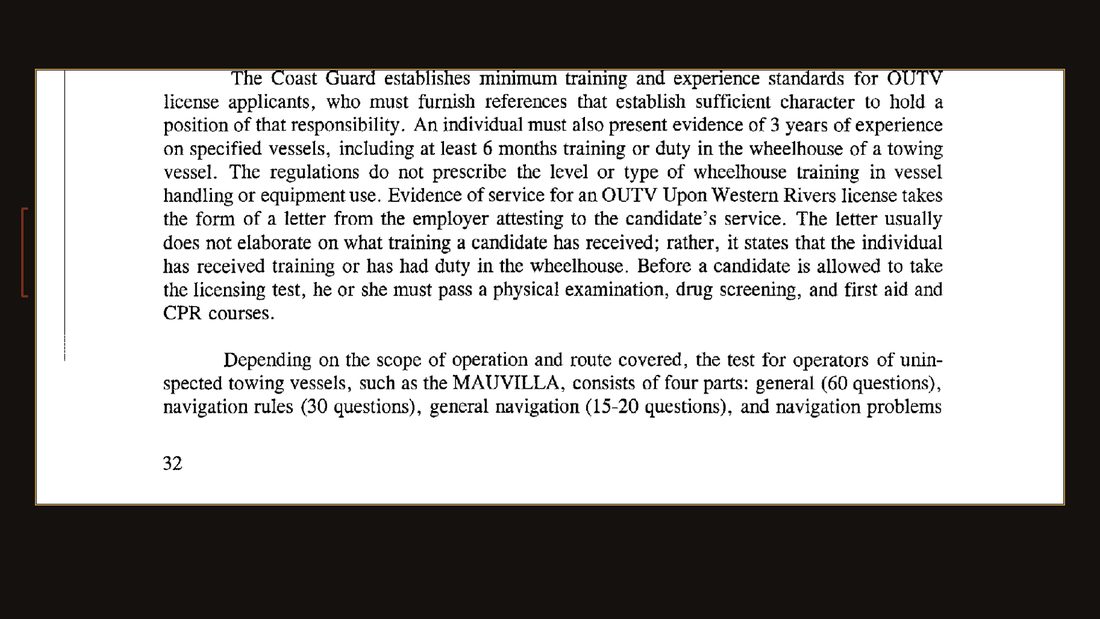
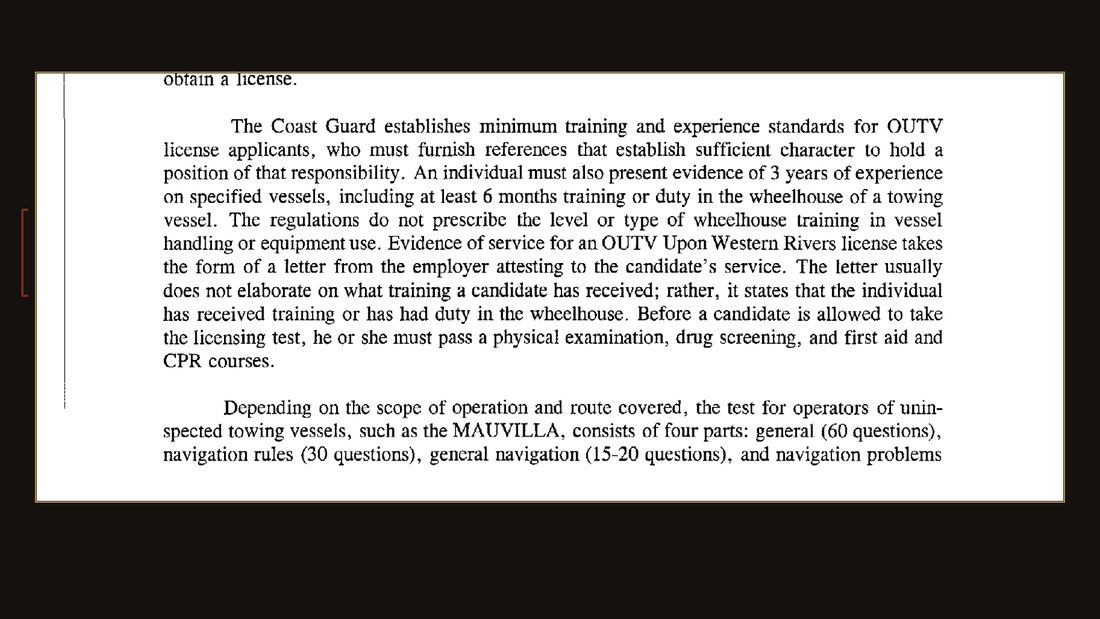
An applicant supplies a letter from his employer saying he received training or had duty in the wheelhouse.
N117
NTSB/RAR-94/01 · Big Bayou Canot · adopted Sept. 19, 1994 · p. 32. View the original.
The regulations do not prescribe the level or type of wheelhouse training in vessel handling or equipment use.
N118
NTSB/RAR-94/01 · Big Bayou Canot · adopted Sept. 19, 1994 · p. 32. View the original.
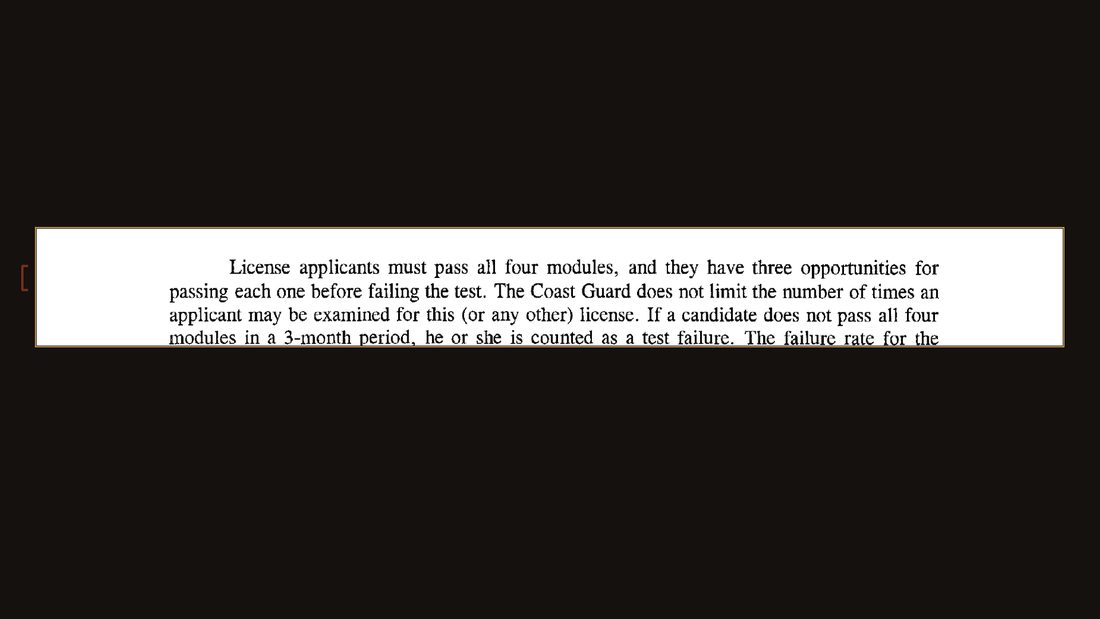
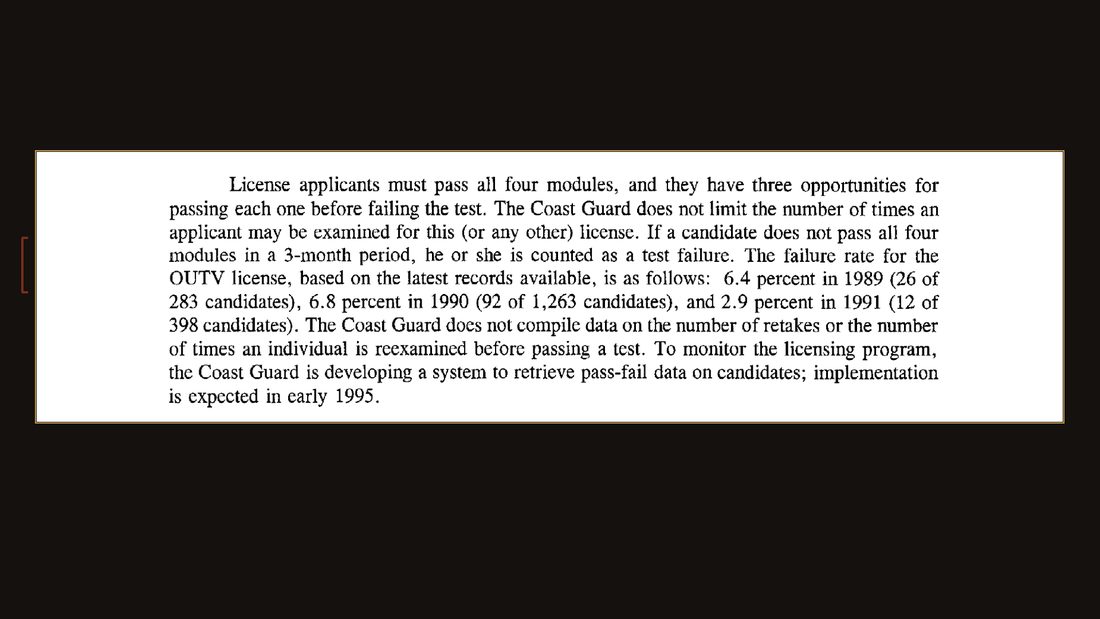
Then a written test in four parts, which you may retake without limit.
N120
NTSB/RAR-94/01 · Big Bayou Canot · adopted Sept. 19, 1994 · p. 33. View the original.
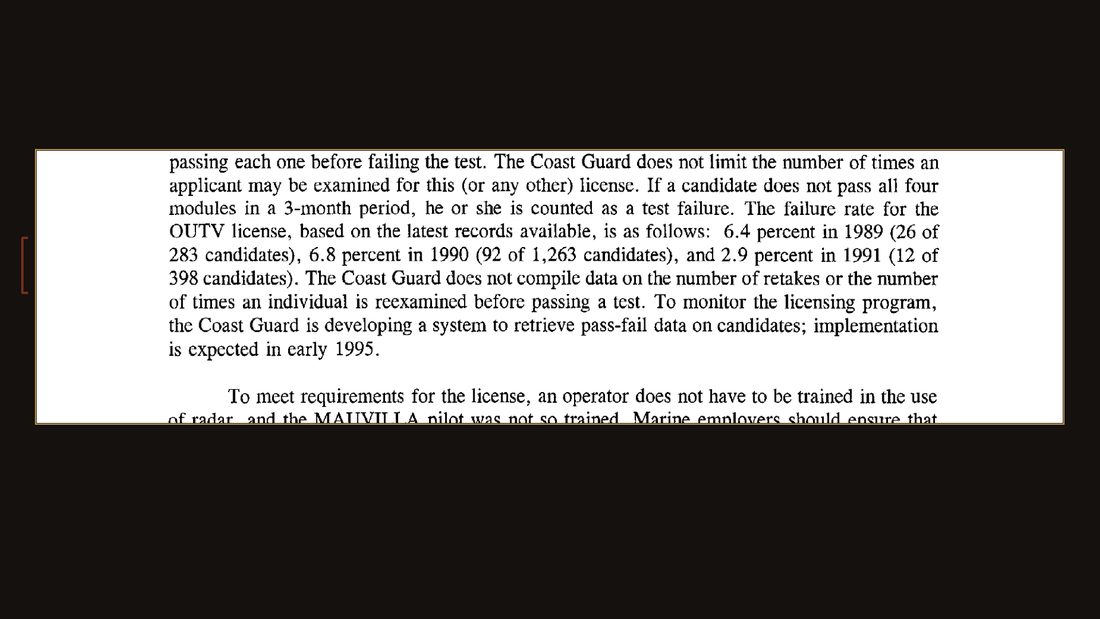
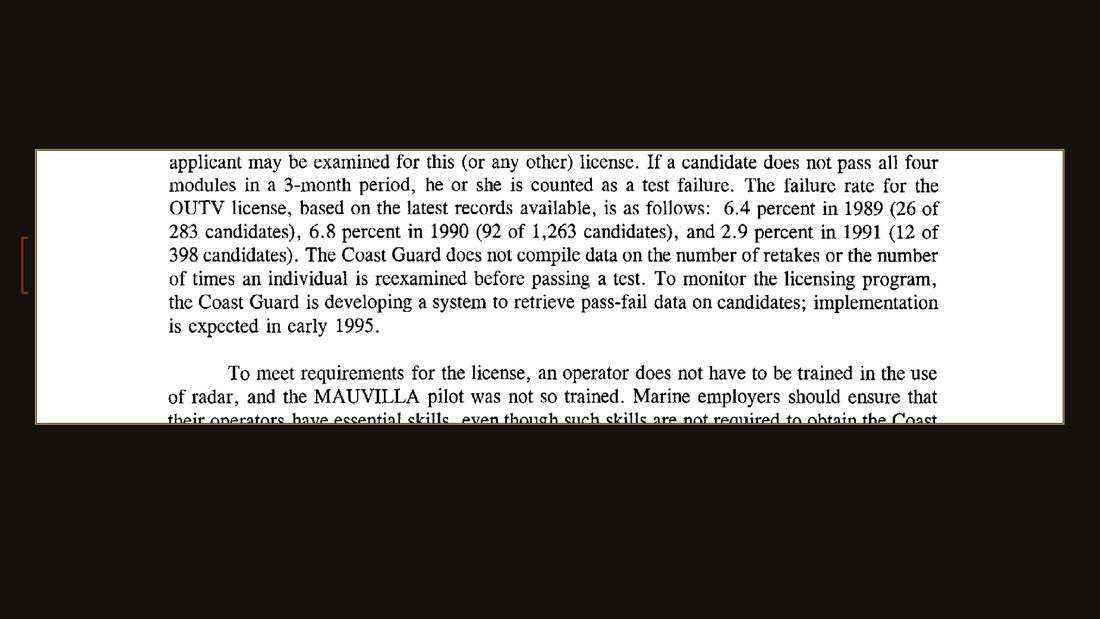
Six point four percent in nineteen eighty-nine, twenty-six of two hundred eighty-three candidates.
N121
NTSB/RAR-94/01 · Big Bayou Canot · adopted Sept. 19, 1994 · p. 33. View the original.
Twenty-six divided by two hundred eighty-three is nine point two percent. The next line does not work either.
N122
NTSB/RAR-94/01 · Big Bayou Canot · adopted Sept. 19, 1994 · p. 33. View the original.
The report does not explain the difference, and the Coast Guard, it says, does not compile data on how many times a candidate retakes the test.
N124
NTSB/RAR-94/01 · Big Bayou Canot · adopted Sept. 19, 1994 · p. 33. View the original.
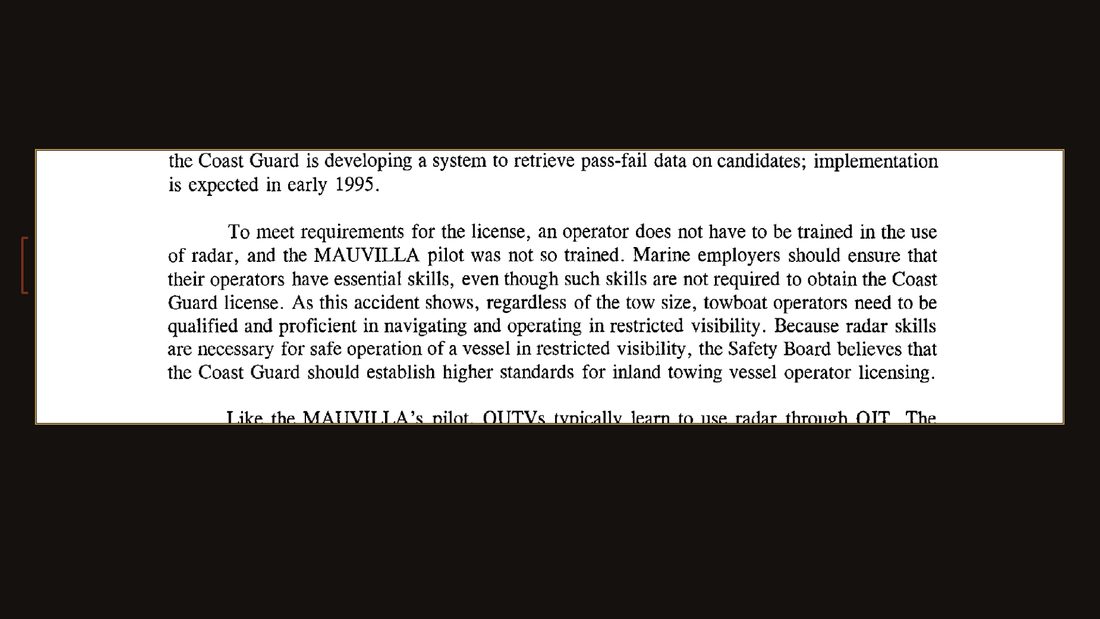
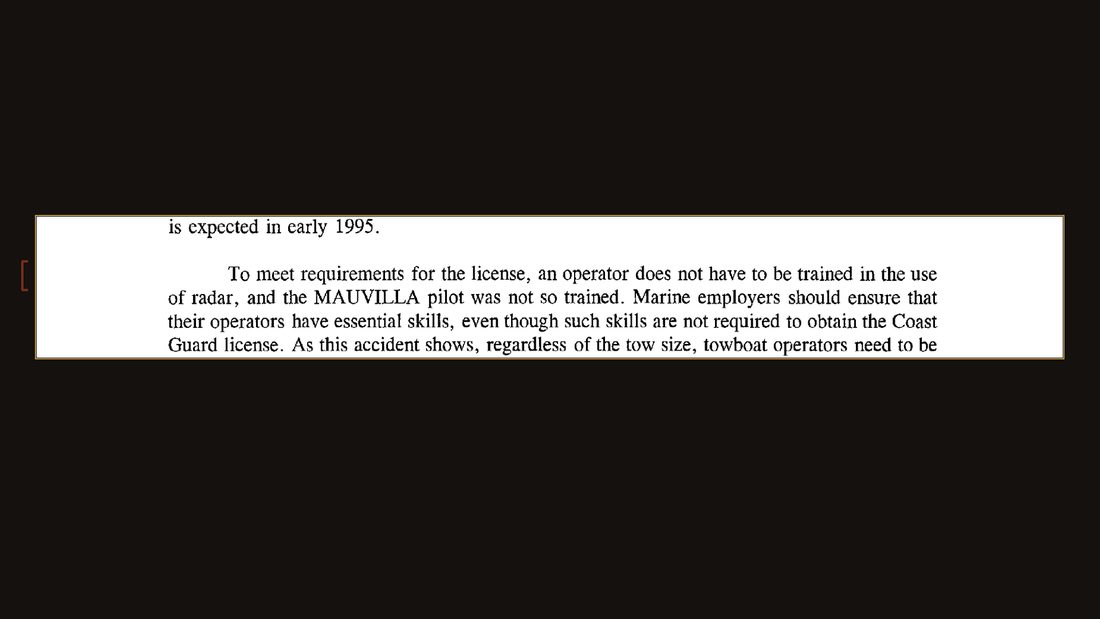
To meet requirements for the license, an operator does not have to be trained in the use of radar.
N125
NTSB/RAR-94/01 · Big Bayou Canot · adopted Sept. 19, 1994 · p. 33. View the original.
And the Mauvilla pilot was not so trained.
N126
NTSB/RAR-94/01 · Big Bayou Canot · adopted Sept. 19, 1994 · p. 33. View the original.
Radar training was required. For men working the ocean. Not for the man in the fog on the river.
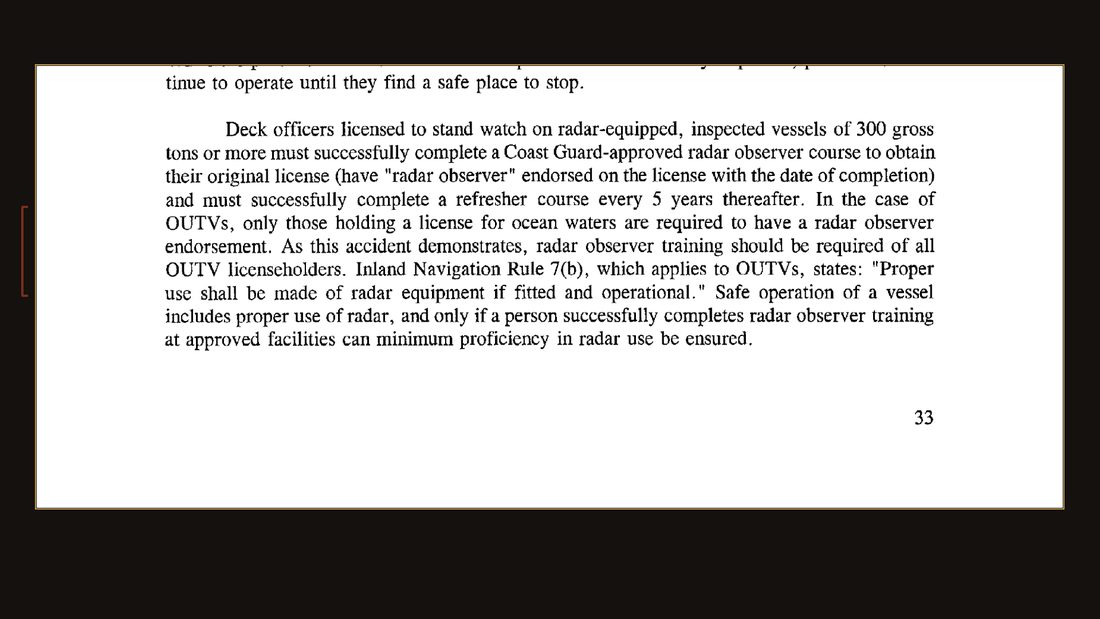
N127
NTSB/RAR-94/01 · Big Bayou Canot · adopted Sept. 19, 1994 · p. 33. View the original.
He learned it the way almost all of them learned it. On the job, from another man, with no examination at the end.
No chart on board
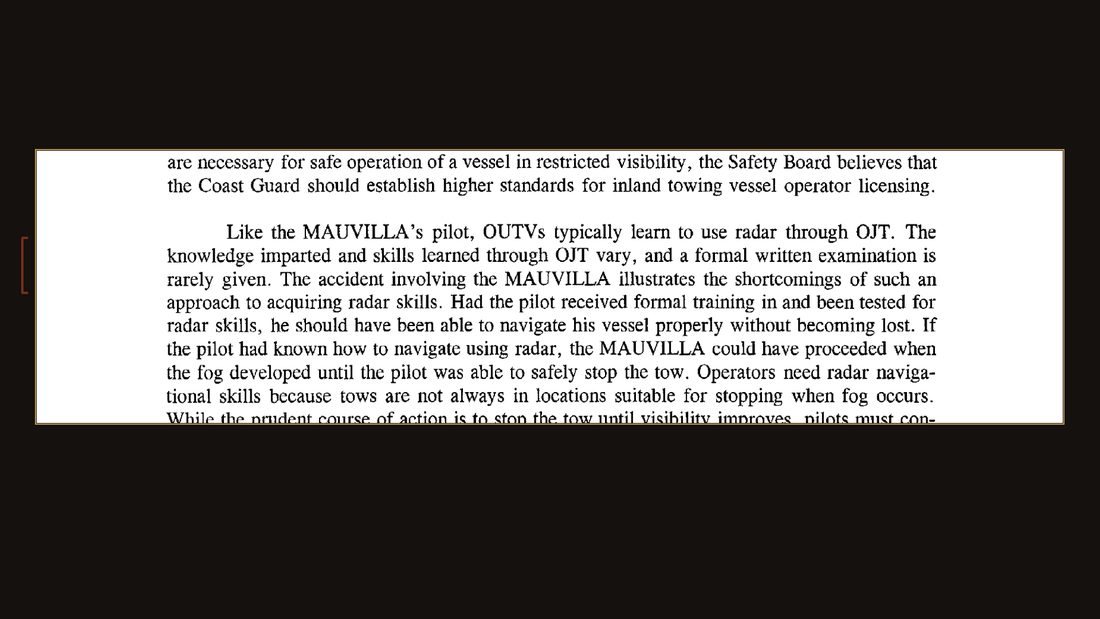
N128
NTSB/RAR-94/01 · Big Bayou Canot · adopted Sept. 19, 1994 · p. 33. View the original.
There were two other things on that towboat that would have told him where he was.
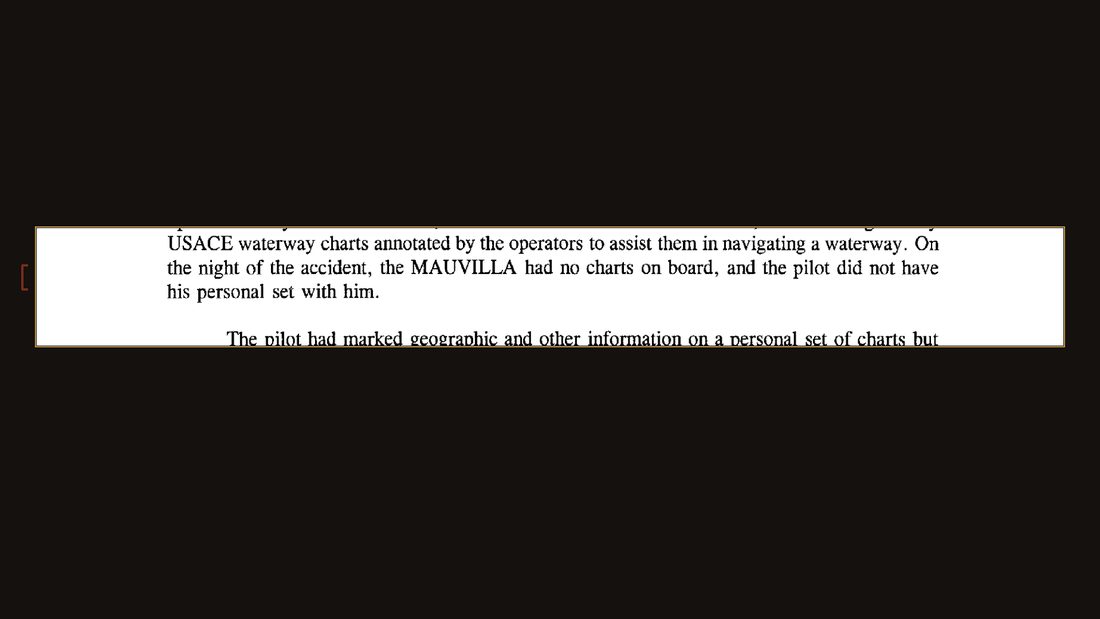
N129
NTSB/RAR-94/01 · Big Bayou Canot · adopted Sept. 19, 1994 · p. 35. View the original.
The first is a chart. The Mauvilla had none.
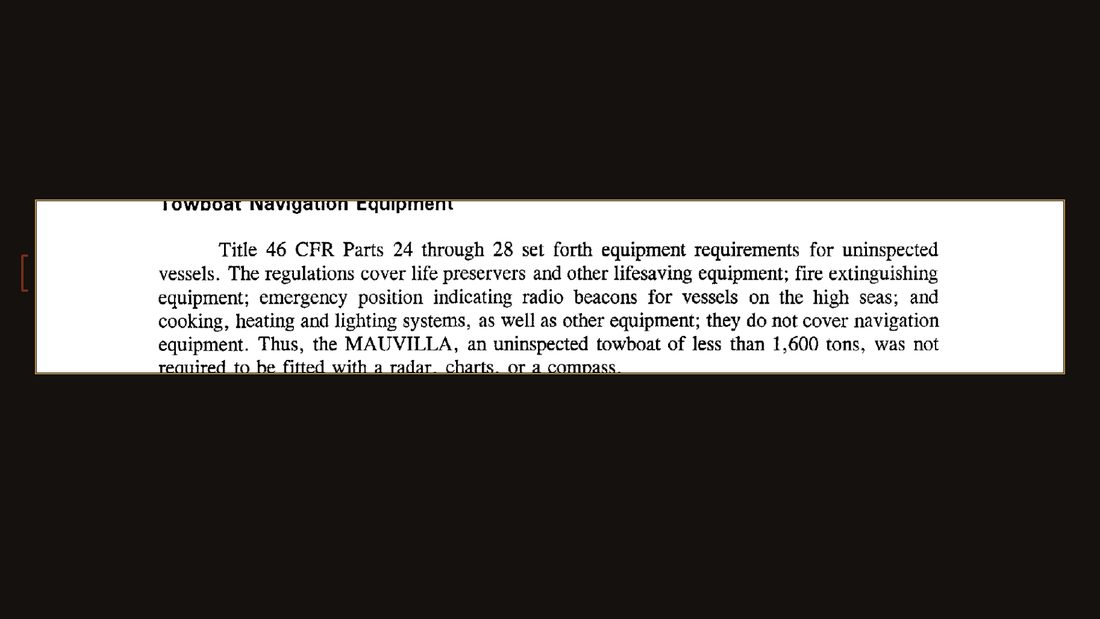
N130
NTSB/RAR-94/01 · Big Bayou Canot · adopted Sept. 19, 1994 · p. 34. View the original.
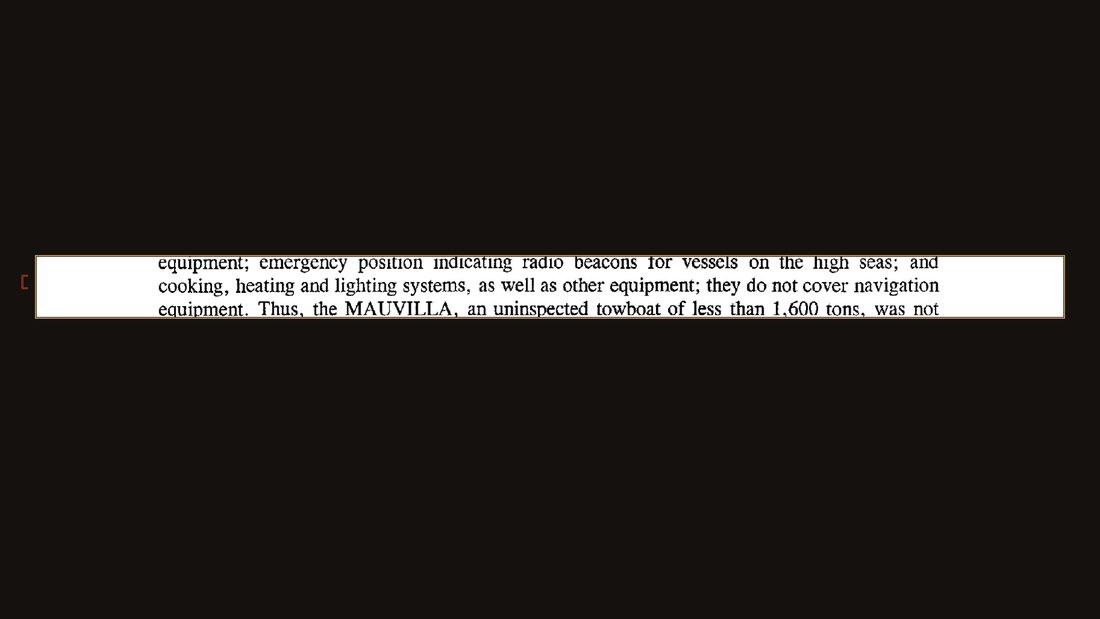
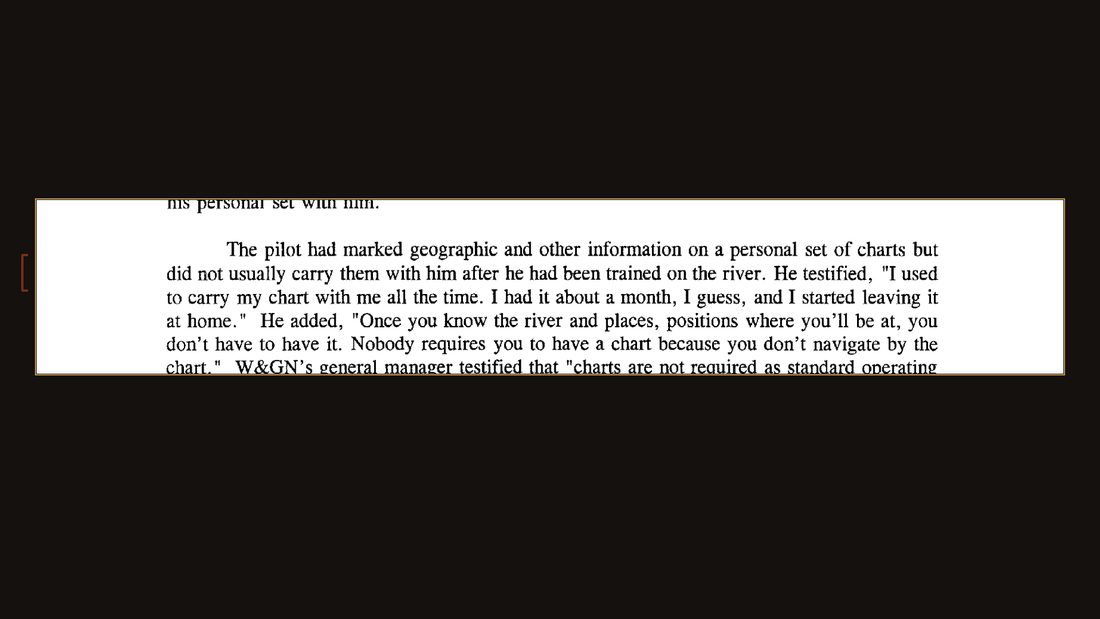
She was not required to carry one. Equipment rules for uninspected towing vessels cover life preservers, fire extinguishers, cooking and heating.
N131
NTSB/RAR-94/01 · Big Bayou Canot · adopted Sept. 19, 1994 · p. 34. View the original.
They do not cover navigation equipment at all.
N132
NTSB/RAR-94/01 · Big Bayou Canot · adopted Sept. 19, 1994 · p. 35. View the original.
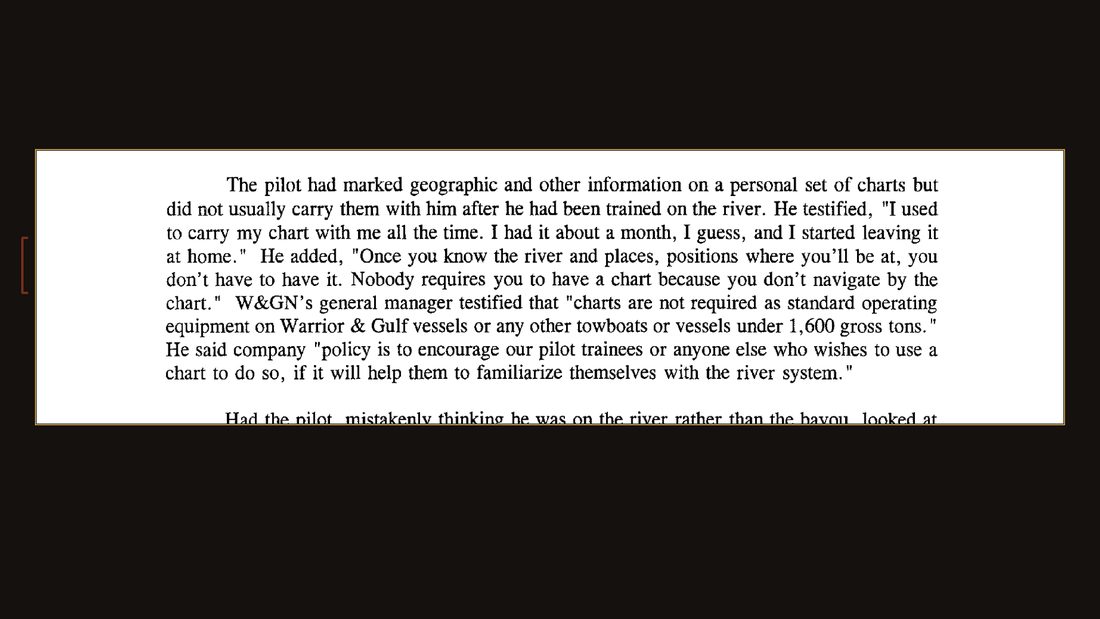
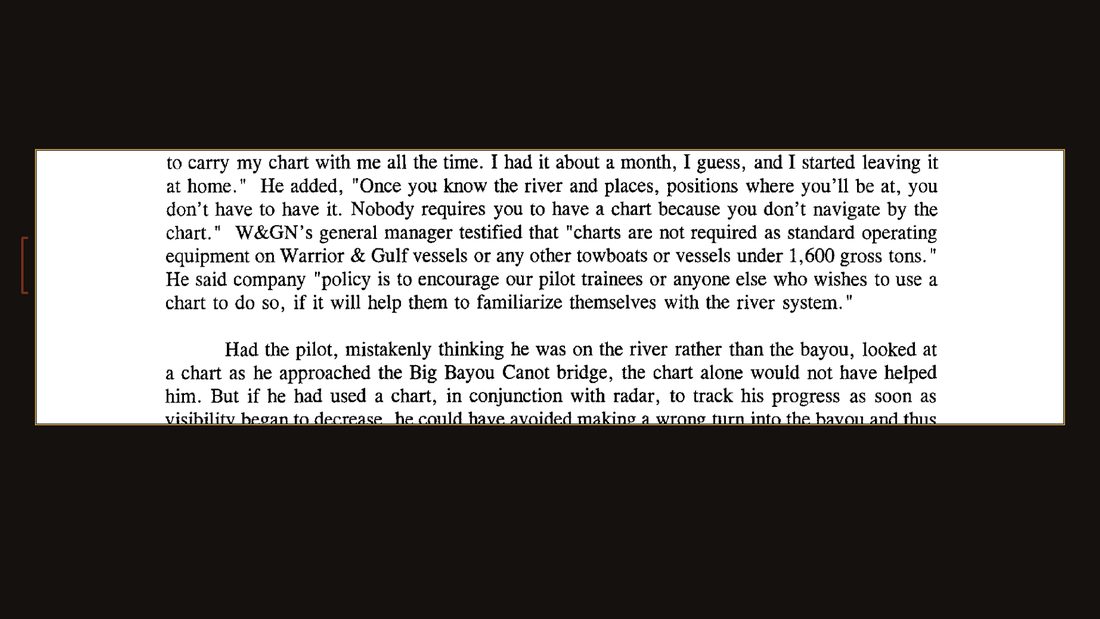
The pilot had his own set of charts once. He told the Board what happened to them.
N133
NTSB/RAR-94/01 · Big Bayou Canot · adopted Sept. 19, 1994 · p. 35. View the original.
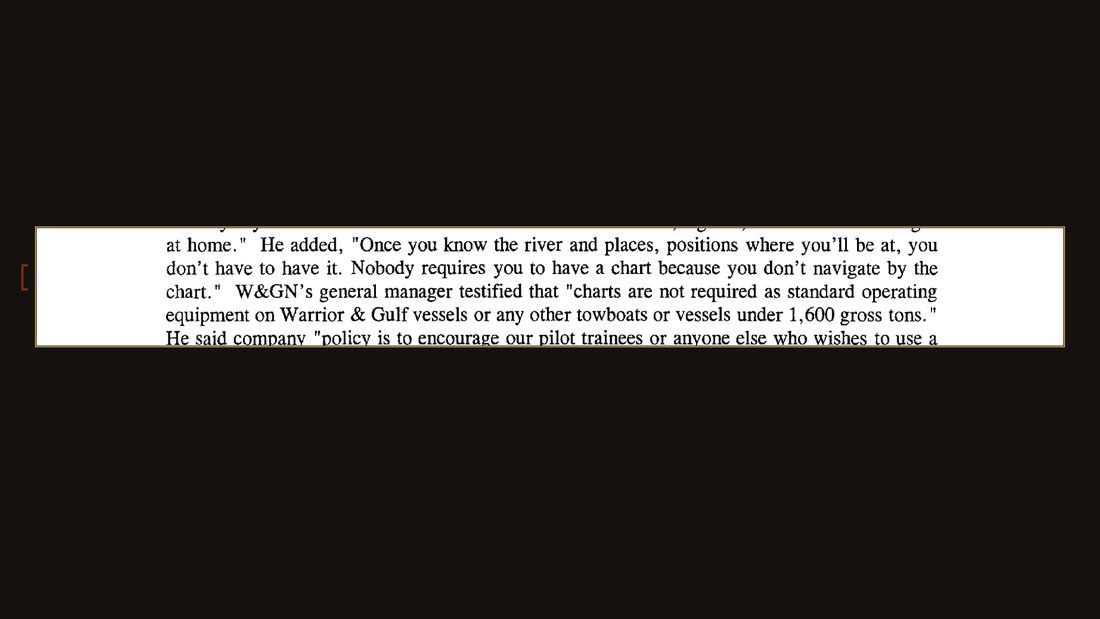
I used to carry my chart with me all the time. I had it about a month, I guess, and I started leaving it at home.
N134
NTSB/RAR-94/01 · Big Bayou Canot · adopted Sept. 19, 1994 · p. 35. View the original.
Once you know the river, you don't have to have it. Nobody requires you to have a chart because you don't navigate by the chart.
N135
NTSB/RAR-94/01 · Big Bayou Canot · adopted Sept. 19, 1994 · p. 35. View the original.
His employer's general manager confirmed it in testimony. Charts are not required as standard operating equipment.
Ninety-five degrees
N136
NTSB/RAR-94/01 · Big Bayou Canot · adopted Sept. 19, 1994 · p. 36. View the original.
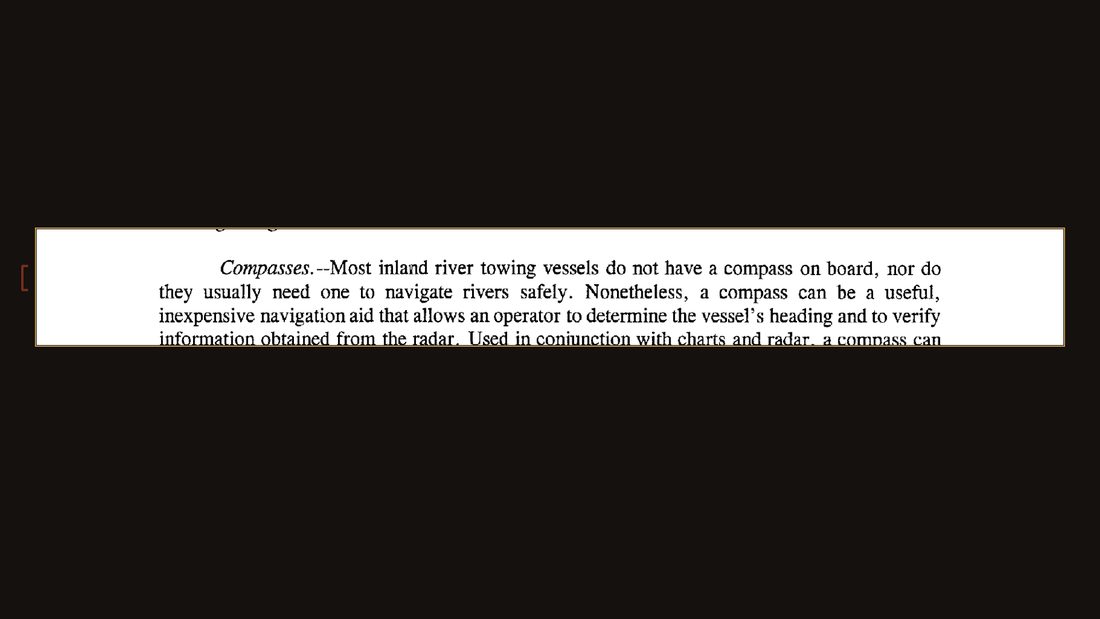
The second thing is a compass.
N138
NTSB/RAR-94/01 · Big Bayou Canot · adopted Sept. 19, 1994 · p. 37. View the original.
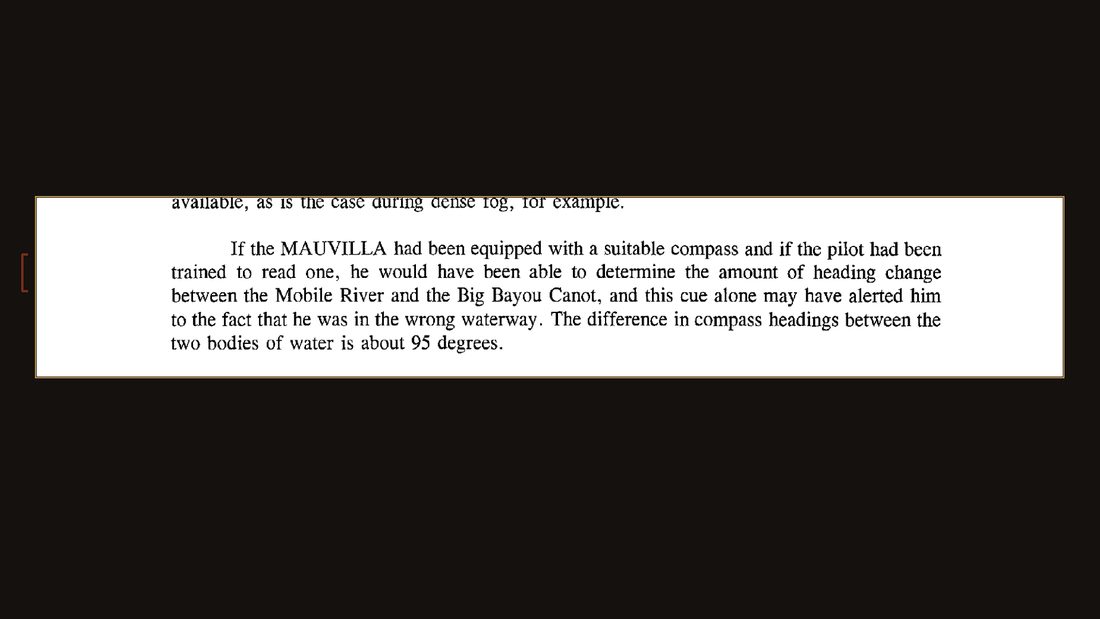
But you cannot look at it in fog. And the Safety Board did the one piece of arithmetic that nobody had done.
N139
NTSB/RAR-94/01 · Big Bayou Canot · adopted Sept. 19, 1994 · p. 37. View the original.
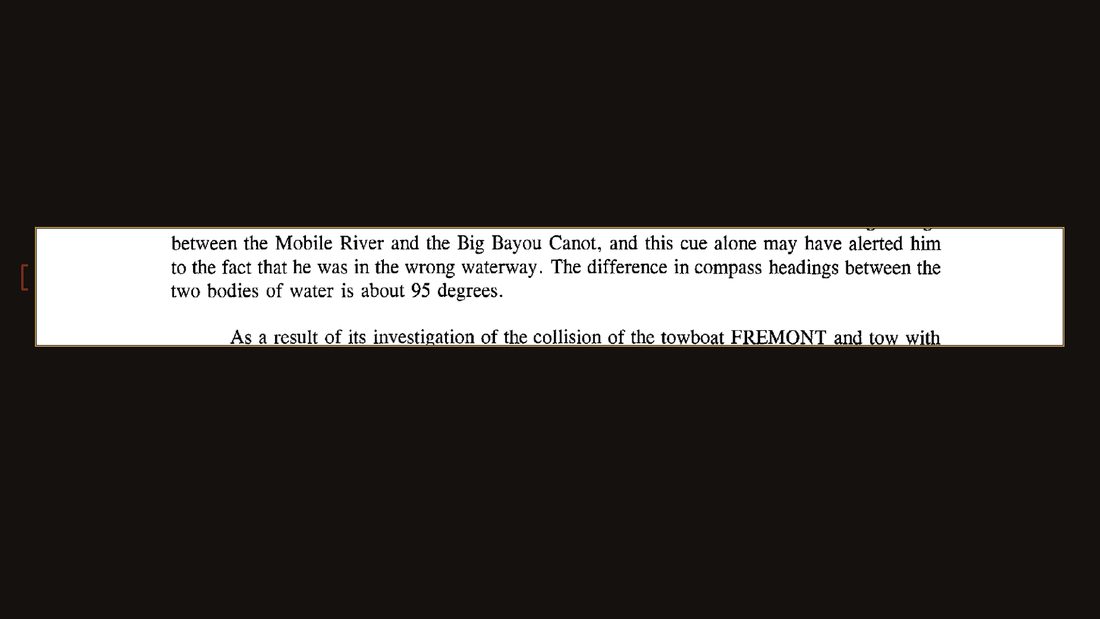
The difference in compass headings between the Mobile River and the Big Bayou Canot is about ninety-five degrees.
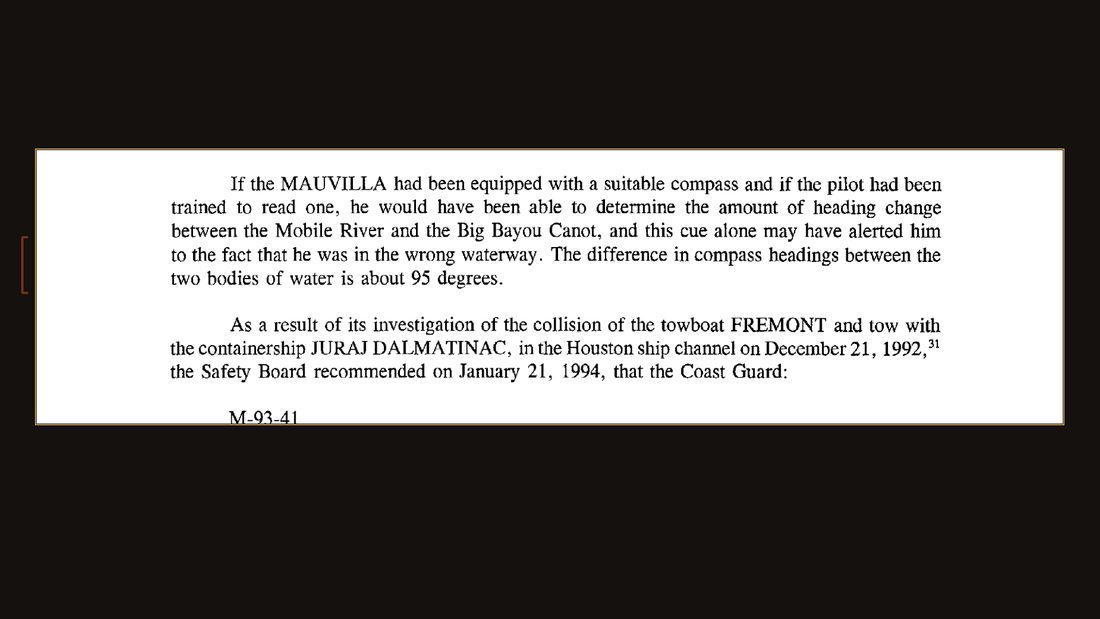
N140
NTSB/RAR-94/01 · Big Bayou Canot · adopted Sept. 19, 1994 · p. 37. View the original.
Ninety-five degrees. A quarter turn, near enough. On any compass on earth, that is not a subtle reading.
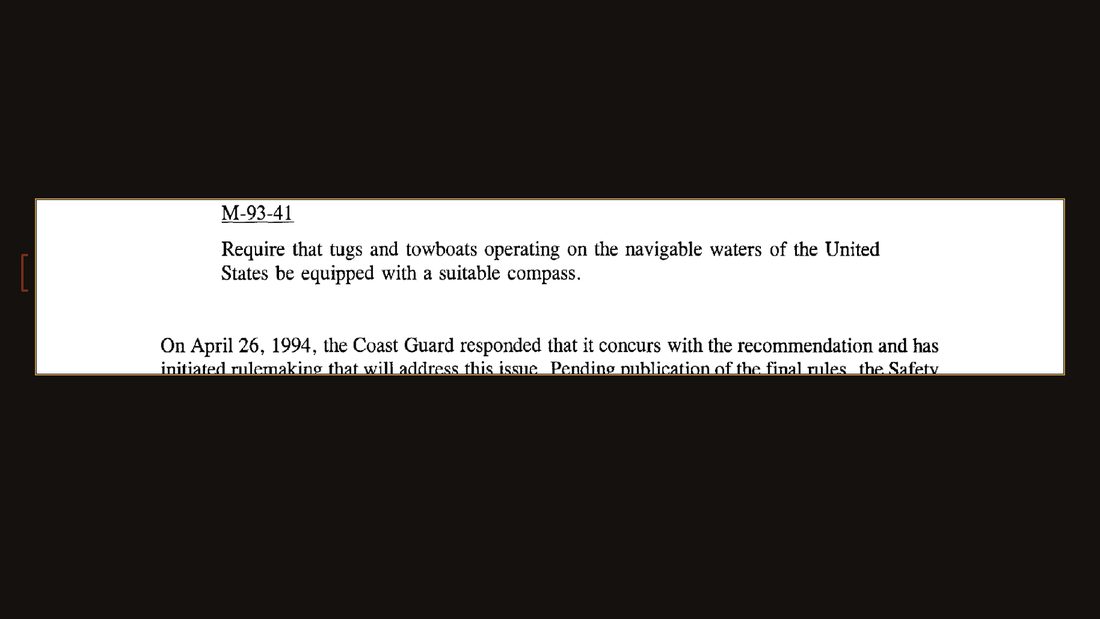
N141
NTSB/RAR-94/01 · Big Bayou Canot · adopted Sept. 19, 1994 · p. 37. View the original.
The Board had already asked the Coast Guard to require compasses on towboats. Nine months before this wreck. After a different accident.
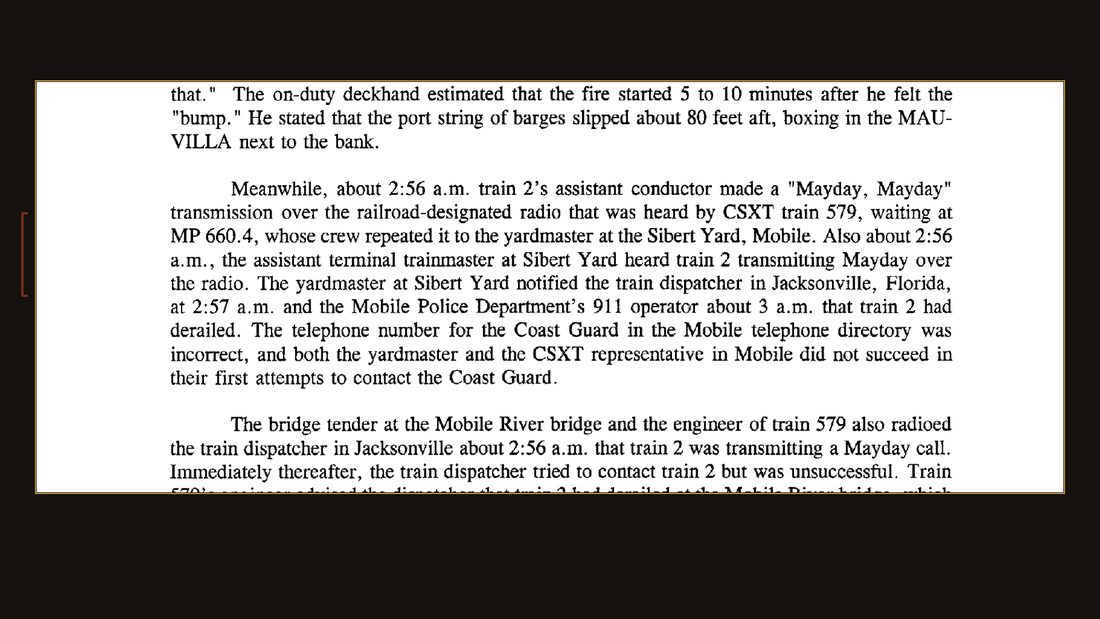
N143
NTSB/RAR-94/01 · Big Bayou Canot · adopted Sept. 19, 1994 · p. 8. View the original.
At two fifty-six, the assistant conductor put out a Mayday on the railroad radio.
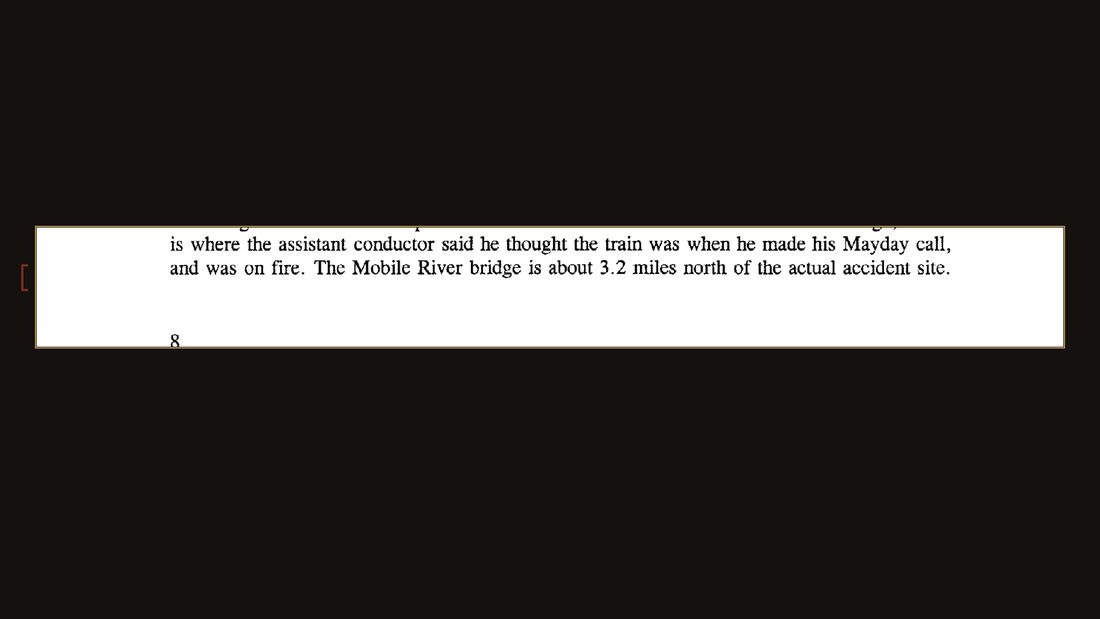
N144
NTSB/RAR-94/01 · Big Bayou Canot · adopted Sept. 19, 1994 · p. 8. View the original.
He said he thought he was at the Mobile River bridge. He was three point two miles from it.
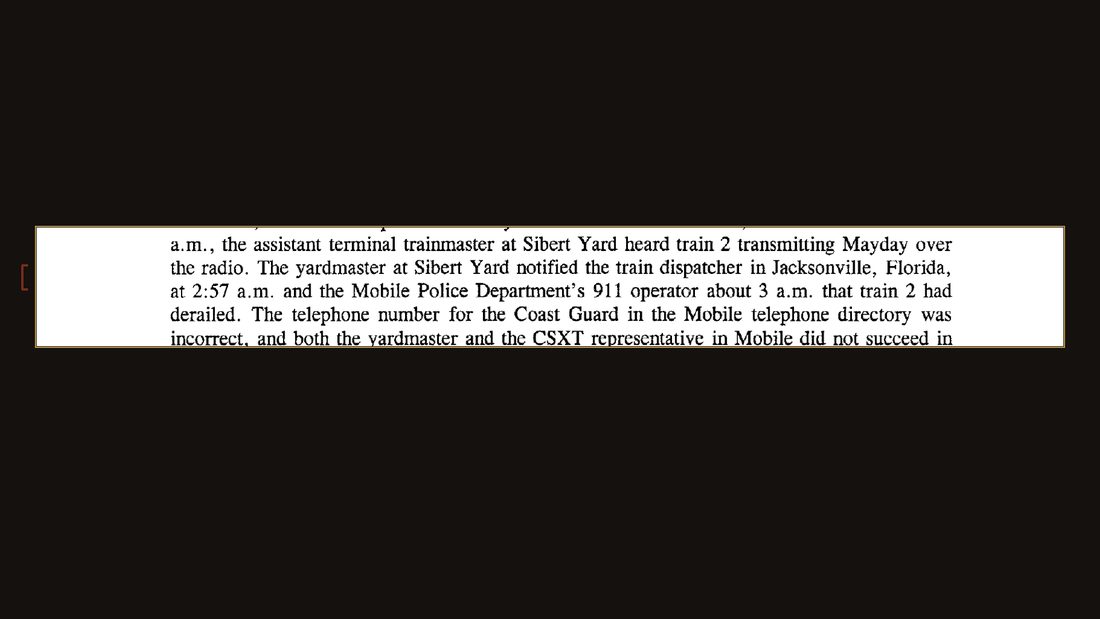
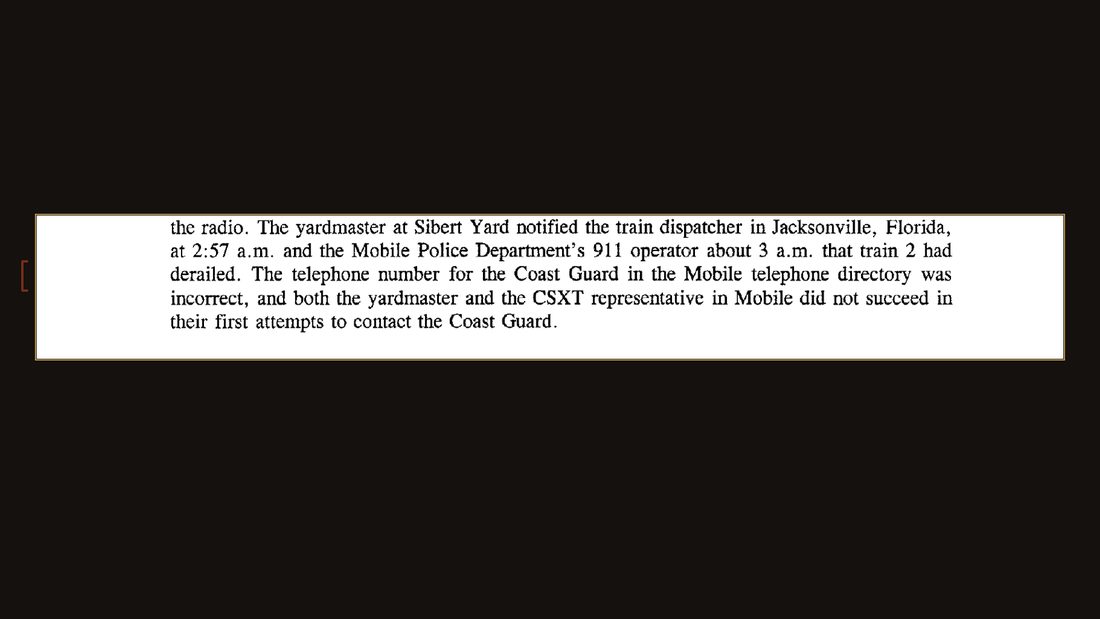
N145
NTSB/RAR-94/01 · Big Bayou Canot · adopted Sept. 19, 1994 · p. 8. View the original.
A yard in Mobile heard him and called the dispatcher in Jacksonville, Florida, at two fifty-seven.
N146
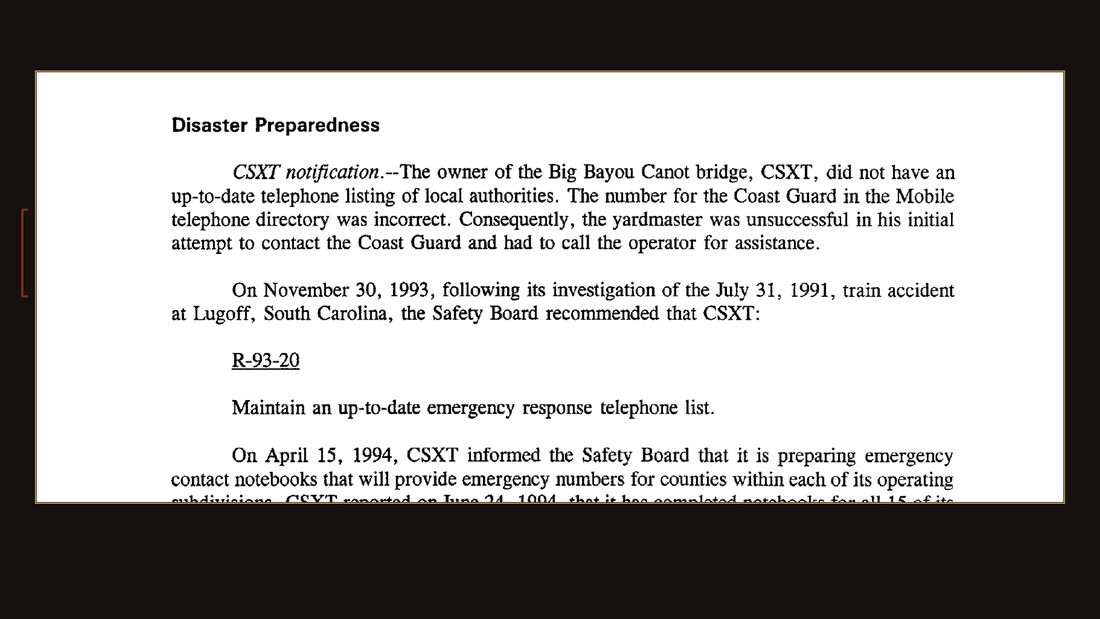
NTSB/RAR-94/01 · Big Bayou Canot · adopted Sept. 19, 1994 · p. 8. View the original.
Then somebody went to call the Coast Guard.
N147
NTSB/RAR-94/01 · Big Bayou Canot · adopted Sept. 19, 1994 · p. 56. View the original.
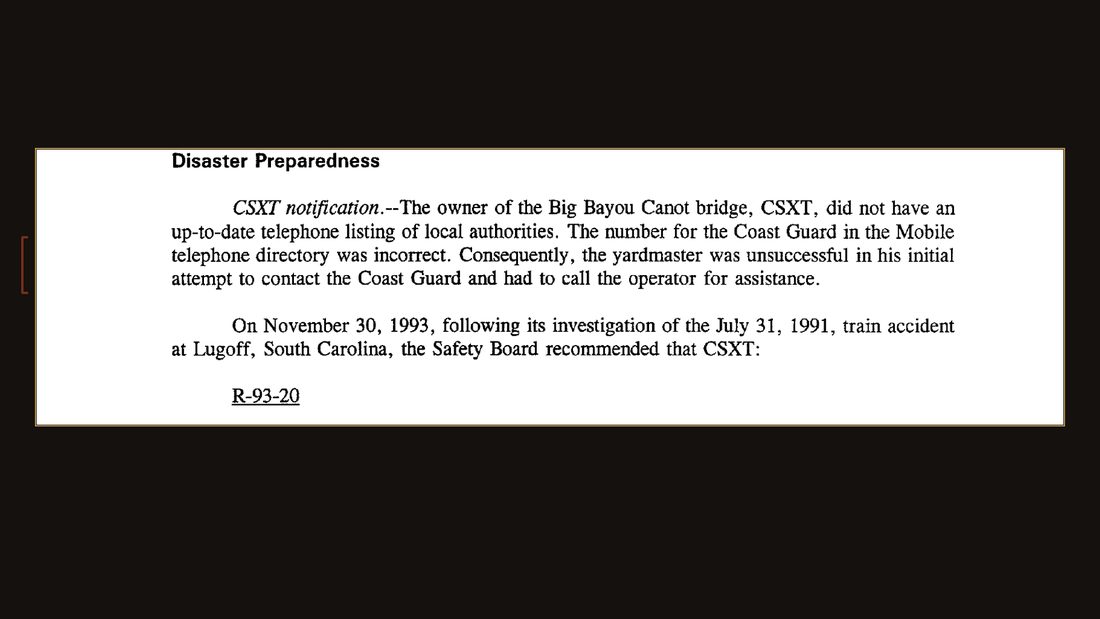
The telephone number for the Coast Guard in the Mobile telephone directory was incorrect.
N148
NTSB/RAR-94/01 · Big Bayou Canot · adopted Sept. 19, 1994 · p. 56. View the original.
Two separate people tried it. Both failed. Somebody had to go through the operator.
N149
NTSB/RAR-94/01 · Big Bayou Canot · adopted Sept. 19, 1994 · p. 51. View the original.
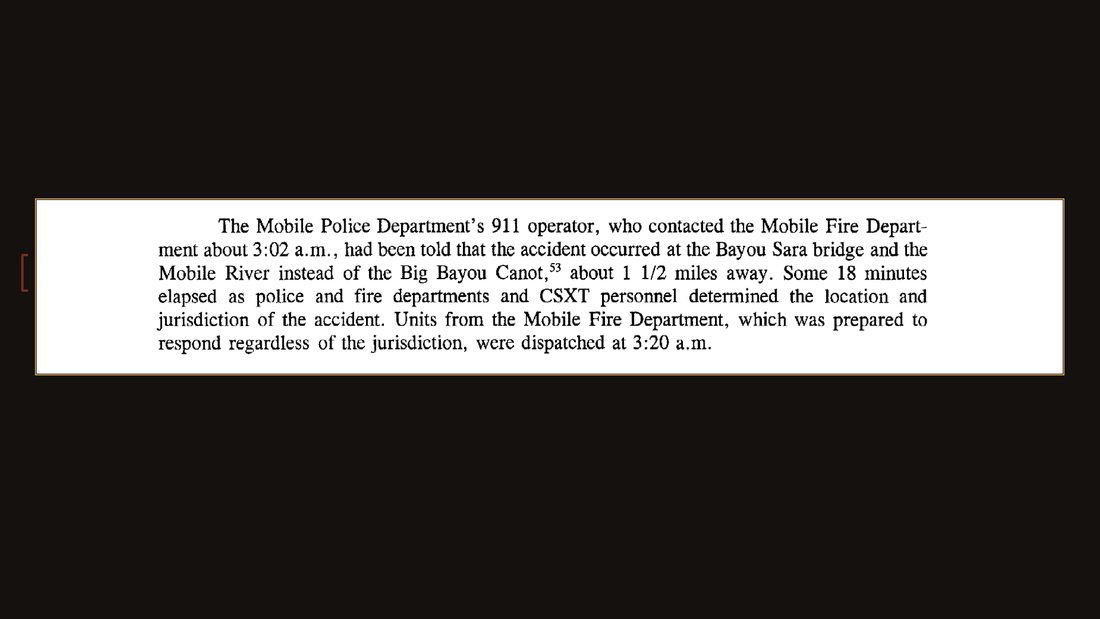
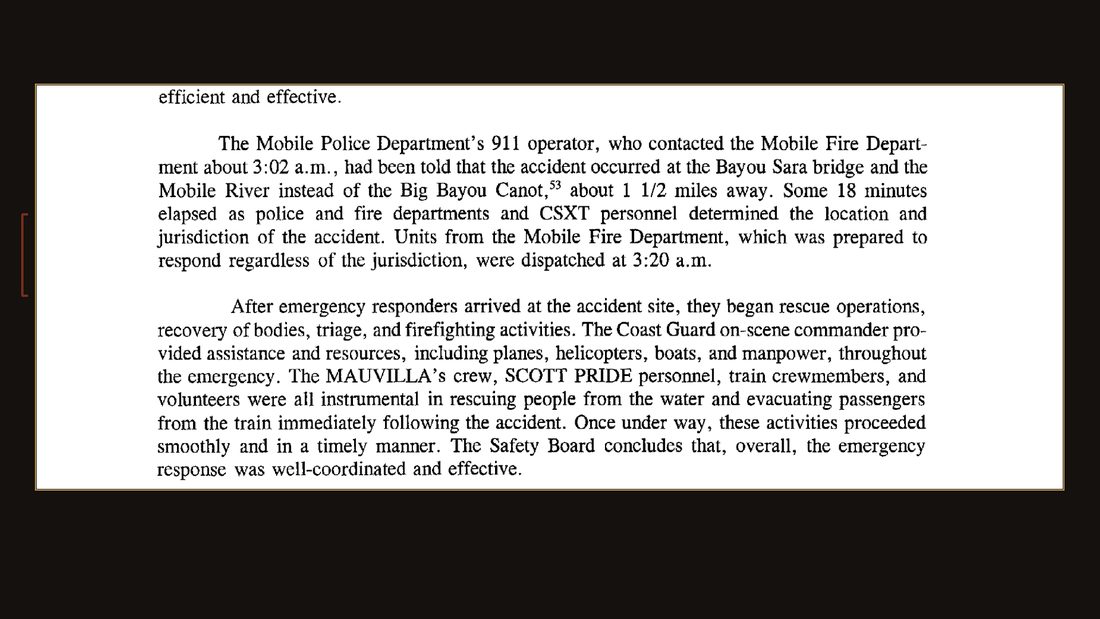
The nine one one operator was told the accident was at the wrong bridge.
N150
NTSB/RAR-94/01 · Big Bayou Canot · adopted Sept. 19, 1994 · p. 51. View the original.
Eighteen minutes went by while police, fire and the railroad worked out where it actually was and whose jurisdiction it was in.
N152
NTSB/RAR-94/01 · Big Bayou Canot · adopted Sept. 19, 1994 · p. 51. View the original.
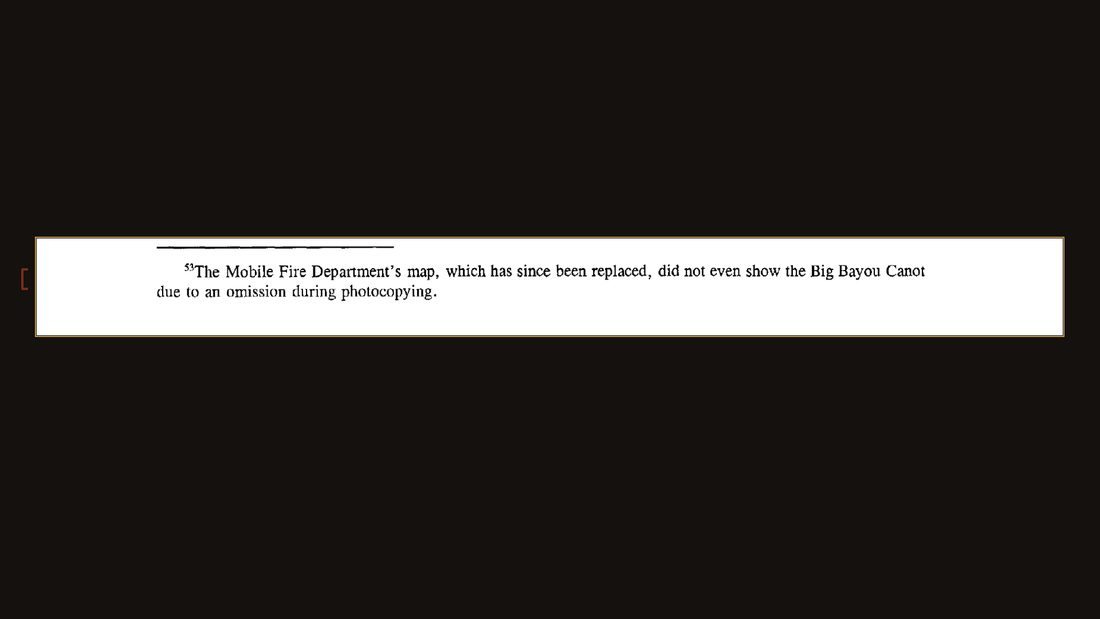
The Mobile Fire Department's map did not even show the Big Bayou Canot, due to an omission during photocopying.
N153
NTSB/RAR-94/01 · Big Bayou Canot · adopted Sept. 19, 1994 · p. 51. View the original.
The bayou existed. The copier had cut it off the edge of the page.
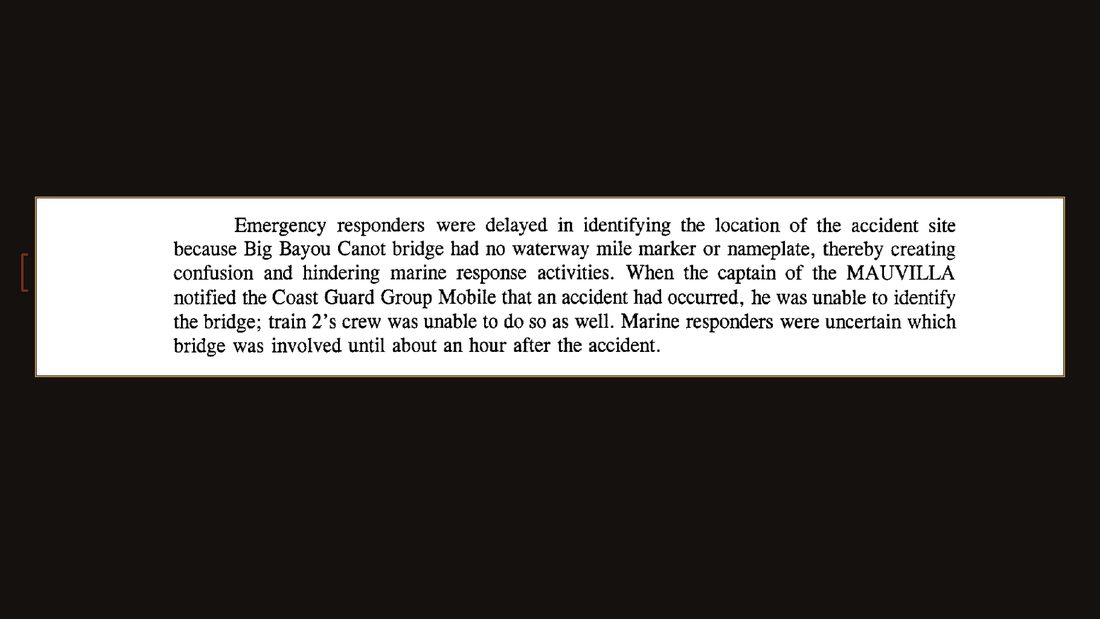
N154
NTSB/RAR-94/01 · Big Bayou Canot · adopted Sept. 19, 1994 · p. 58. View the original.
The bridge itself had no name plate and no mile marker on it. Boats searching for it went to the wrong bridge first.
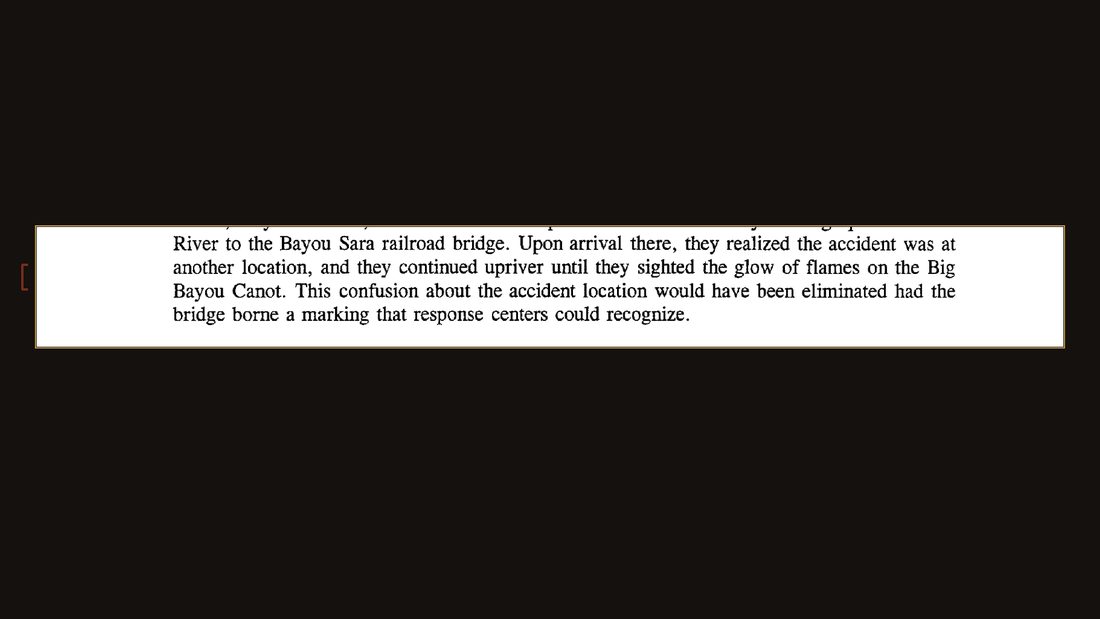
N155
NTSB/RAR-94/01 · Big Bayou Canot · adopted Sept. 19, 1994 · p. 58. View the original.
They found it by seeing the fire.
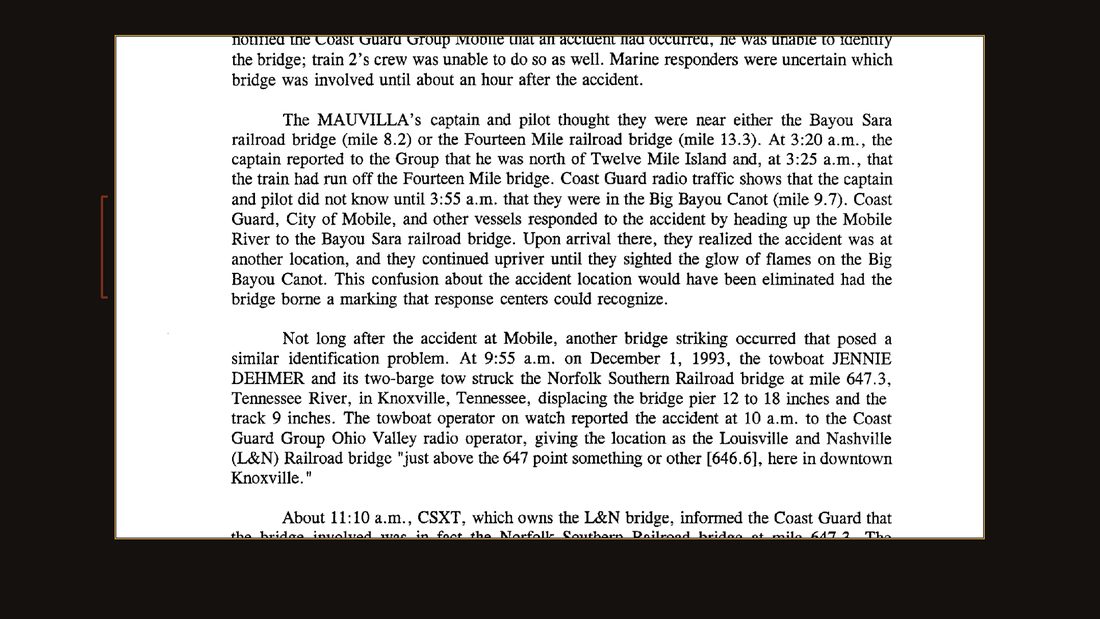
N156
NTSB/RAR-94/01 · Big Bayou Canot · adopted Sept. 19, 1994 · p. 58. View the original.
The men who hit it did not learn where they were until three fifty-five in the morning.
Forty-seven
N157
NTSB/RAR-94/01 · Big Bayou Canot · adopted Sept. 19, 1994 · p. 52. View the original.
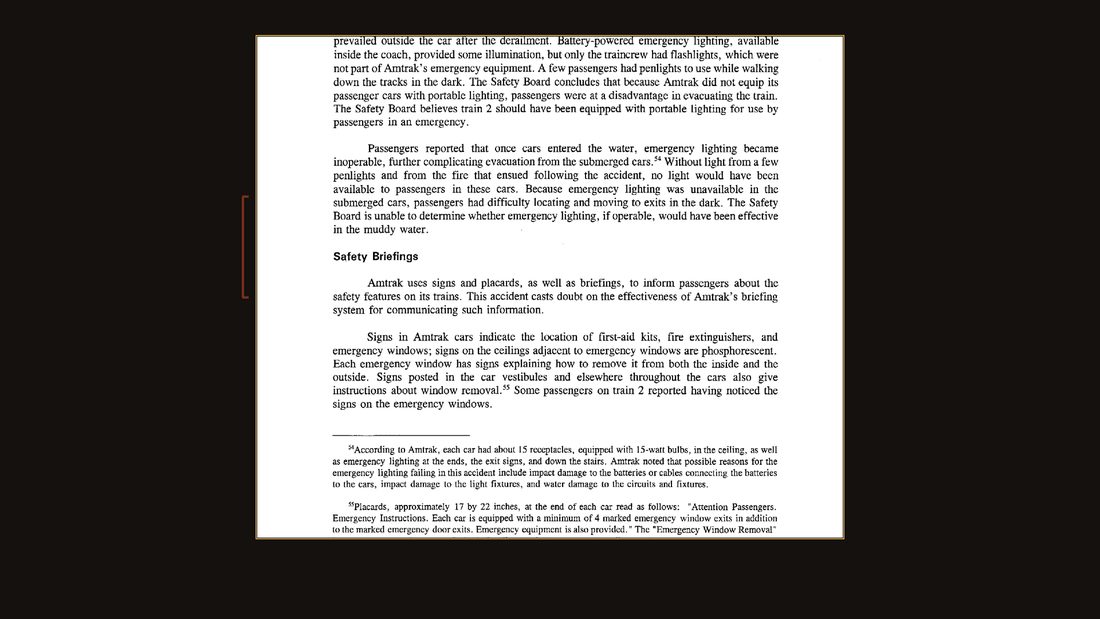
In the water, in the dark, people were getting out of two submerged double-decker cars.
N158
NTSB/RAR-94/01 · Big Bayou Canot · adopted Sept. 19, 1994 · p. 52. View the original.
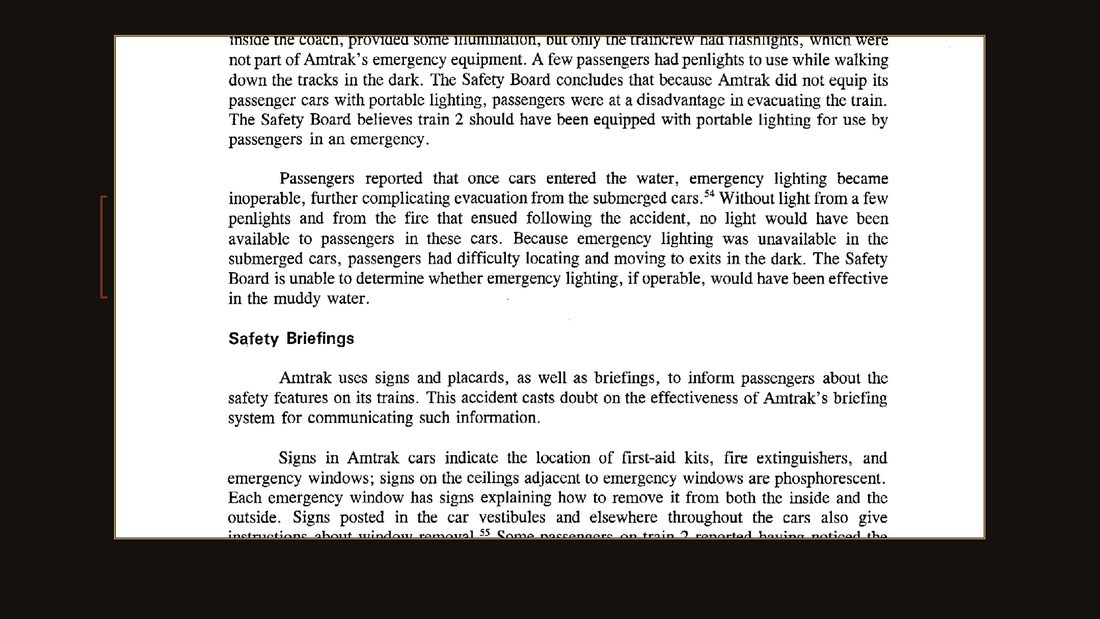
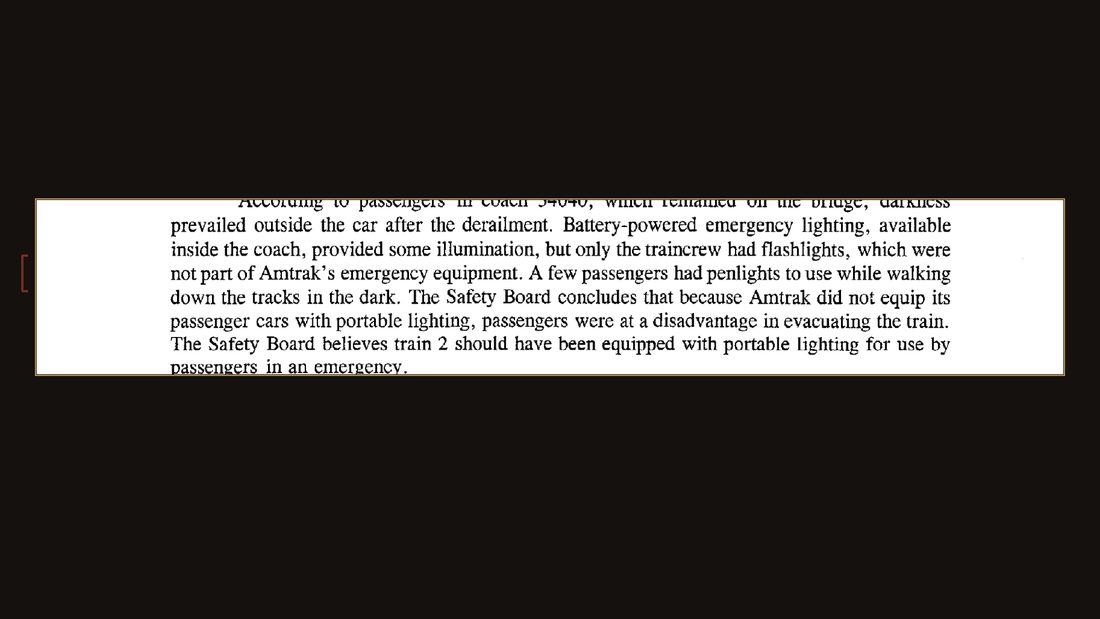
Once the cars went under, the emergency lighting stopped working.
N159
NTSB/RAR-94/01 · Big Bayou Canot · adopted Sept. 19, 1994 · p. 52. View the original.
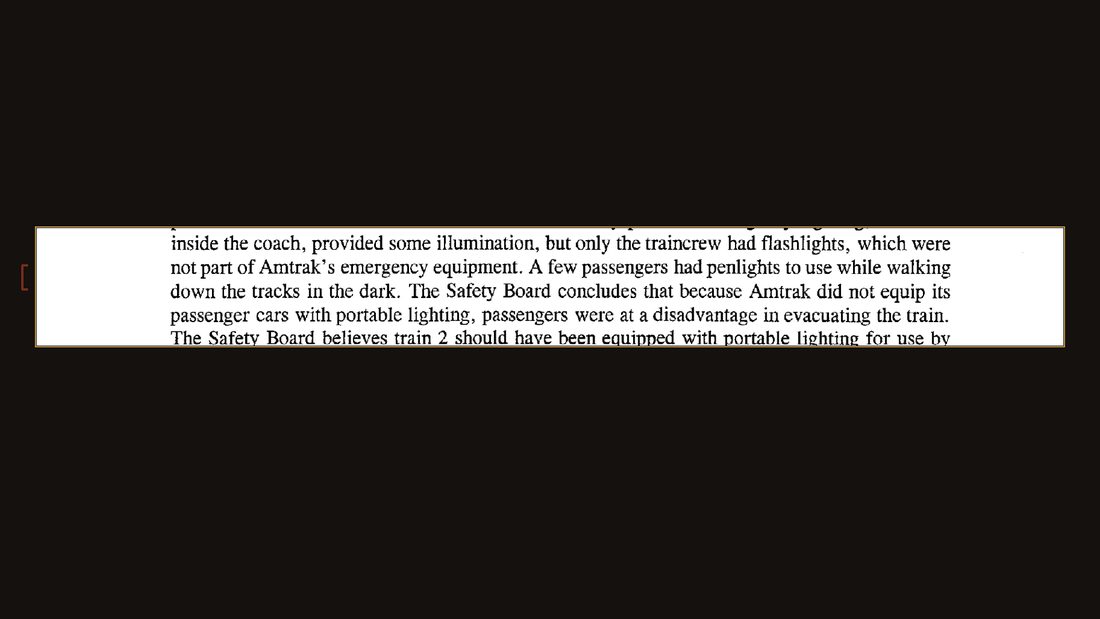
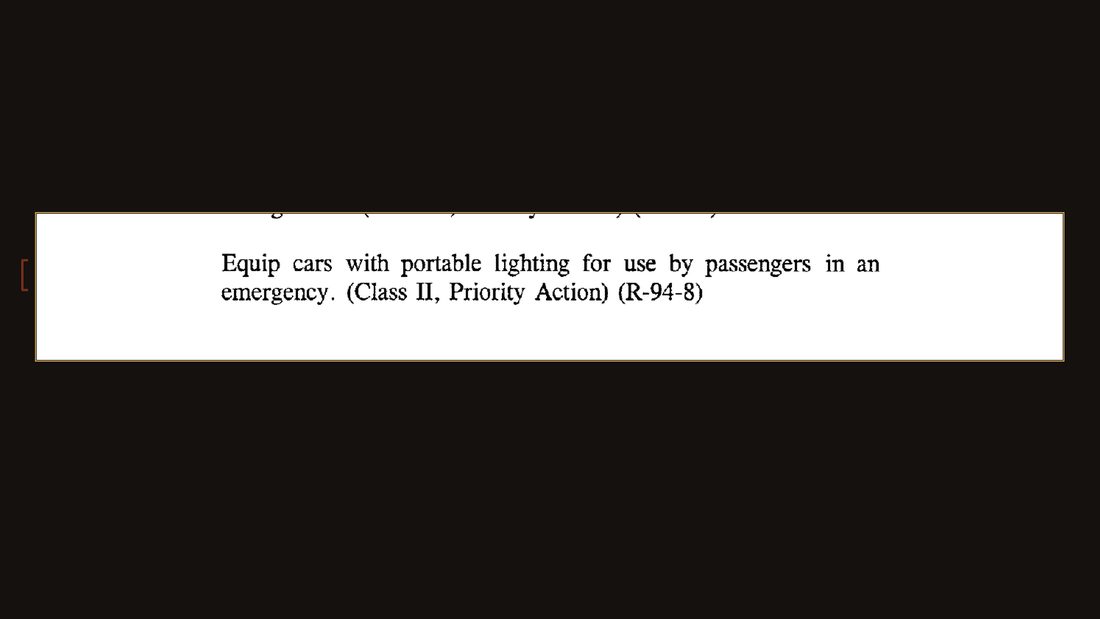
Only the train crew had flashlights, and flashlights were not part of Amtrak's emergency equipment.
N160
NTSB/RAR-94/01 · Big Bayou Canot · adopted Sept. 19, 1994 · p. 52. View the original.
A few passengers had penlights. That is what people used to find the exits.
N161
NTSB/RAR-94/01 · Big Bayou Canot · adopted Sept. 19, 1994 · p. 61. View the original.
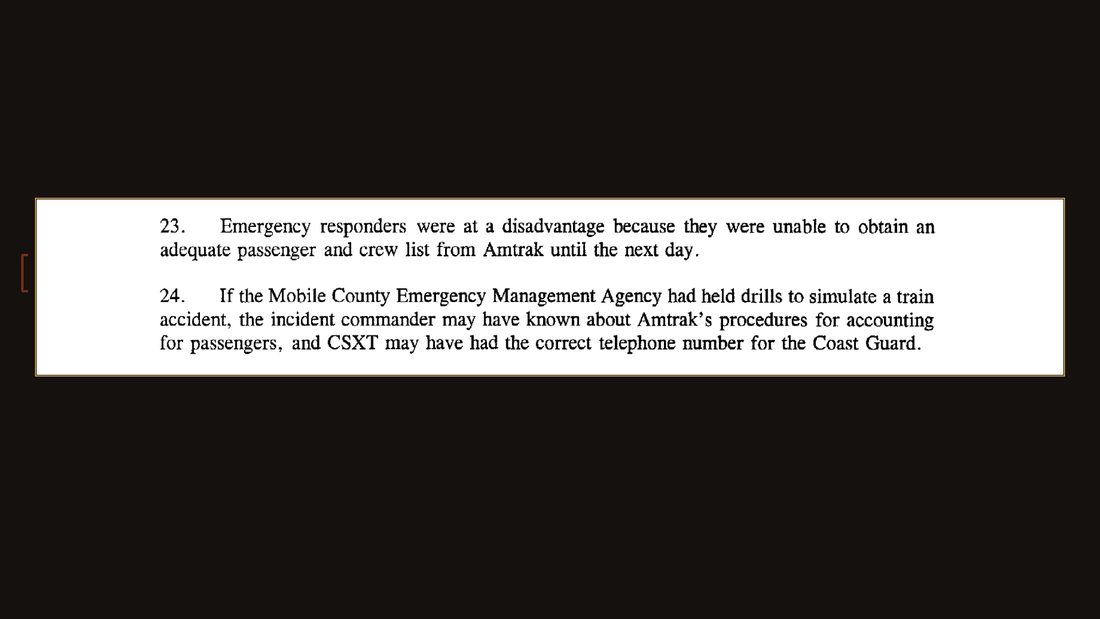
Emergency responders could not get an adequate list of who was on that train until the next day.
N162
NTSB/RAR-94/01 · Big Bayou Canot · adopted Sept. 19, 1994 · p. 56. View the original.
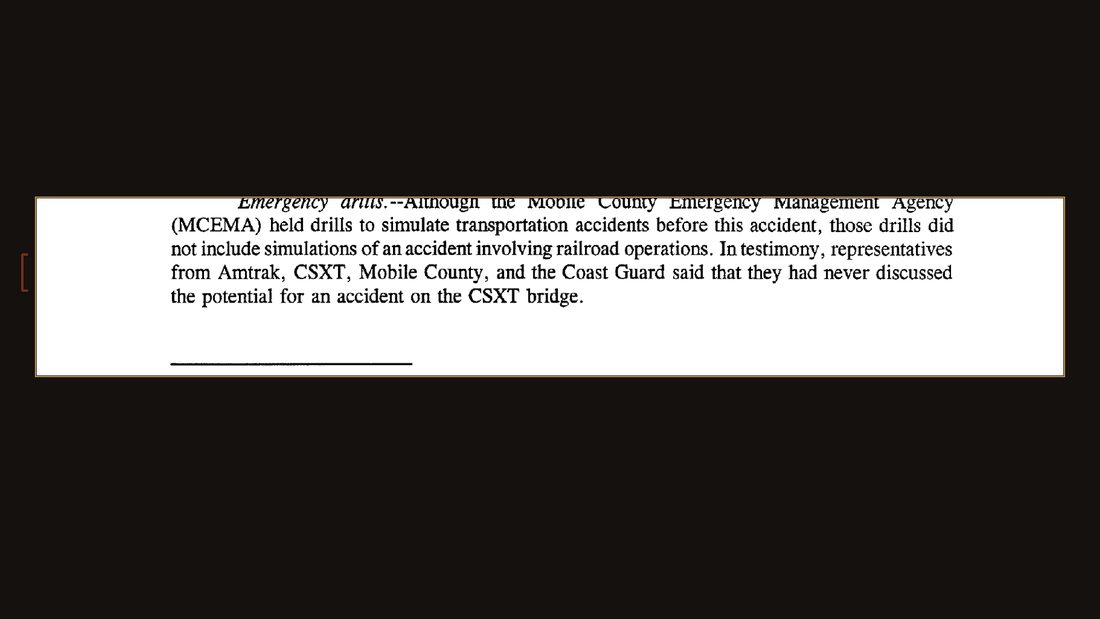
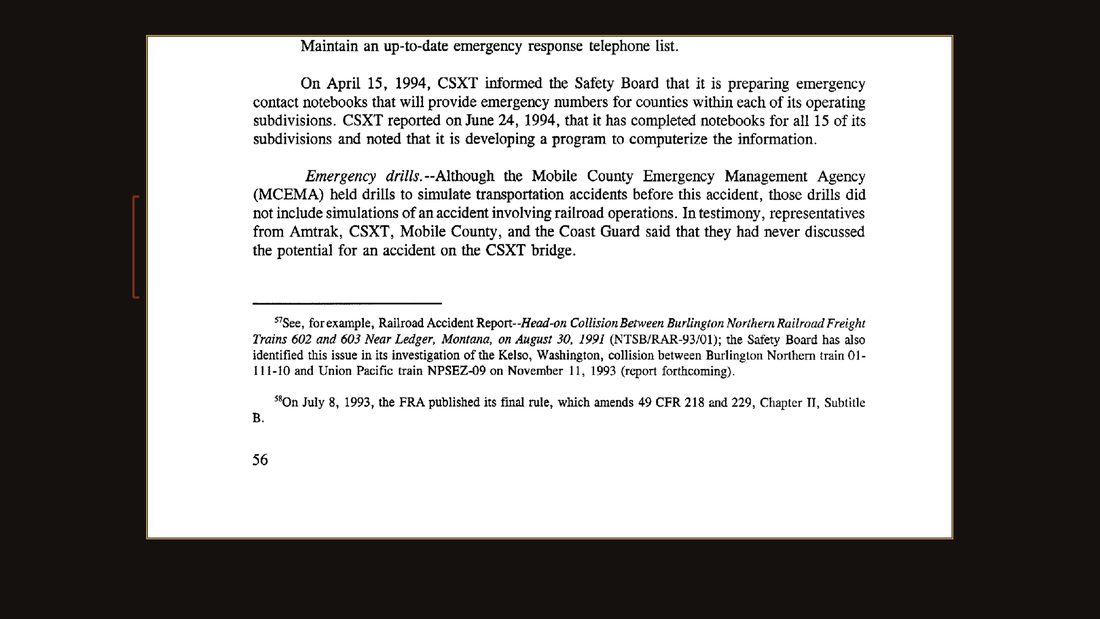
The county had run disaster drills. It had never run one for a railroad accident.
N163
NTSB/RAR-94/01 · Big Bayou Canot · adopted Sept. 19, 1994 · p. 56. View the original.
Representatives of Amtrak, CSX, the county and the Coast Guard testified that they had never discussed the possibility of an accident on that bridge.
N165
NTSB/RAR-94/01 · Big Bayou Canot · adopted Sept. 19, 1994 · p. 60. View the original.
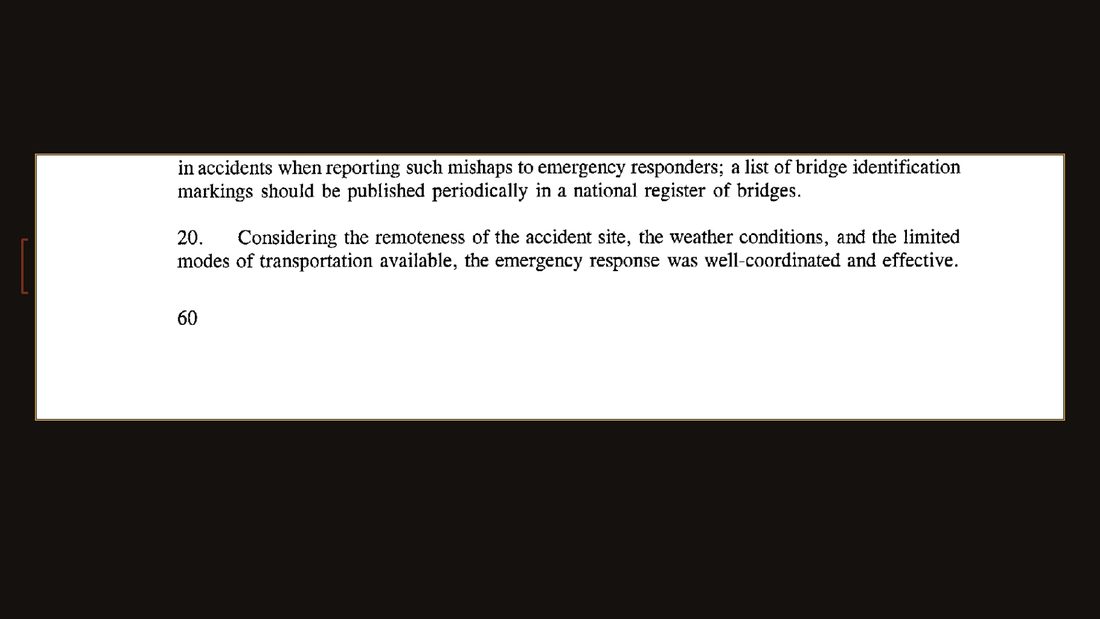
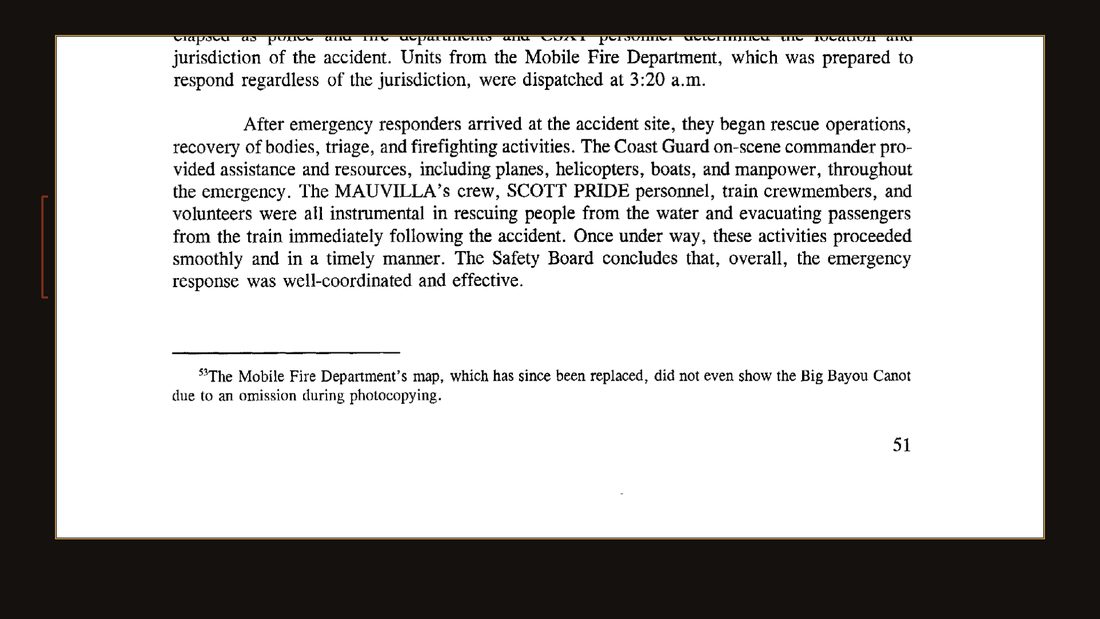
Given the remoteness, the fog and the limited ways in, the response was well coordinated and effective.
N166
NTSB/RAR-94/01 · Big Bayou Canot · adopted Sept. 19, 1994 · p. 51. View the original.
Towboat crew, a passing vessel's crew, train crew and volunteers pulled people out of that water.
The failures in this story are not failures of the people who showed up.
Twenty-nine recommendations
N167
NTSB/RAR-94/01 · Big Bayou Canot · adopted Sept. 19, 1994 · p. 66. View the original.
On the nineteenth of September, nineteen ninety-four, the Safety Board adopted its report.
N168
NTSB/RAR-94/01 · Big Bayou Canot · adopted Sept. 19, 1994 · p. 61. View the original.
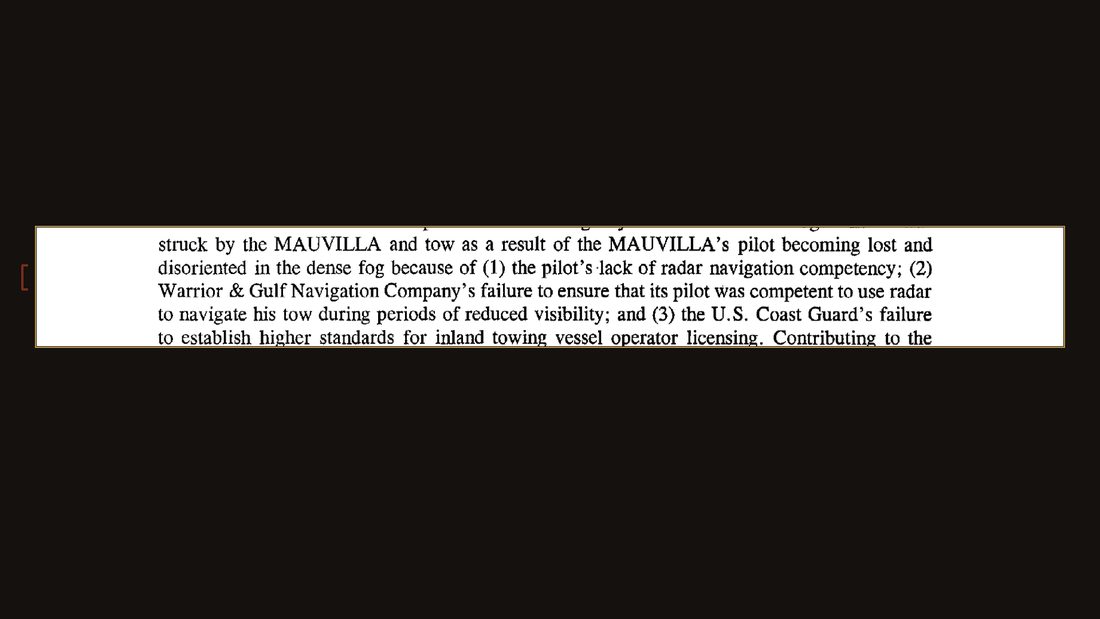
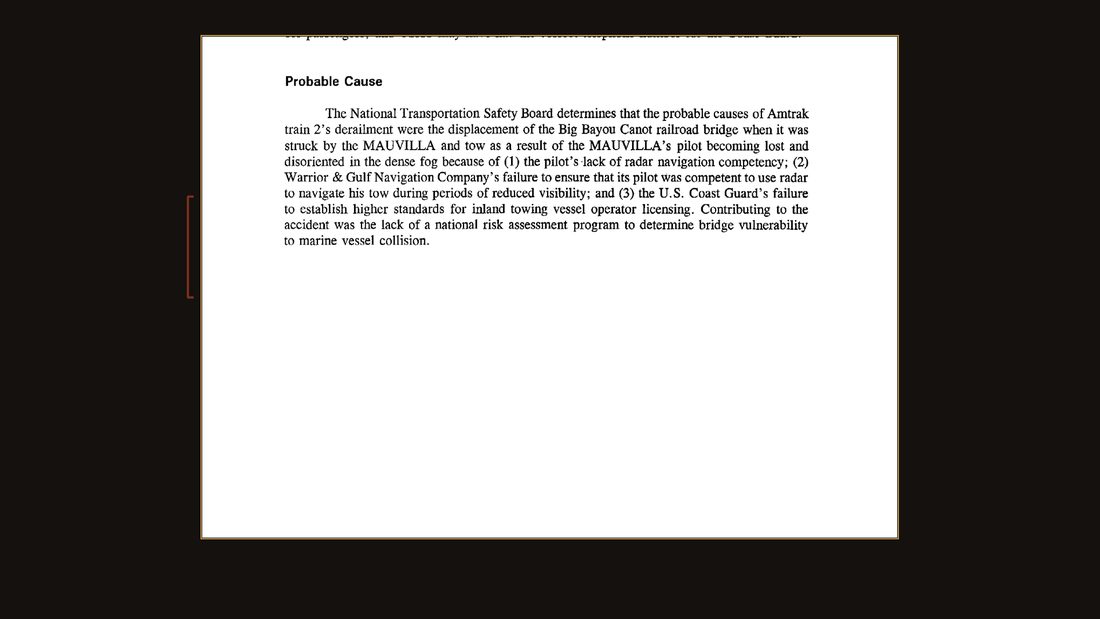
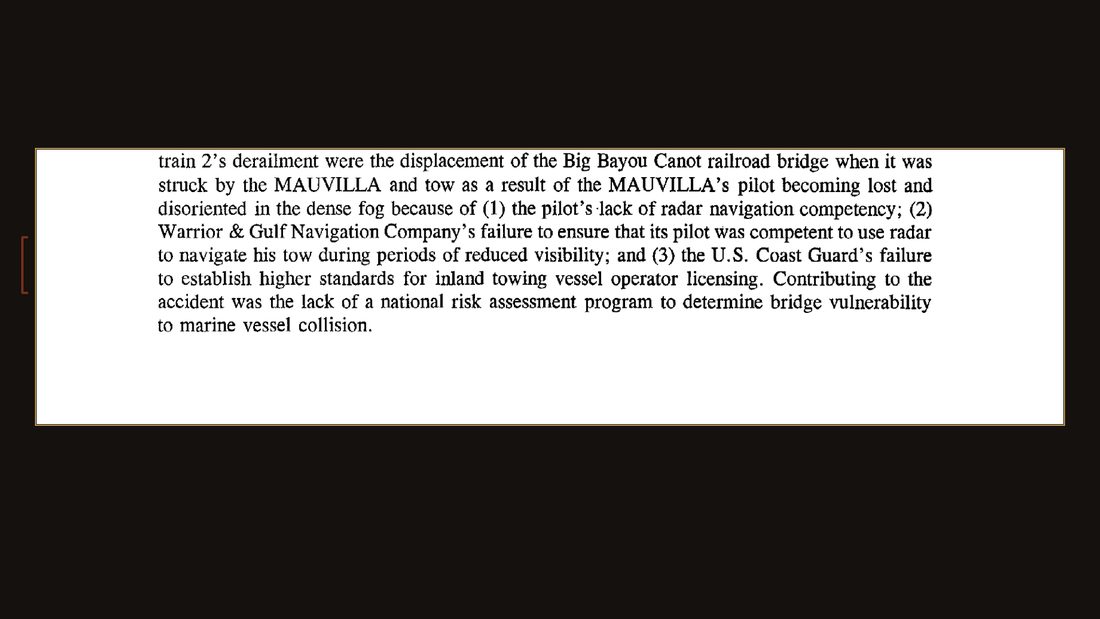
The probable cause names the pilot's lack of radar competency, and his company's failure to make sure he had it.
N169
NTSB/RAR-94/01 · Big Bayou Canot · adopted Sept. 19, 1994 · p. 61. View the original.
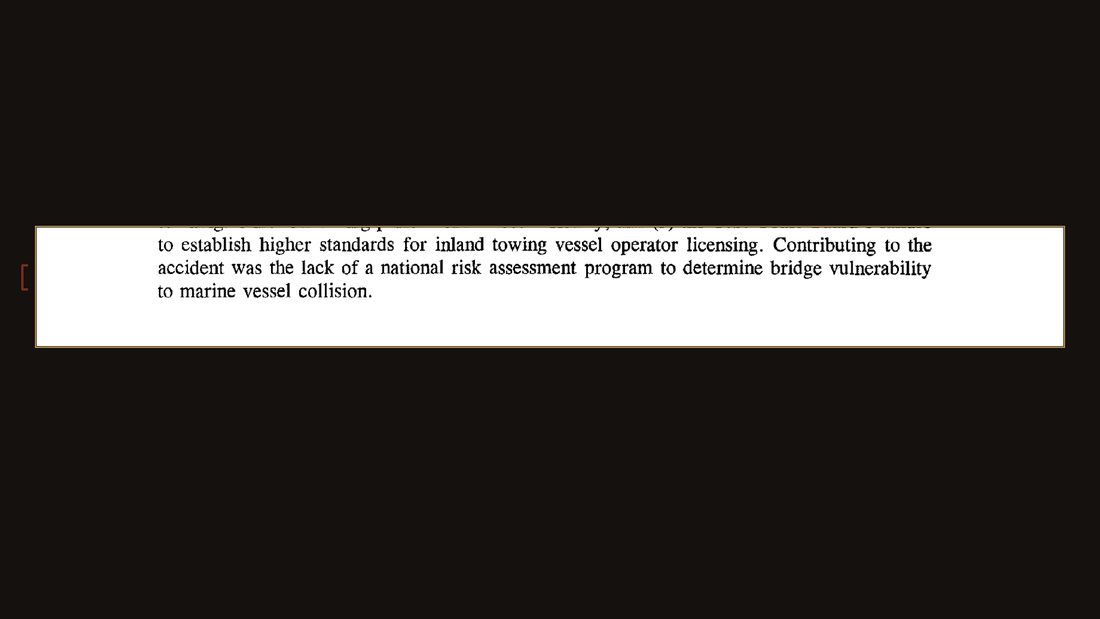
And third, the U.S. Coast Guard's failure to establish higher standards for inland towing vessel operator licensing.
N170
NTSB/RAR-94/01 · Big Bayou Canot · adopted Sept. 19, 1994 · p. 61. View the original.
A federal agency named as a cause of forty-seven deaths, in a document that agency's own department published.
N171
NTSB/RAR-94/01 · Big Bayou Canot · adopted Sept. 19, 1994 · p. 61. View the original.
Contributing: the lack of a national program to assess whether bridges can survive being hit by boats.
N172
NTSB/RAR-94/01 · Big Bayou Canot · adopted Sept. 19, 1994 · p. 62. View the original.
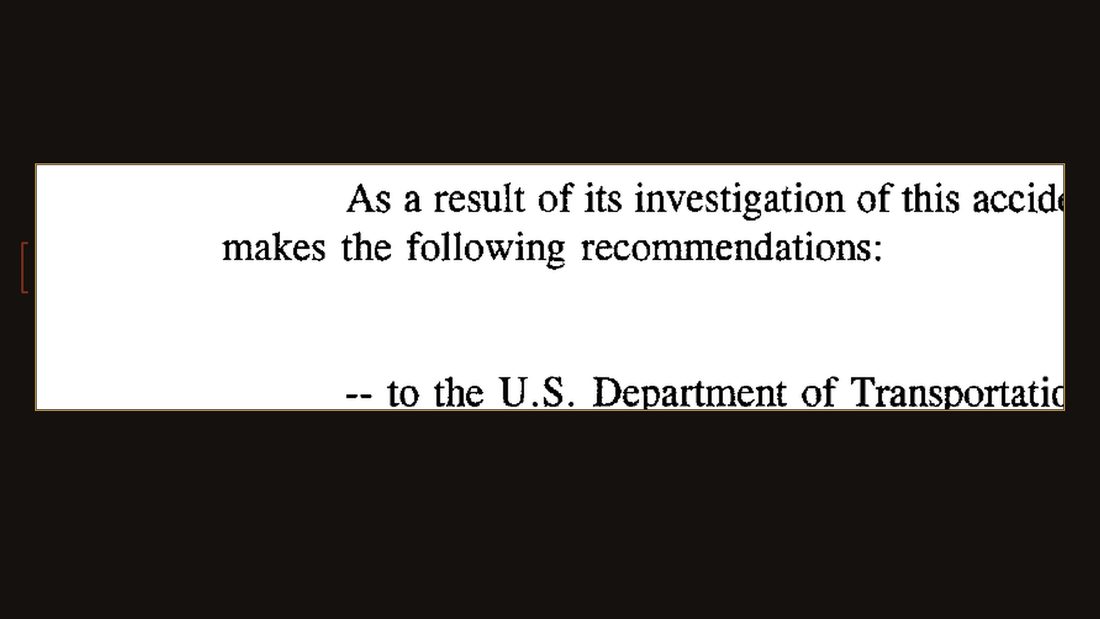
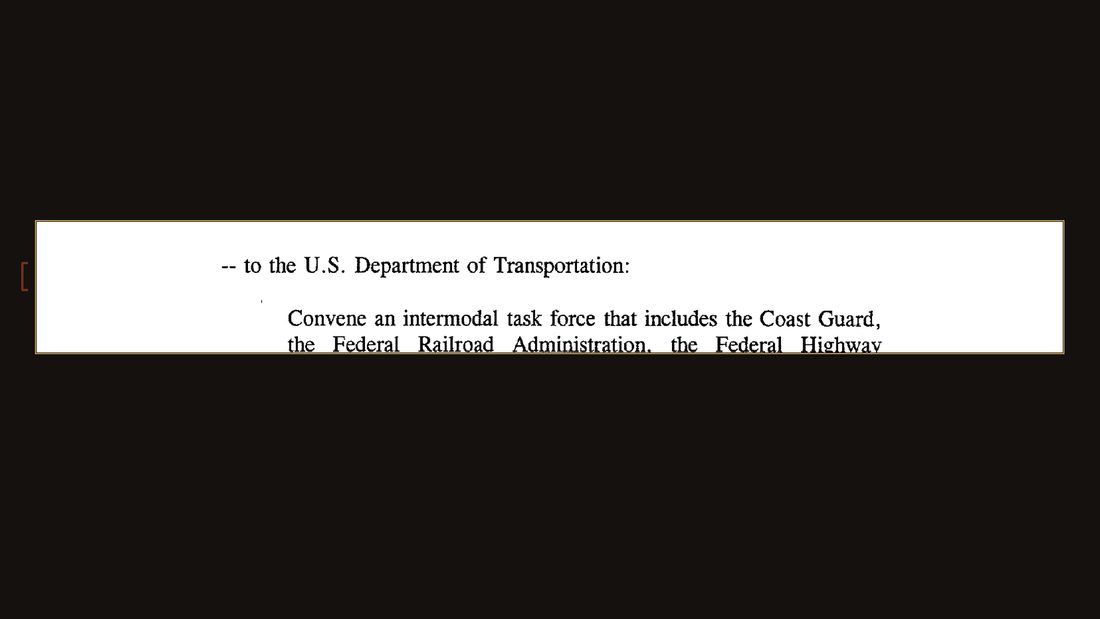
Then twenty-nine recommendations, to nine different recipients.
N173
NTSB/RAR-94/01 · Big Bayou Canot · adopted Sept. 19, 1994 · p. 63. View the original.
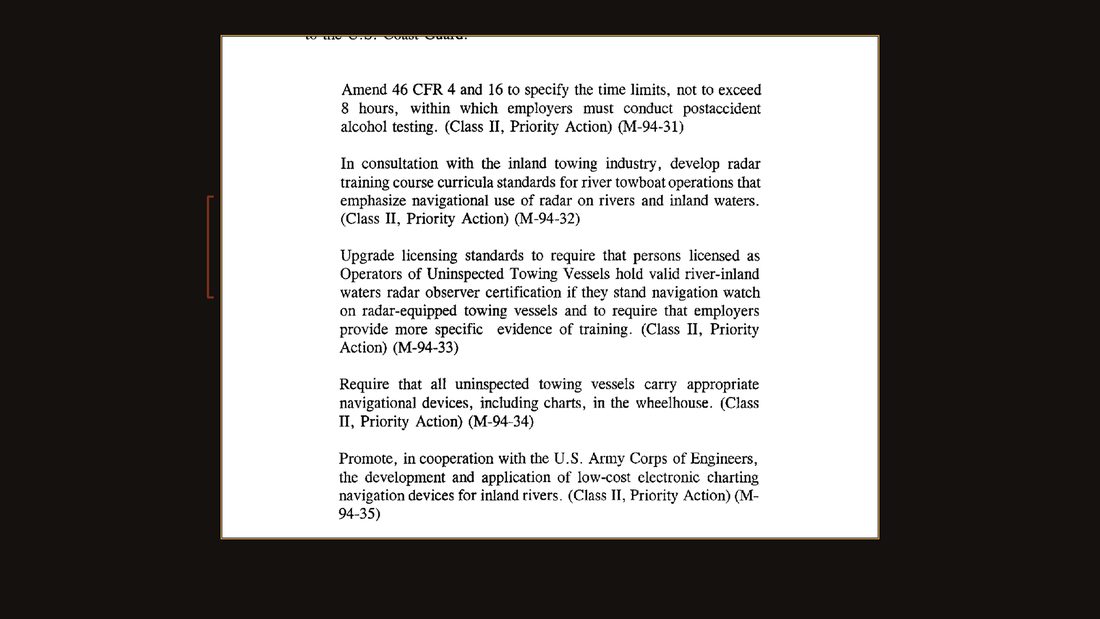
Radar training. Radar aboard. Charts aboard. Compasses. Alcohol testing time limits. Bridge markings. A national bridge register.
N175
NTSB/RAR-94/01 · Big Bayou Canot · adopted Sept. 19, 1994 · p. 64. View the original.
Every one of them addresses something real in this record.
N176
NTSB/RAR-94/01 · Big Bayou Canot · adopted Sept. 19, 1994 · p. 62. View the original.
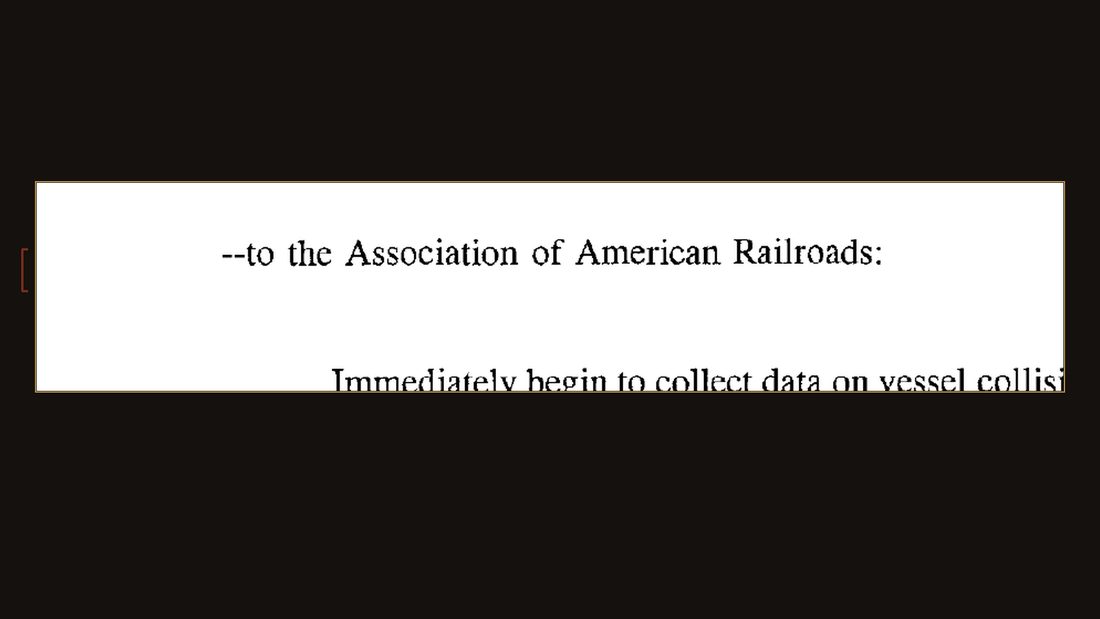
Read all twenty-nine, to all nine recipients, and count how many concern a way to detect that a bridge has moved.
N177
NTSB/RAR-94/01 · Big Bayou Canot · adopted Sept. 19, 1994 · p. 65. View the original.
None of them.
N178
NTSB/RAR-94/01 · Big Bayou Canot · adopted Sept. 19, 1994 · p. 42. View the original.
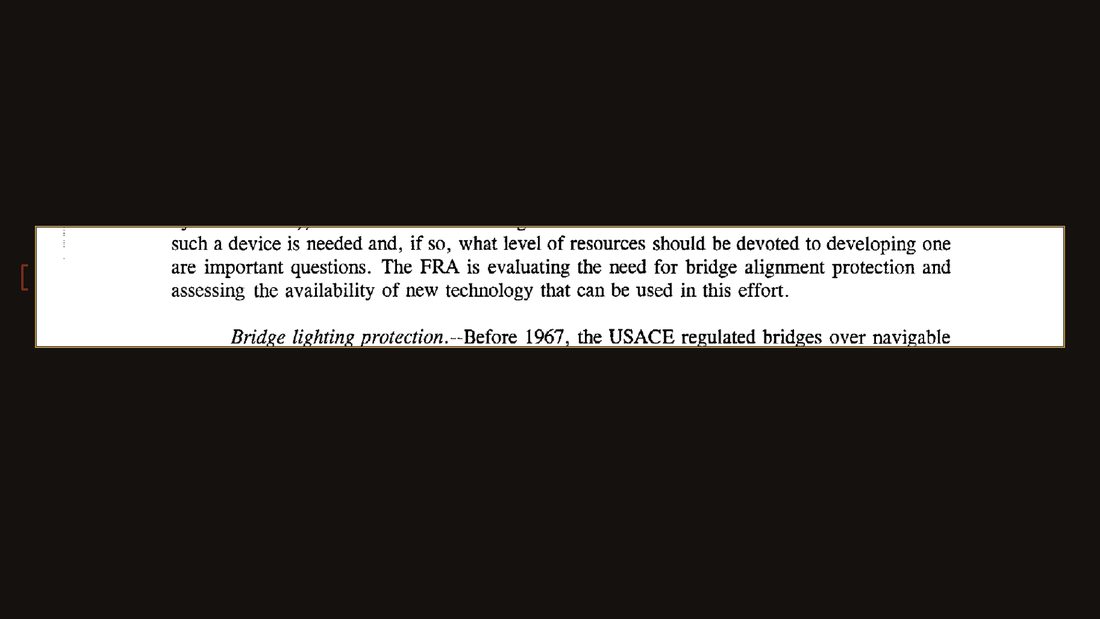
The Board spent two pages on that question, laid out the whole history, and issued nothing.
N179
NTSB/RAR-94/01 · Big Bayou Canot · adopted Sept. 19, 1994 · p. 42. View the original.
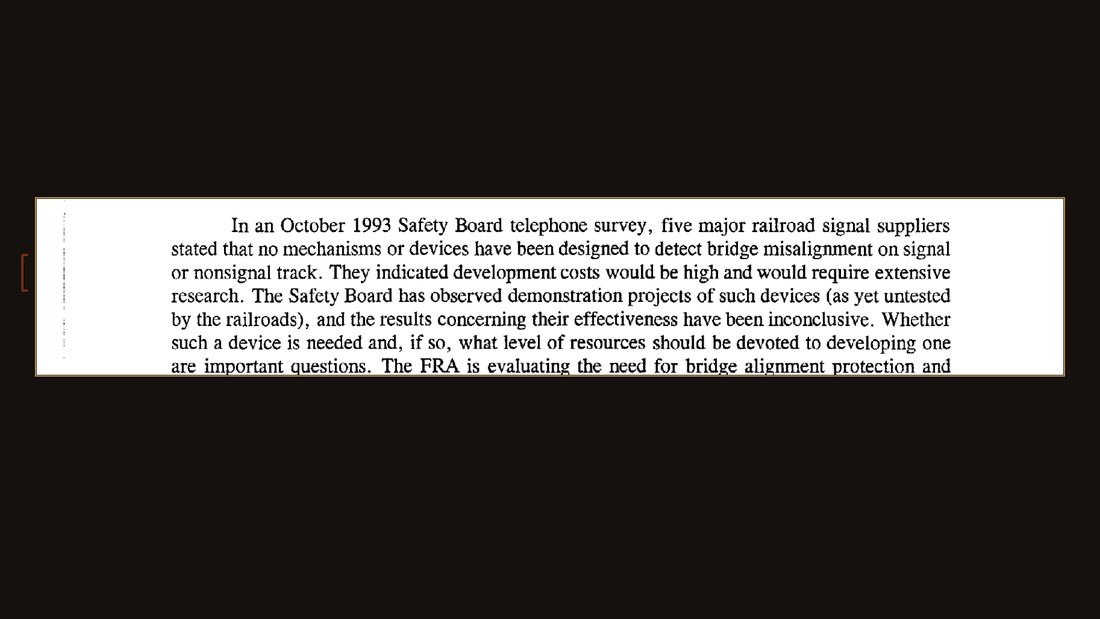
It closed the section by noting that the FRA is evaluating the need for bridge alignment protection.
N180
NTSB/RAR-94/01 · Big Bayou Canot · adopted Sept. 19, 1994 · p. 42. View the original.
Five railroad signal suppliers had told the Board's investigators, by telephone, that no such device had been designed.
Knoxville
N181
NTSB/RAR-94/01 · Big Bayou Canot · adopted Sept. 19, 1994 · p. 58. View the original.
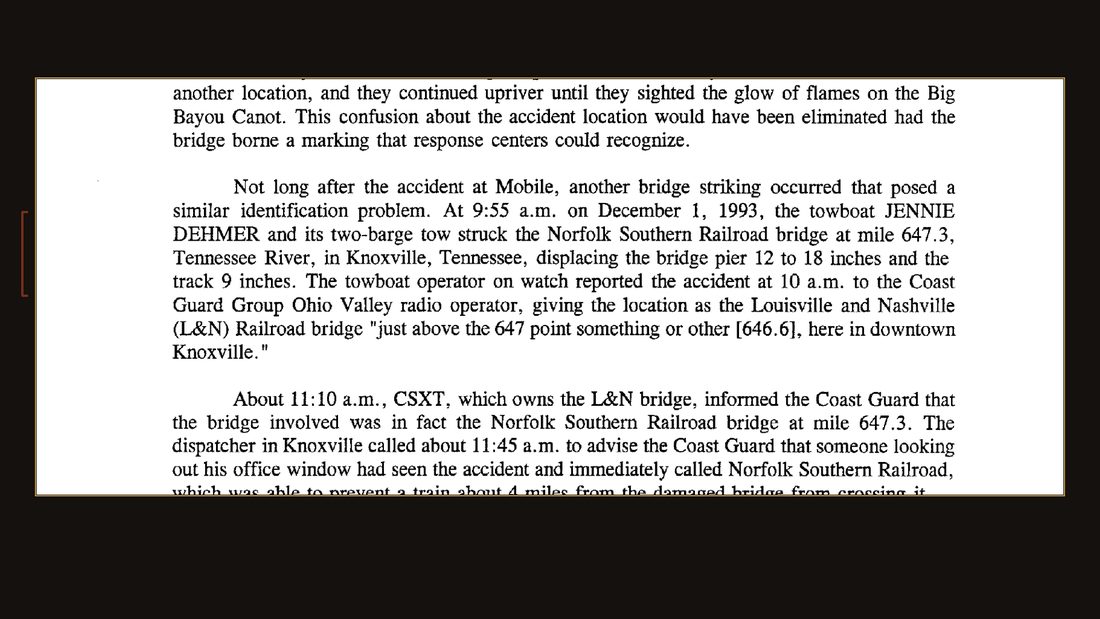
Ten weeks after Mobile, the same thing happened in Tennessee.
N182
NTSB/RAR-94/01 · Big Bayou Canot · adopted Sept. 19, 1994 · p. 58. View the original.
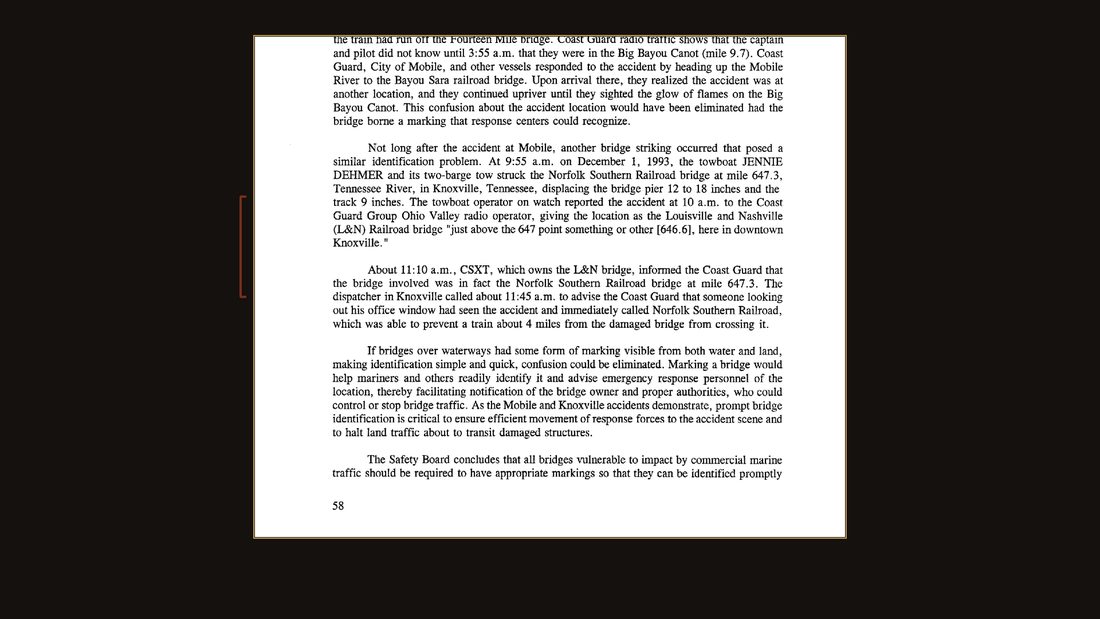
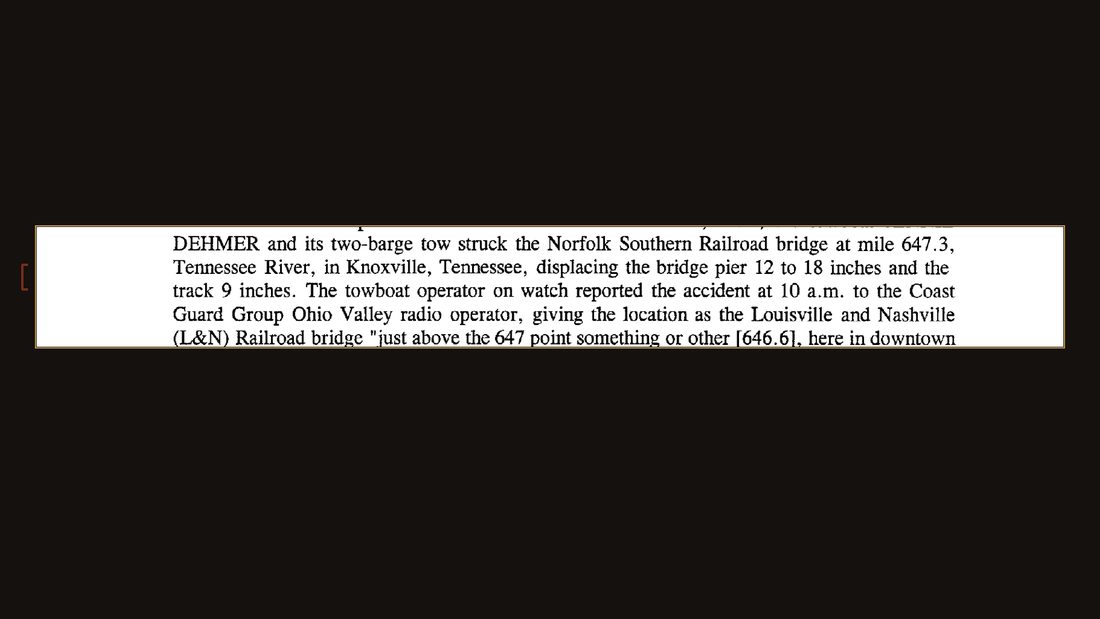
The first of December, nineteen ninety-three. A towboat and two barges struck a Norfolk Southern bridge in downtown Knoxville.
N183
NTSB/RAR-94/01 · Big Bayou Canot · adopted Sept. 19, 1994 · p. 58. View the original.
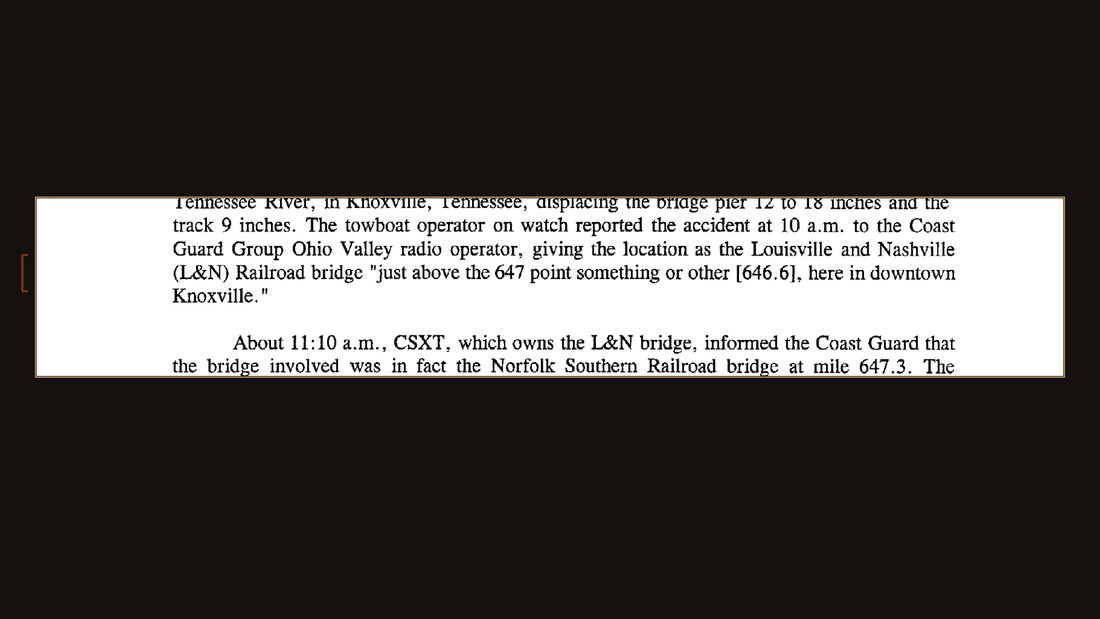
The pier moved twelve to eighteen inches. The track moved nine.
N184
NTSB/RAR-94/01 · Big Bayou Canot · adopted Sept. 19, 1994 · p. 58. View the original.
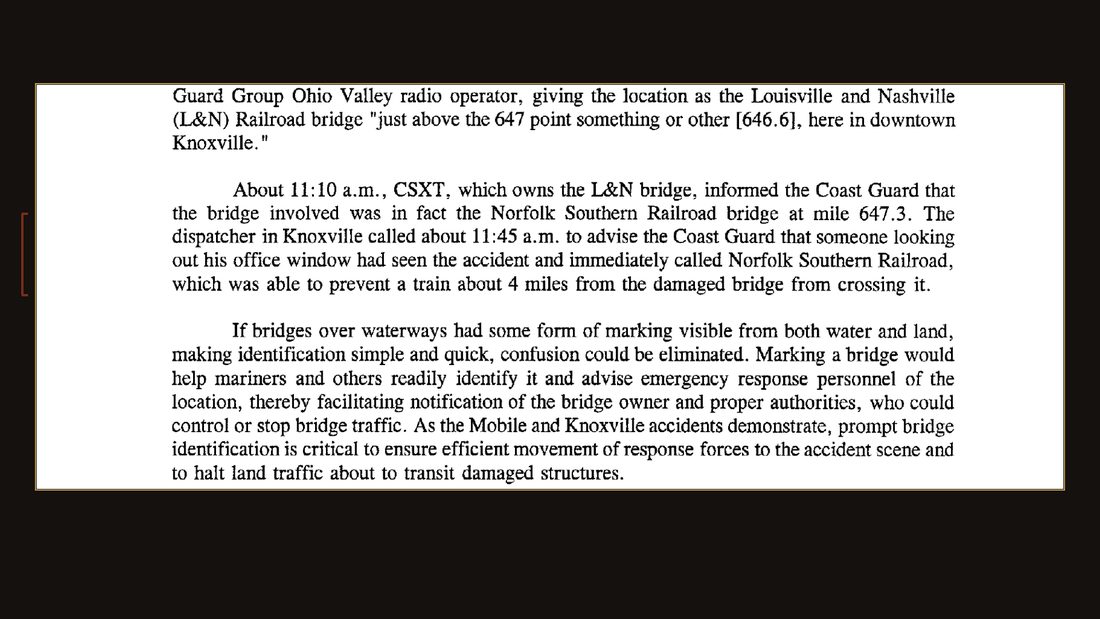
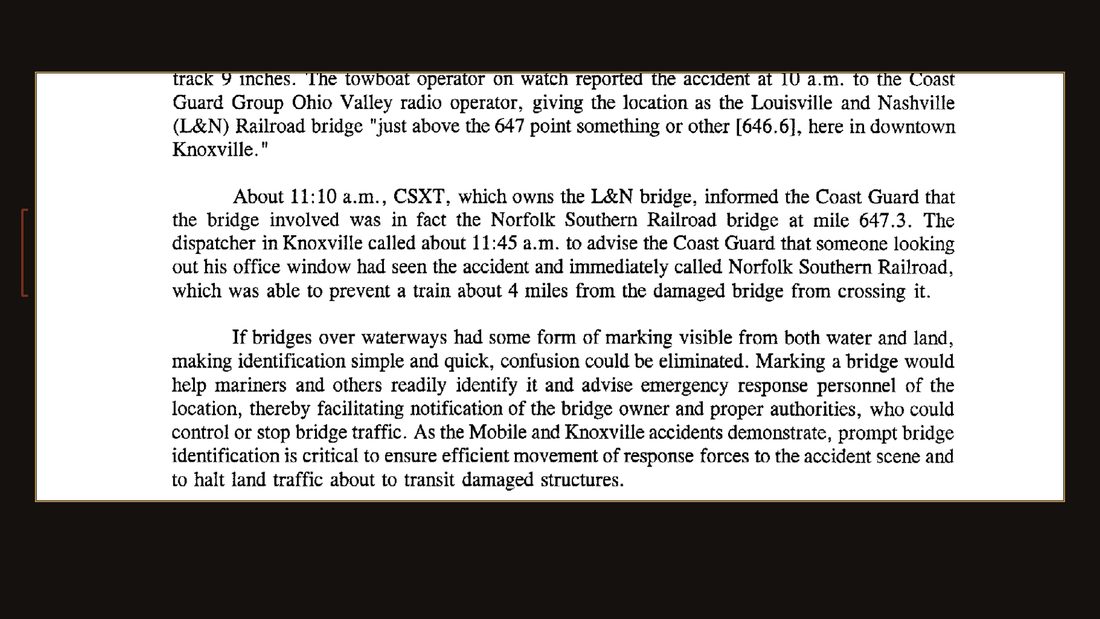
The towboat operator called it in and gave the wrong bridge. It took an hour to work out which bridge it was.
N185
NTSB/RAR-94/01 · Big Bayou Canot · adopted Sept. 19, 1994 · p. 58. View the original.
Every failure from Mobile, repeating exactly, ten weeks later.
N186
NTSB/RAR-94/01 · Big Bayou Canot · adopted Sept. 19, 1994 · p. 58. View the original.
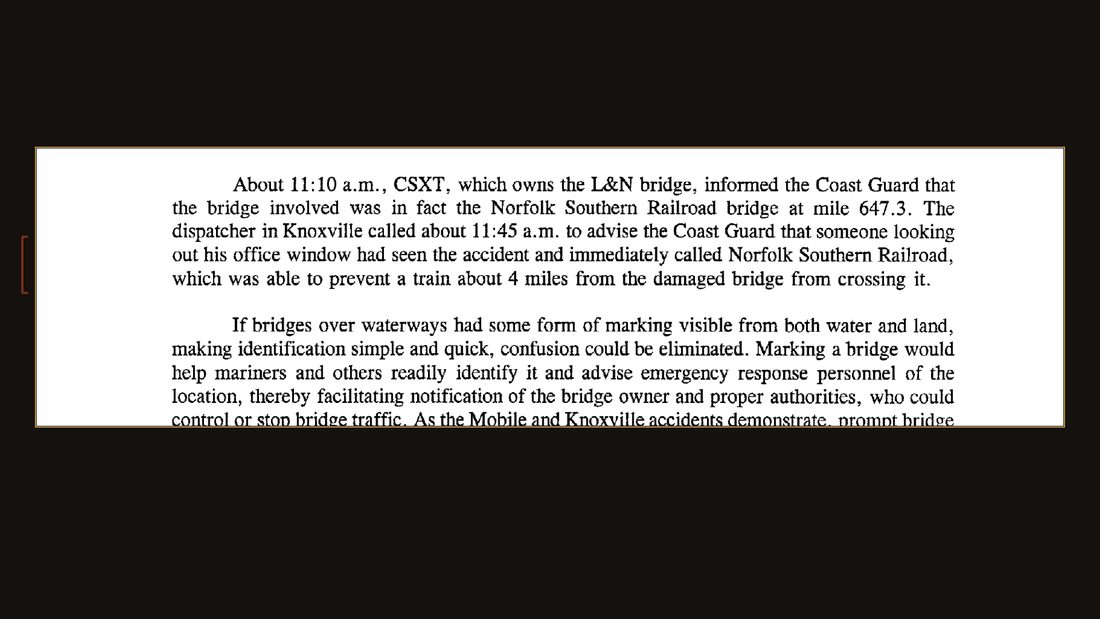
No train hit that bridge. Here is why.
N187
NTSB/RAR-94/01 · Big Bayou Canot · adopted Sept. 19, 1994 · p. 58. View the original.
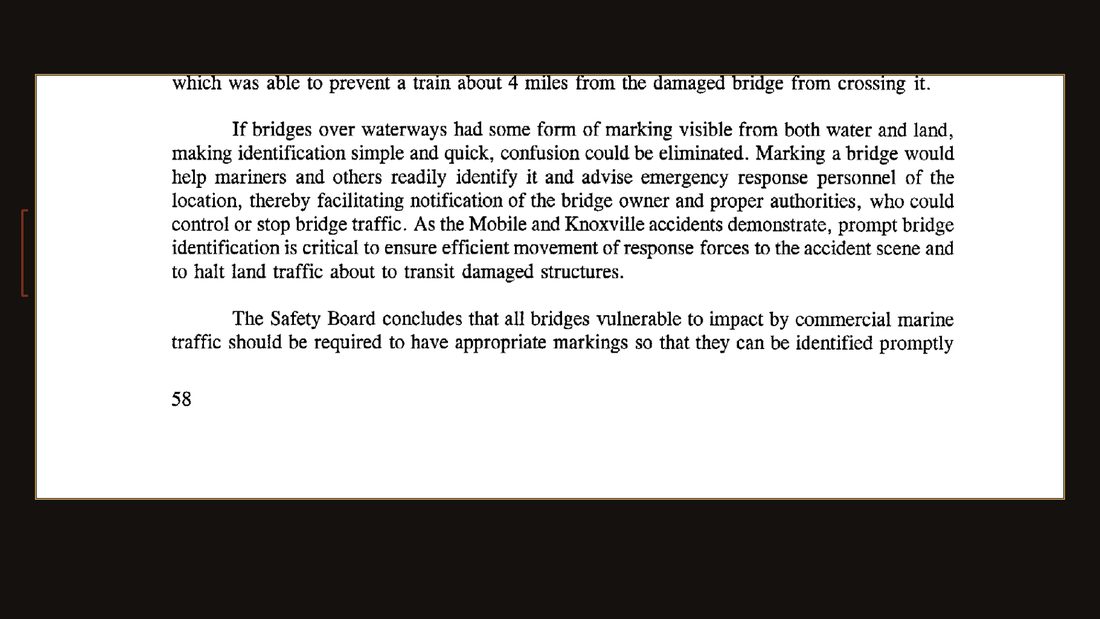
Someone looking out his office window had seen the accident and immediately called Norfolk Southern Railroad.
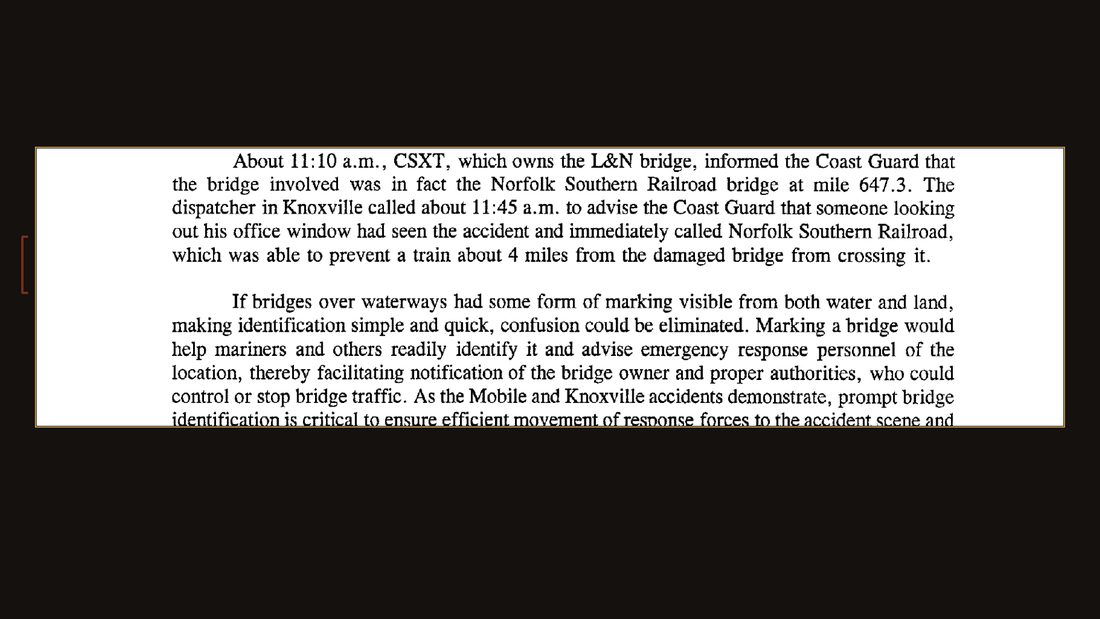
N188
NTSB/RAR-94/01 · Big Bayou Canot · adopted Sept. 19, 1994 · p. 58. View the original.
Which was able to prevent a train about four miles from the damaged bridge from crossing it.
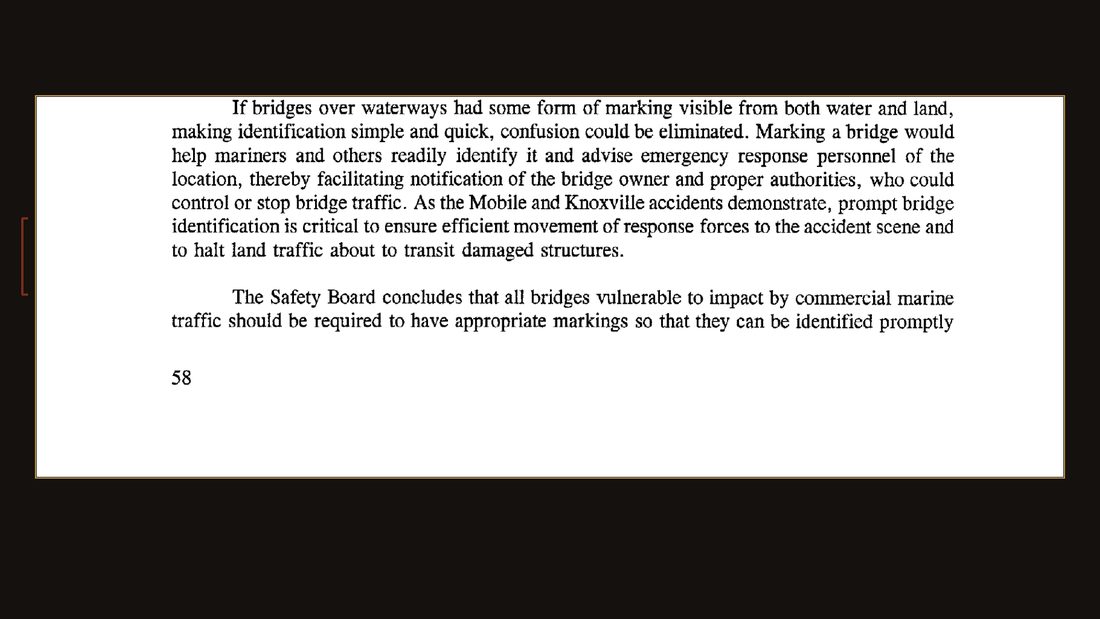
N189
NTSB/RAR-94/01 · Big Bayou Canot · adopted Sept. 19, 1994 · p. 58. View the original.
In Knoxville it was daylight, and a man happened to be looking out a window.
At Big Bayou Canot it was quarter to three in the morning, in fog, in a bayou with no houses on it.
N190
NTSB/RAR-94/01 · Big Bayou Canot · adopted Sept. 19, 1994 · p. 58. View the original.
The difference between forty-seven deaths and none was a person who happened to be looking.
What the rules say now
A1
Federal Register · 63 FR 24630 · May 4, 1998 · FRA final rule. View the original.
Things did change. Slowly, and in the places the Board had aimed.
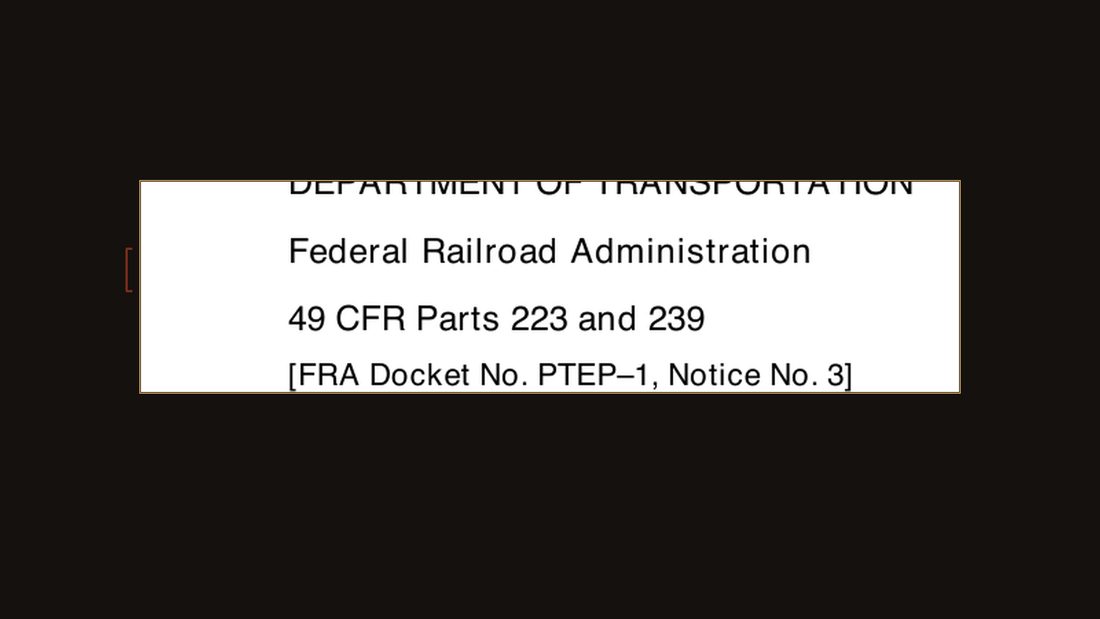
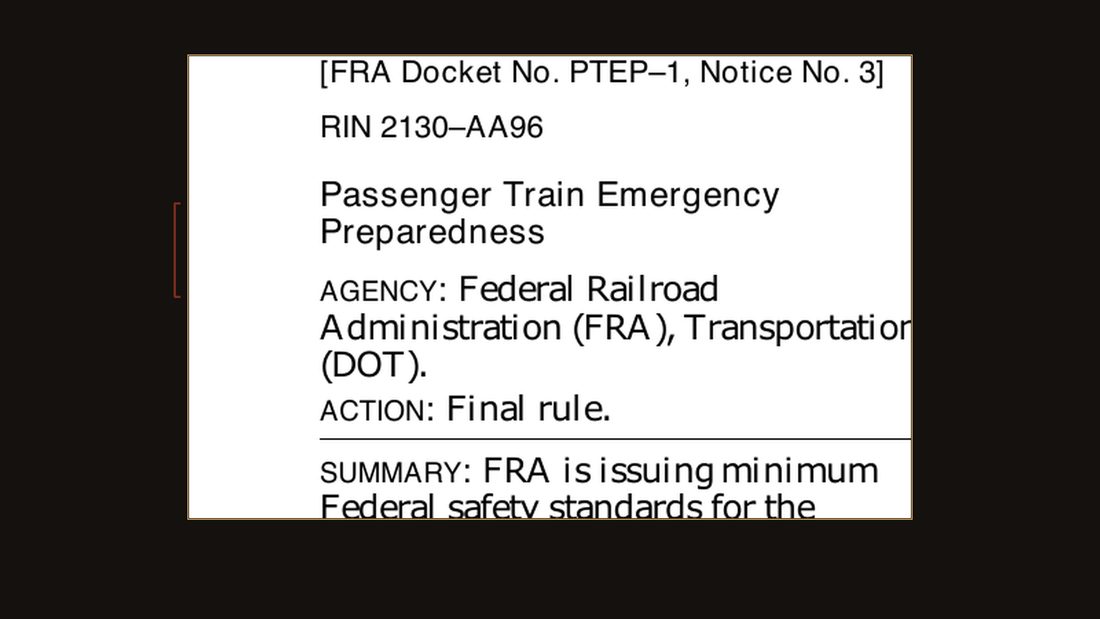
A2
Federal Register · 63 FR 24630 · May 4, 1998 · FRA final rule. View the original.
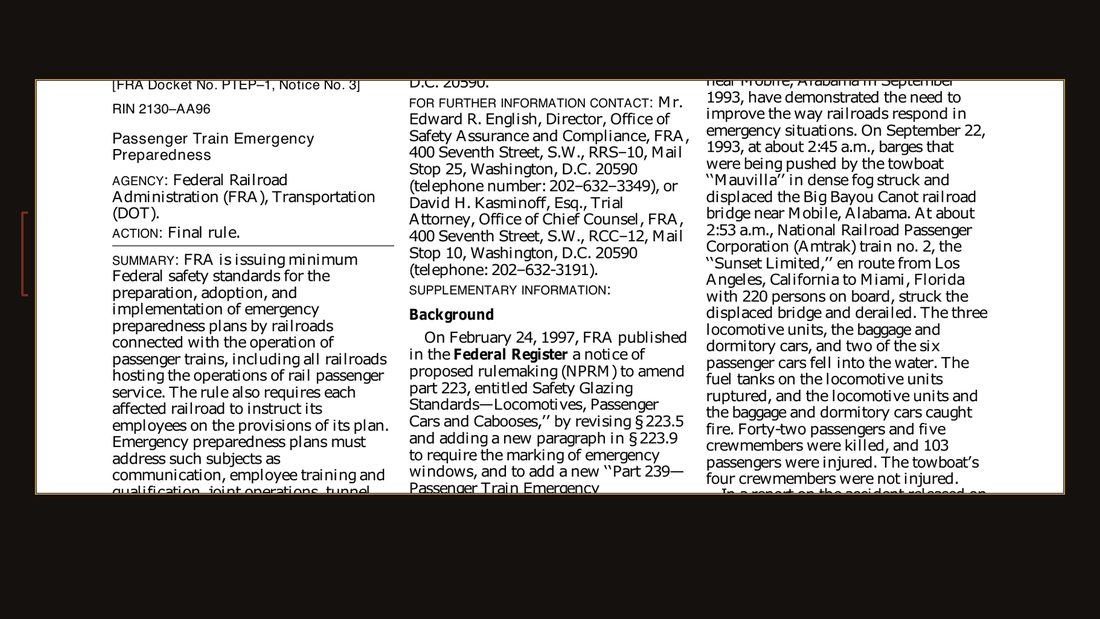
In May of nineteen ninety-eight, the Federal Railroad Administration issued a rule on passenger train emergency preparedness.
A3
Federal Register · 63 FR 24630 · May 4, 1998 · FRA final rule. View the original.
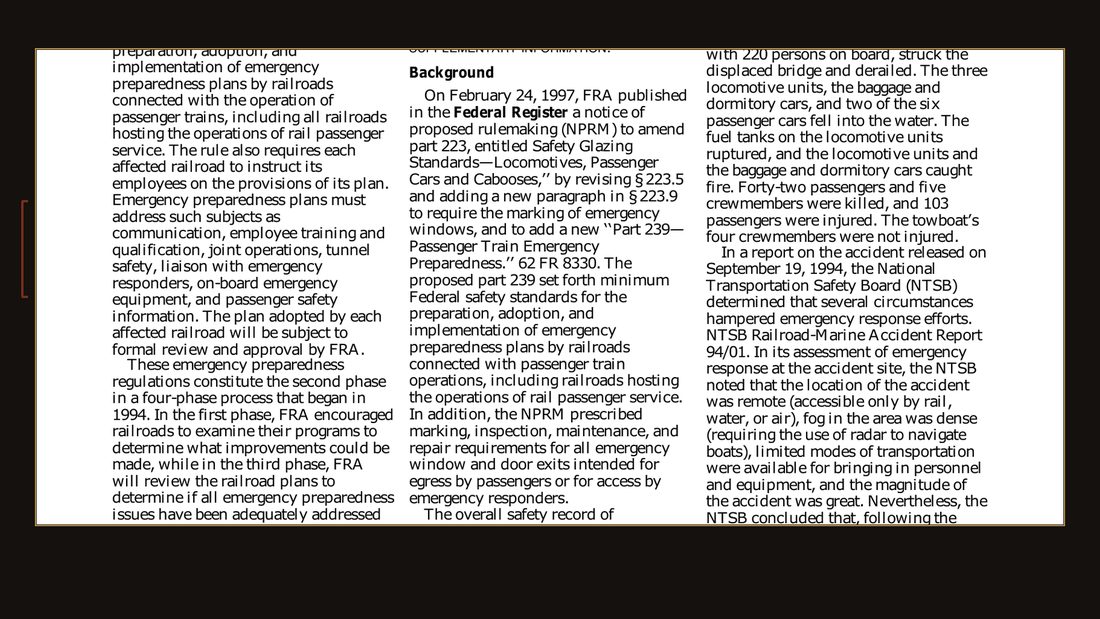
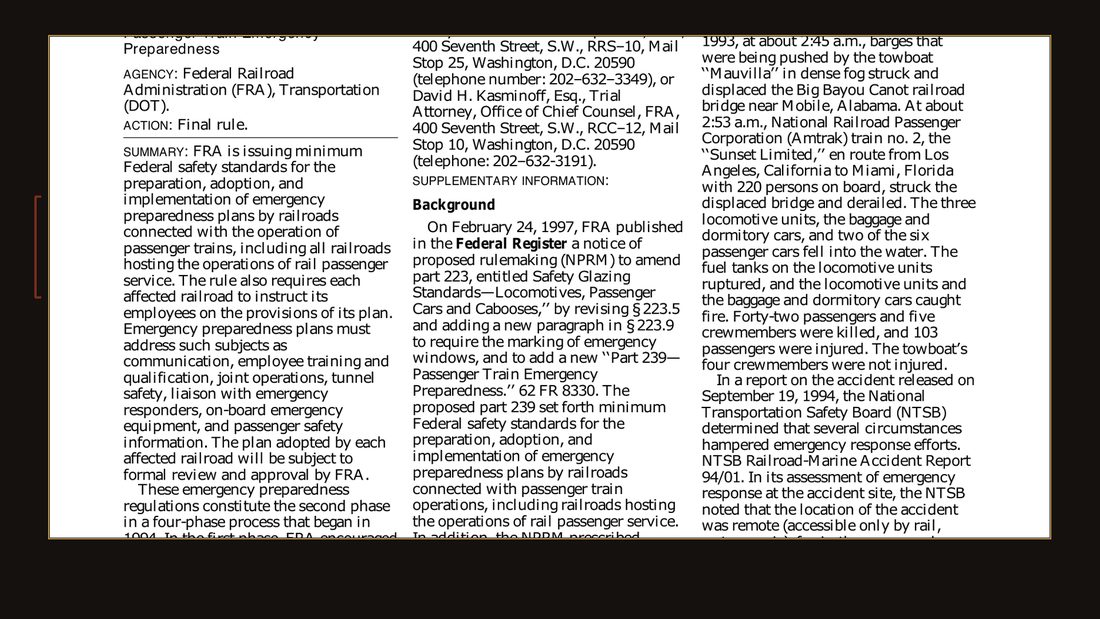
It opens by describing this accident.
A4
Federal Register · 63 FR 24630 · May 4, 1998 · FRA final rule. View the original.
Emergency plans. Marked emergency windows. Safety information for passengers. Accurate passenger counts for responders. Drills.
A5
Federal Register · 63 FR 24630 · May 4, 1998 · FRA final rule. View the original.
Every one of those is a finding from Big Bayou Canot, turned into a federal requirement, four years and seven months later.
B1
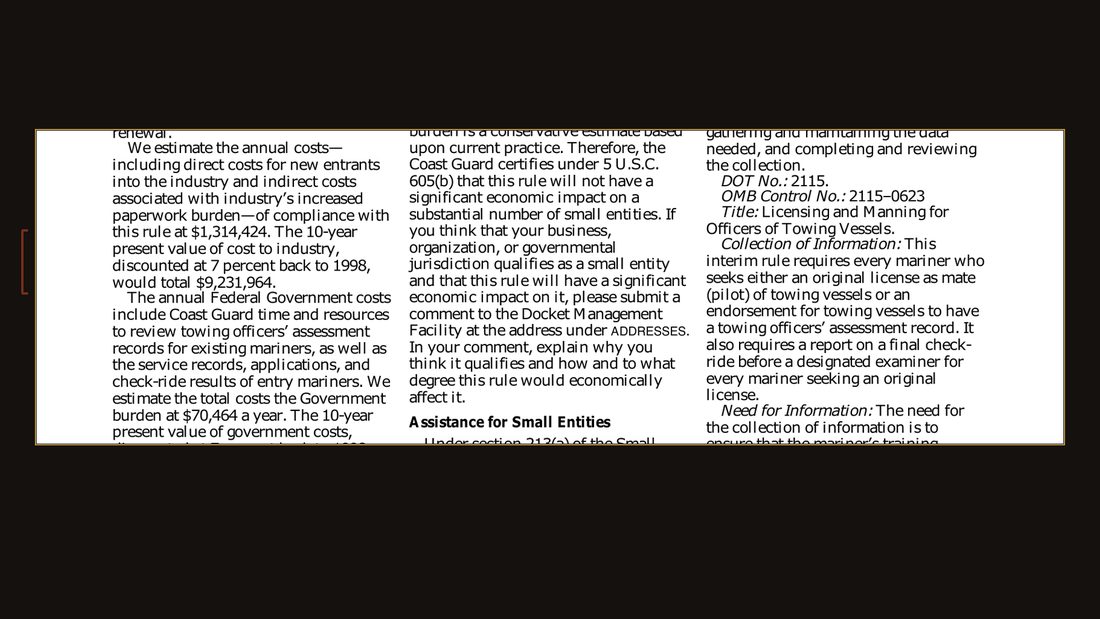
Federal Register · 64 FR 63223 · Nov. 19, 1999 · USCG interim rule. View the original.
In November of nineteen ninety-nine, the Coast Guard rewrote licensing for towing vessel officers.
B2
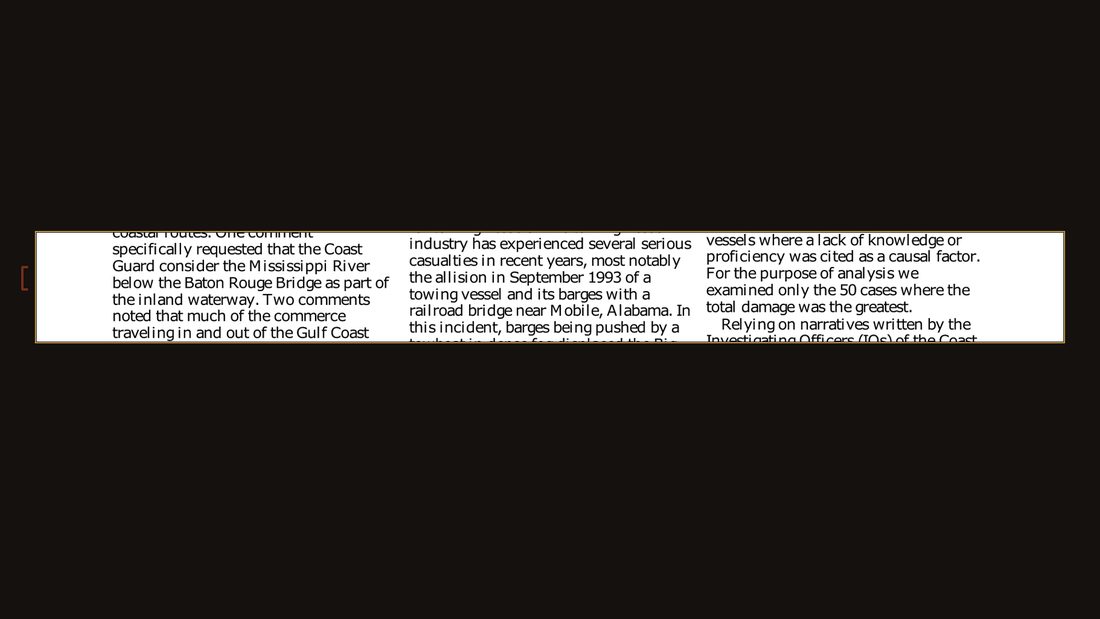
Federal Register · 64 FR 63222 · Nov. 19, 1999 · USCG interim rule. View the original.
That rule opens by describing this accident too.
B3
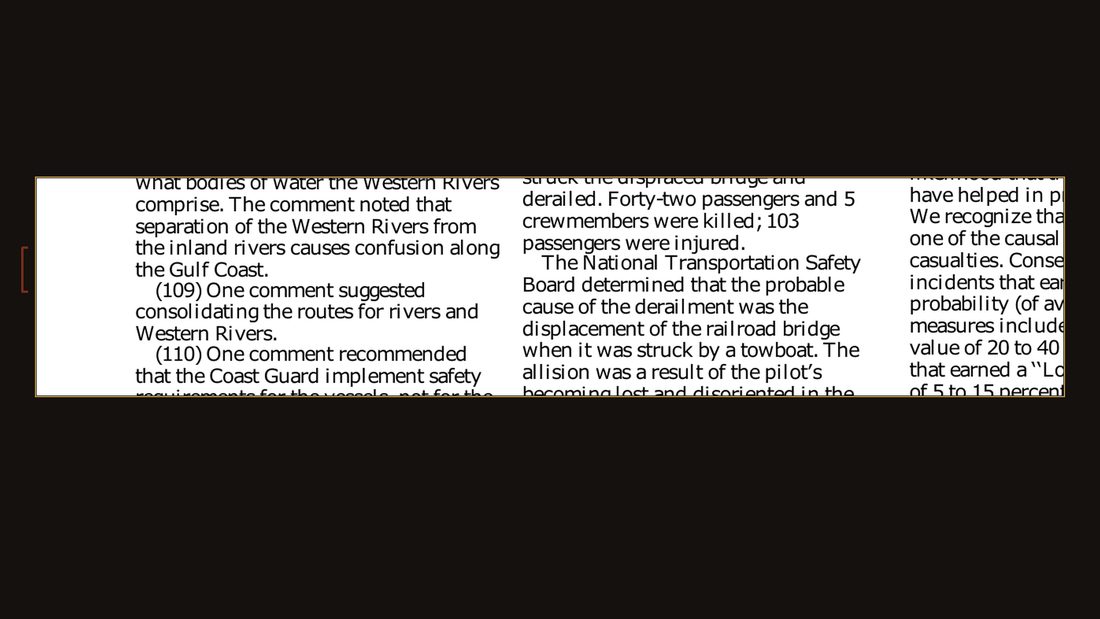
Federal Register · 64 FR 63222 · Nov. 19, 1999 · USCG interim rule. View the original.
Watch the wording the Coast Guard chose for the finding against itself.
B4
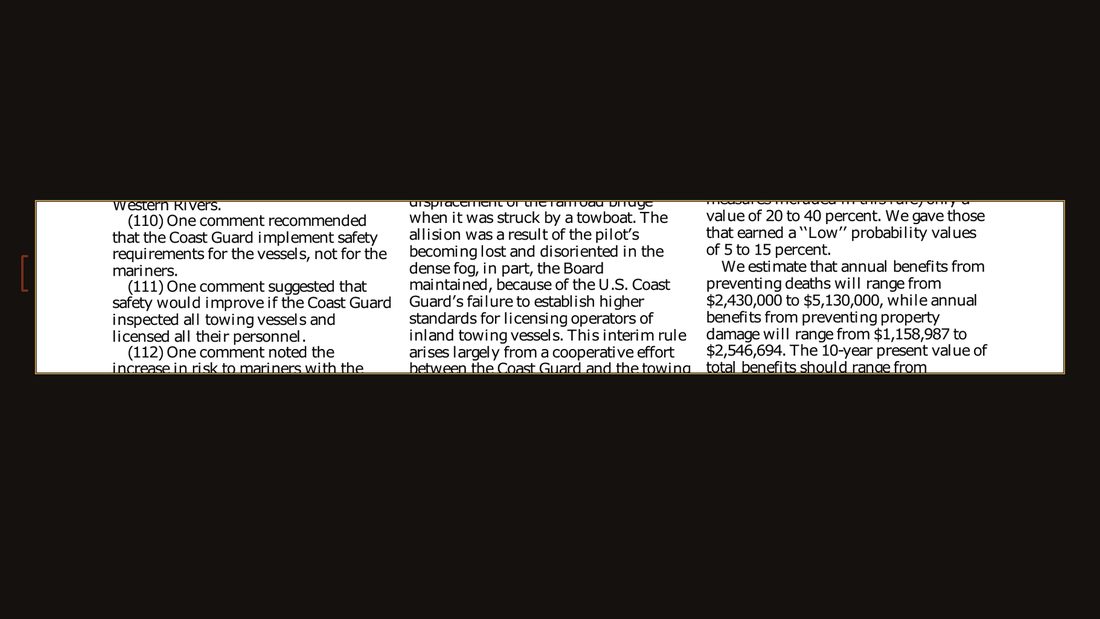
Federal Register · 64 FR 63222 · Nov. 19, 1999 · USCG interim rule. View the original.
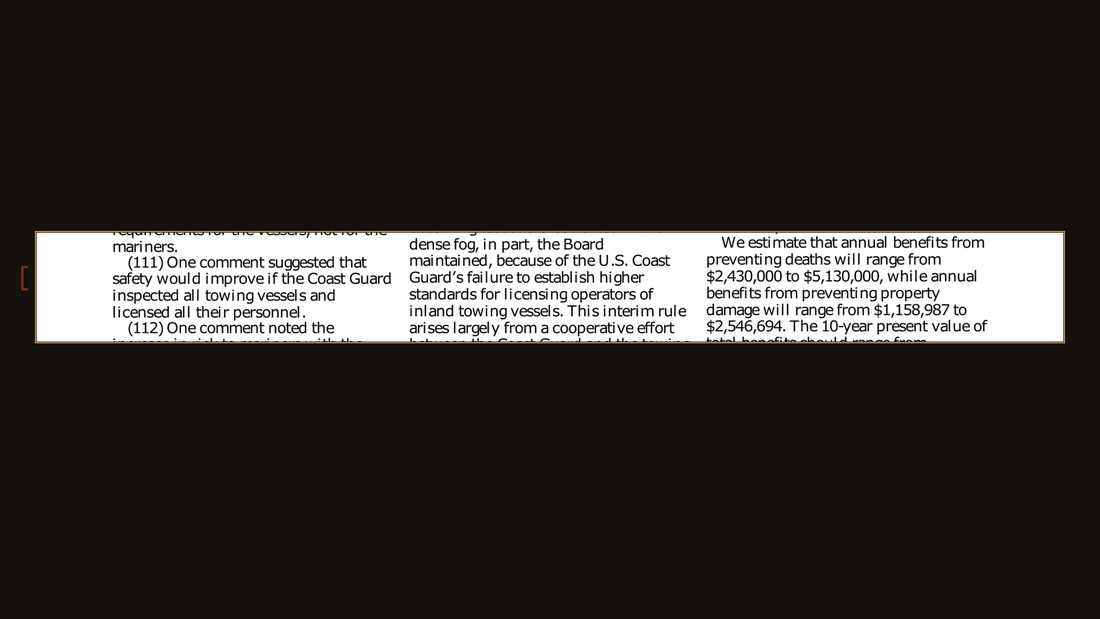
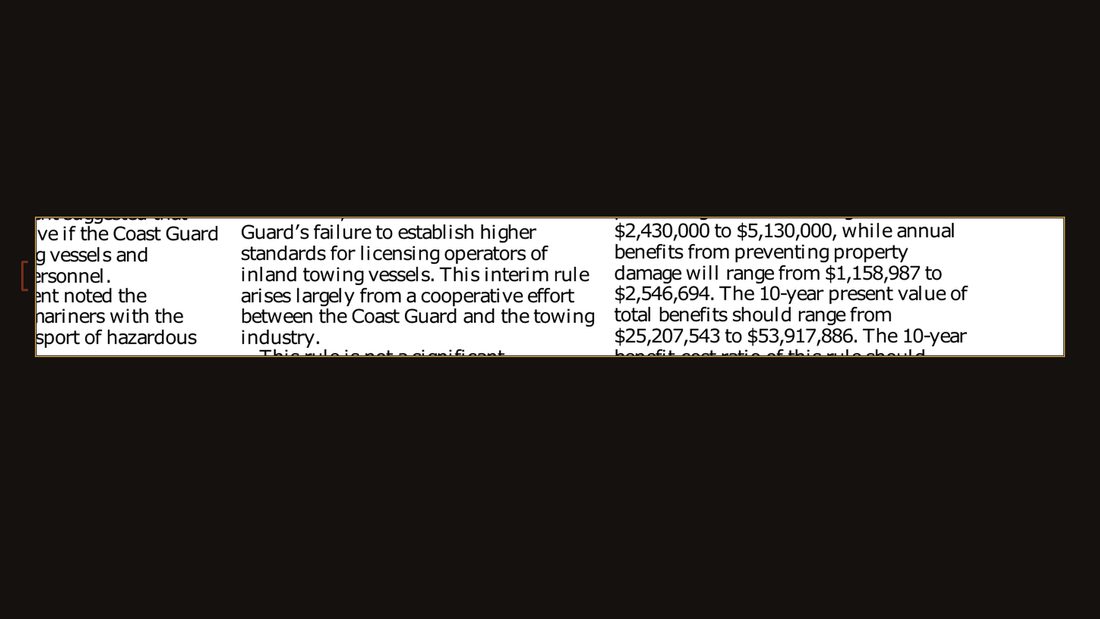
In part, the Board maintained, because of the U.S. Coast Guard's failure to establish higher standards.
B5
Federal Register · 64 FR 63222 · Nov. 19, 1999 · USCG interim rule. View the original.
The Board maintained. Six years on, still held at arm's length.
B6
Federal Register · 64 FR 63234 · Nov. 19, 1999 · USCG interim rule. View the original.
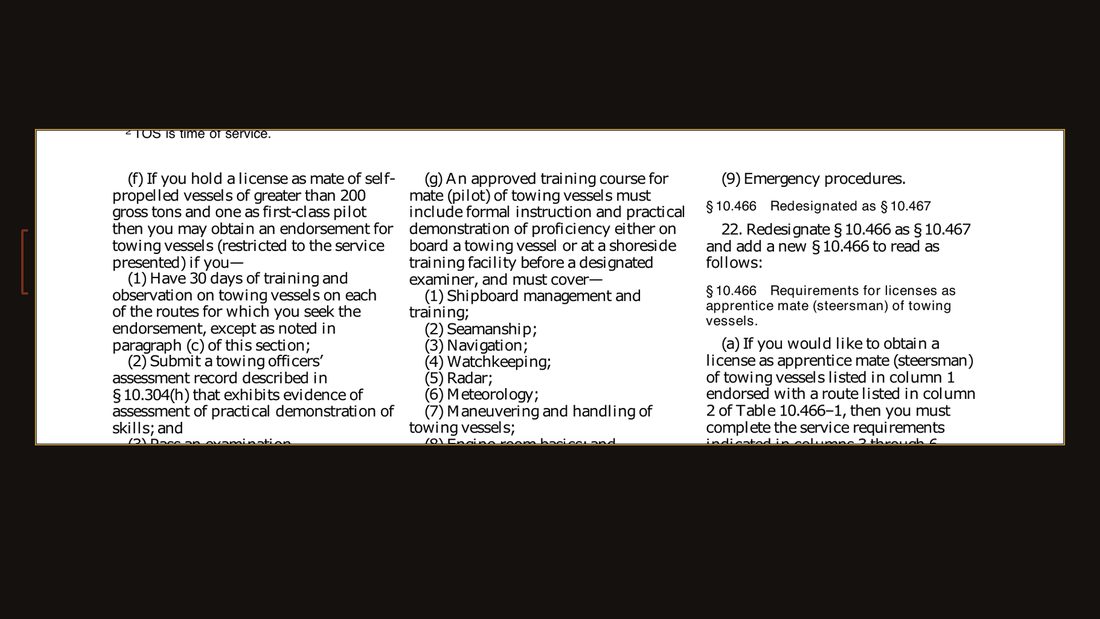
But the rule itself is real. An approved course, with radar in it, and a practical demonstration of skill before a designated examiner.
B7
Federal Register · 64 FR 63222 · Nov. 19, 1999 · USCG interim rule. View the original.
Six years and two months after the wreck. And it was published as an interim rule.
G1
Federal Register · 75 FR 41282 · July 15, 2010 · FRA final rule. View the original.
Which leaves the bridge.
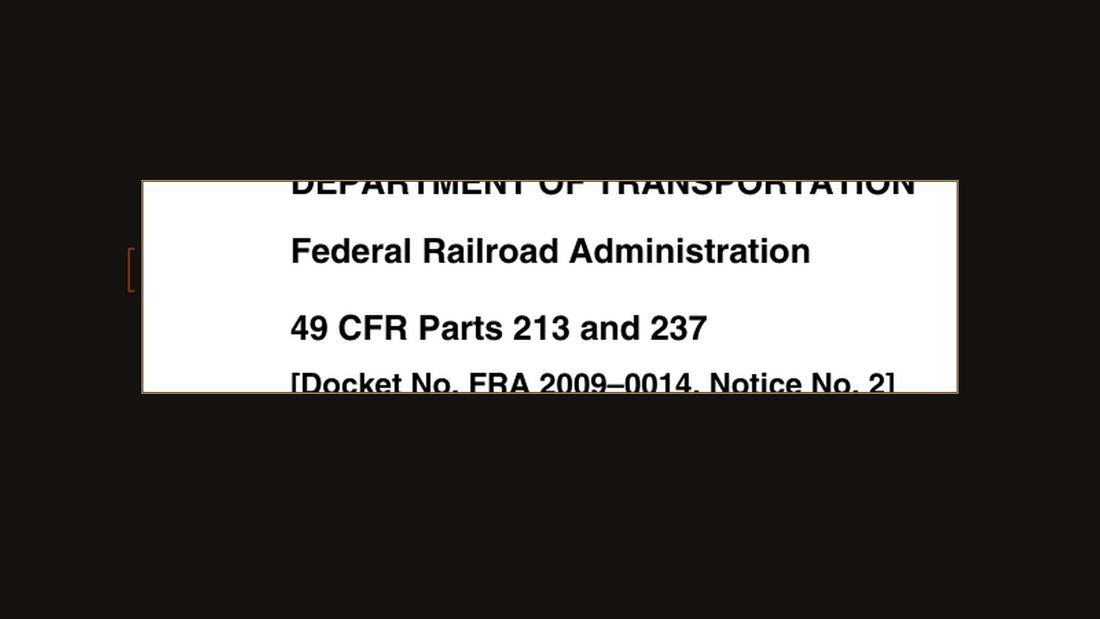
G2
Federal Register · 75 FR 41282 · July 15, 2010 · FRA final rule. View the original.
In July of twenty-ten, the FRA finally issued federal bridge safety standards for railroads.
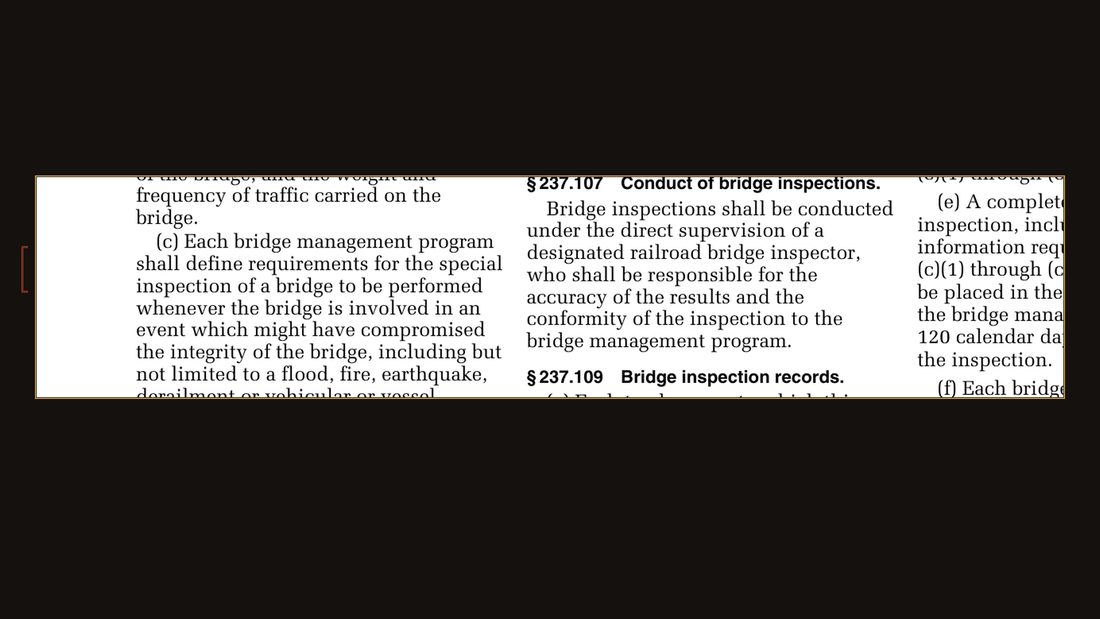
G3
Federal Register · 75 FR 41305 · July 15, 2010 · FRA final rule. View the original.
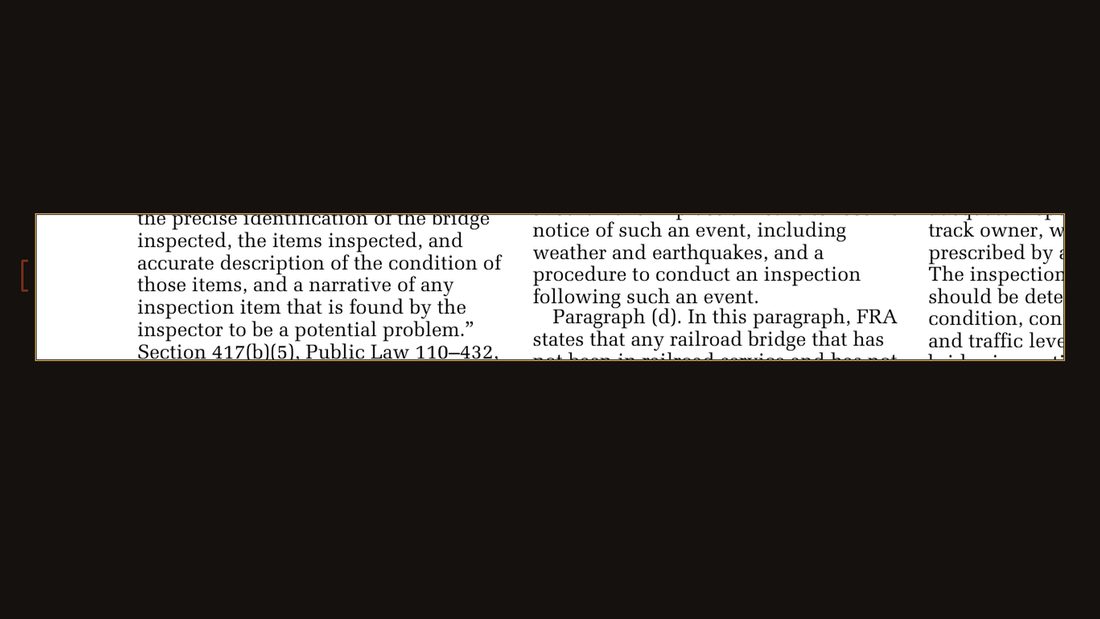
Seventeen years later. It requires a special inspection whenever a bridge is involved in an event that might have compromised it.
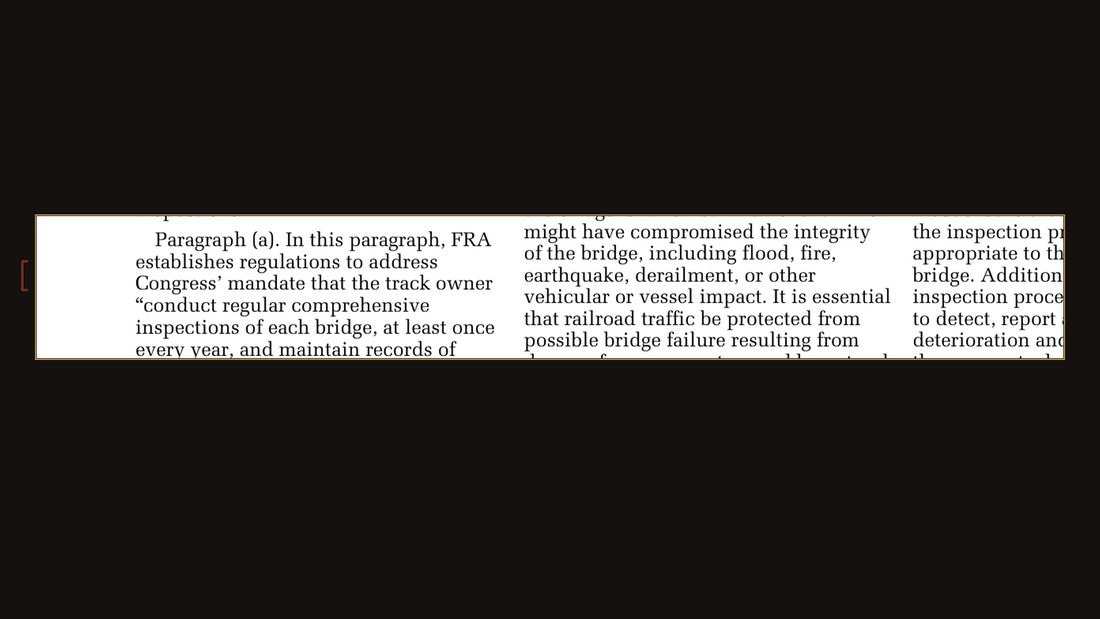
G4
Federal Register · 75 FR 41293 · July 15, 2010 · FRA final rule. View the original.
Including, in the text, vessel impact.
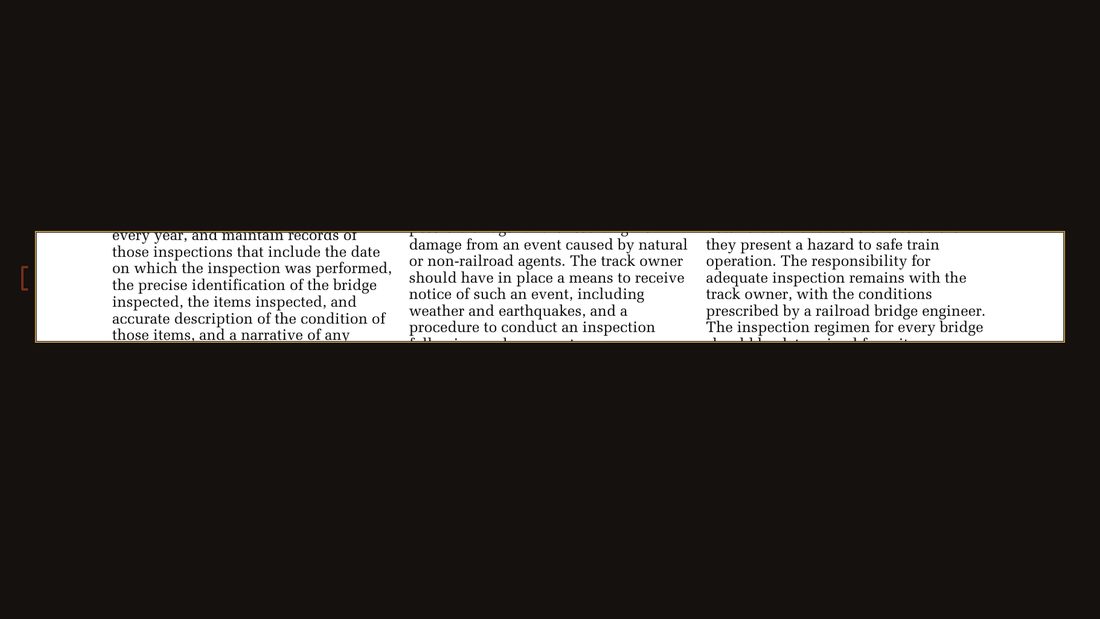
G5
Federal Register · 75 FR 41293 · July 15, 2010 · FRA final rule. View the original.
And it says the track owner should have in place a means to receive notice of such an event.
G6
Federal Register · 75 FR 41293 · July 15, 2010 · FRA final rule. View the original.
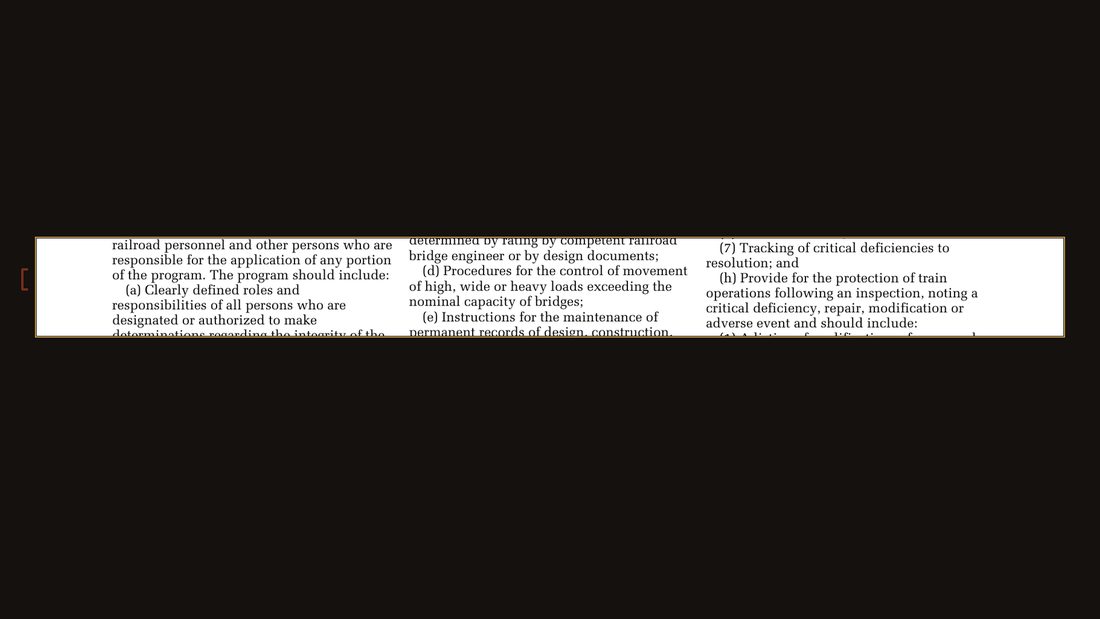
Receive notice. From someone who saw it.
G7
Federal Register · 75 FR 41308 · July 15, 2010 · FRA final rule. View the original.
That is the whole architecture, and it has not changed. The rule presumes a person knows.
N191
NTSB/RAR-94/01 · Big Bayou Canot · adopted Sept. 19, 1994 · p. 5. View the original.
At Big Bayou Canot, for eight minutes, no person on earth knew.
N192
NTSB/RAR-94/01 · Big Bayou Canot · adopted Sept. 19, 1994 · p. 15. View the original.
Not the dispatcher in Jacksonville. Not the railroad. Not the Coast Guard.
N193
NTSB/RAR-94/01 · Big Bayou Canot · adopted Sept. 19, 1994 · p. 7. View the original.
Not the crew of the Sunset Limited, calling a clear signal aloud and repeating it back to each other over the radio.
N194
NTSB/RAR-94/01 · Big Bayou Canot · adopted Sept. 19, 1994 · p. 4. View the original.
Not even the man who hit it, standing in the wheelhouse four hundred feet away, still trying to figure out what was in front of him.
N195
NTSB/RAR-94/01 · Big Bayou Canot · adopted Sept. 19, 1994 · p. 41. View the original.
In nineteen eighty-one somebody priced the machine that would have known. Eight hundred and fifty million dollars.
N196
NTSB/RAR-94/01 · Big Bayou Canot · adopted Sept. 19, 1994 · p. 42. View the original.
The number was probably right. The file was closed in good faith. Nobody in it did anything wrong.
N197
NTSB/RAR-94/01 · Big Bayou Canot · adopted Sept. 19, 1994 · p. 41. View the original.
That is what makes it worth showing you. This is what a system looks like when every part of it is working.
N198
NTSB/RAR-94/01 · Big Bayou Canot · adopted Sept. 19, 1994 · Executive Summary. View the original.
Sources
- [N] National Transportation Safety Board, *Railroad-Marine Accident Report: Derailment of Amtrak Train No. 2 on the CSXT Big Bayou Canot Bridge near Mobile, Alabama, September 22, 1993*, NTSB/RAR-94/01, adopted September 19, 1994. 78 pp. https://www.ntsb.gov/investigations/AccidentReports/Reports/RAR9401.pdf
- [A] Federal Railroad Administration, *Passenger Train Emergency Preparedness*, final rule, 63 FR 24630, May 4, 1998 (49 CFR Parts 223 and 239). 54 pp. https://www.govinfo.gov/content/pkg/FR-1998-05-04/pdf/98-11393.pdf
- [B] U.S. Coast Guard, *Licensing and Manning for Officers of Towing Vessels*, interim rule, 64 FR 63213, November 19, 1999 (46 CFR Parts 10, 12, 15). 23 pp. https://www.govinfo.gov/content/pkg/FR-1999-11-19/pdf/99-29832.pdf
- [G] Federal Railroad Administration, *Bridge Safety Standards*, final rule, 75 FR 41282, July 15, 2010 (49 CFR Parts 213 and 237). 28 pp. https://www.govinfo.gov/content/pkg/FR-2010-07-15/pdf/2010-16929.pdf
- [C] *In re Amtrak "Sunset Limited" Train Crash in Bayou Canot, Alabama, on September 22, 1993* — Altosino v. Warrior & Gulf Navigation Co., 121 F.3d 1421 (11th Cir. 1997); and Amended Order No. 201, 188 F. Supp. 2d 1341 (S.D. Ala.). https://www.courtlistener.com/opinion/72143/altosino-v-warrior-gulf/