The Government Told Them There Was Uranium in Their Wells. It Left Out One Word.
For thirty-four years, a plant eighteen miles northwest of downtown Cincinnati made the uranium metal that began America's nuclear weapons cycle. It was called the Feed Materials Production Center, near the village of Fernald, Ohio, and it was run for the government by a contractor called National Lead of Ohio.
Transcript
A sentence in a statement
S1
S. Hrg. 99-156 · U.S. Senate Gov't Affairs · Apr. 22, 1985 · p. 111.
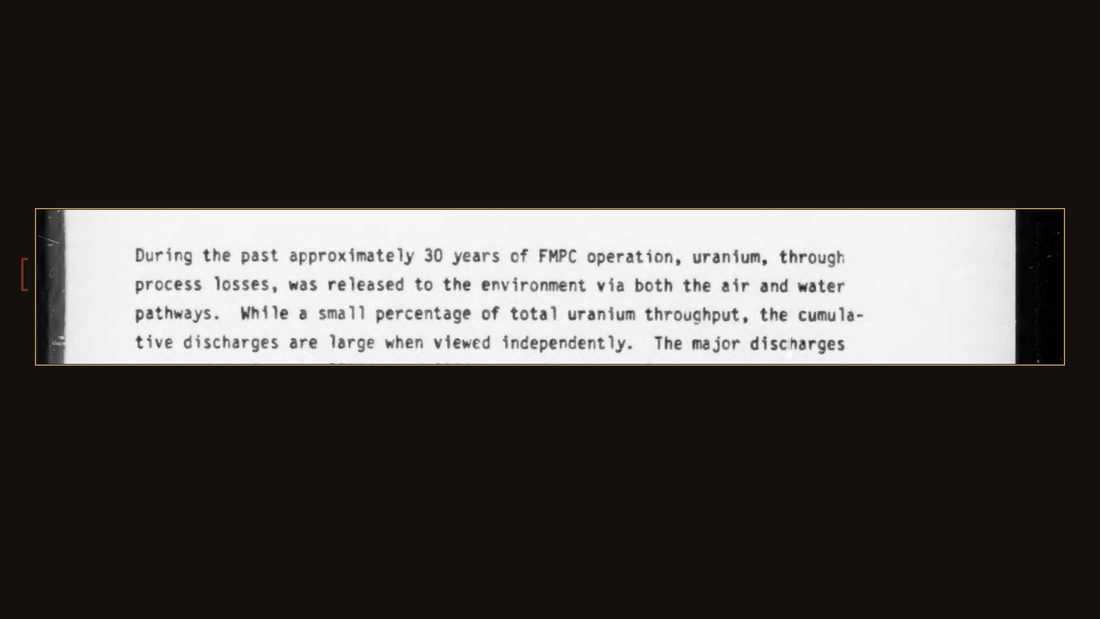
This is one sentence from a statement the Department of Energy handed to the United States Senate on the twenty-second of April, nineteen eighty-five.
S2
S. Hrg. 99-156 · U.S. Senate Gov't Affairs · Apr. 22, 1985 · p. 111.
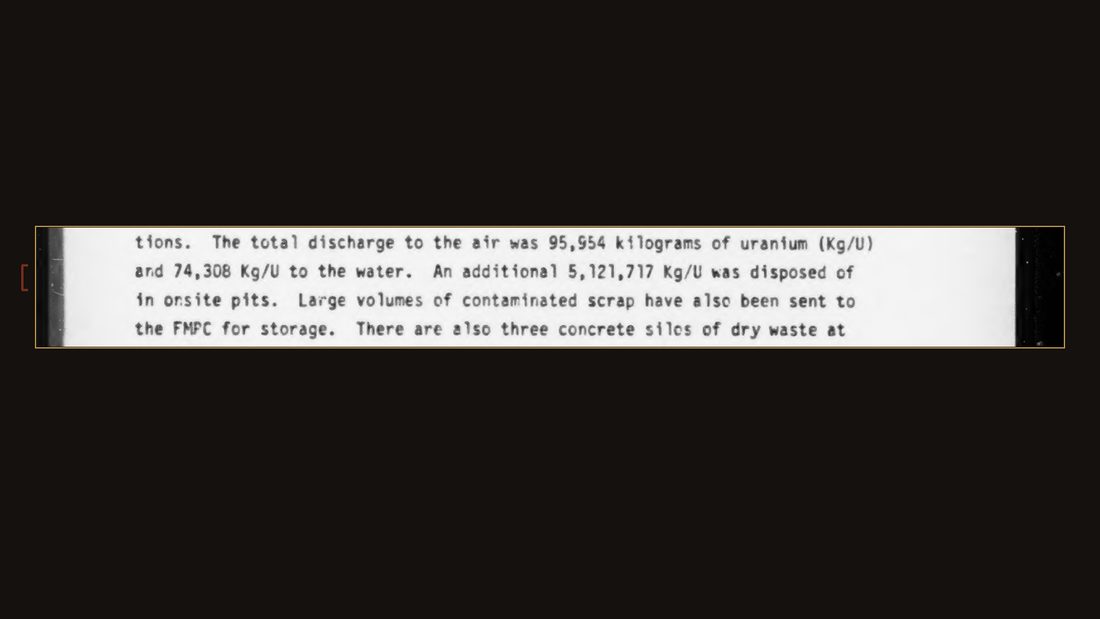
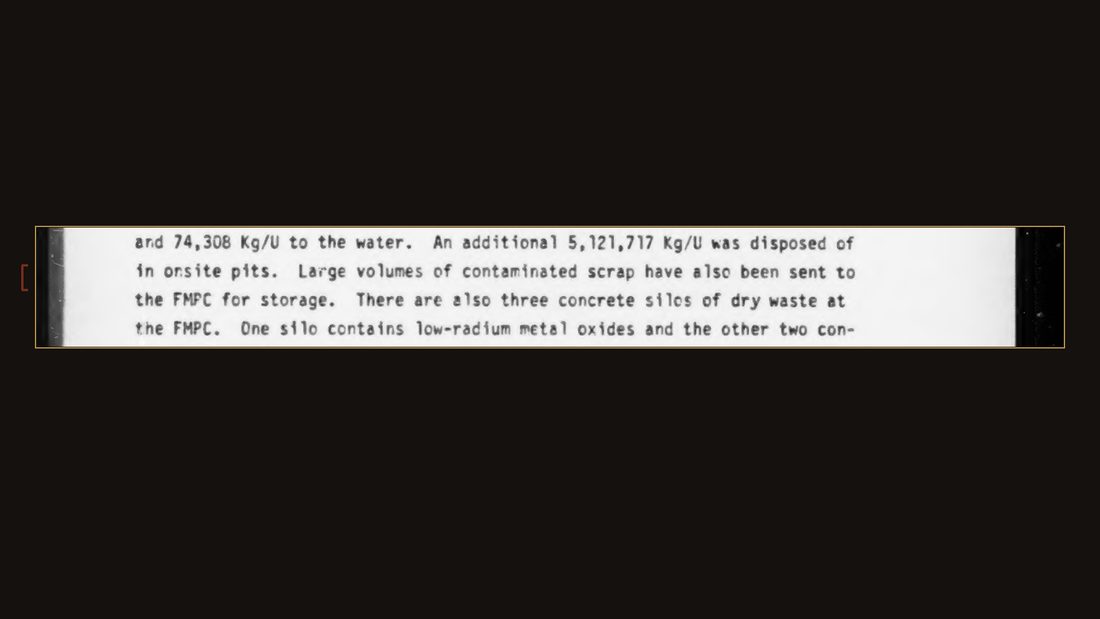
It says five million, one hundred twenty-one thousand, seven hundred and seventeen kilograms of uranium had been disposed of in pits on the site.
S3
S. Hrg. 99-156 · U.S. Senate Gov't Affairs · Apr. 22, 1985 · p. 111.
Not spilled. Not lost. Put into the ground, deliberately, over thirty years, and left there.
The site is about eighteen miles northwest of downtown Cincinnati.
S4
S. Hrg. 99-156 · U.S. Senate Gov't Affairs · Apr. 22, 1985 · p. 106.
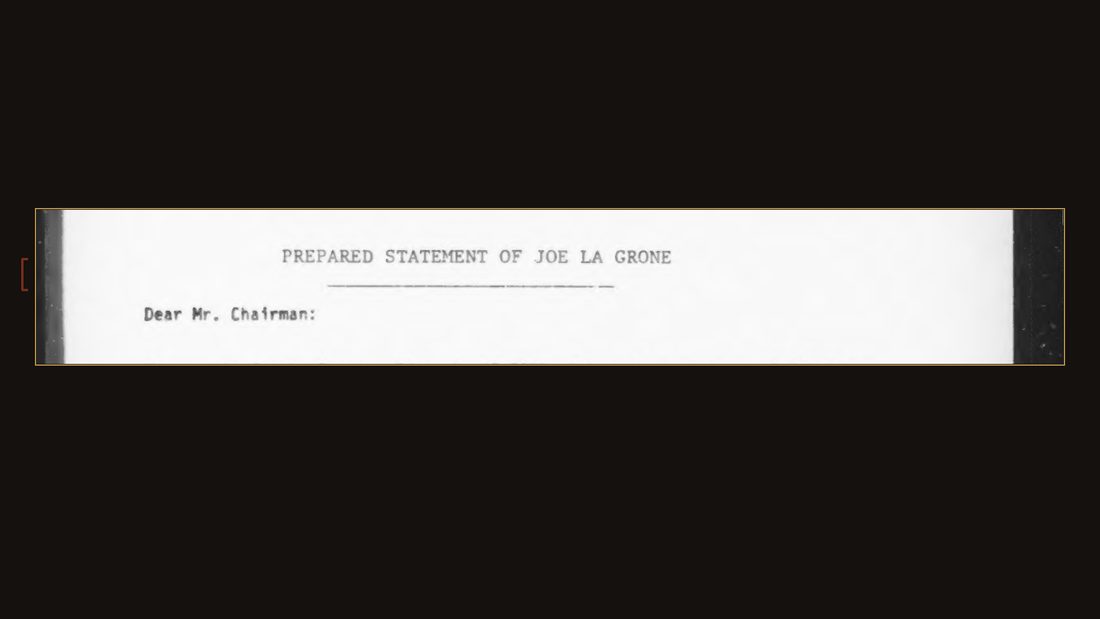
The man who signed that statement was Joe La Grone, manager of the Department of Energy's Oak Ridge Operations Office. He delivered it in a hearing room in Cincinnati, in front of the people who lived downwind.
Feed materials
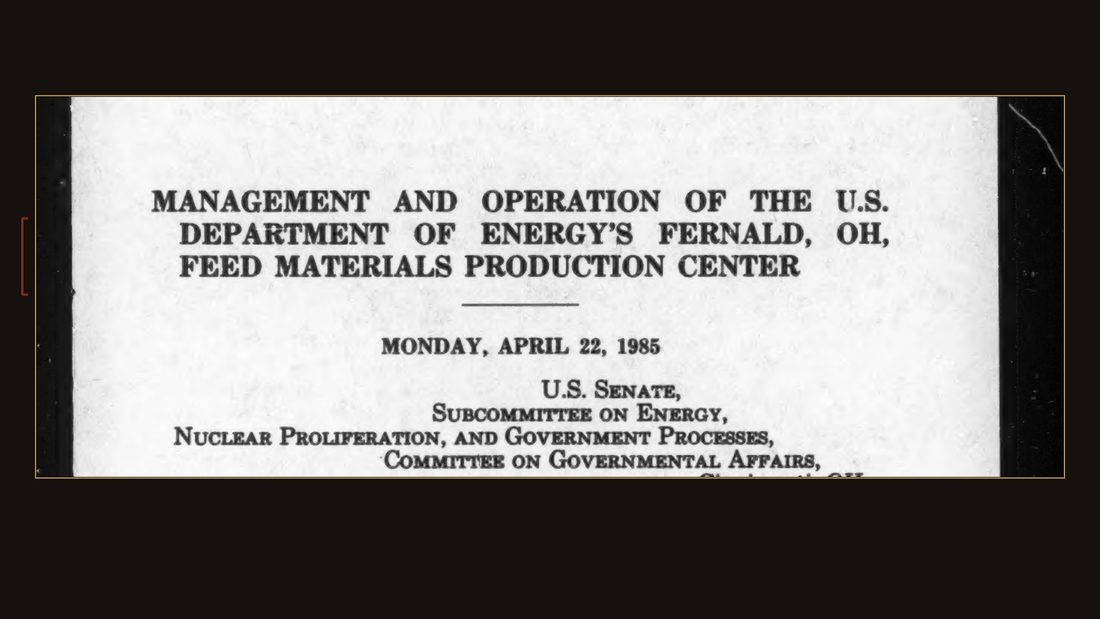
S5
S. Hrg. 99-156 · U.S. Senate Gov't Affairs · Apr. 22, 1985 · p. 1.
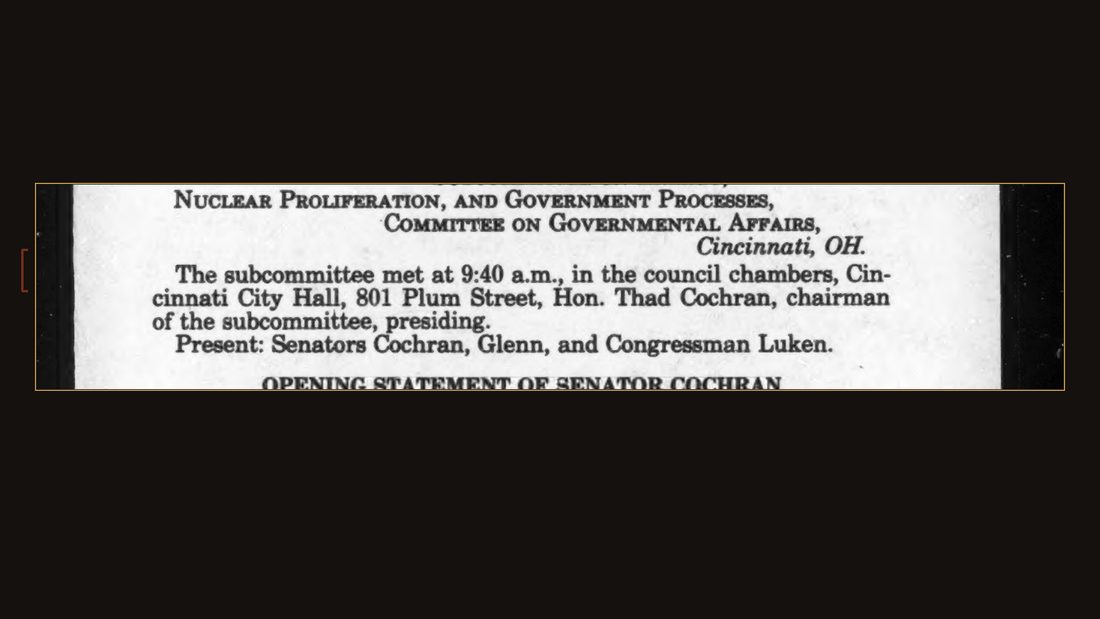
What follows is what the United States government said about itself, out loud, in one day, on the record. Almost nobody has read it since.
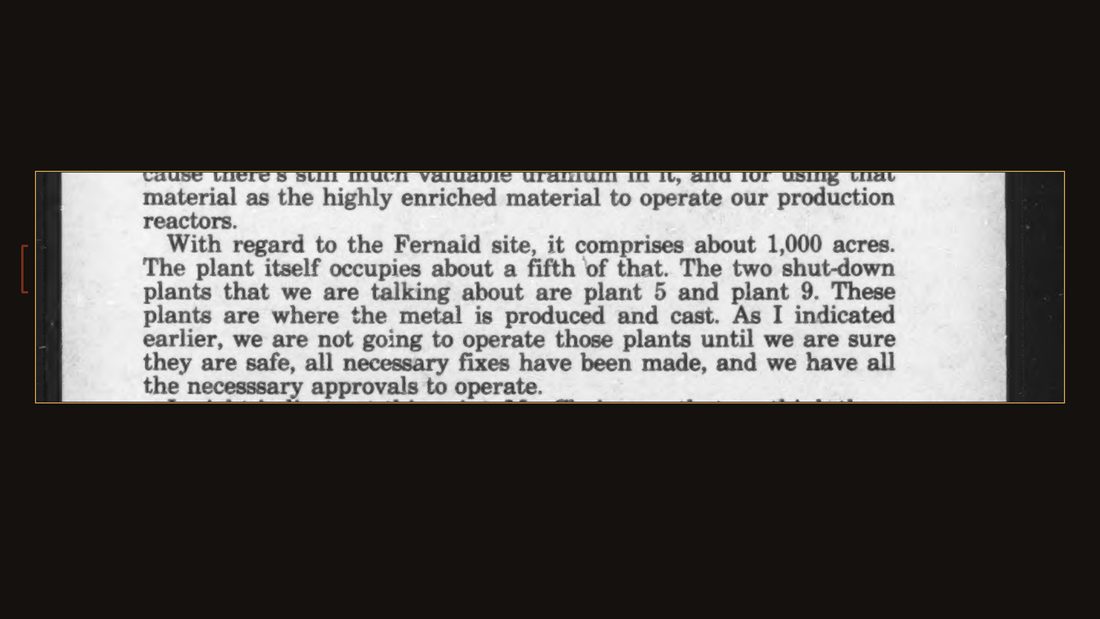
S6
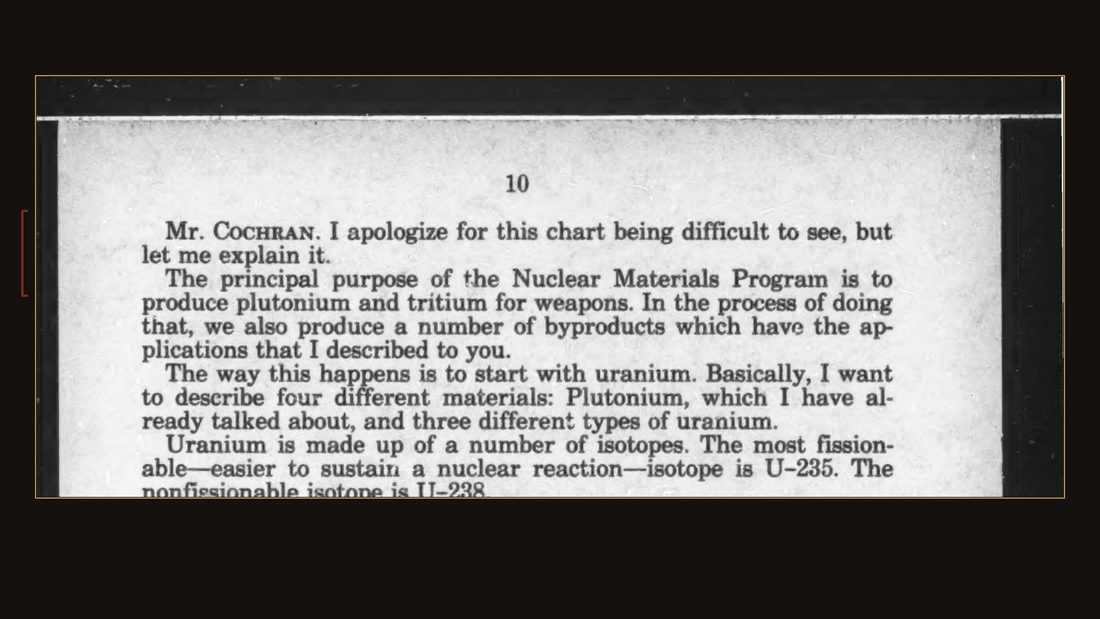
S. Hrg. 99-156 · U.S. Senate Gov't Affairs · Apr. 22, 1985 · p. 10.
The plant was called the Feed Materials Production Center. It sat on about a thousand acres near the village of Fernald, in Hamilton County, Ohio.
The name is accurate, and it is also a kind of camouflage. Feed materials meant feed for reactors.
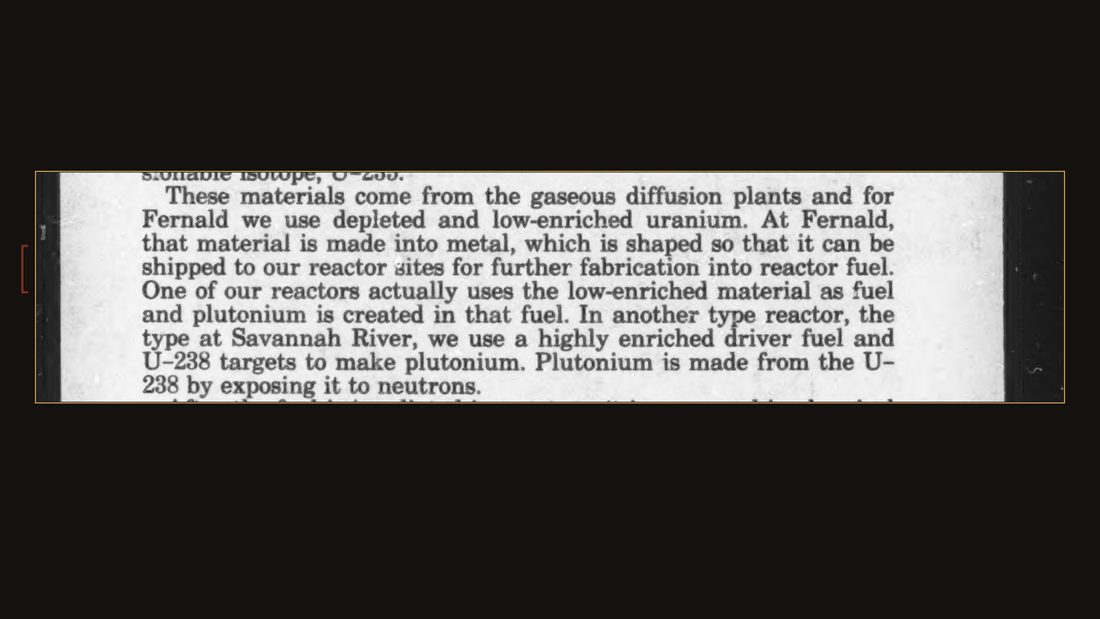
S7
S. Hrg. 99-156 · U.S. Senate Gov't Affairs · Apr. 22, 1985 · p. 10.
Ronald Cochran of the Department of Energy explained it to the committee. The plant took uranium and made it into metal, and the metal went to other government sites to be built into reactor fuel and targets.
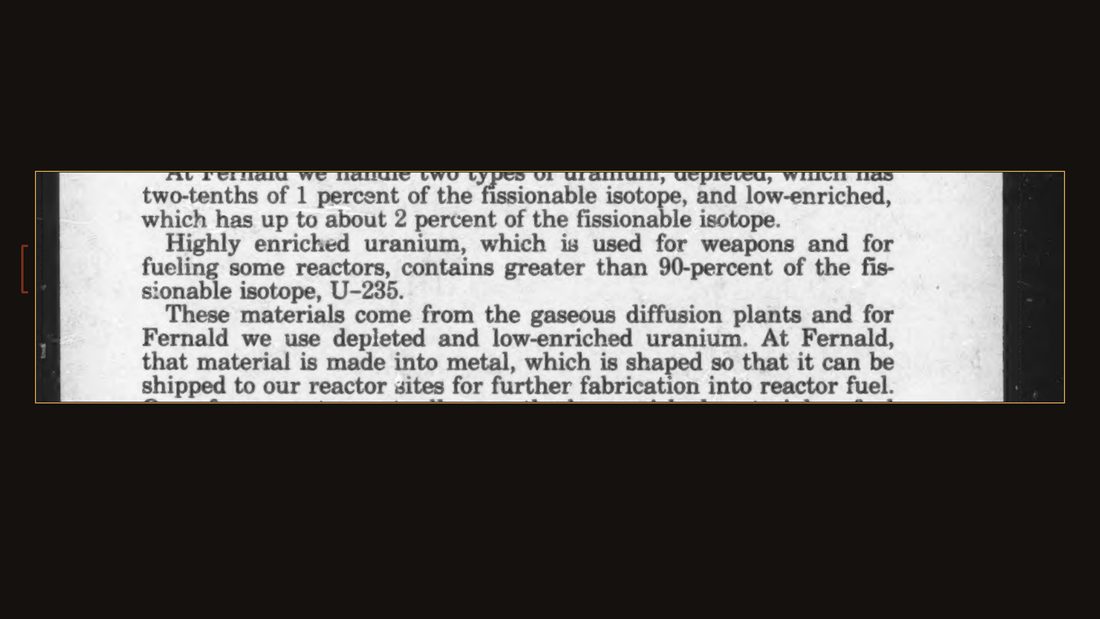
S8
S. Hrg. 99-156 · U.S. Senate Gov't Affairs · Apr. 22, 1985 · p. 10.
At the far end of that process was plutonium, and at the far end of the plutonium were warheads. Fernald was the first step in the American nuclear weapons cycle, and by nineteen eighty-five it was the only plant of its kind operating in the United States.
S9
S. Hrg. 99-156 · U.S. Senate Gov't Affairs · Apr. 22, 1985 · p. 16.
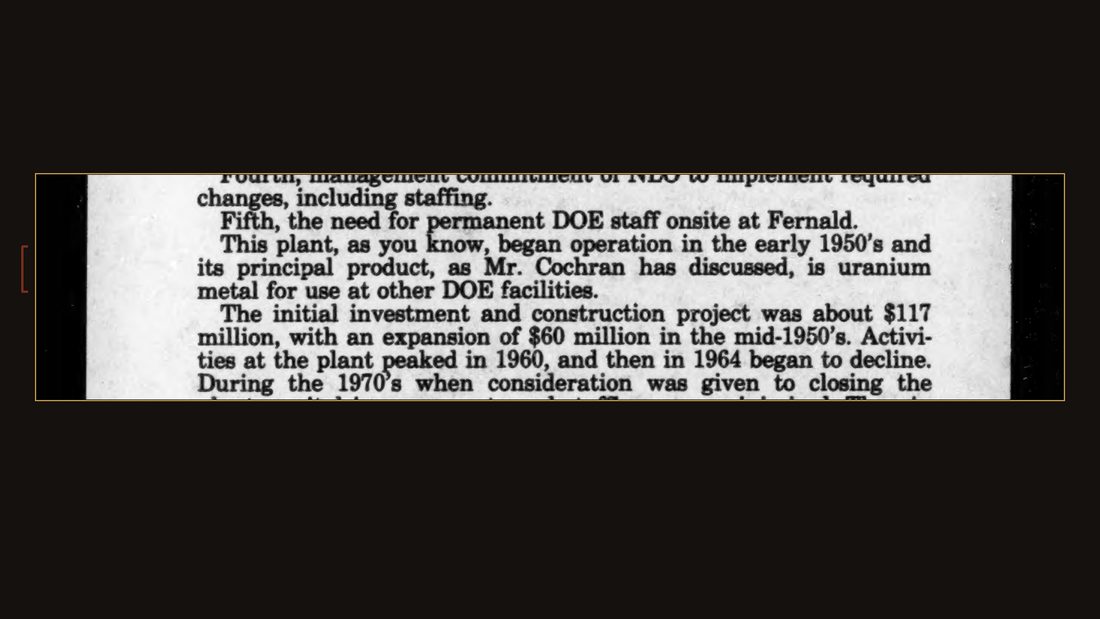
It opened in nineteen fifty-one, and it was run for the government by a private contractor: National Lead of Ohio. Everyone in the record calls it N-L-O.
S10
S. Hrg. 99-156 · U.S. Senate Gov't Affairs · Apr. 22, 1985 · p. 16.
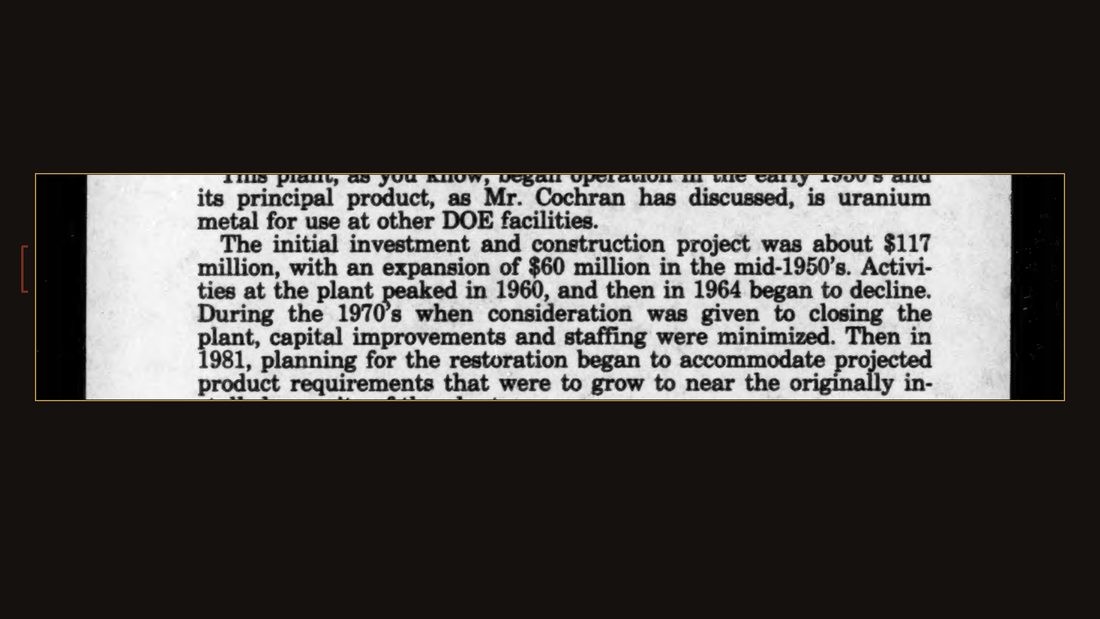
Construction cost about one hundred and seventeen million dollars, with another sixty million spent expanding it in the mid-fifties. Production peaked in nineteen sixty and began falling off in sixty-four.
S11
S. Hrg. 99-156 · U.S. Senate Gov't Affairs · Apr. 22, 1985 · p. 16.
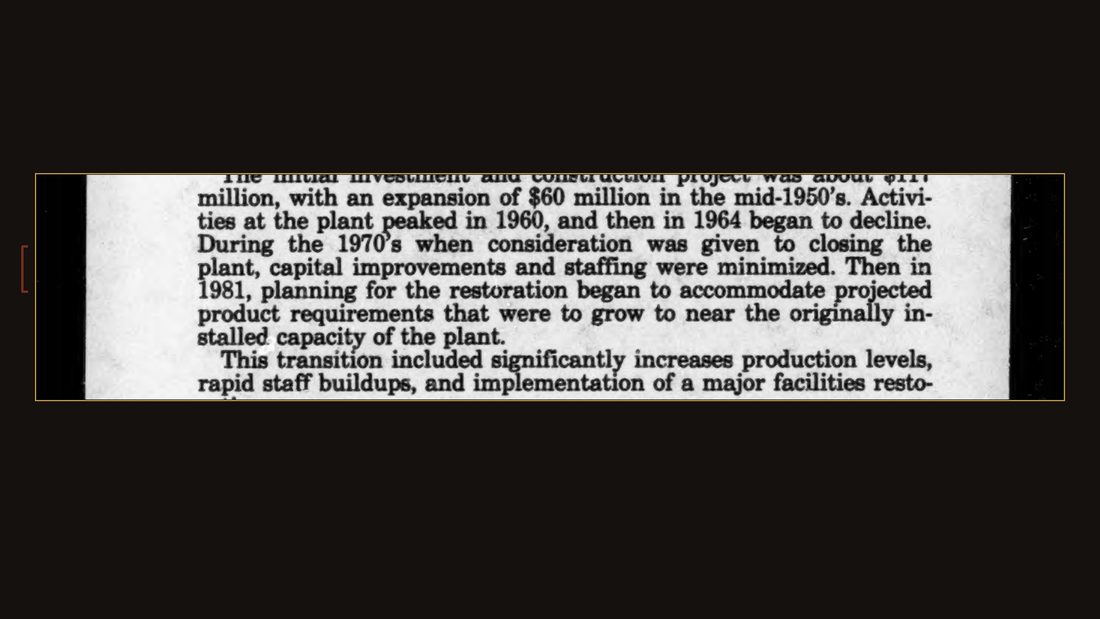
Through the nineteen seventies the government considered closing the place, so it spent as little on it as it could. Then, in nineteen eighty-one, the orders came back.
S12
S. Hrg. 99-156 · U.S. Senate Gov't Affairs · Apr. 22, 1985 · p. 16.
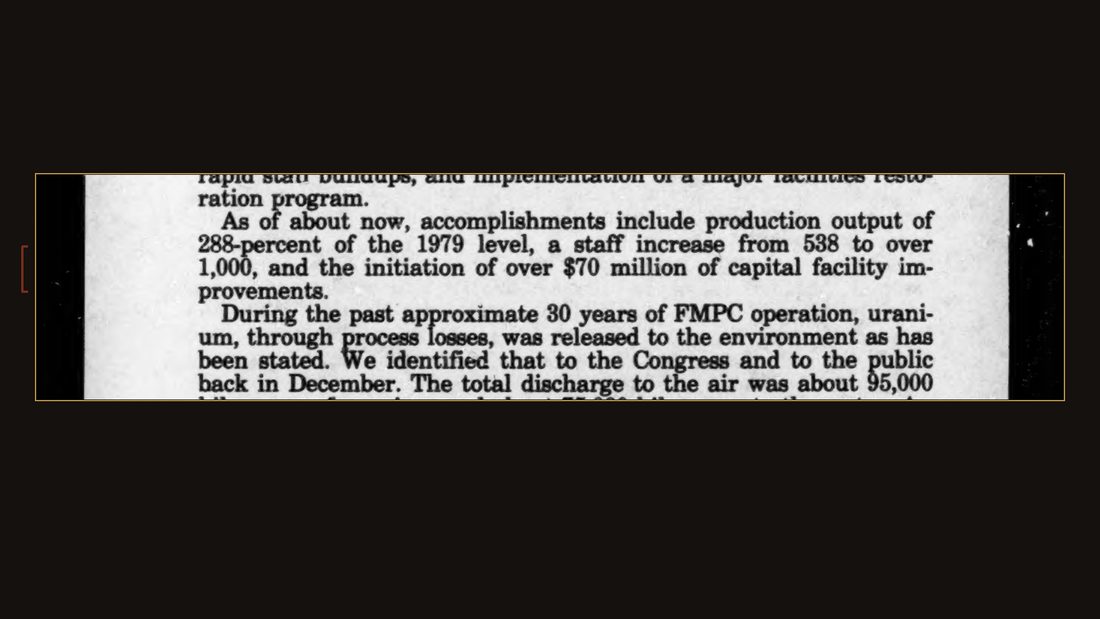
By the spring of nineteen eighty-five the plant was running at two hundred and eighty-eight percent of its nineteen seventy-nine output, and the staff had gone from five hundred and thirty-eight people to over a thousand.
The bags
The thing that caught uranium dust before it went out the stack was a bag house. Rows of long fabric bags, like the world's largest vacuum cleaner.
S13
S. Hrg. 99-156 · U.S. Senate Gov't Affairs · Apr. 22, 1985 · p. 227.
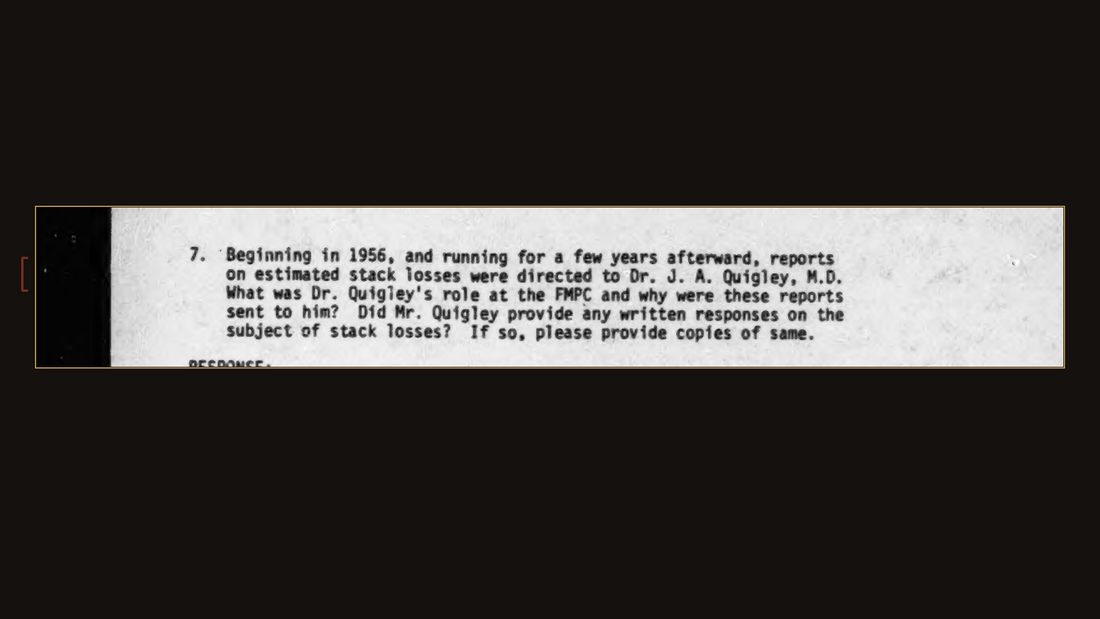
When a bag tore, the dust went out the stack. The Senate asked how often that happened, and it asked about one particular day.
S14
S. Hrg. 99-156 · U.S. Senate Gov't Affairs · Apr. 22, 1985 · p. 227.
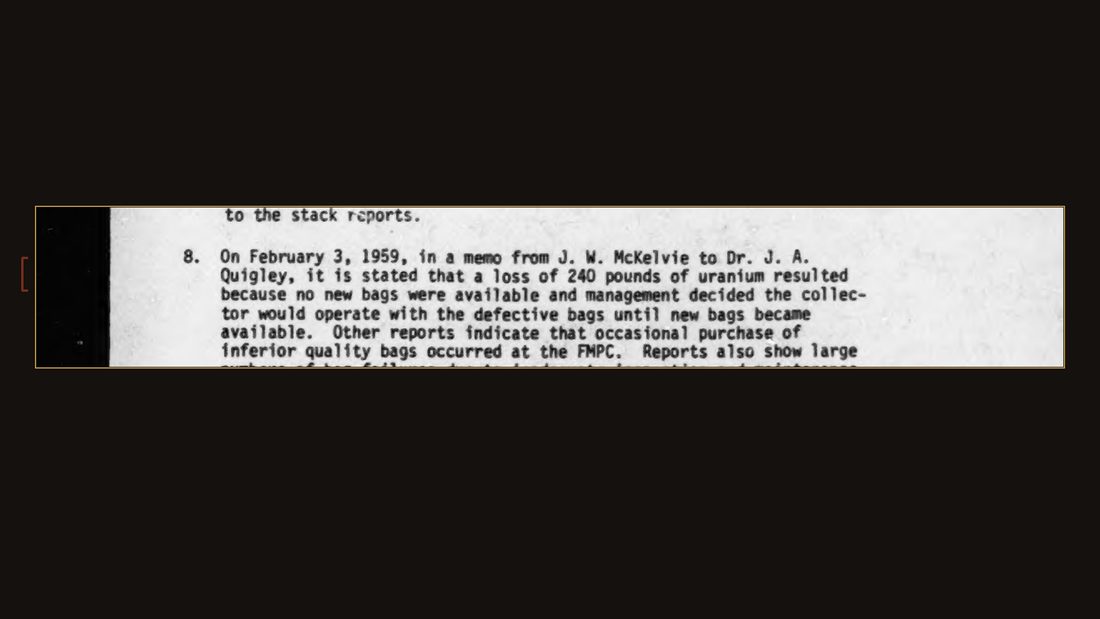
On the third of February, nineteen fifty-nine, an internal memo went from J. W. McKelvie to Doctor J. A. Quigley, the plant's director of health and safety.
S15
S. Hrg. 99-156 · U.S. Senate Gov't Affairs · Apr. 22, 1985 · p. 227.
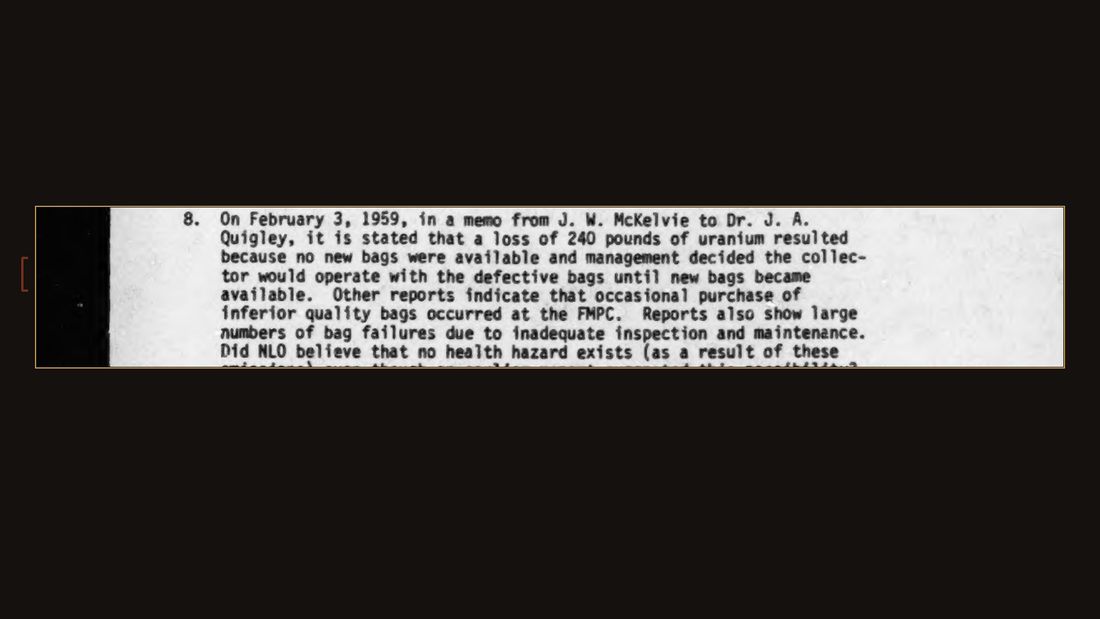
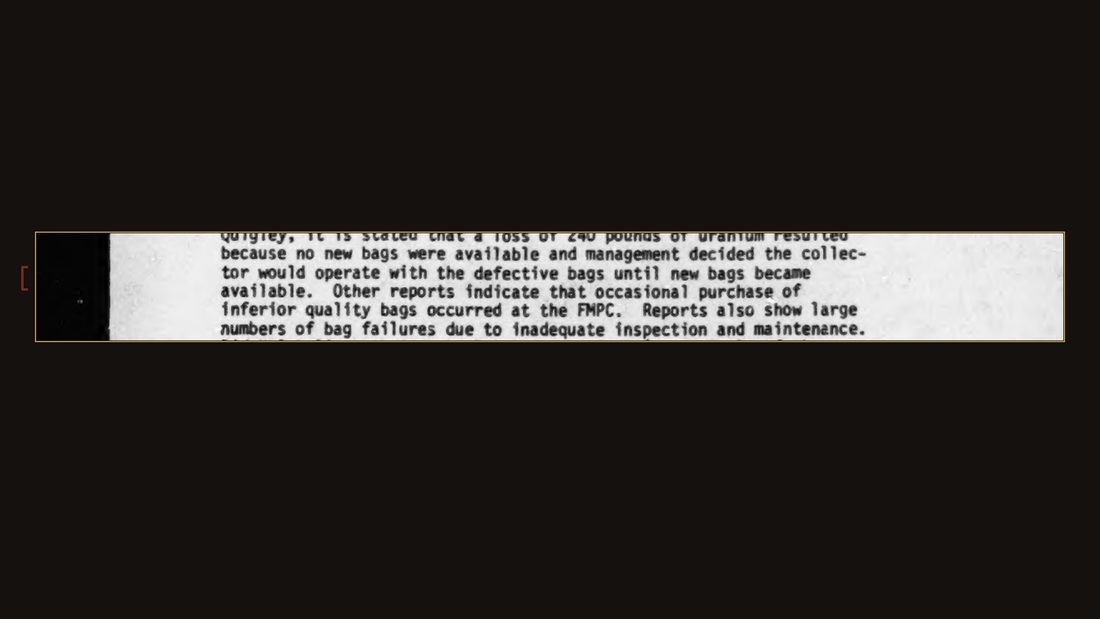
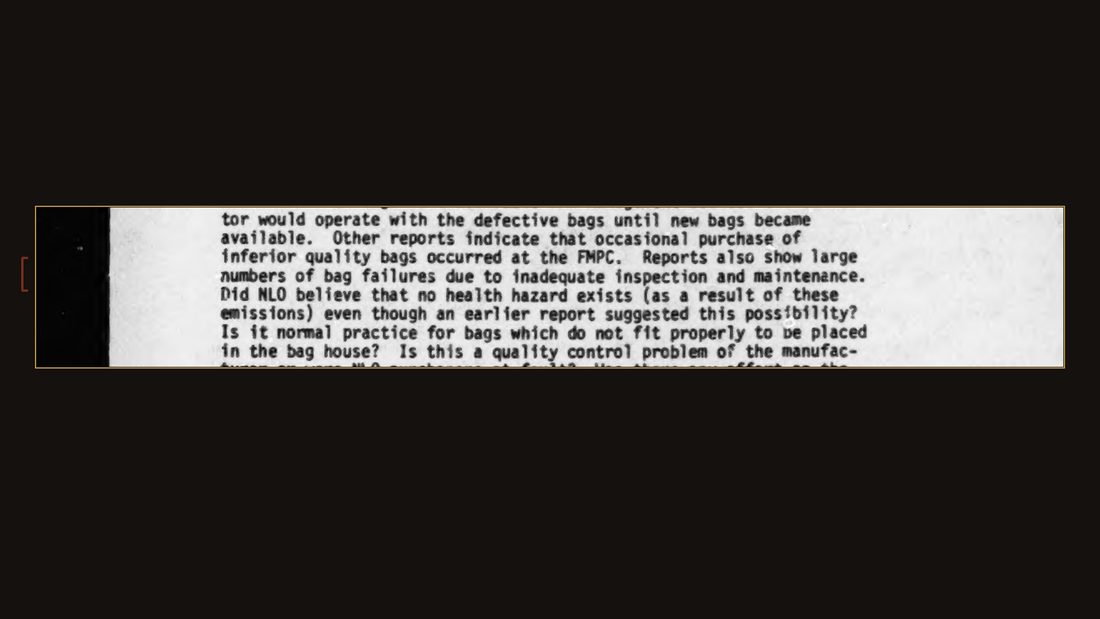
It recorded a loss of two hundred and forty pounds of uranium. The reason given was that no new bags were available, and management decided the collector would keep operating with the defective bags until new ones came in.
S16
S. Hrg. 99-156 · U.S. Senate Gov't Affairs · Apr. 22, 1985 · p. 227.
They knew the filters were torn. They decided to keep running.
S17
S. Hrg. 99-156 · U.S. Senate Gov't Affairs · Apr. 22, 1985 · p. 227.
The committee added that the plant had occasionally bought inferior bags, and that reports showed large numbers of bag failures from inadequate inspection and maintenance.
S18
S. Hrg. 99-156 · U.S. Senate Gov't Affairs · Apr. 22, 1985 · p. 227.
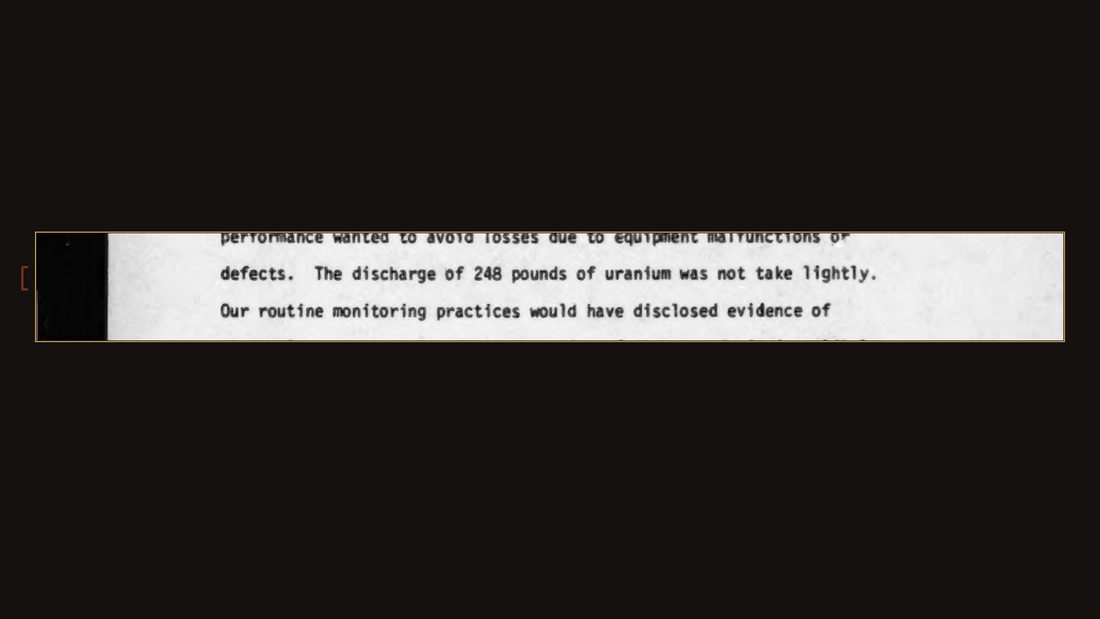
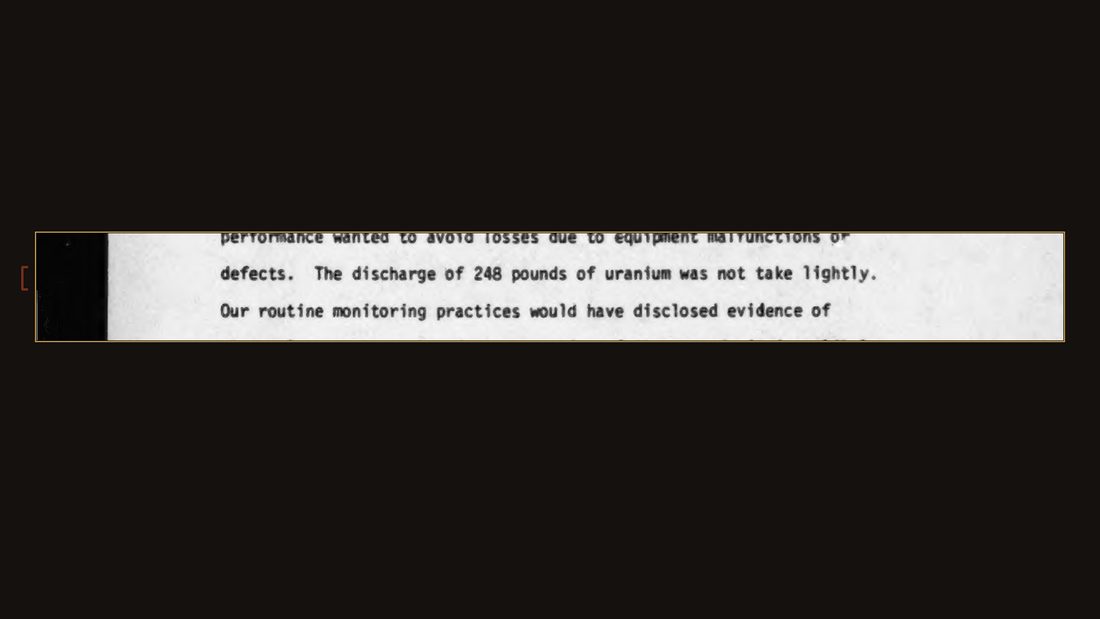
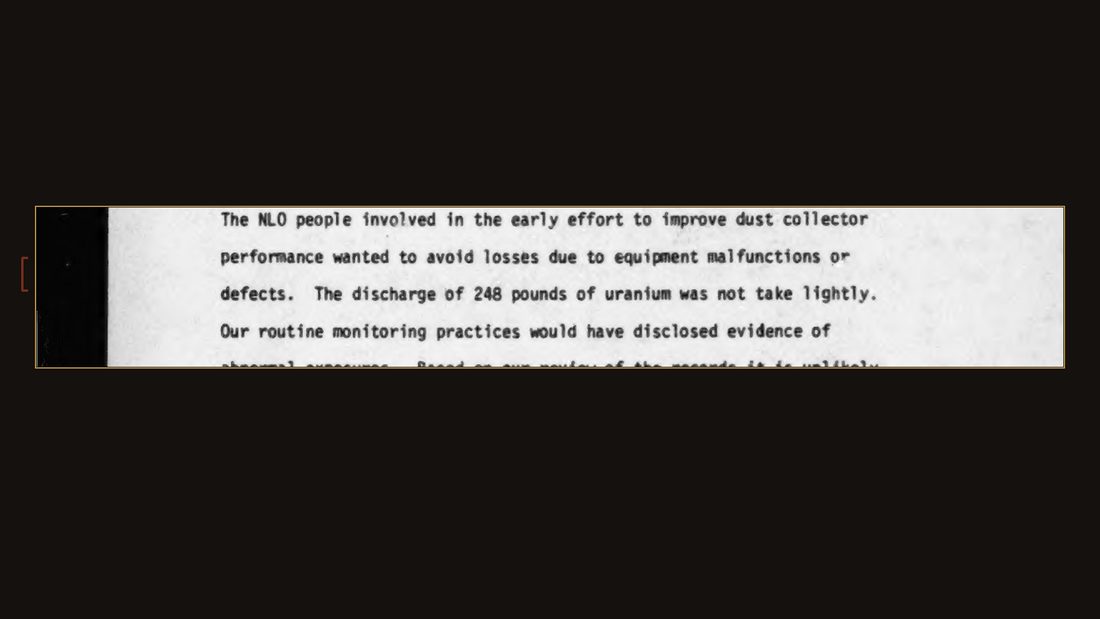
The contractor's written answer is four sentences long. It says the discharge of two hundred and forty-eight pounds of uranium was not taken lightly.
S19
S. Hrg. 99-156 · U.S. Senate Gov't Affairs · Apr. 22, 1985 · p. 227.
The question said two hundred and forty pounds. The answer said two hundred and forty-eight. Nobody in four hundred and thirty-four pages ever reconciles the two.
S20
S. Hrg. 99-156 · U.S. Senate Gov't Affairs · Apr. 22, 1985 · p. 227.
And the answer does not answer. It was asked whether the company had experimented with cheaper bags that failed more easily. It replies that the people involved wanted to avoid losses.
No such device existed
S21
S. Hrg. 99-156 · U.S. Senate Gov't Affairs · Apr. 22, 1985 · p. 229.
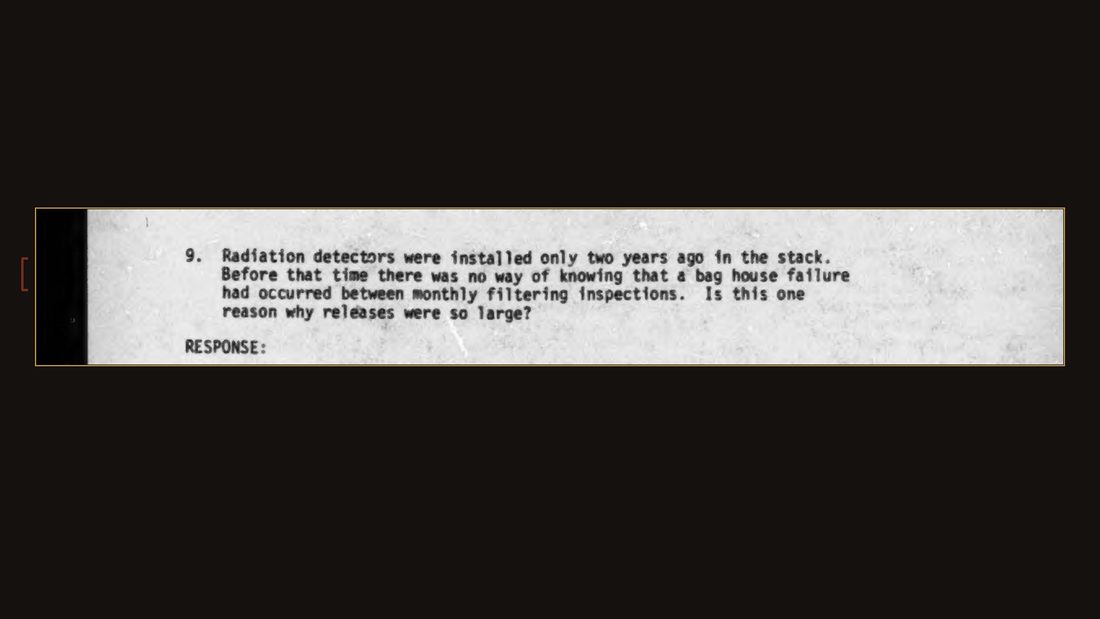
The Senate also asked why nobody noticed the leaks sooner. The reply is the most revealing paragraph in the volume.
S22
S. Hrg. 99-156 · U.S. Senate Gov't Affairs · Apr. 22, 1985 · p. 229.
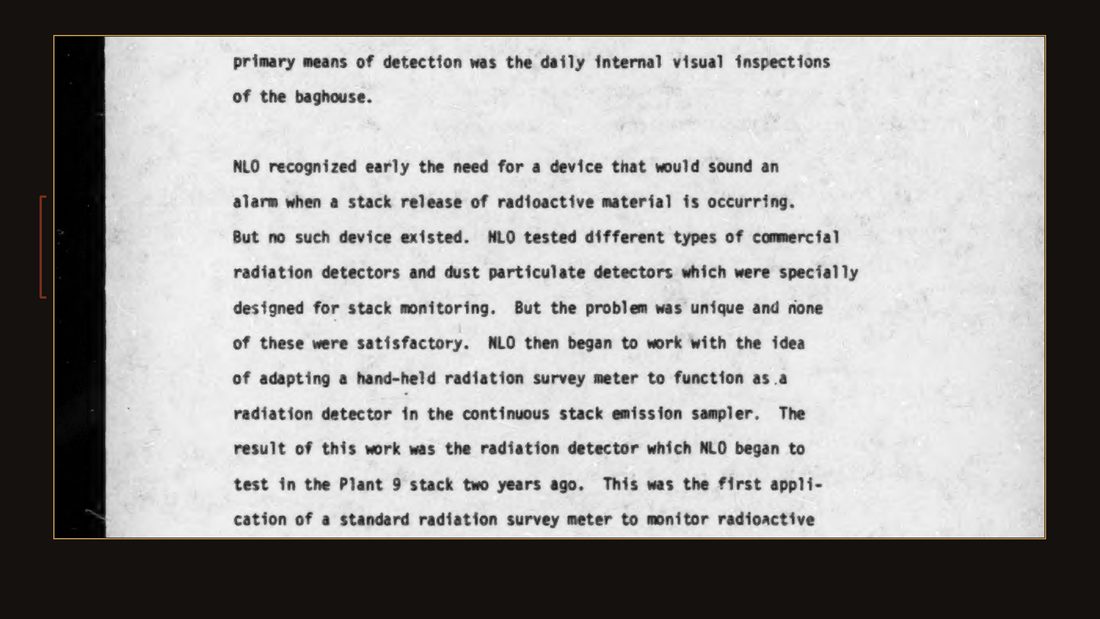
N-L-O wrote that it had recognized early the need for a device that would sound an alarm when a stack release of radioactive material was occurring.
S23
S. Hrg. 99-156 · U.S. Senate Gov't Affairs · Apr. 22, 1985 · p. 229.
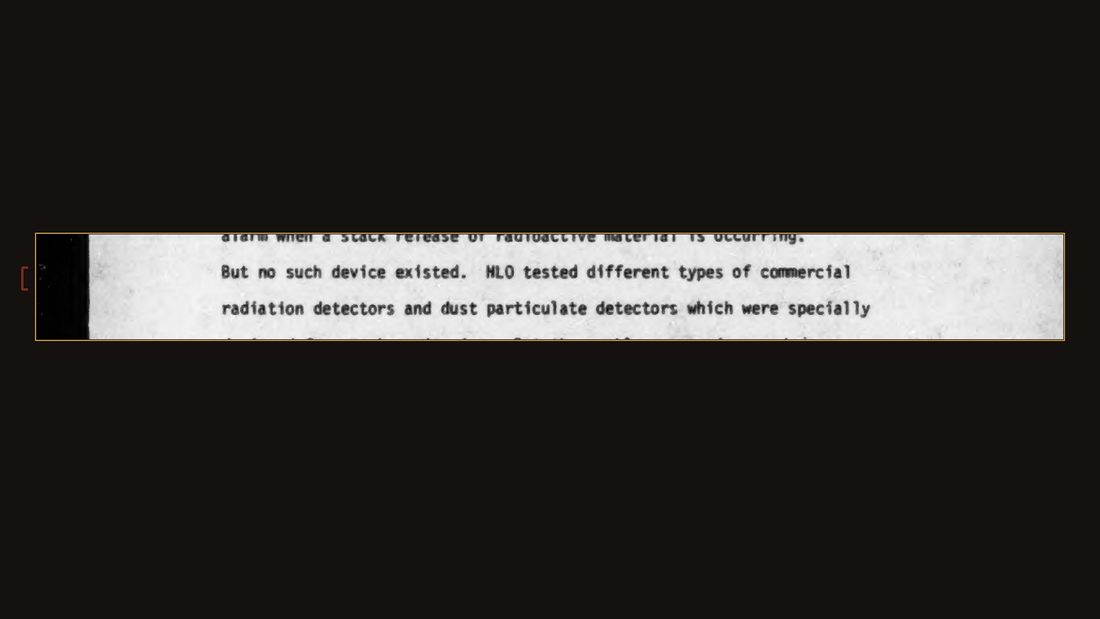
And then: but no such device existed.
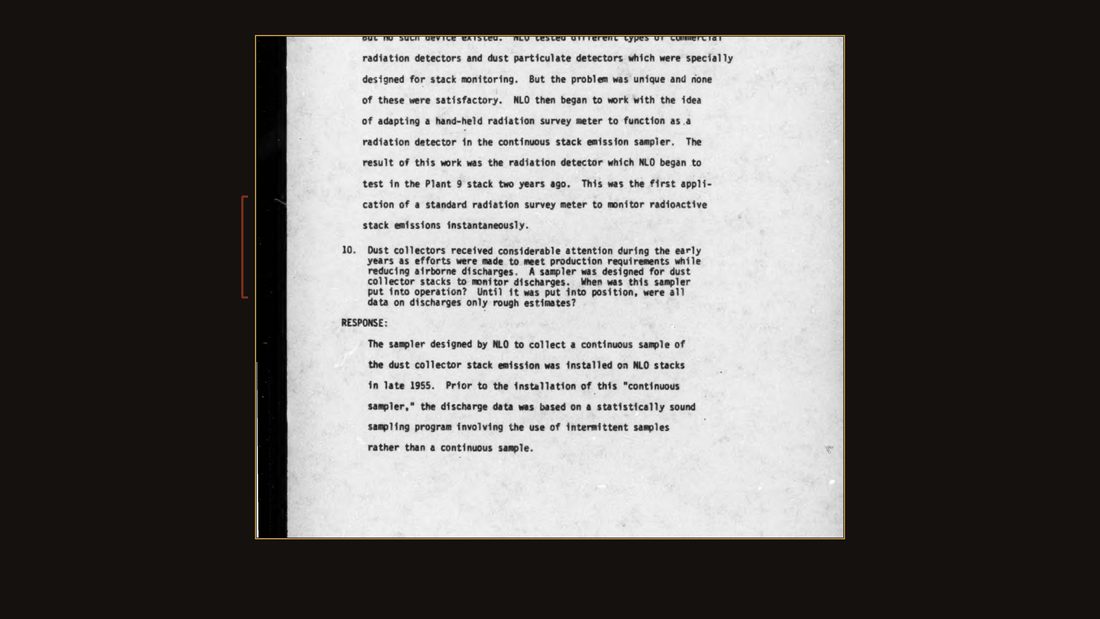
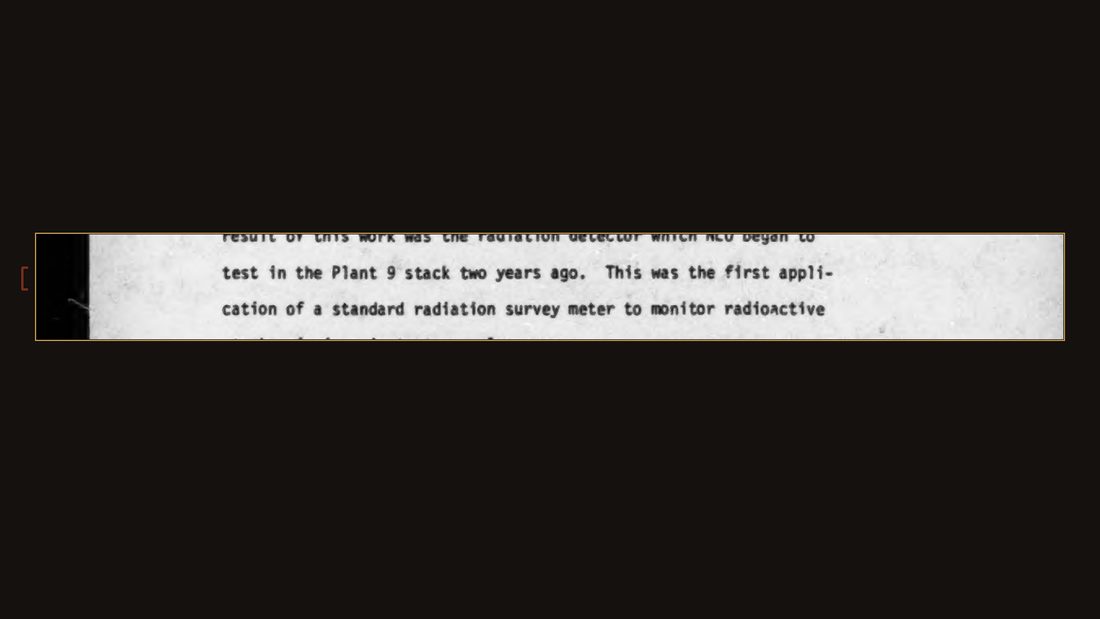
So they improvised. They took a hand-held radiation survey meter, the kind an inspector carries on a belt, and adapted it to sit inside the stack sampler.
S24
S. Hrg. 99-156 · U.S. Senate Gov't Affairs · Apr. 22, 1985 · p. 229.
They began testing it in the Plant Nine stack two years before the hearing. That is to say, around nineteen eighty-three.
S25
S. Hrg. 99-156 · U.S. Senate Gov't Affairs · Apr. 22, 1985 · p. 229.
The plant had been running since nineteen fifty-one. For roughly three decades, nothing at that stack told anyone, in the moment, that uranium was leaving it.
Ninety-five thousand
S26
S. Hrg. 99-156 · U.S. Senate Gov't Affairs · Apr. 22, 1985 · p. 111.
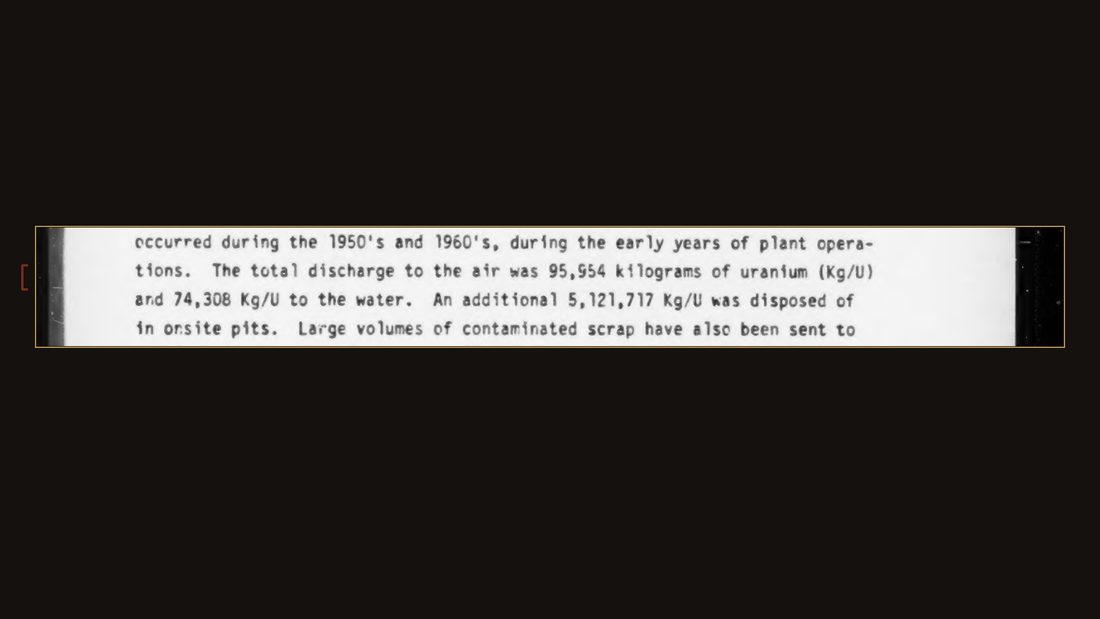
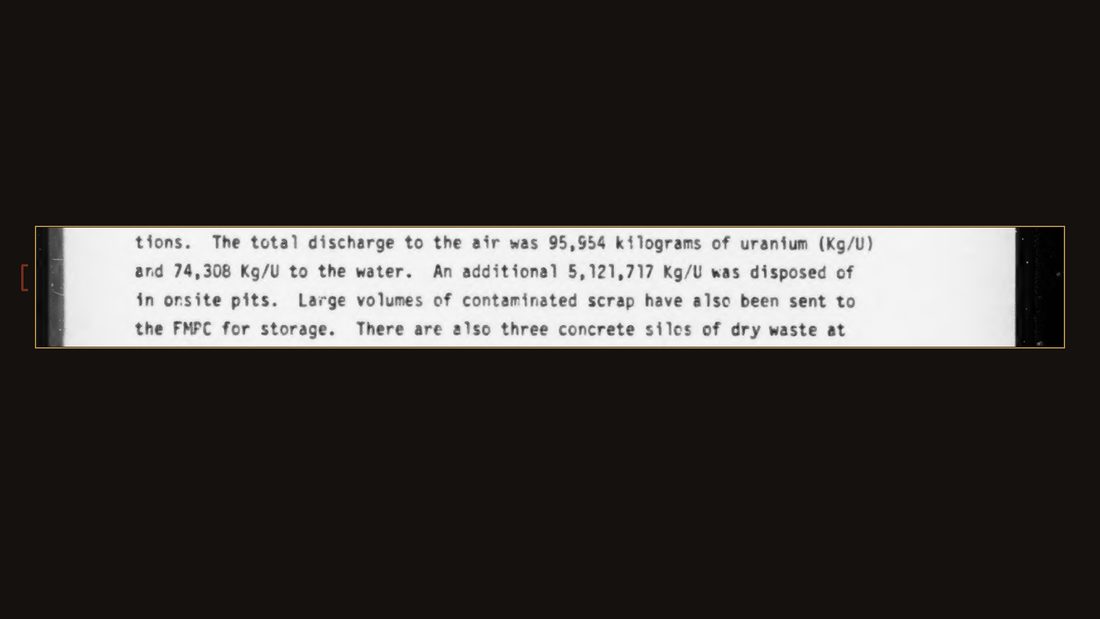
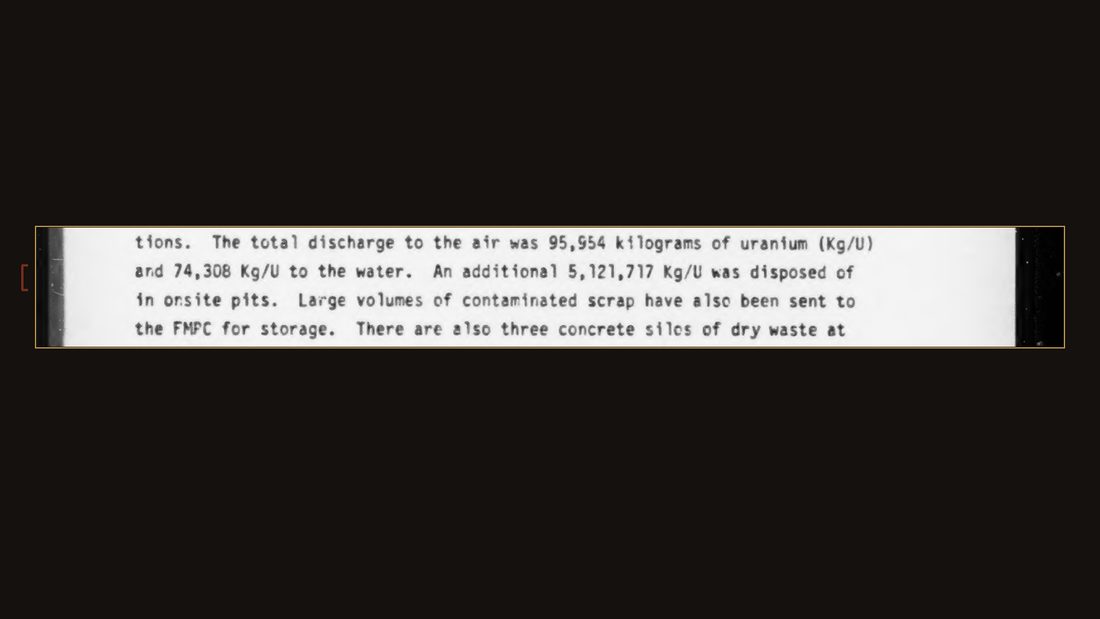
So here is the arithmetic the government finally did on itself. Over about thirty years of operation, the total discharge to the air was ninety-five thousand, nine hundred and fifty-four kilograms of uranium.
S27
S. Hrg. 99-156 · U.S. Senate Gov't Affairs · Apr. 22, 1985 · p. 111.
Seventy-four thousand, three hundred and eight kilograms went to the water.
S28
S. Hrg. 99-156 · U.S. Senate Gov't Affairs · Apr. 22, 1985 · p. 111.
And five million, one hundred twenty-one thousand, seven hundred and seventeen kilograms went into the pits.
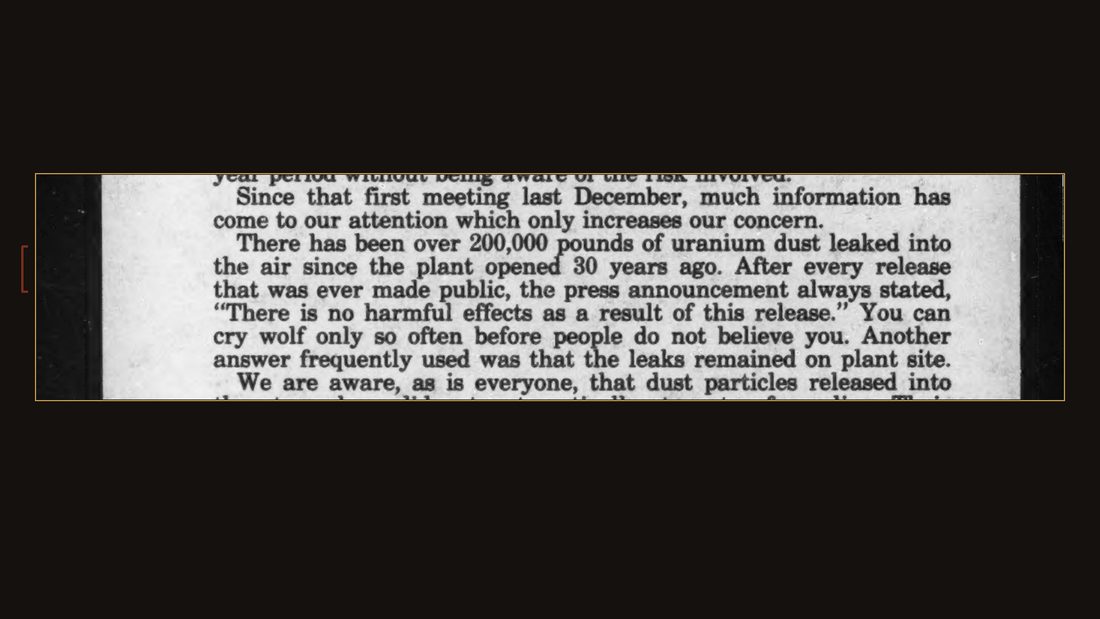
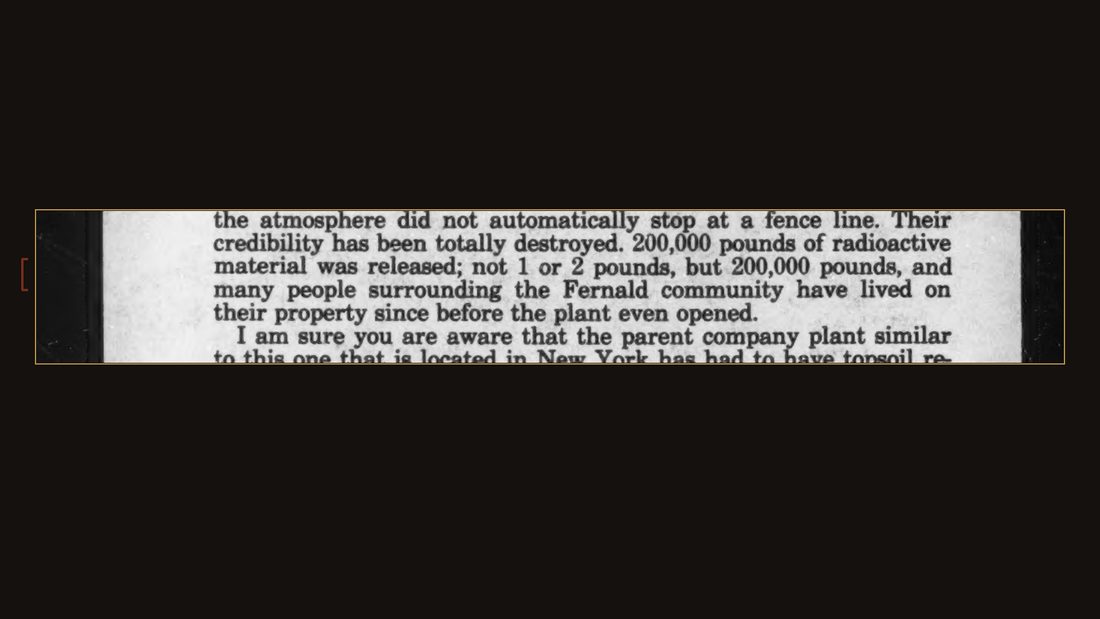
In pounds, the amount that went into the air is a little over two hundred thousand.
S29
S. Hrg. 99-156 · U.S. Senate Gov't Affairs · Apr. 22, 1985 · p. 254.
A woman named Kathy Meyer put that number to the committee herself, and she put it the way a neighbor would.
S30
S. Hrg. 99-156 · U.S. Senate Gov't Affairs · Apr. 22, 1985 · p. 254.
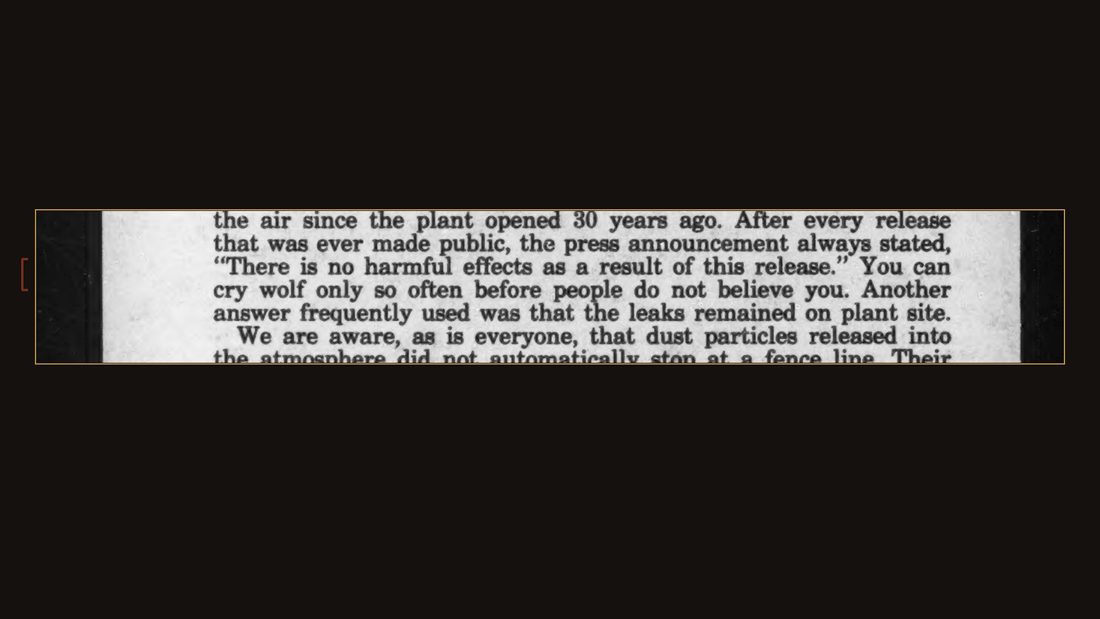
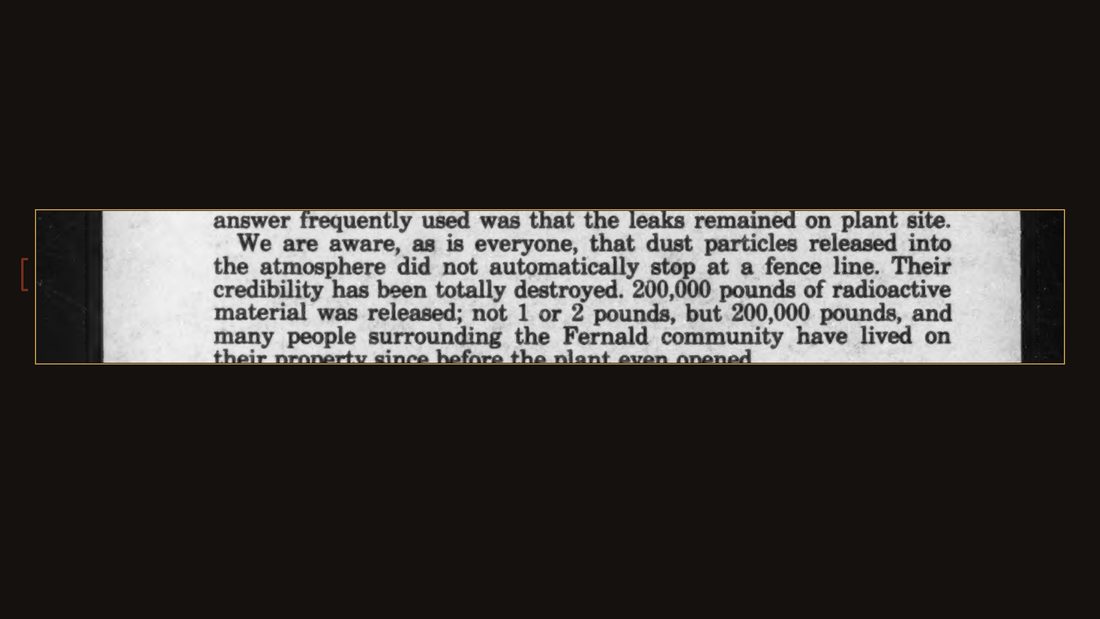
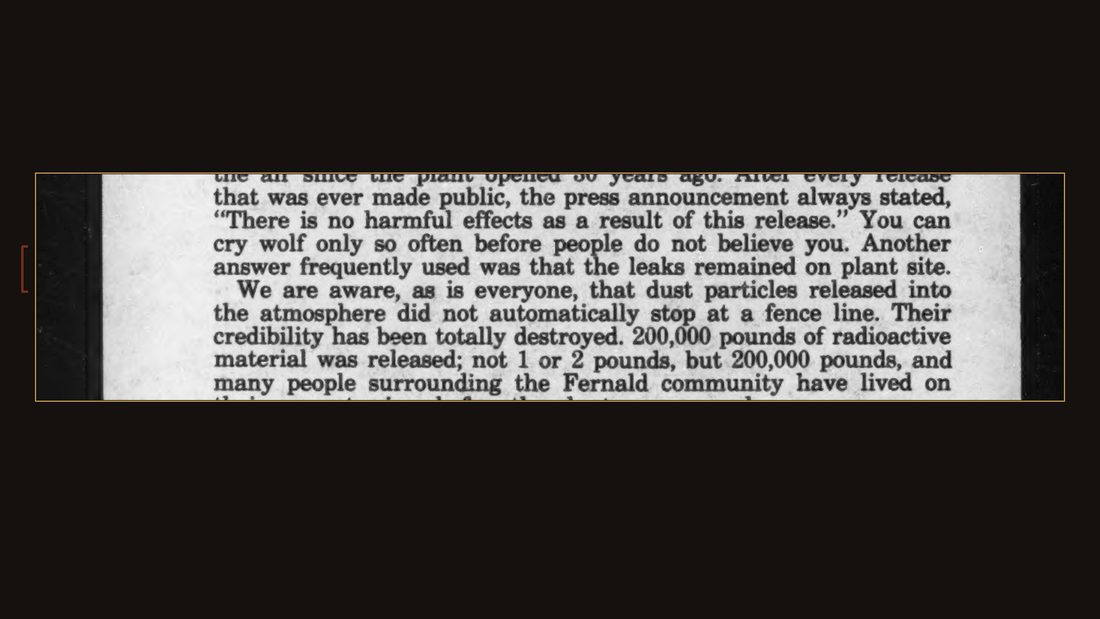
Two hundred thousand pounds of radioactive material was released. Not one or two pounds, she said. Two hundred thousand pounds.
S31
S. Hrg. 99-156 · U.S. Senate Gov't Affairs · Apr. 22, 1985 · p. 254.
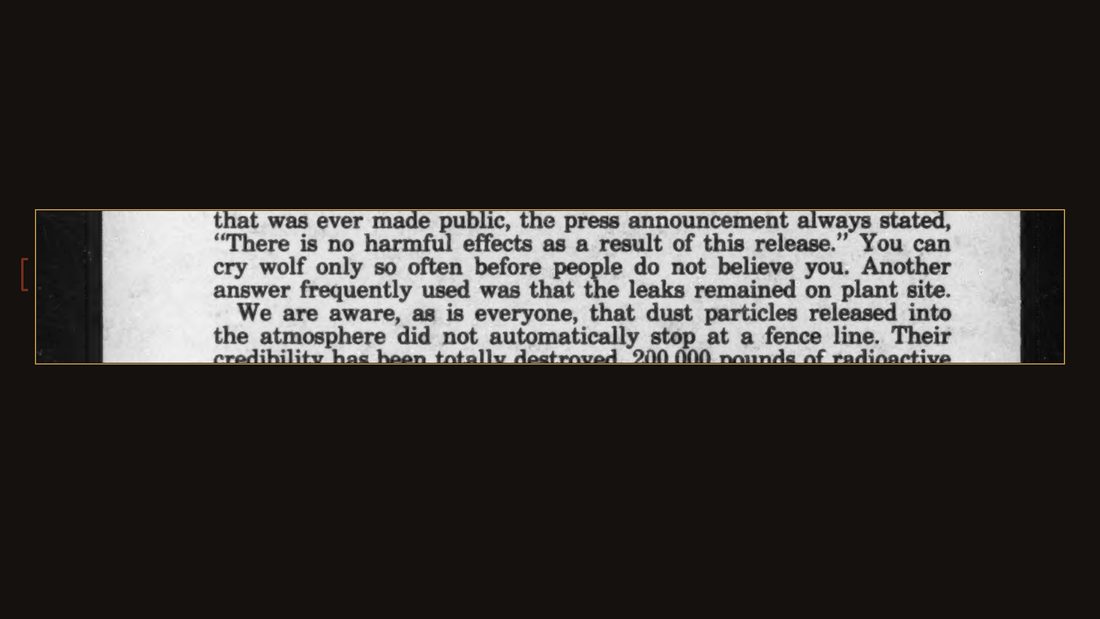
She also told them what the plant said every single time. After every release that was ever made public, the press announcement always stated: there is no harmful effects as a result of this release.
S32
S. Hrg. 99-156 · U.S. Senate Gov't Affairs · Apr. 22, 1985 · p. 254.
You can cry wolf only so often, she said, before people do not believe you.
S33
S. Hrg. 99-156 · U.S. Senate Gov't Affairs · Apr. 22, 1985 · p. 254.
The other standard answer was that the leaks stayed on plant property. Dust particles released into the atmosphere, she said, did not automatically stop at a fence line.
Three point six four pounds
Then there were the silos.
S34
S. Hrg. 99-156 · U.S. Senate Gov't Affairs · Apr. 22, 1985 · p. 212.
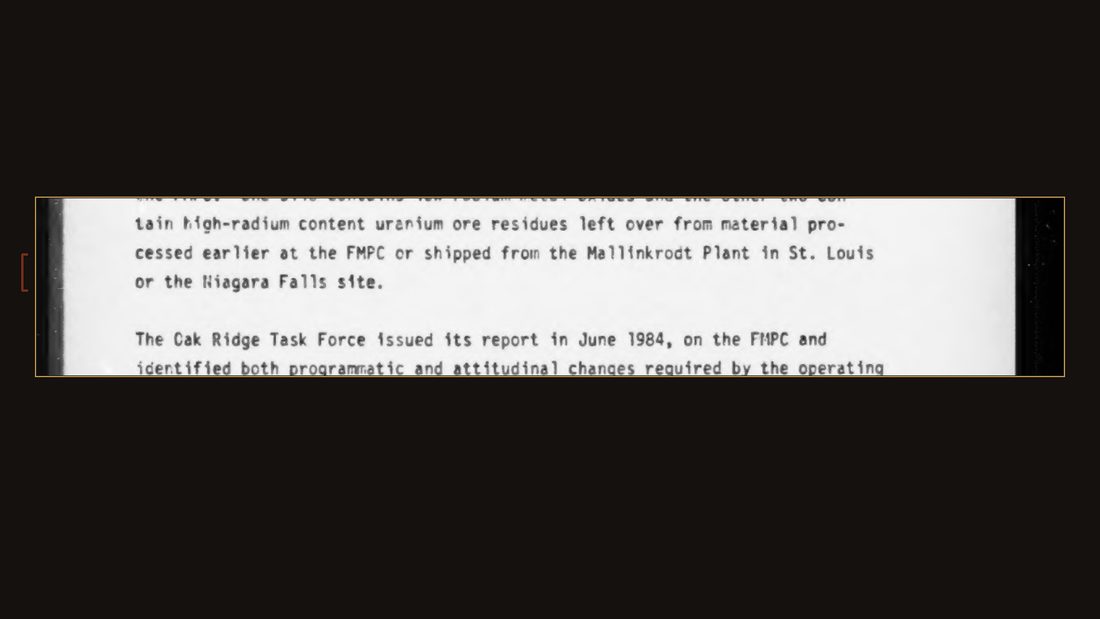
Concrete silos stood above ground on the site. Two of them held what the record calls K-sixty-five residues: high-radium leftovers from processing uranium ore.
S35
S. Hrg. 99-156 · U.S. Senate Gov't Affairs · Apr. 22, 1985 · p. 111.
They were shipped in from a plant in St. Louis and a site at Niagara Falls, and they went into those silos between nineteen fifty-two and nineteen fifty-nine.
S36
S. Hrg. 99-156 · U.S. Senate Gov't Affairs · Apr. 22, 1985 · p. 212.
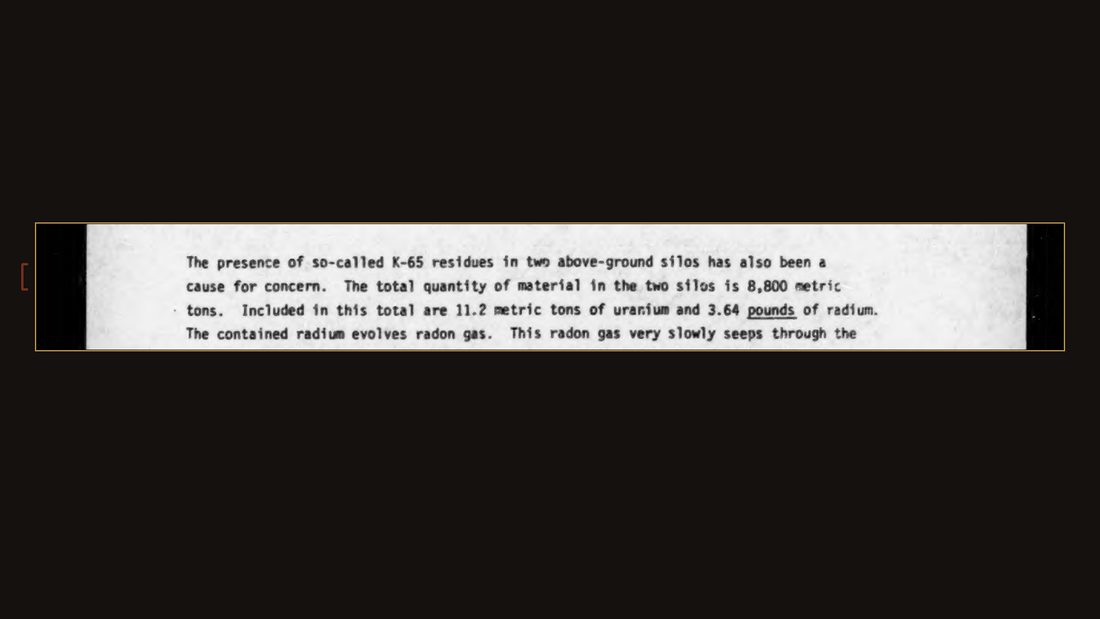
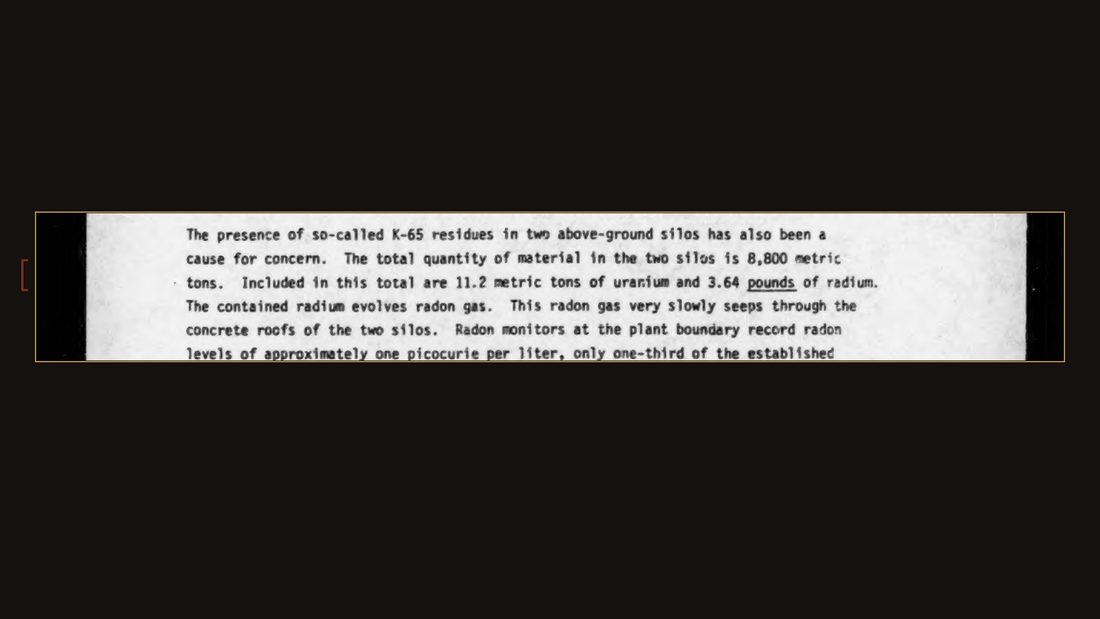
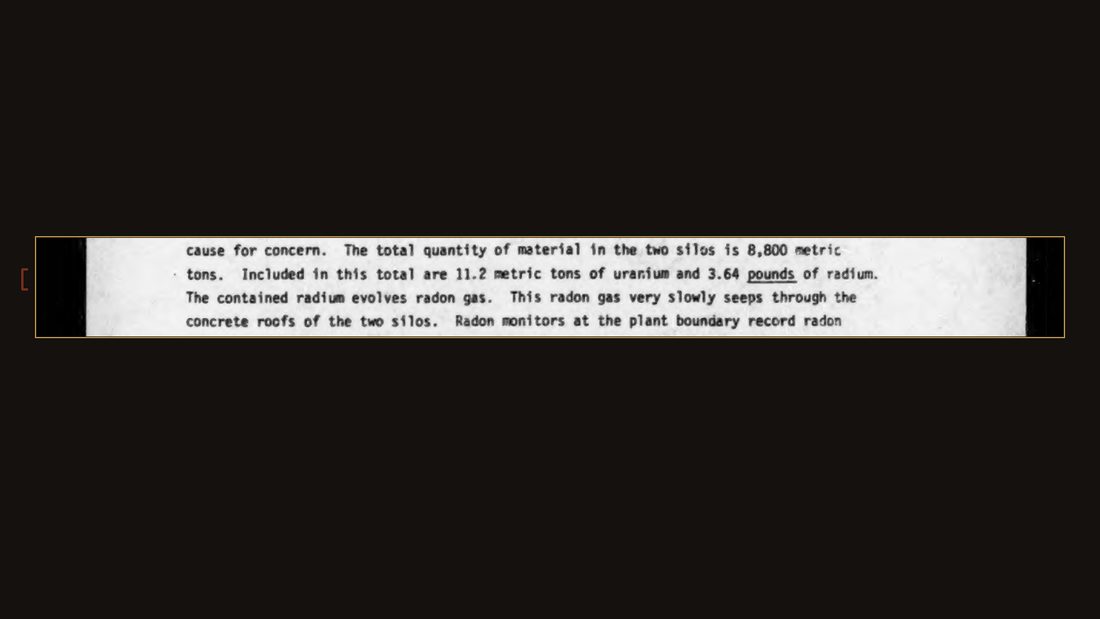
The contractor gave the committee the contents. Eight thousand eight hundred metric tons of material in the two silos. Inside that, eleven point two metric tons of uranium, and three point six four pounds of radium.
S37
S. Hrg. 99-156 · U.S. Senate Gov't Affairs · Apr. 22, 1985 · p. 212.
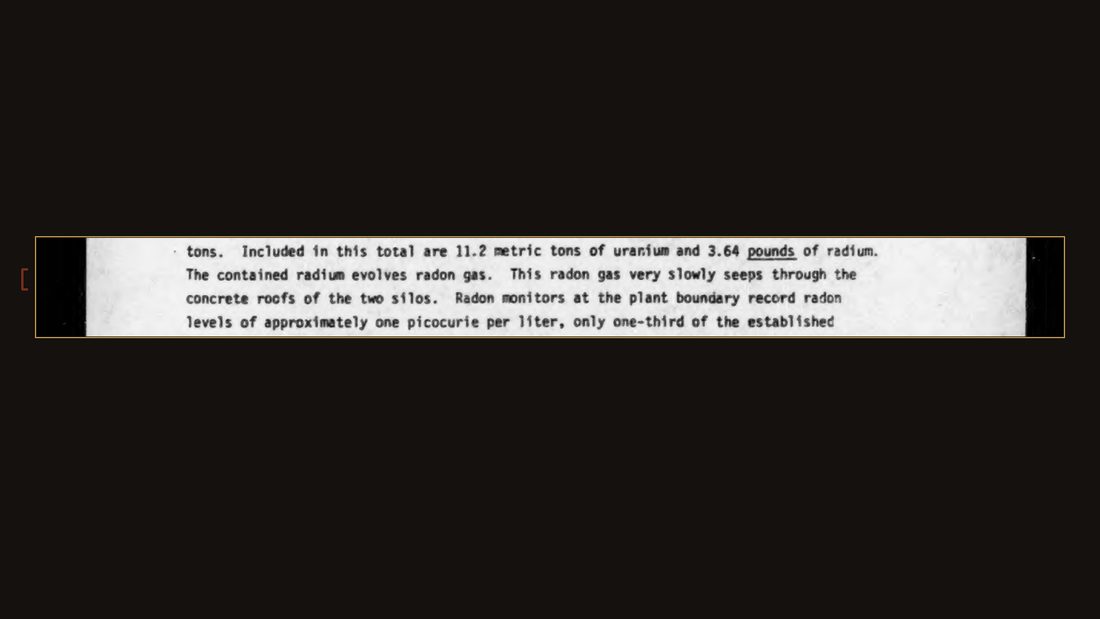
In the typed original, the word pounds is underlined. That underline is the contractor telling the Senate it is only a few pounds.
Radium is measured in grams and fractions of grams. The women who painted radium onto watch dials and died of it were carrying micrograms.
S38
S. Hrg. 99-156 · U.S. Senate Gov't Affairs · Apr. 22, 1985 · p. 212.
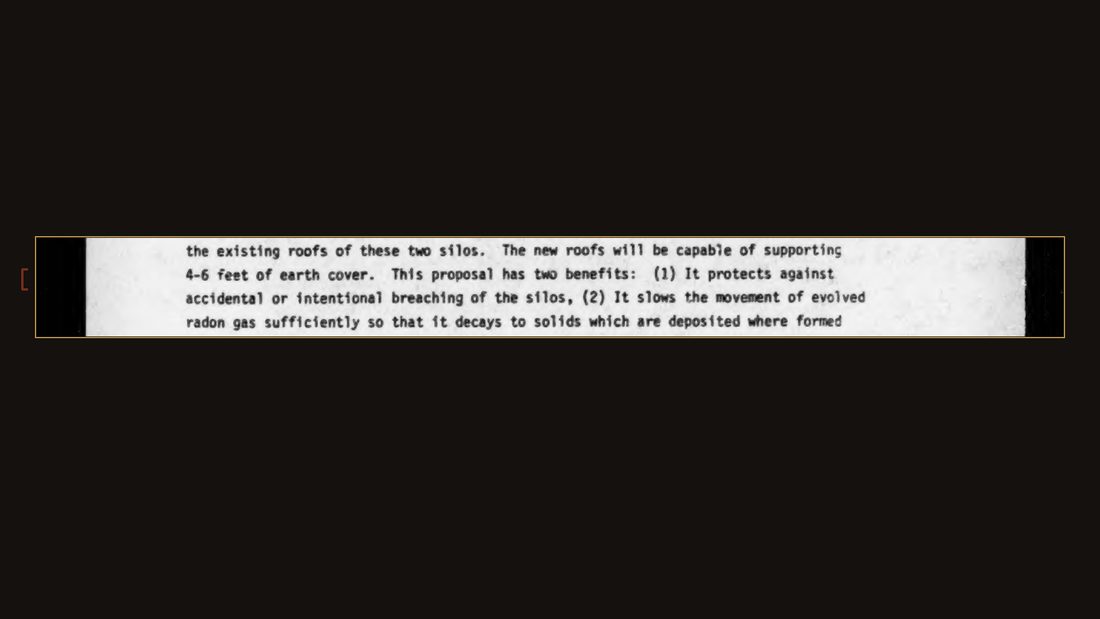
The radium was evolving radon gas, and the radon was seeping up through the concrete roofs of the silos.
S39
S. Hrg. 99-156 · U.S. Senate Gov't Affairs · Apr. 22, 1985 · p. 212.
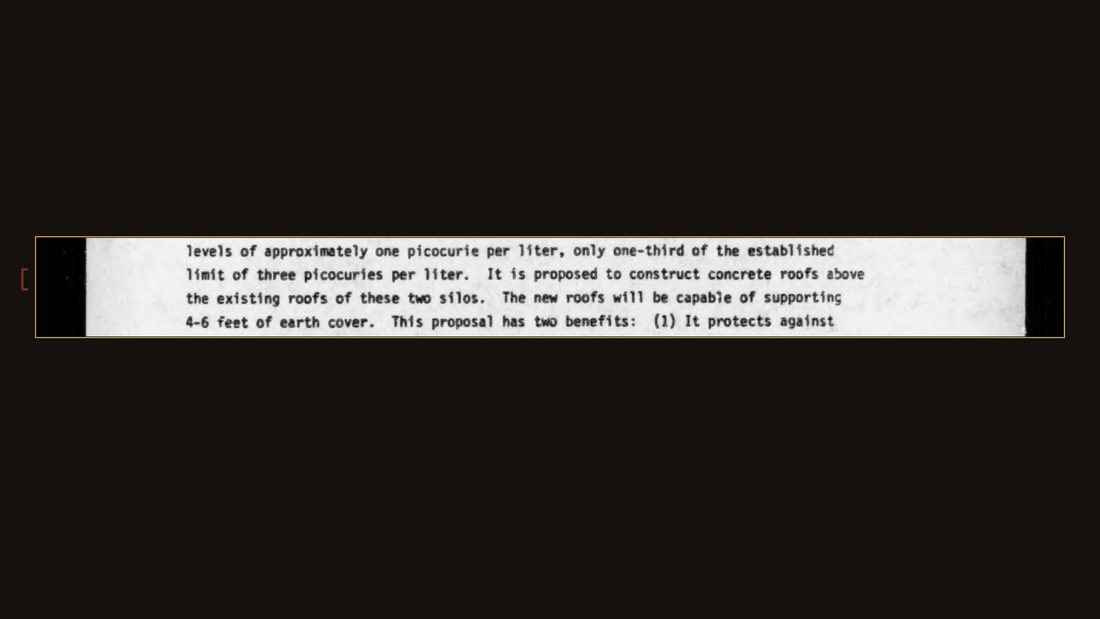
The proposed fix was to build a second set of concrete roofs over the first, strong enough to hold four to six feet of earth on top.
S40
S. Hrg. 99-156 · U.S. Senate Gov't Affairs · Apr. 22, 1985 · p. 212.
The solution to a leaking container was to bury the container.
Unaccounted for
S41
S. Hrg. 99-156 · U.S. Senate Gov't Affairs · Apr. 22, 1985 · p. 16.
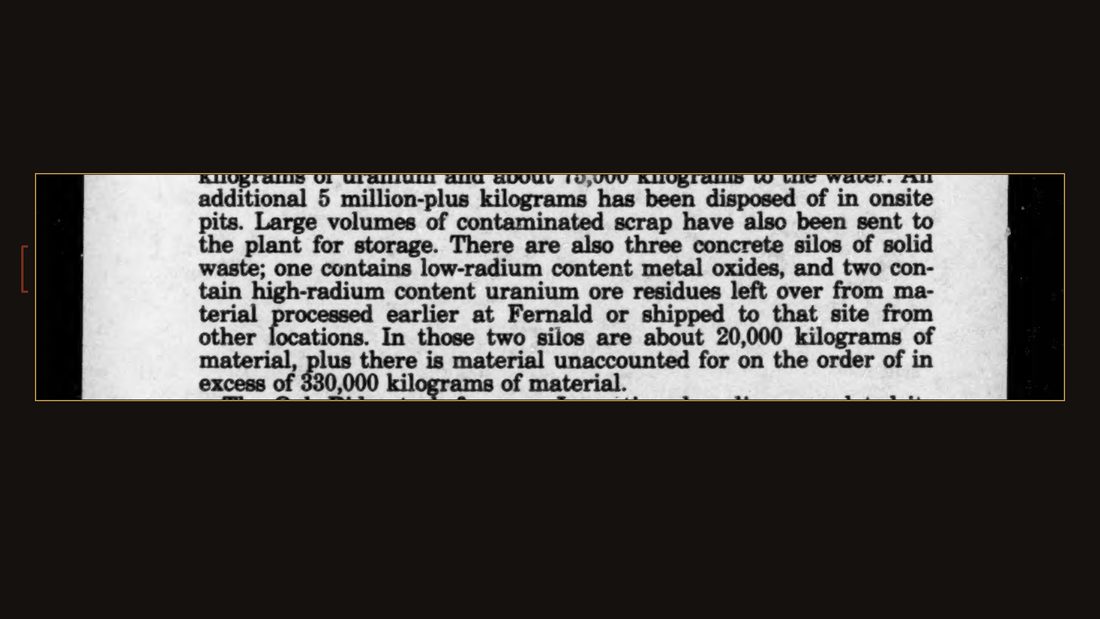
Now the part that is hardest to read. La Grone told the committee what was in those two silos, and then added one more clause.
S42
S. Hrg. 99-156 · U.S. Senate Gov't Affairs · Apr. 22, 1985 · p. 16.
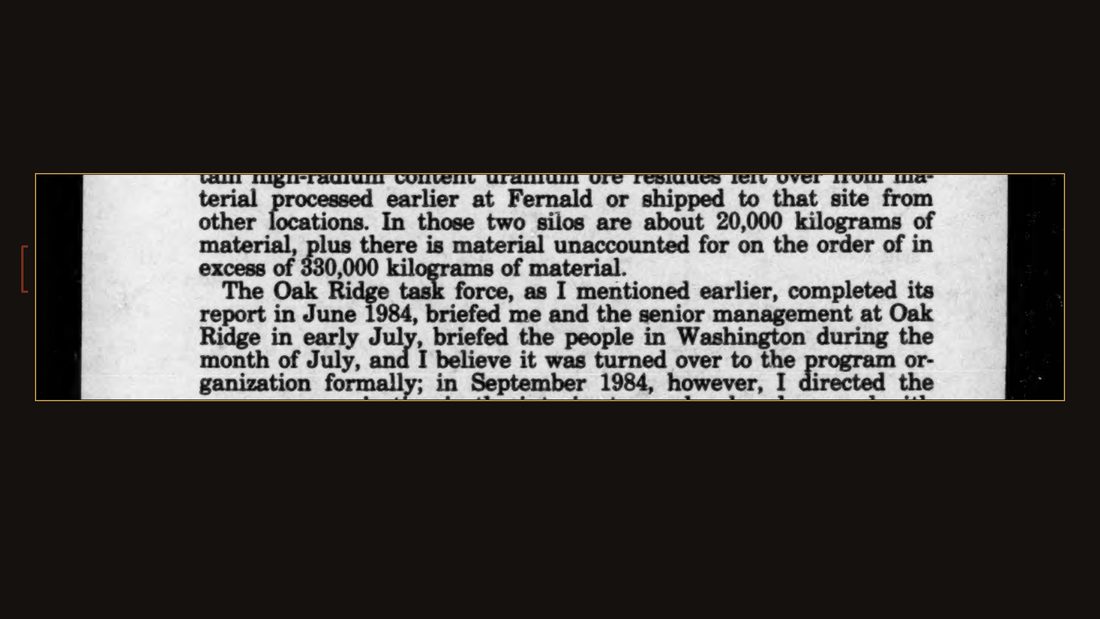
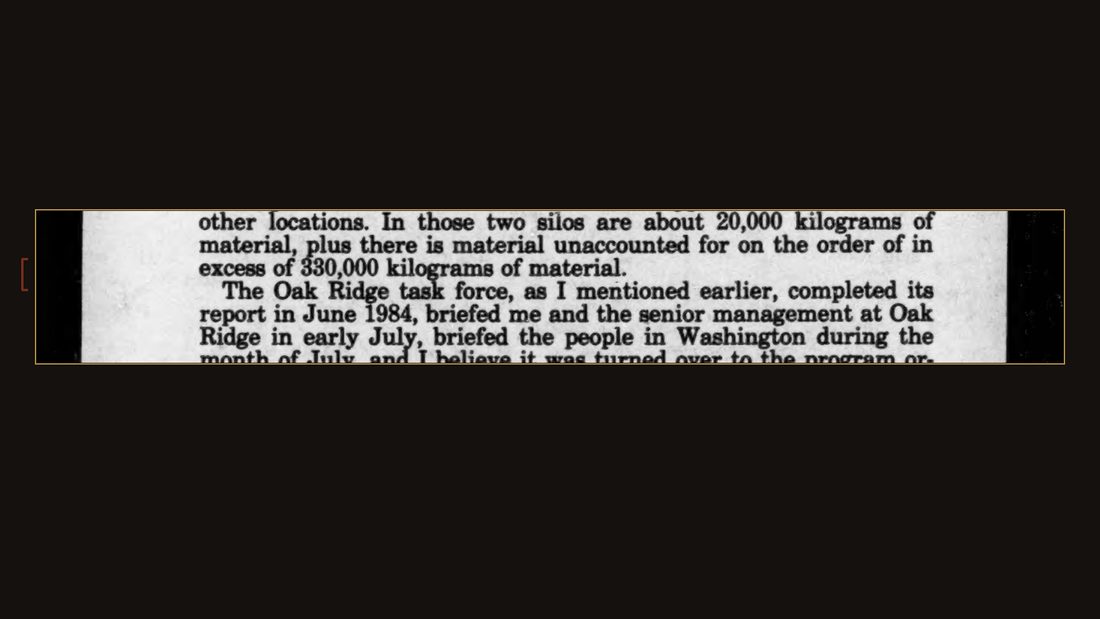
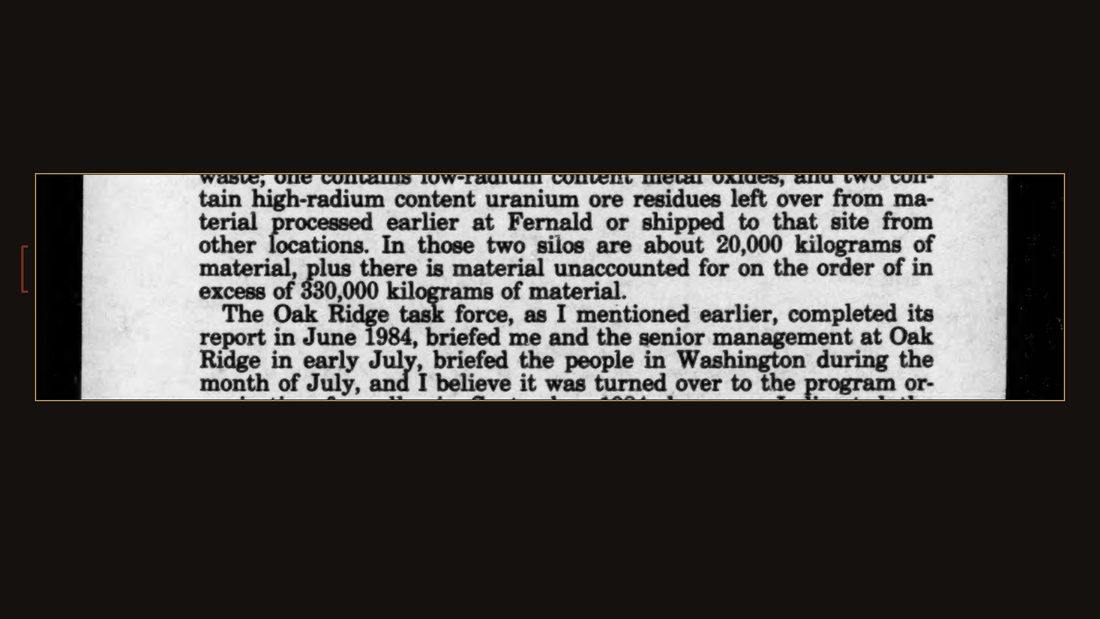
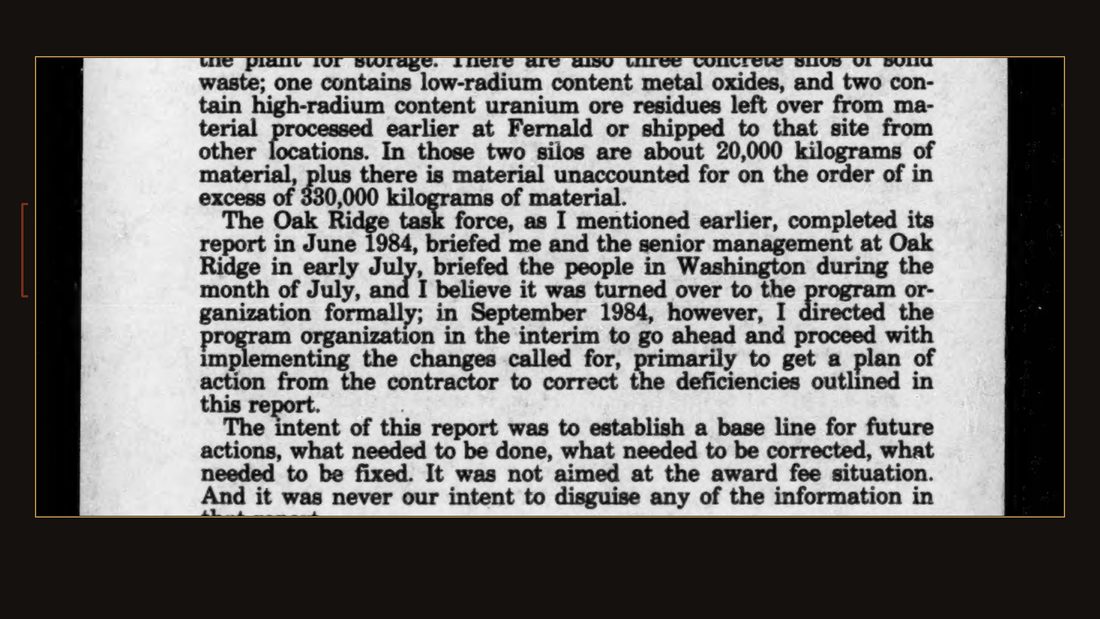
In those two silos are about twenty thousand kilograms of material, he said, plus there is material unaccounted for on the order of in excess of three hundred and thirty thousand kilograms of material.
S43
S. Hrg. 99-156 · U.S. Senate Gov't Affairs · Apr. 22, 1985 · p. 16.
Unaccounted for. Three hundred and thirty thousand kilograms.
S44
S. Hrg. 99-156 · U.S. Senate Gov't Affairs · Apr. 22, 1985 · p. 16.
That is the manager of Oak Ridge Operations telling the United States Senate that the government could not say where a third of a million kilograms of its own radioactive material had gone.
S45
S. Hrg. 99-156 · U.S. Senate Gov't Affairs · Apr. 22, 1985 · p. 47.
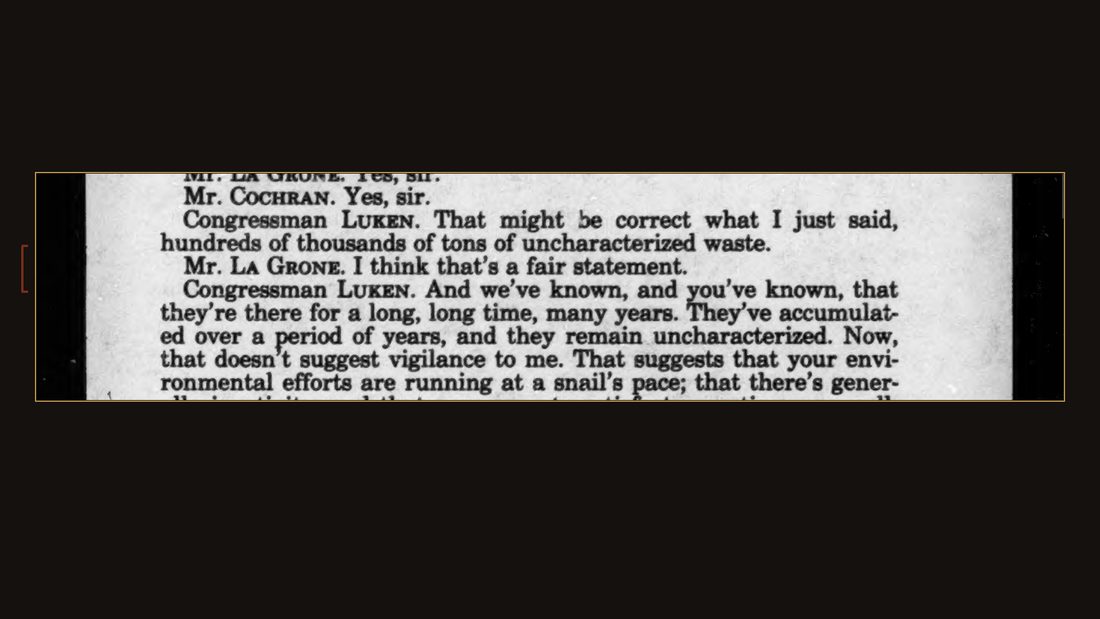
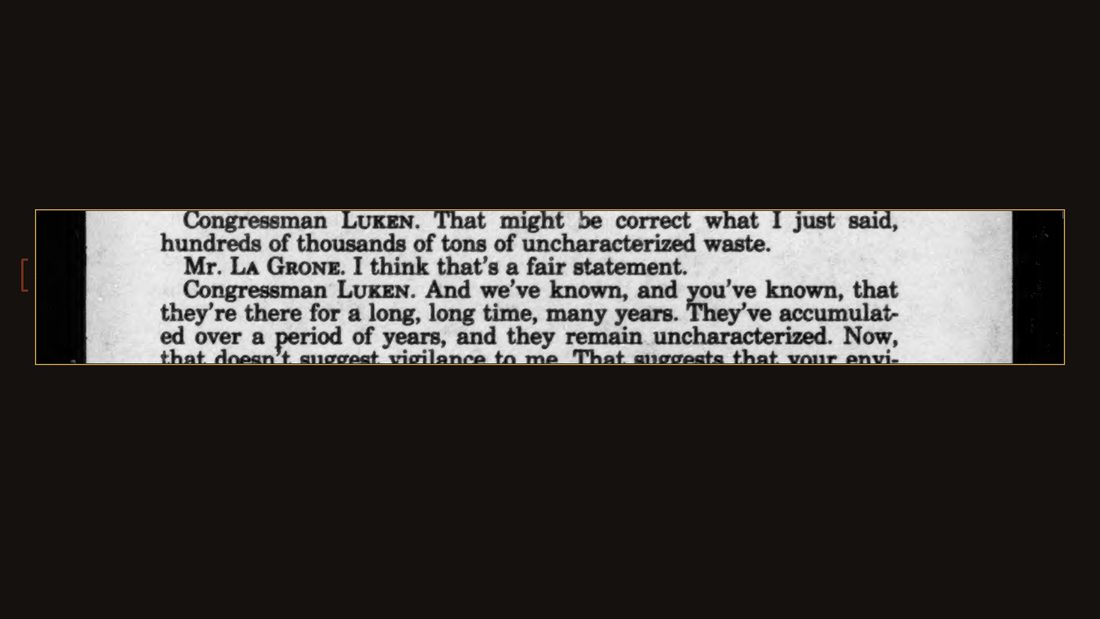
Congressman Tom Lukin of Cincinnati asked about the pits, and put it to the two Energy Department witnesses as a number. Hundreds of thousands of tons of uncharacterized waste.
S46
S. Hrg. 99-156 · U.S. Senate Gov't Affairs · Apr. 22, 1985 · p. 47.
Uncharacterized means nobody had established what was in it. La Grone answered: I think that's a fair statement.
They had been putting material in those pits since the Truman administration, and in nineteen eighty-five they could not tell a congressman what was down there.
S47
S. Hrg. 99-156 · U.S. Senate Gov't Affairs · Apr. 22, 1985 · p. 432.
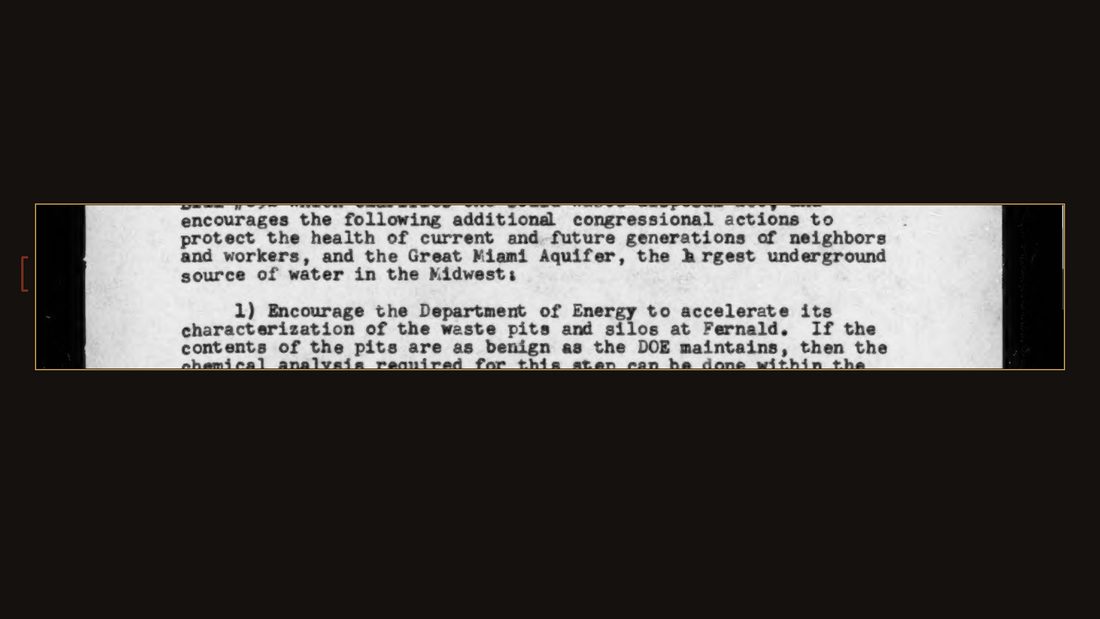
Underneath all of it is the Great Miami Aquifer. One of the statements filed with the committee calls it the largest underground source of water in the Midwest.
The wells
S48
S. Hrg. 99-156 · U.S. Senate Gov't Affairs · Apr. 22, 1985 · p. 265.
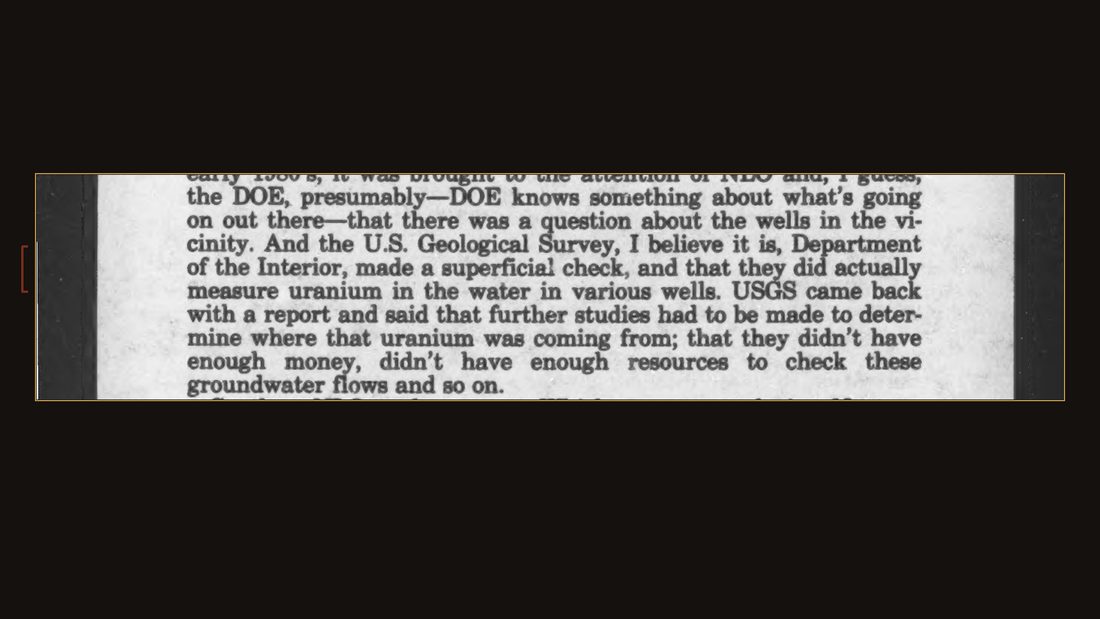
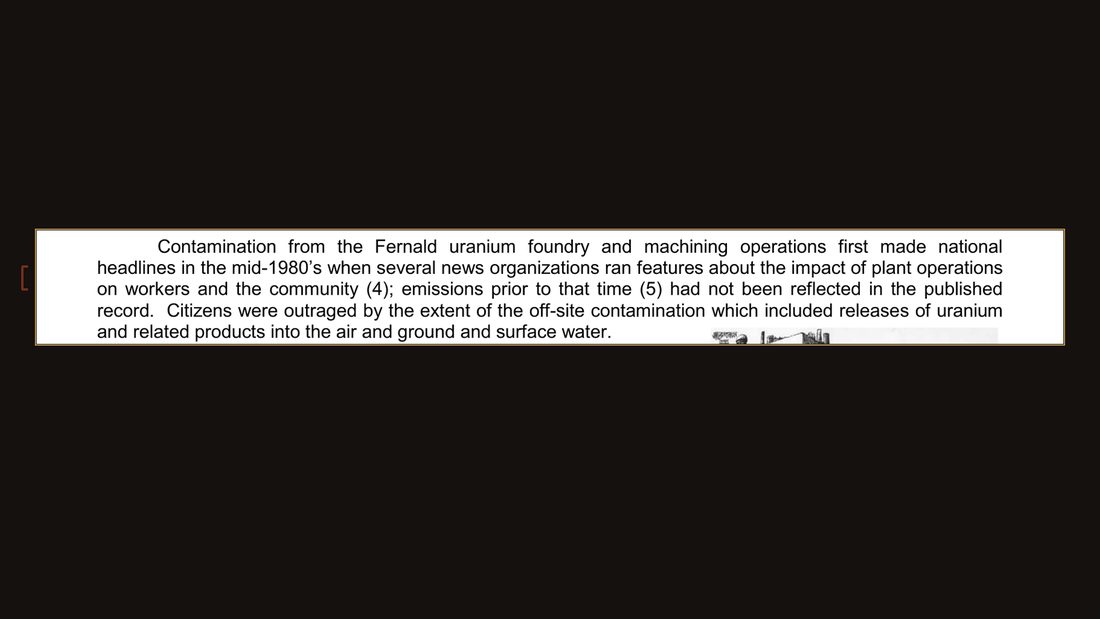
In nineteen eighty-one the United States Geological Survey looked at wells near the plant and found uranium in the water.
The Survey said further study was needed to determine where the uranium was coming from, and that it did not have the money or the people to do it.
S49
S. Hrg. 99-156 · U.S. Senate Gov't Affairs · Apr. 22, 1985 · p. 266.
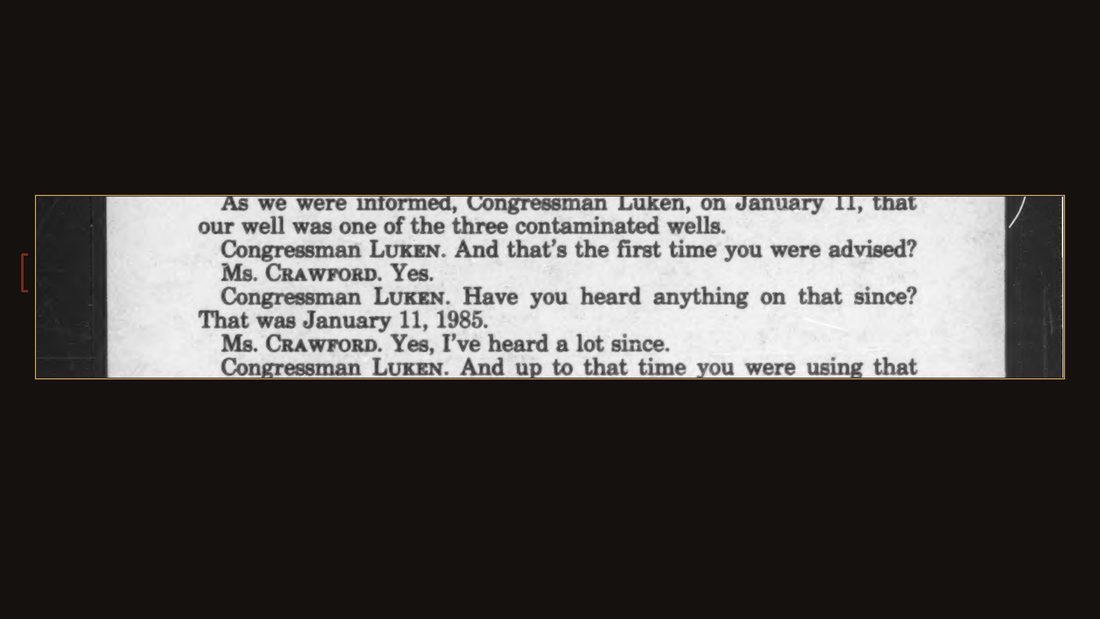
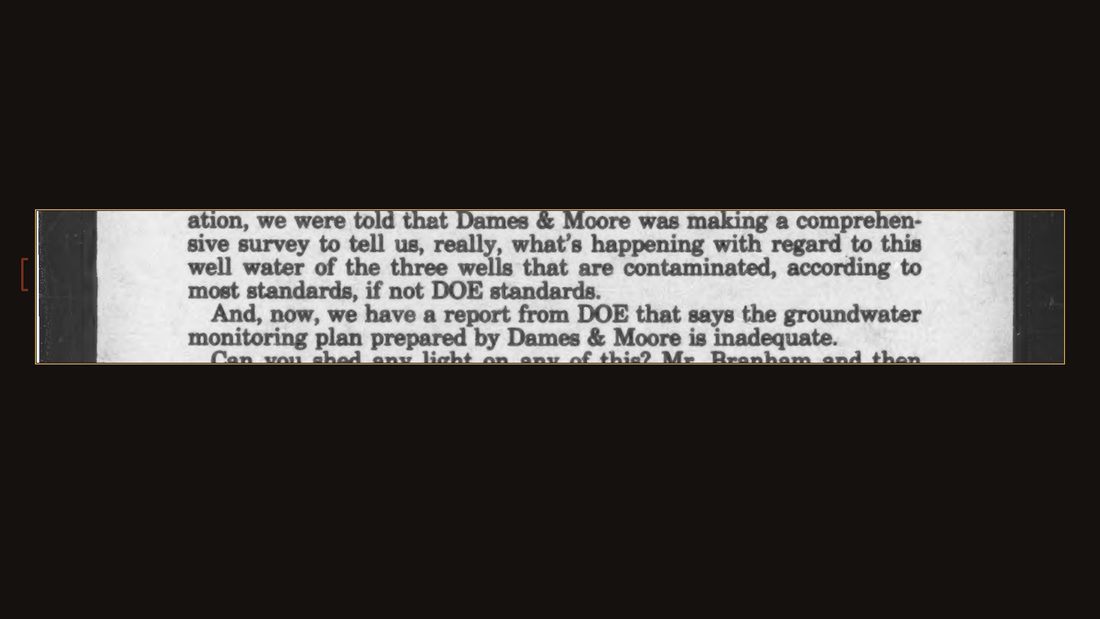
Three wells were eventually identified as contaminated. One of them served a rented farmhouse on Willey Road.
S50
S. Hrg. 99-156 · U.S. Senate Gov't Affairs · Apr. 22, 1985 · p. 253.
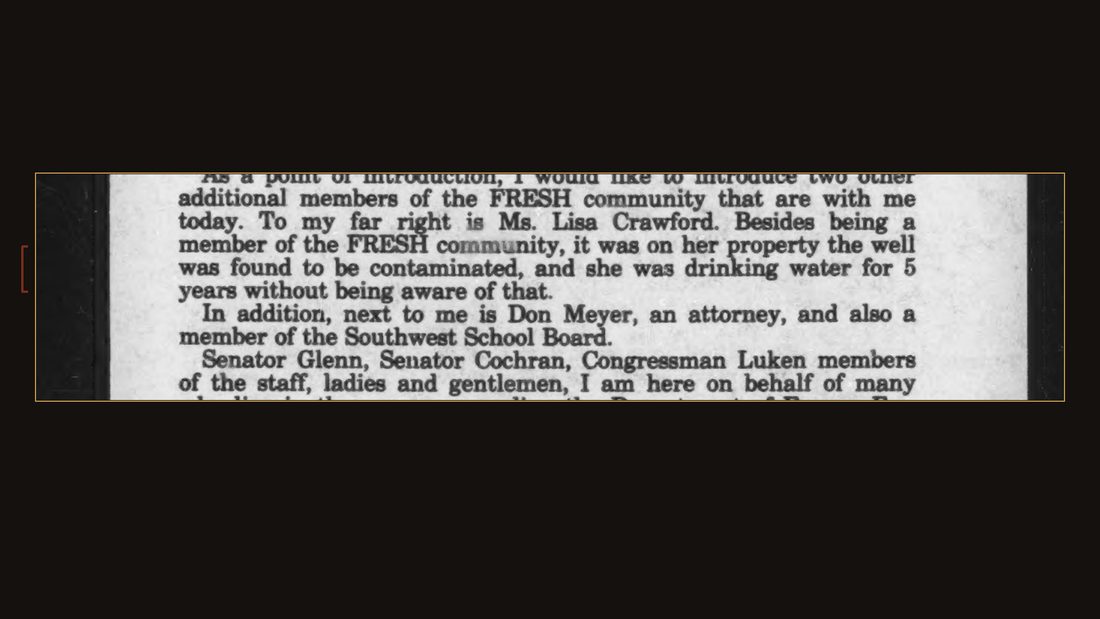
The tenant was a woman named Lisa Crawford, and she had two things to tell the United States Senate. Neither took long.
S51
S. Hrg. 99-156 · U.S. Senate Gov't Affairs · Apr. 22, 1985 · p. 266.
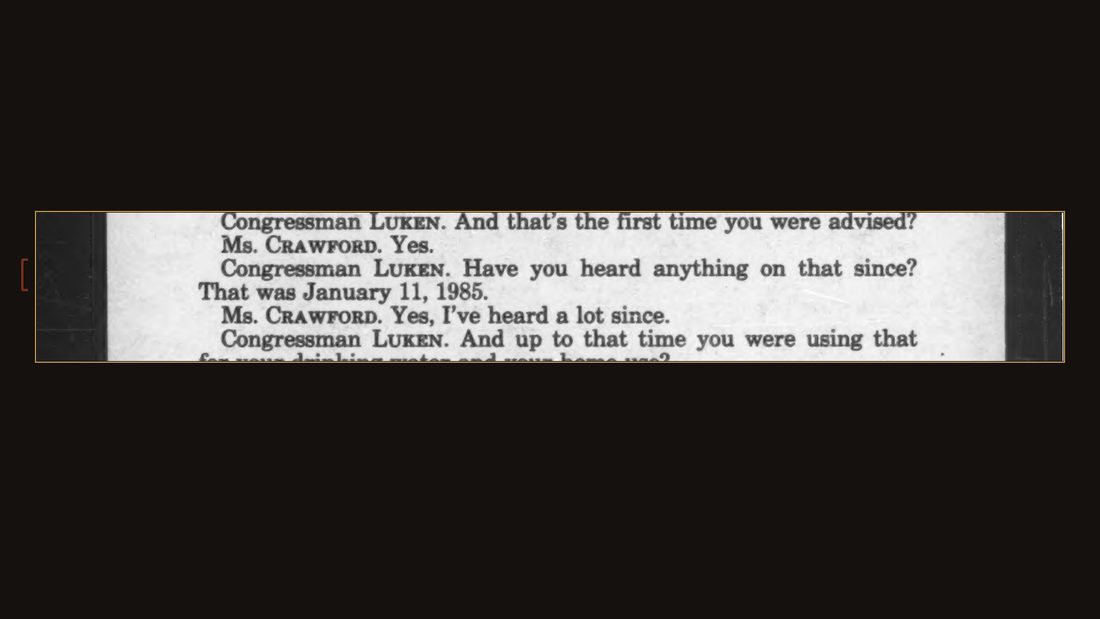
The first was that she learned about the well on the eleventh of January, nineteen eighty-five.
S52
S. Hrg. 99-156 · U.S. Senate Gov't Affairs · Apr. 22, 1985 · p. 266.
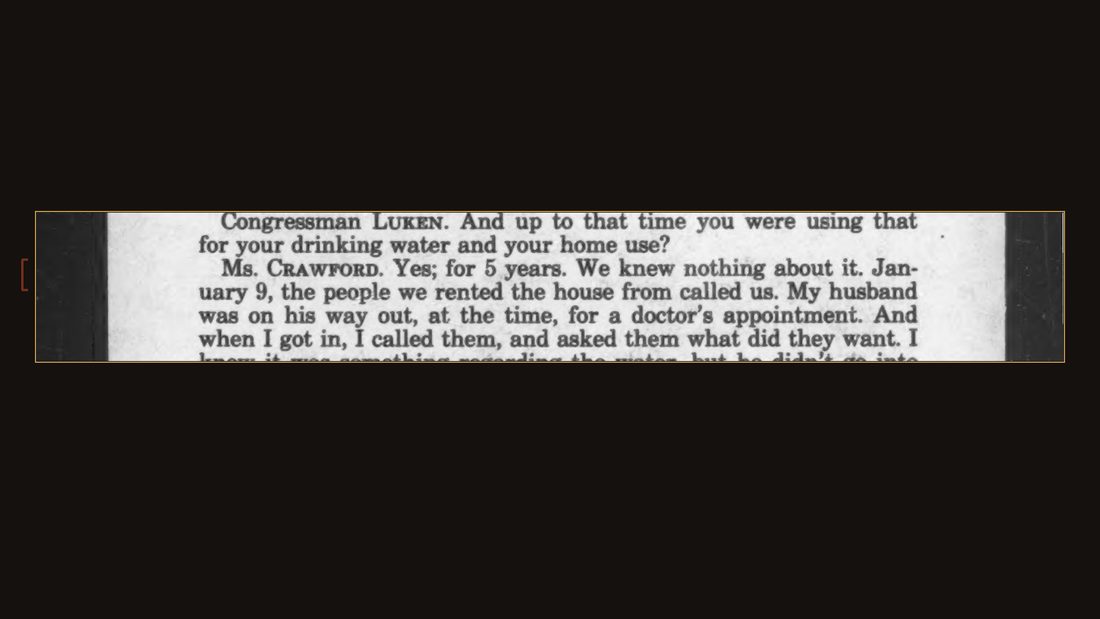
The second was how long her family had been drinking out of it. Yes, she said. For five years. We knew nothing about it.
S53
S. Hrg. 99-156 · U.S. Senate Gov't Affairs · Apr. 22, 1985 · p. 266.
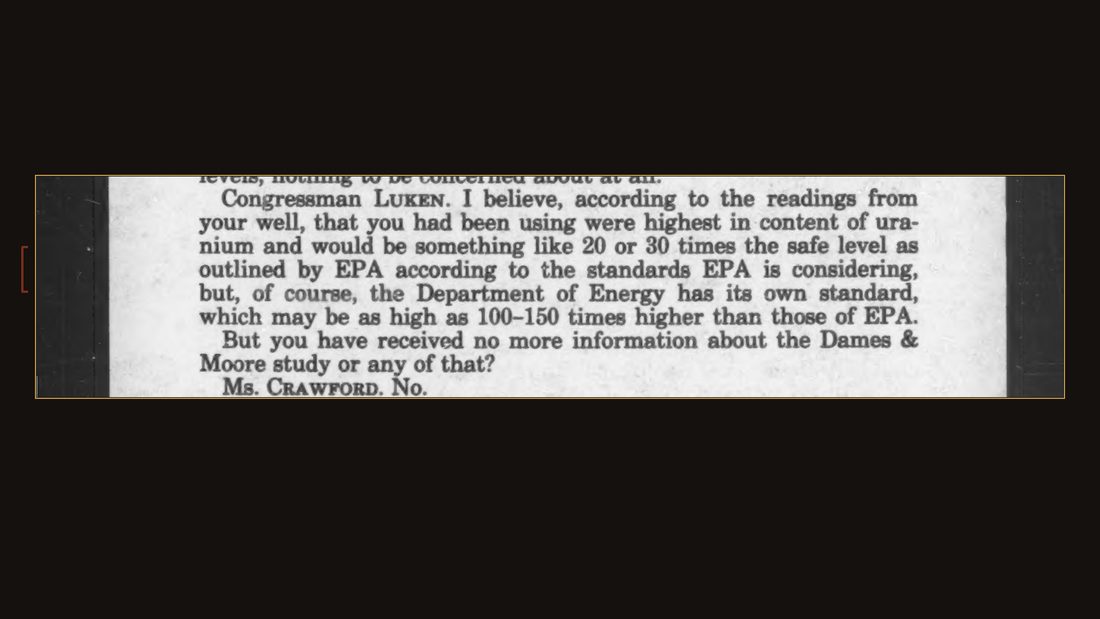
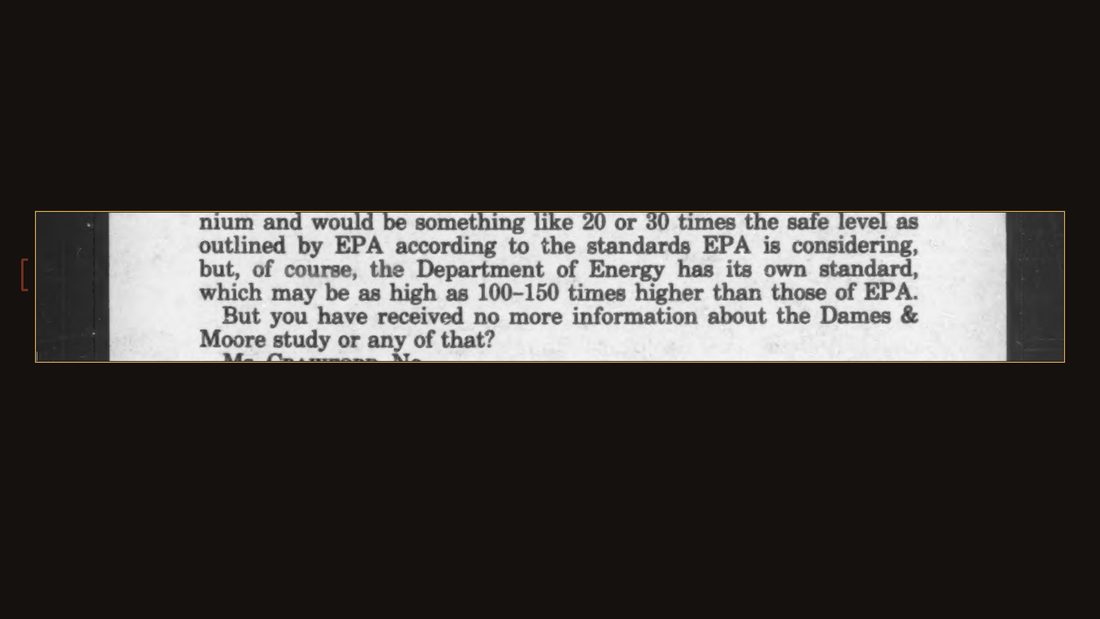
Lukin told her what the readings meant. Hers was the highest of the three, something like twenty or thirty times the safe level the Environmental Protection Agency was then considering.
S54
S. Hrg. 99-156 · U.S. Senate Gov't Affairs · Apr. 22, 1985 · p. 266.
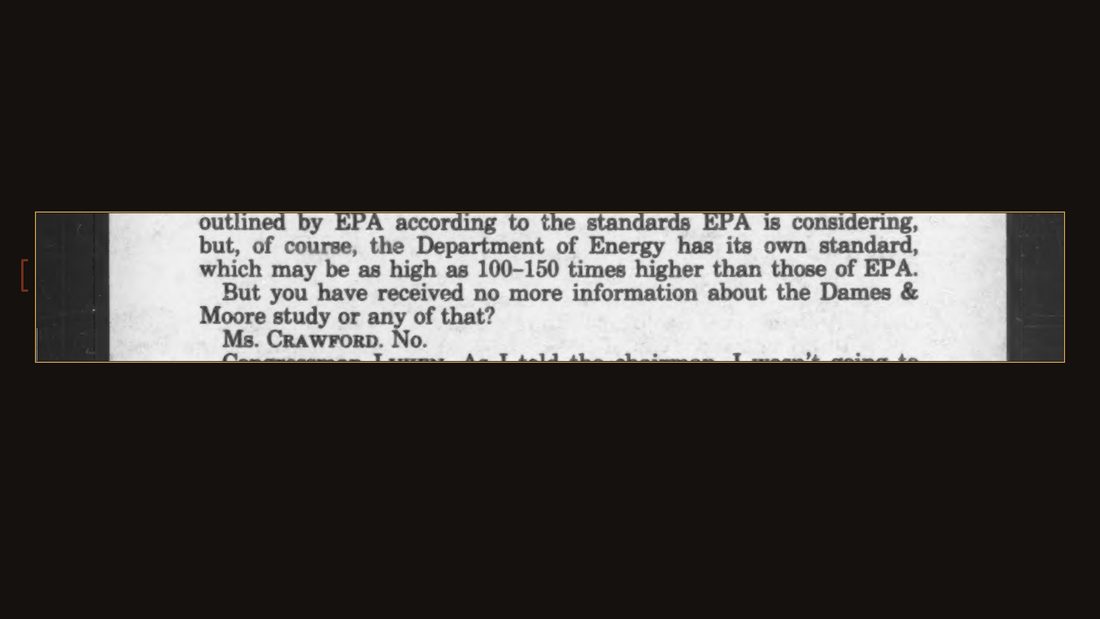
And then he said the sentence that explains this entire story. But, of course, the Department of Energy has its own standard.
S55
S. Hrg. 99-156 · U.S. Senate Gov't Affairs · Apr. 22, 1985 · p. 266.
Which may be, he said, as high as one hundred to one hundred and fifty times higher than E-P-A's.
The agency that made the uranium also set the limit for how much uranium was allowed to be in your drinking water. And it measured its own compliance.
One word
S56
S. Hrg. 99-156 · U.S. Senate Gov't Affairs · Apr. 22, 1985 · p. 6.
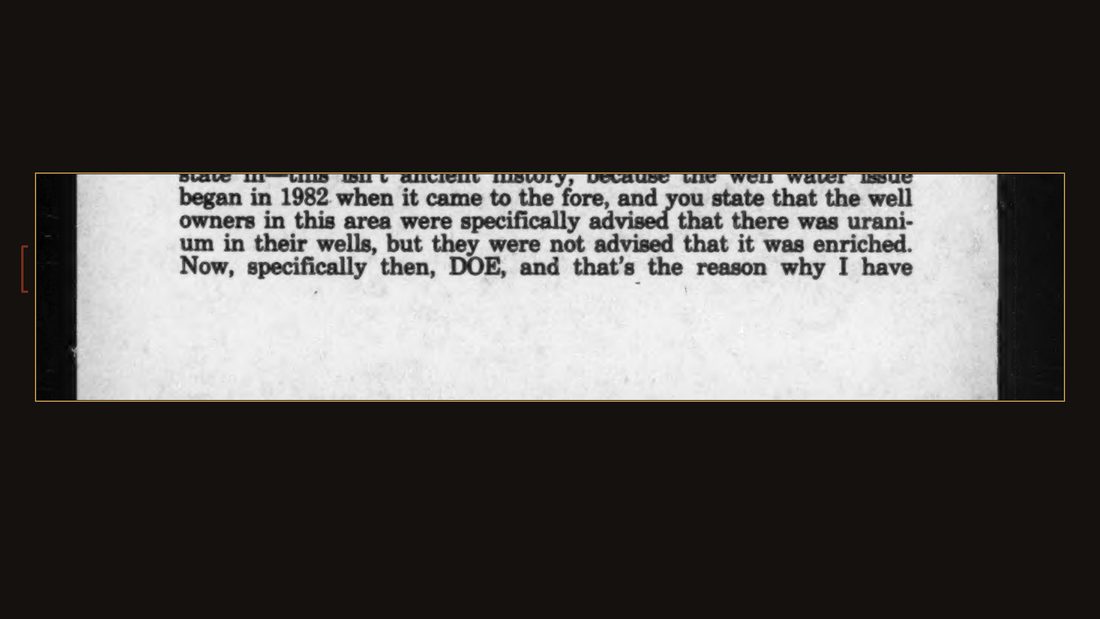
The well owners were told there was uranium in their water. There was one word they were not told.
S57
S. Hrg. 99-156 · U.S. Senate Gov't Affairs · Apr. 22, 1985 · p. 44.
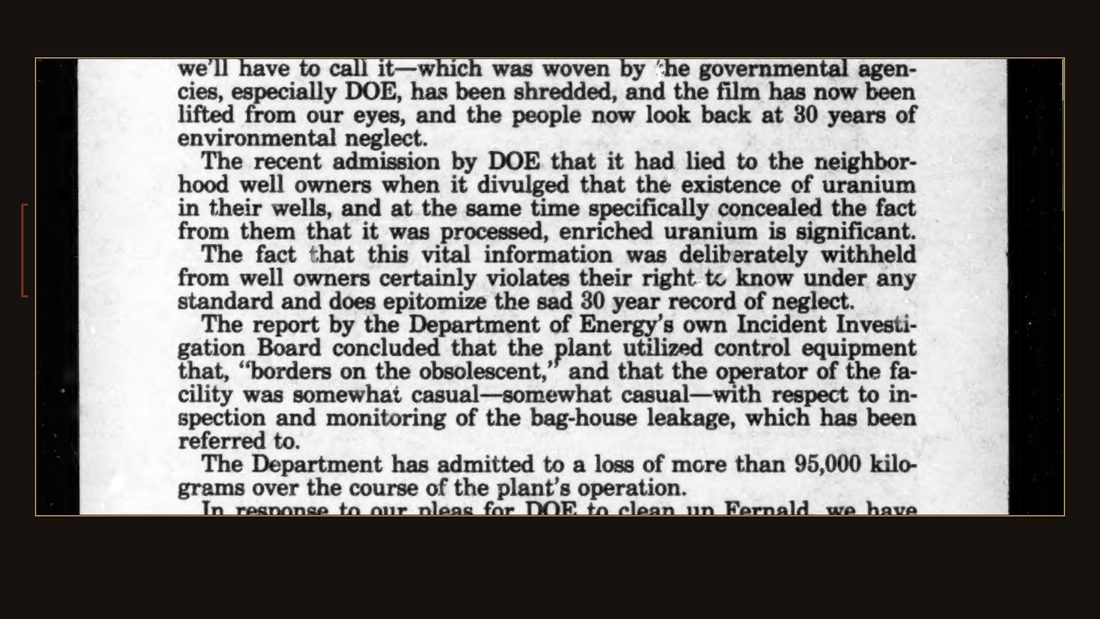
A Department of Energy report stated that the homeowners had not been informed that the uranium was slightly enriched.
S58
S. Hrg. 99-156 · U.S. Senate Gov't Affairs · Apr. 22, 1985 · p. 10.
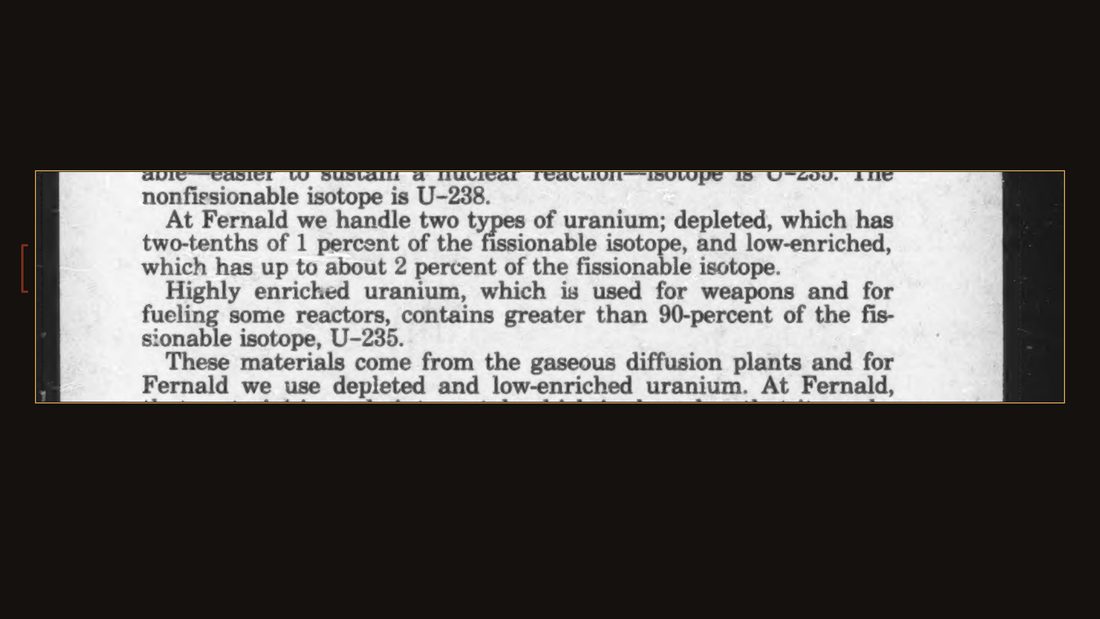
Enriched matters for exactly one reason. Uranium occurs in the ground naturally. Enriched uranium does not. Enriched uranium has been through a plant.
Telling a family there is uranium in their well leaves open the possibility that it had always been there. Telling them it is enriched tells them where it came from.
S59
S. Hrg. 99-156 · U.S. Senate Gov't Affairs · Apr. 22, 1985 · p. 44.
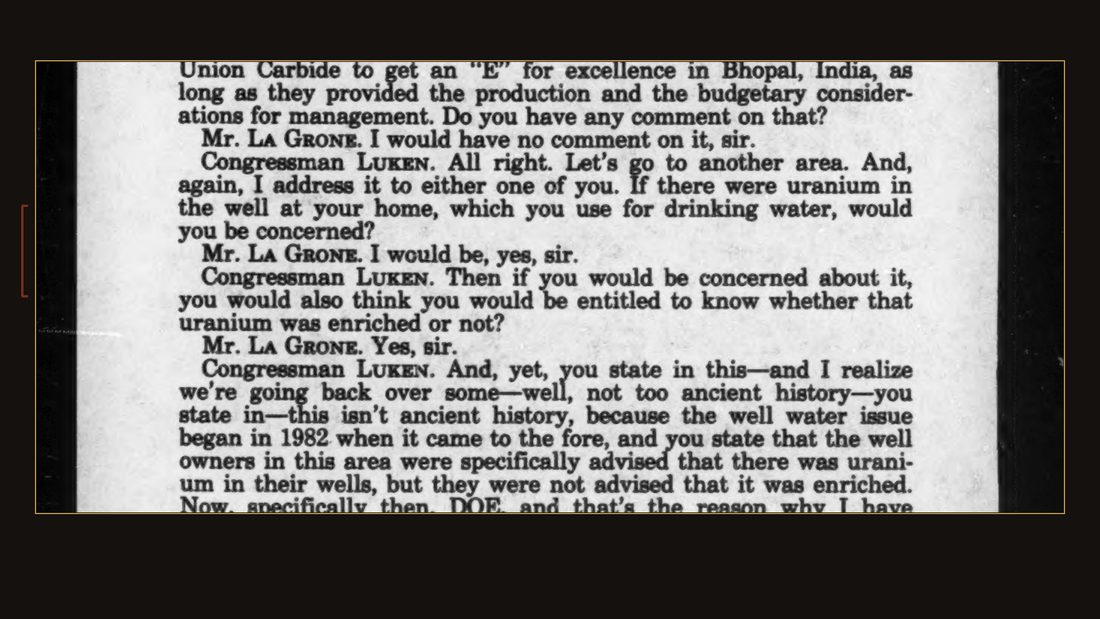
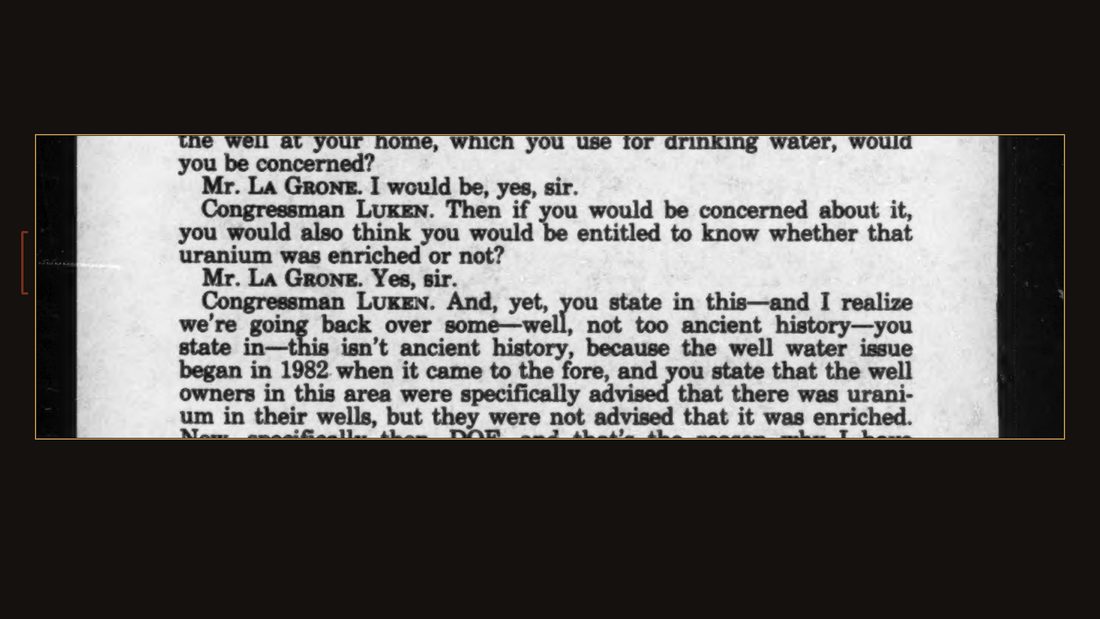
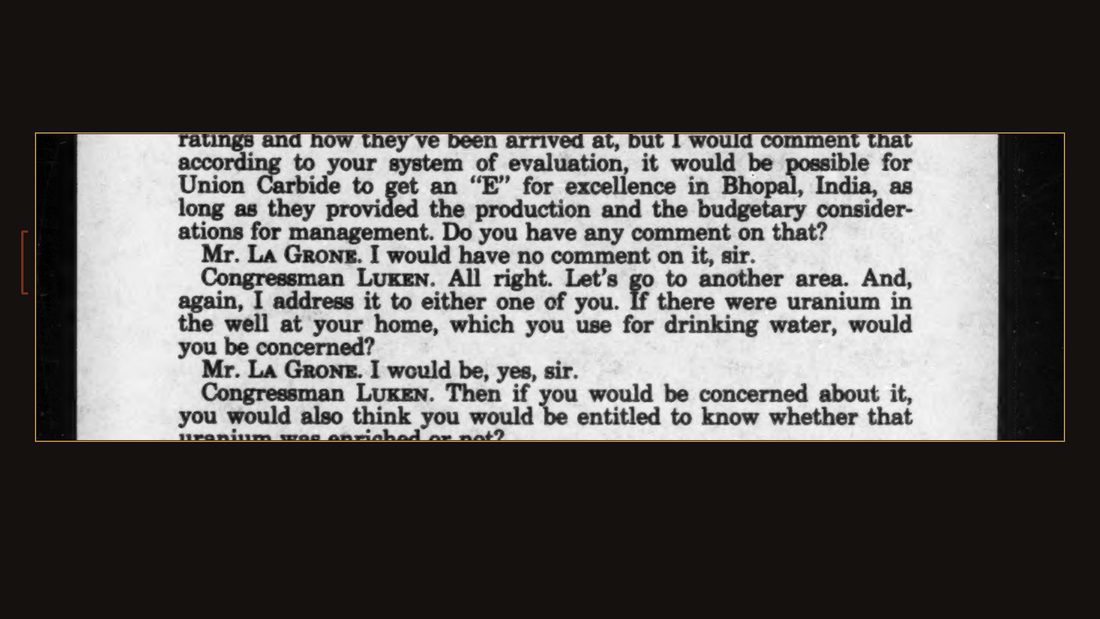
Lukin took the two Energy Department witnesses through it one question at a time. If there were uranium in the well at your home, which you use for drinking water, would you be concerned?
S60
S. Hrg. 99-156 · U.S. Senate Gov't Affairs · Apr. 22, 1985 · p. 44.
La Grone: I would be, yes, sir.
S61
S. Hrg. 99-156 · U.S. Senate Gov't Affairs · Apr. 22, 1985 · p. 44.
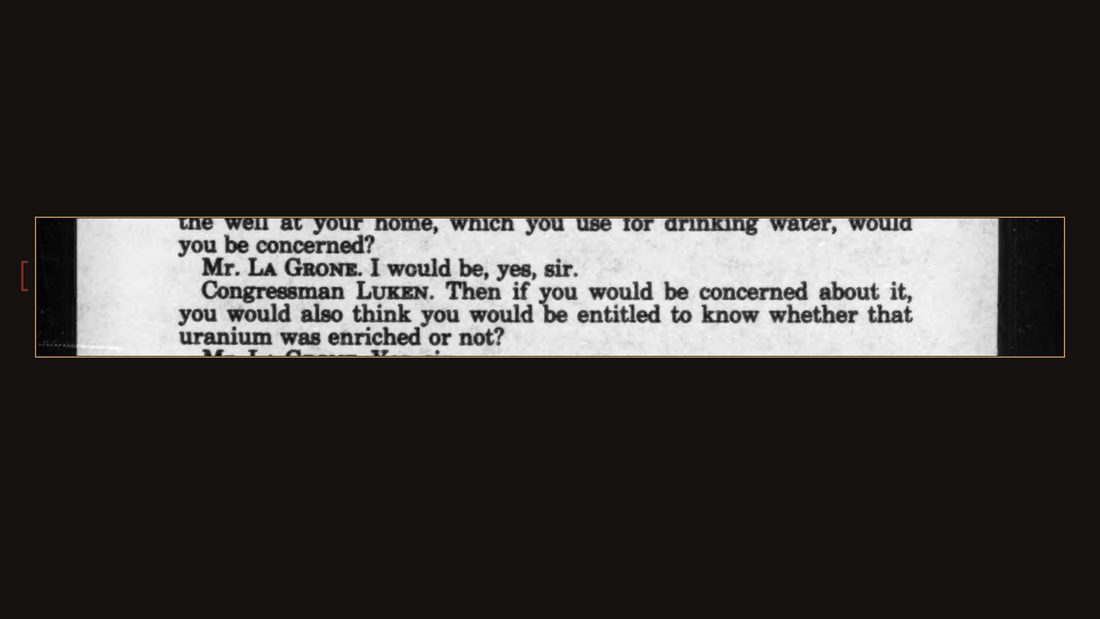
Then if you would be concerned about it, you would also think you would be entitled to know whether that uranium was enriched or not?
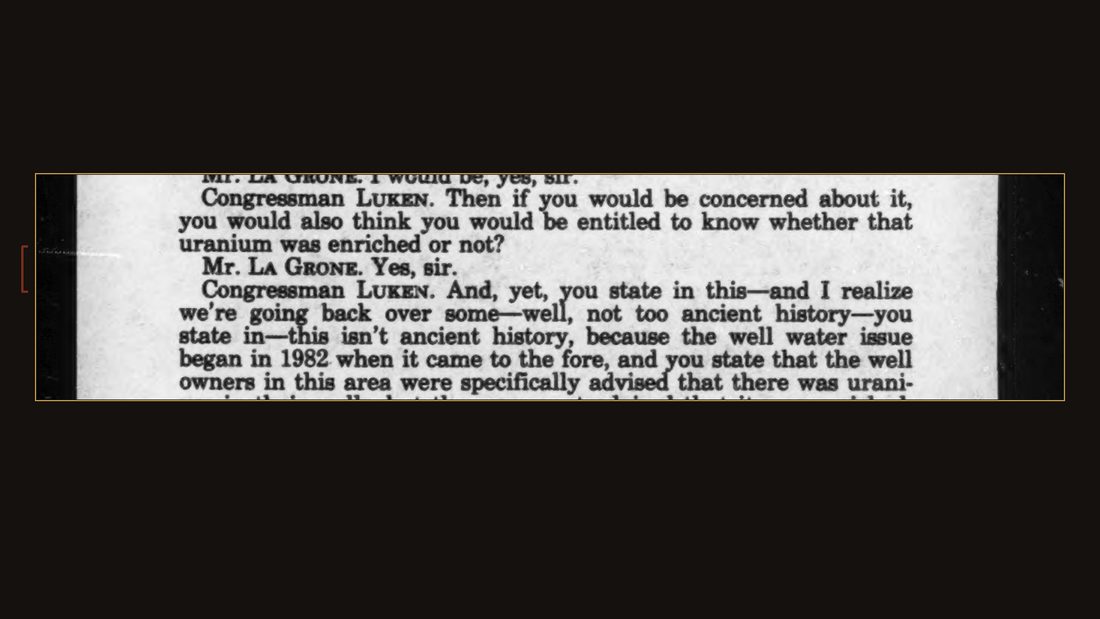
S62
S. Hrg. 99-156 · U.S. Senate Gov't Affairs · Apr. 22, 1985 · p. 44.
La Grone: Yes, sir.
S63
S. Hrg. 99-156 · U.S. Senate Gov't Affairs · Apr. 22, 1985 · p. 45.
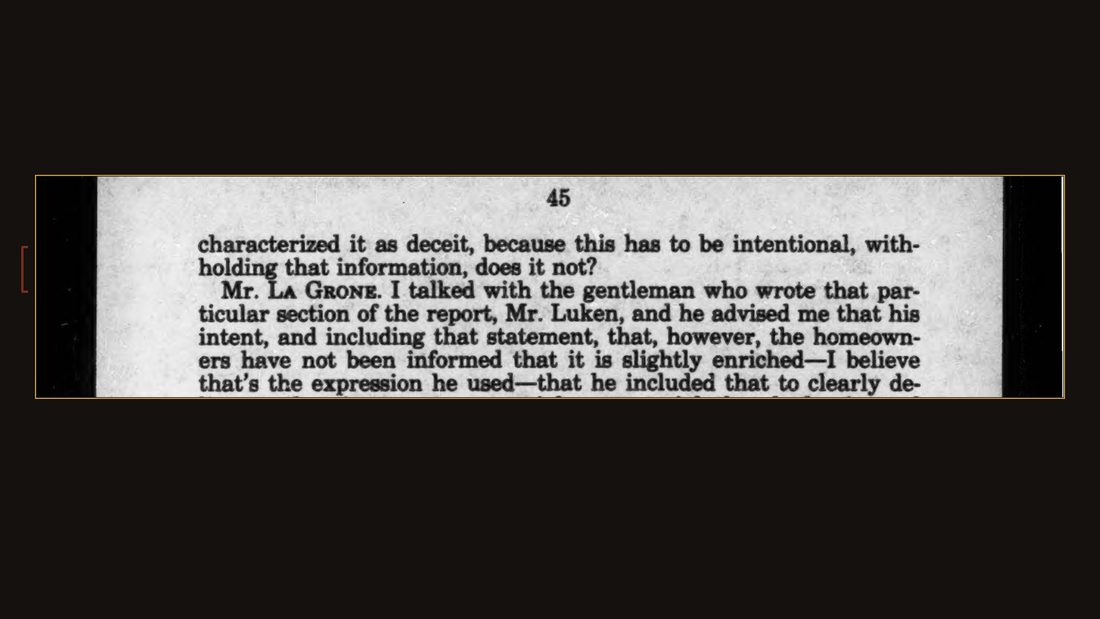
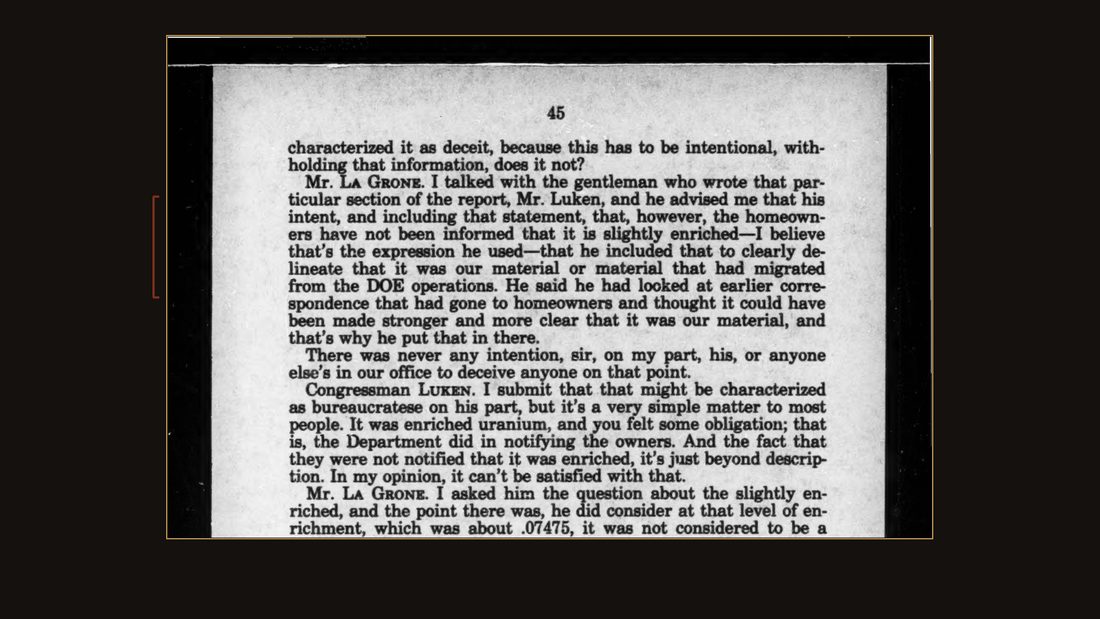
Lukin read the report back to him and called the omission what he thought it was. Because this has to be intentional, he said. Withholding that information.
S64
S. Hrg. 99-156 · U.S. Senate Gov't Affairs · Apr. 22, 1985 · p. 45.
La Grone said he had spoken to the man who wrote that section, and that the man's intent had been the opposite: to make clear the uranium was theirs. That it had come from the plant.
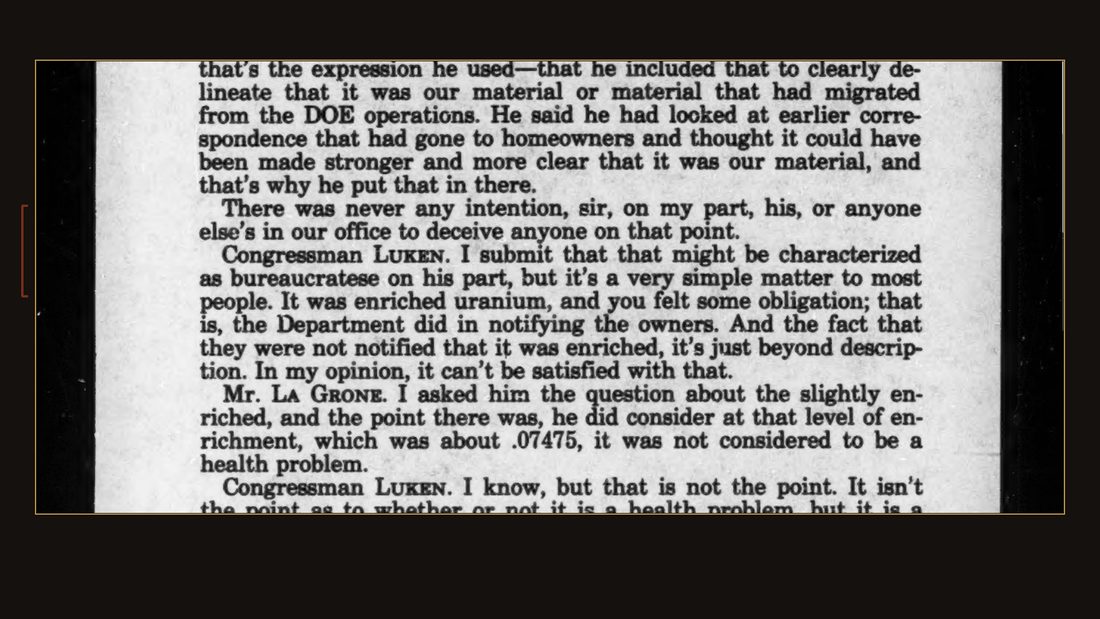
S65
S. Hrg. 99-156 · U.S. Senate Gov't Affairs · Apr. 22, 1985 · p. 45.
There was never any intention, La Grone said, on my part, his, or anyone else's in our office, to deceive anyone on that point.
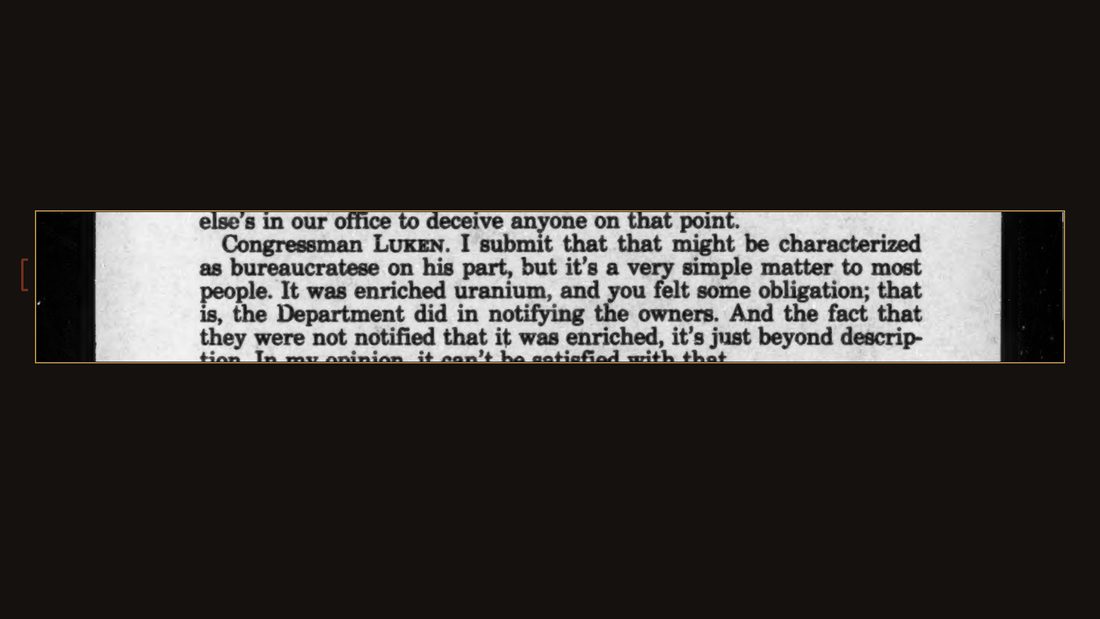
S66
S. Hrg. 99-156 · U.S. Senate Gov't Affairs · Apr. 22, 1985 · p. 45.
Lukin's reply is the best sentence in the volume. I submit that that might be characterized as bureaucratese on his part.
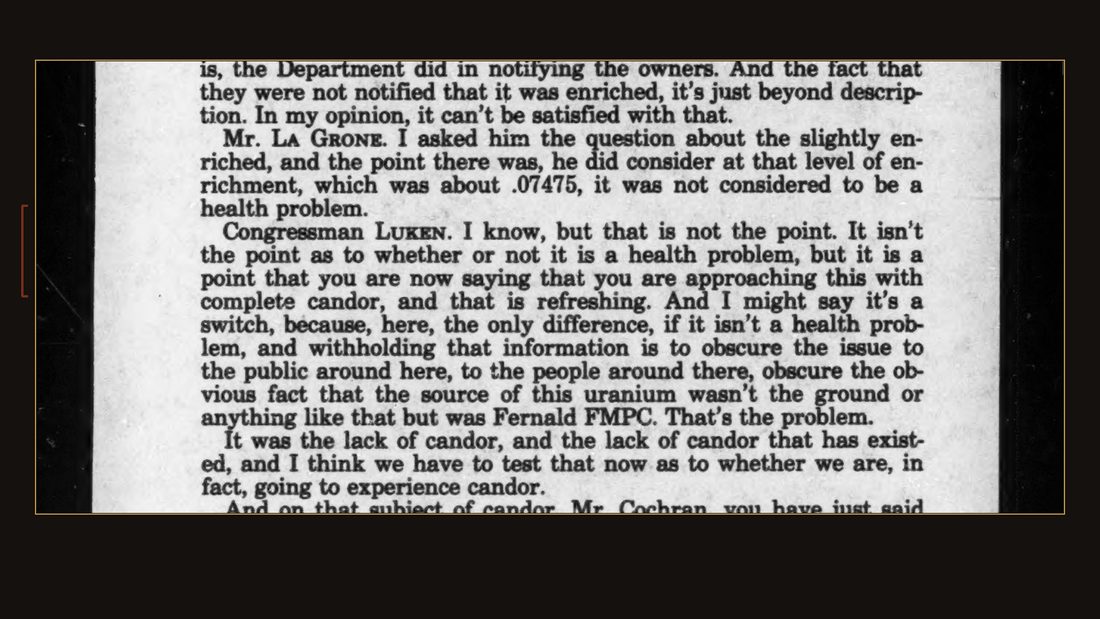
S67
S. Hrg. 99-156 · U.S. Senate Gov't Affairs · Apr. 22, 1985 · p. 45.
La Grone tried once more. The enrichment level, he said, was low enough that it was not considered a health problem.
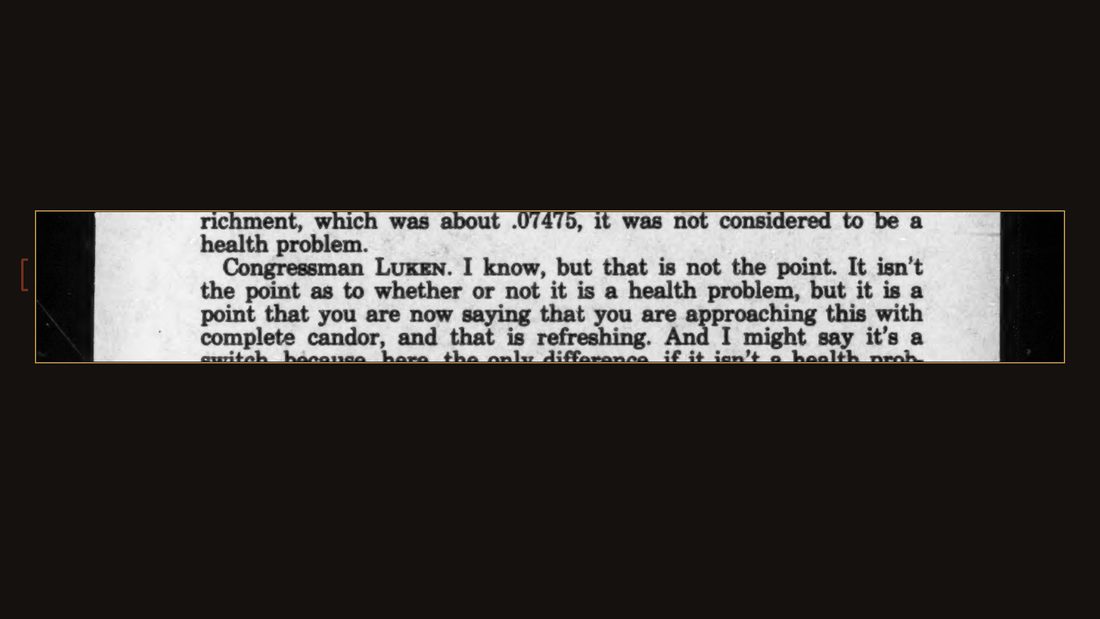
S68
S. Hrg. 99-156 · U.S. Senate Gov't Affairs · Apr. 22, 1985 · p. 45.
I know, Lukin said, but that is not the point. Whether it was a health problem was never the reason to leave the word out.
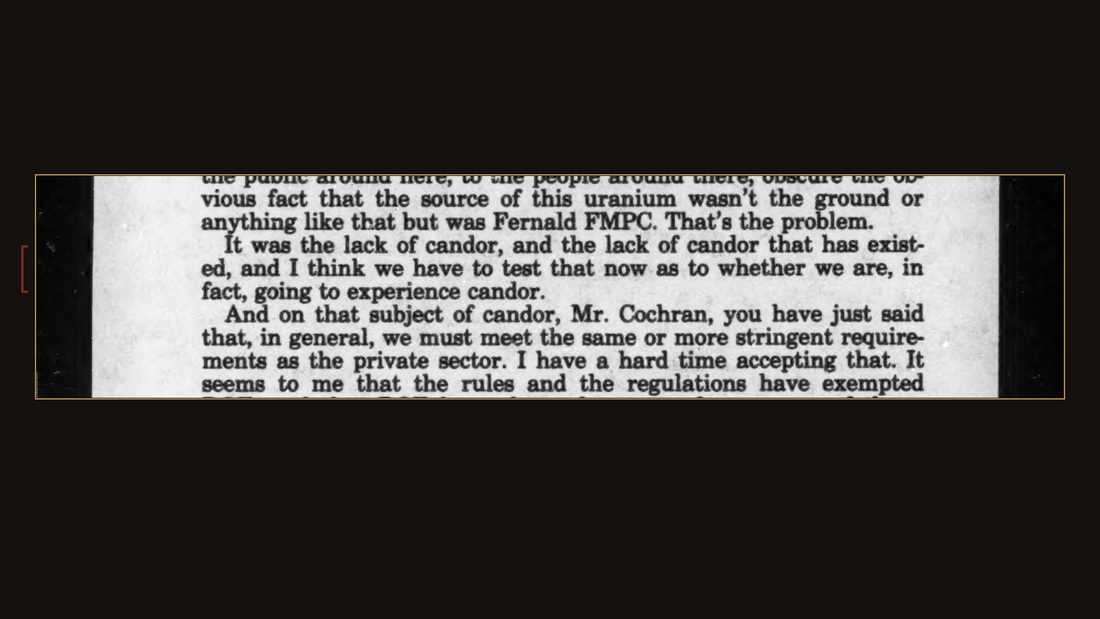
S69
S. Hrg. 99-156 · U.S. Senate Gov't Affairs · Apr. 22, 1985 · p. 45.
The word enriched would have told those families exactly whose uranium was in their water.
December
S70
S. Hrg. 99-156 · U.S. Senate Gov't Affairs · Apr. 22, 1985 · p. 1.
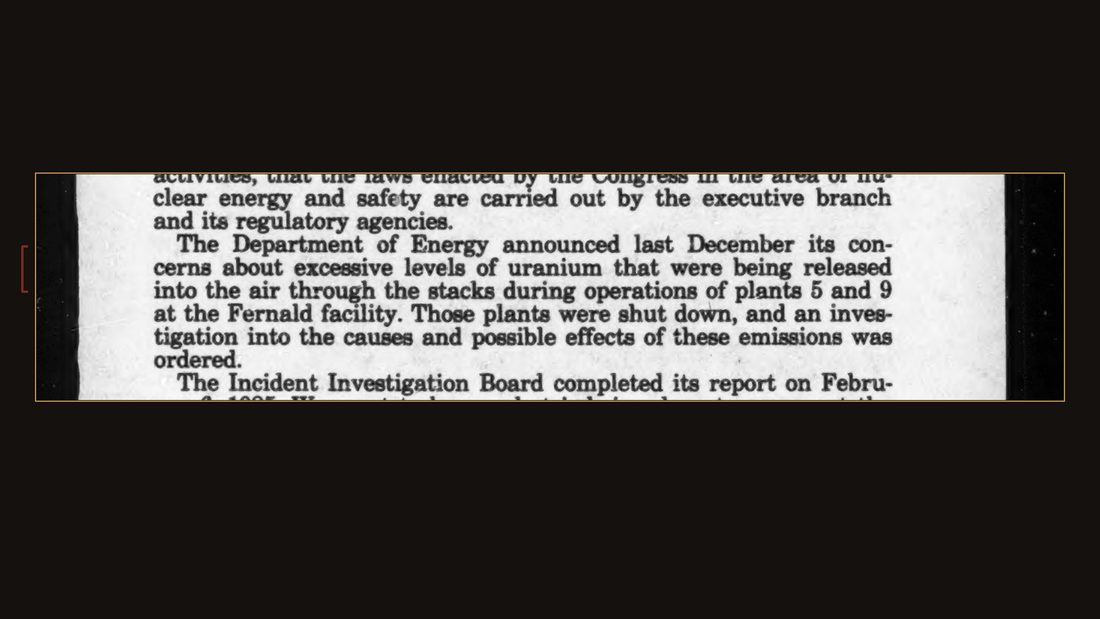
Here is how the neighbors found out any of this.
S71
S. Hrg. 99-156 · U.S. Senate Gov't Affairs · Apr. 22, 1985 · p. 111.
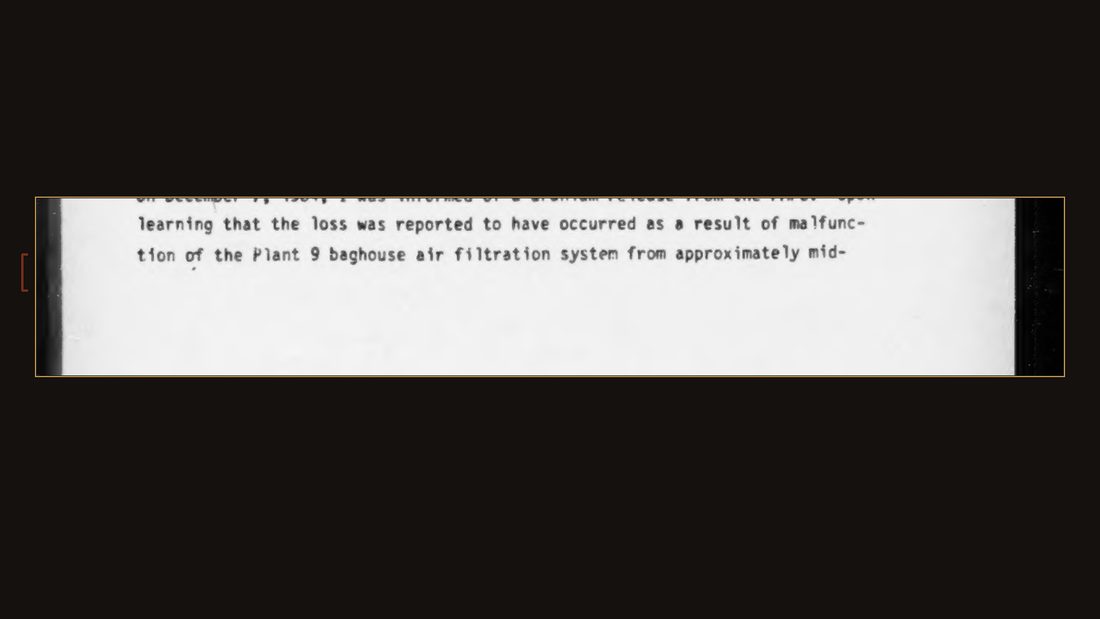
Between September and December of nineteen eighty-four, the bag house on Plant Nine failed and uranium oxide went out the stack.
S72
S. Hrg. 99-156 · U.S. Senate Gov't Affairs · Apr. 22, 1985 · p. 2.
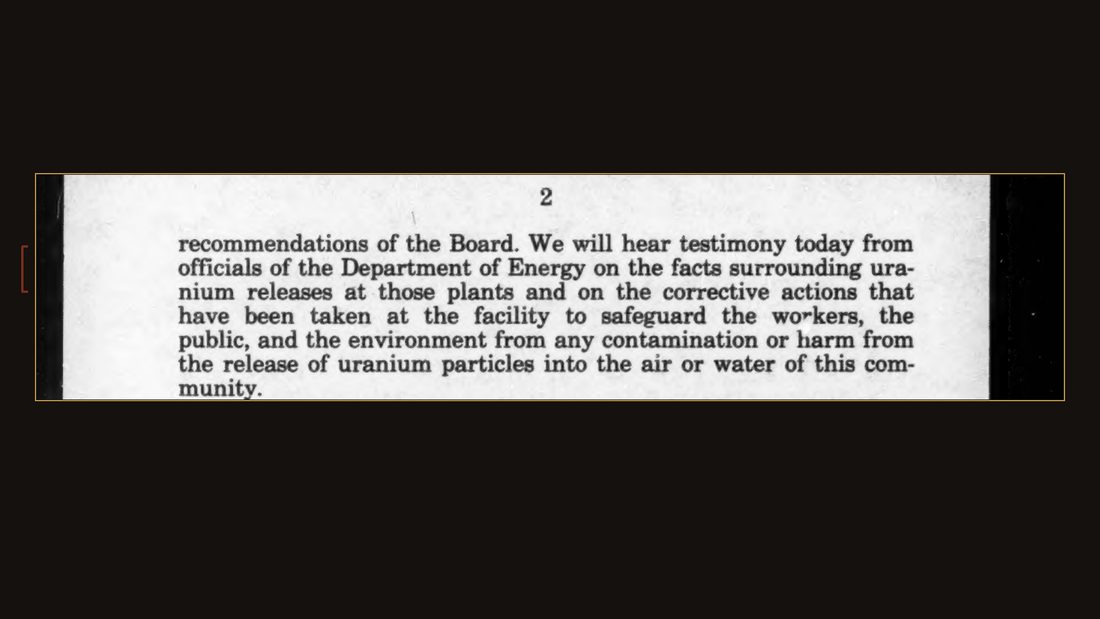
La Grone was informed on the seventh of December. The plants were shut down and an Incident Investigation Board was convened. It finished its report on the sixth of February.
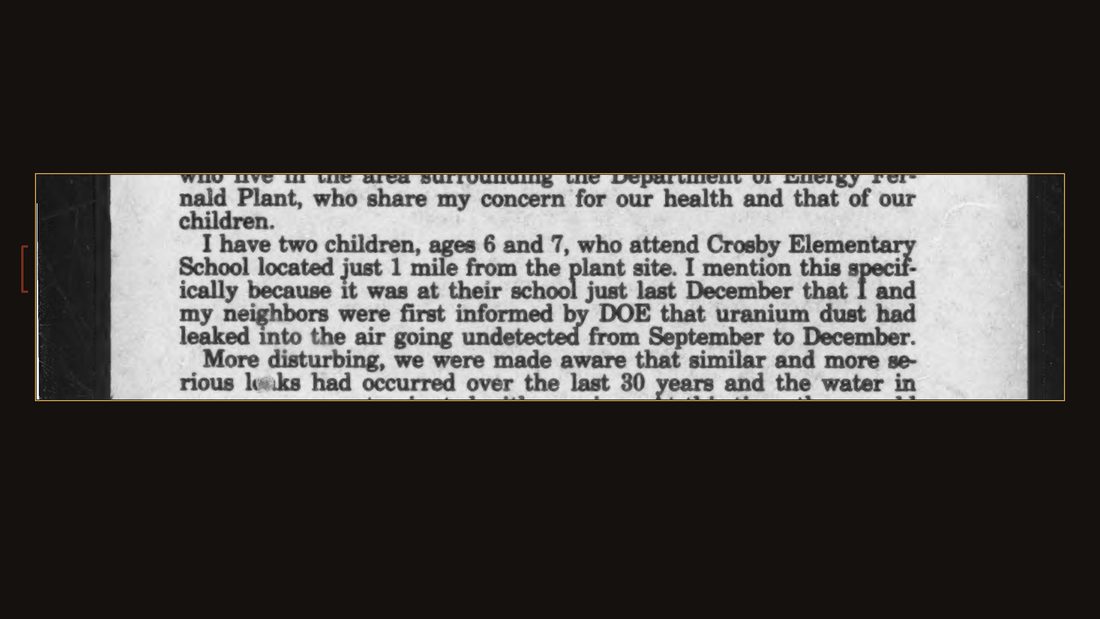
That December, the Department of Energy called a public meeting to tell the community. It held it in the auditorium of Crosby Elementary School, one mile from the plant.
S73
S. Hrg. 99-156 · U.S. Senate Gov't Affairs · Apr. 22, 1985 · p. 253.
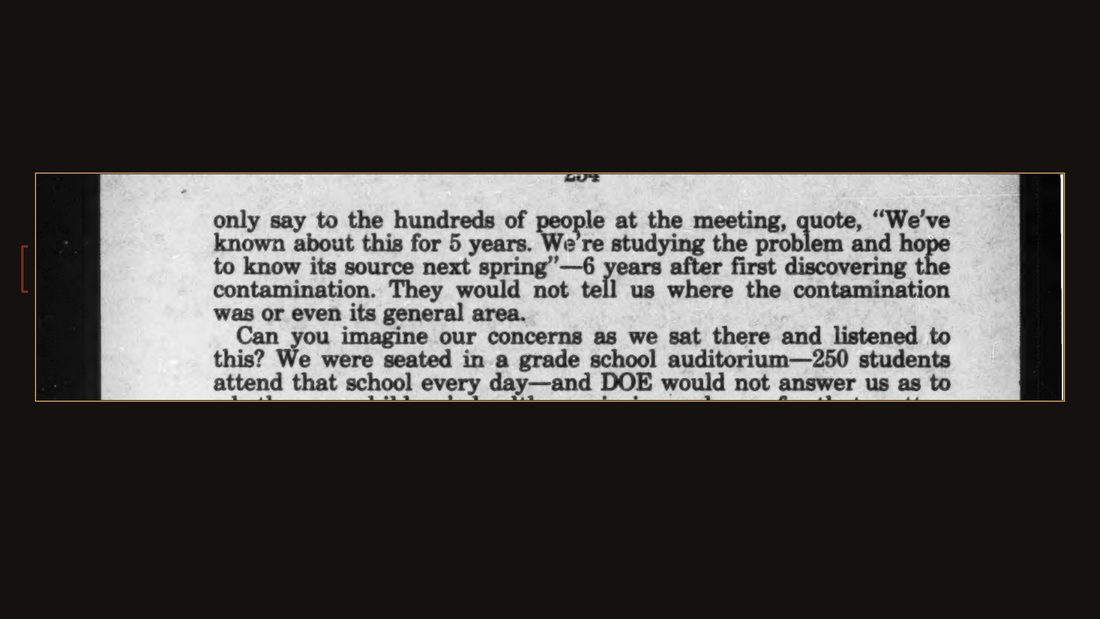
Two hundred and fifty children went to that school every day. Kathy Meyer had two of them there, aged six and seven.
S74
S. Hrg. 99-156 · U.S. Senate Gov't Affairs · Apr. 22, 1985 · p. 254.
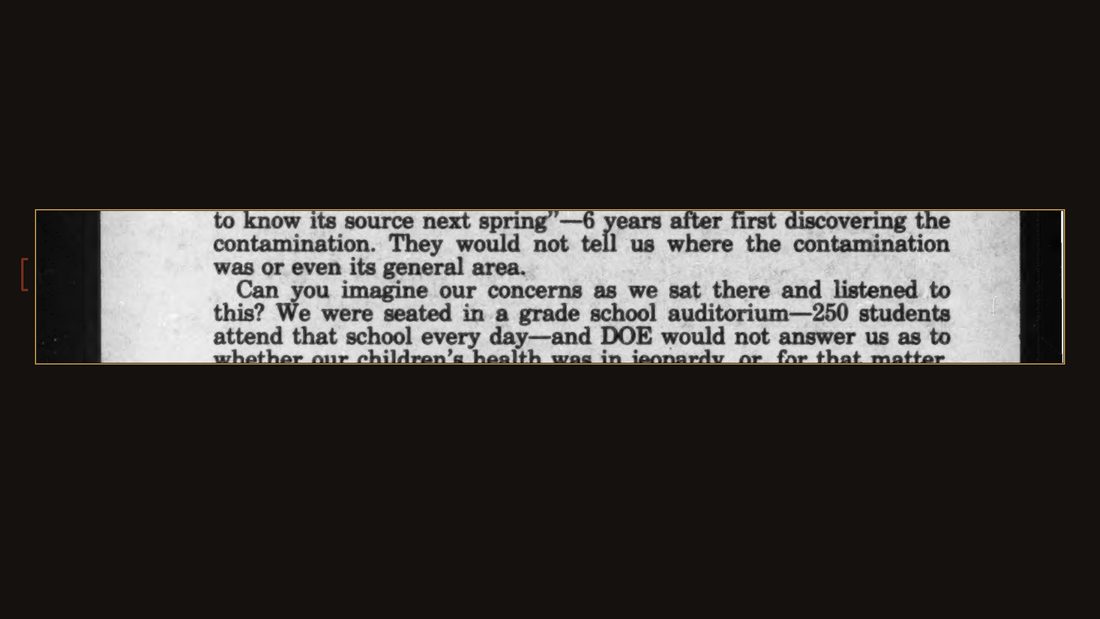
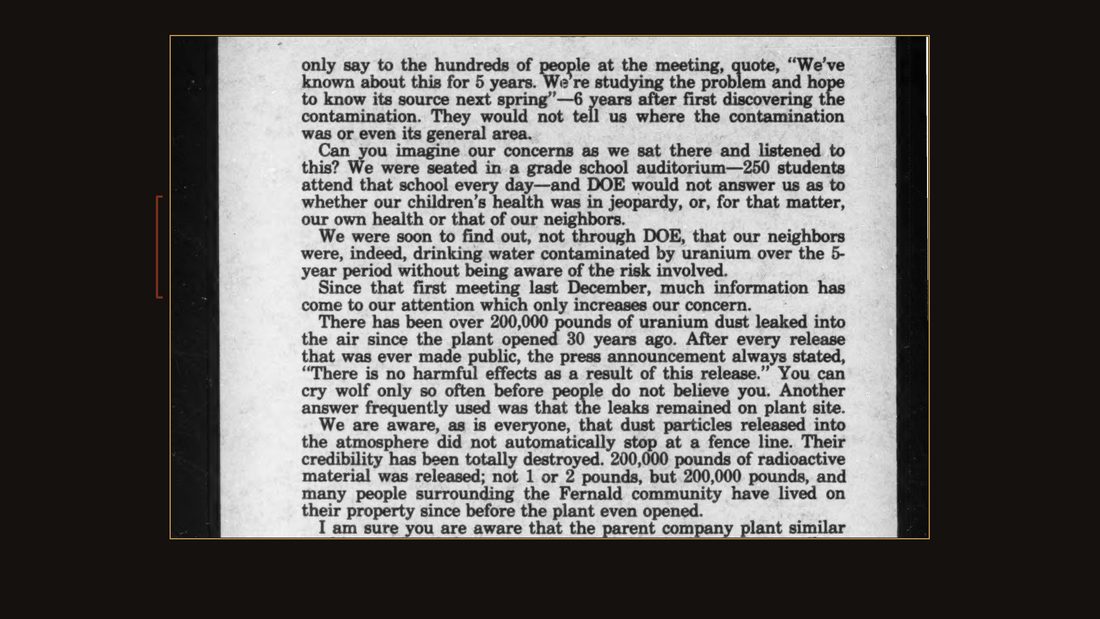
She told the Senate what the Department said to the hundreds of people in that room. We've known about this for five years. We're studying the problem and hope to know its source next spring.
S75
S. Hrg. 99-156 · U.S. Senate Gov't Affairs · Apr. 22, 1985 · p. 254.
They would not say where the contamination was, she said. Not even its general area.
S76
S. Hrg. 99-156 · U.S. Senate Gov't Affairs · Apr. 22, 1985 · p. 254.
A room full of parents, in their children's school, were told the government had known for five years and would get back to them.
Excellent
S77
S. Hrg. 99-156 · U.S. Senate Gov't Affairs · Apr. 22, 1985 · p. 4.
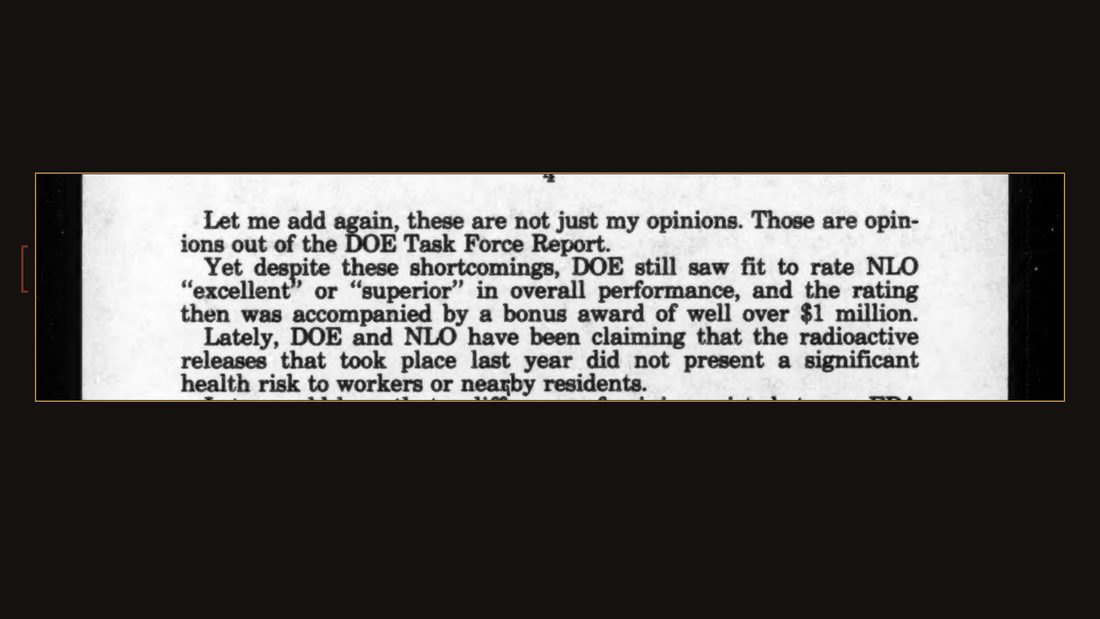
Six months before that meeting, in June of nineteen eighty-four, an Oak Ridge task force had finished its own review of the plant.
S78
S. Hrg. 99-156 · U.S. Senate Gov't Affairs · Apr. 22, 1985 · p. 3.
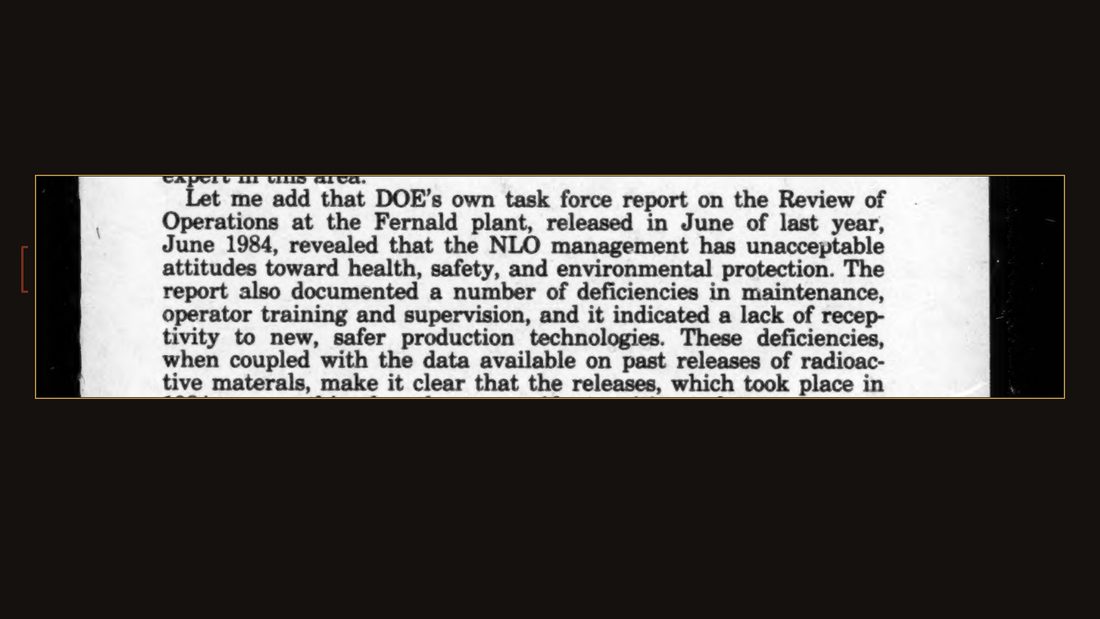
Senator John Glenn read the committee what it found. N-L-O management, it said, had unacceptable attitudes toward health, safety, and environmental protection.
S79
S. Hrg. 99-156 · U.S. Senate Gov't Affairs · Apr. 22, 1985 · p. 4.
It documented deficiencies in maintenance, in operator training, in supervision. It found a lack of receptivity to newer, safer production technology.
S80
S. Hrg. 99-156 · U.S. Senate Gov't Affairs · Apr. 22, 1985 · p. 4.
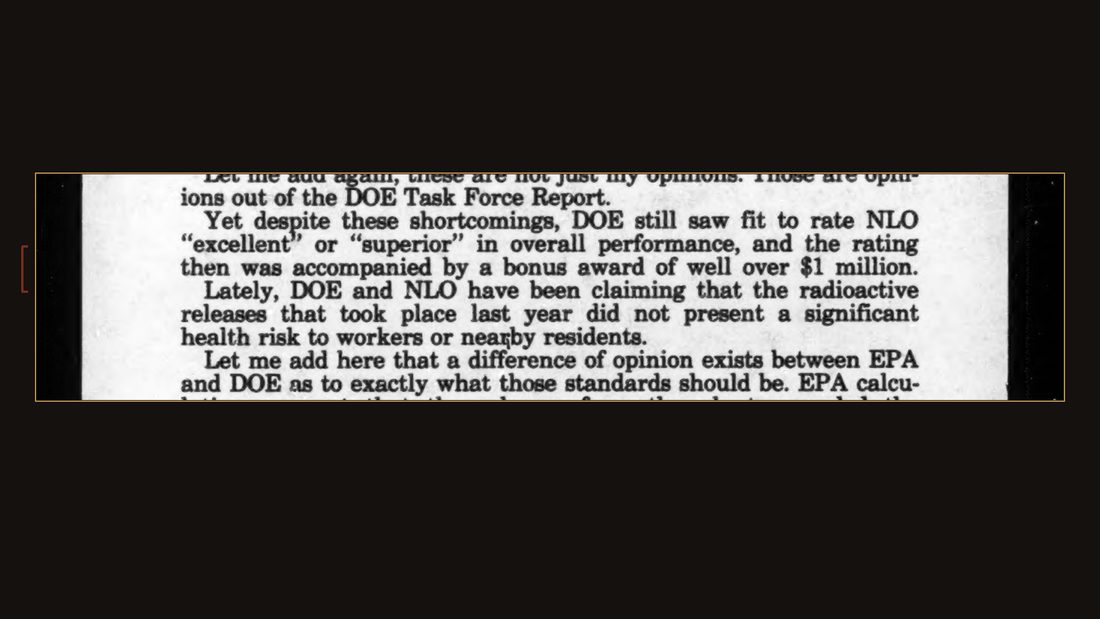
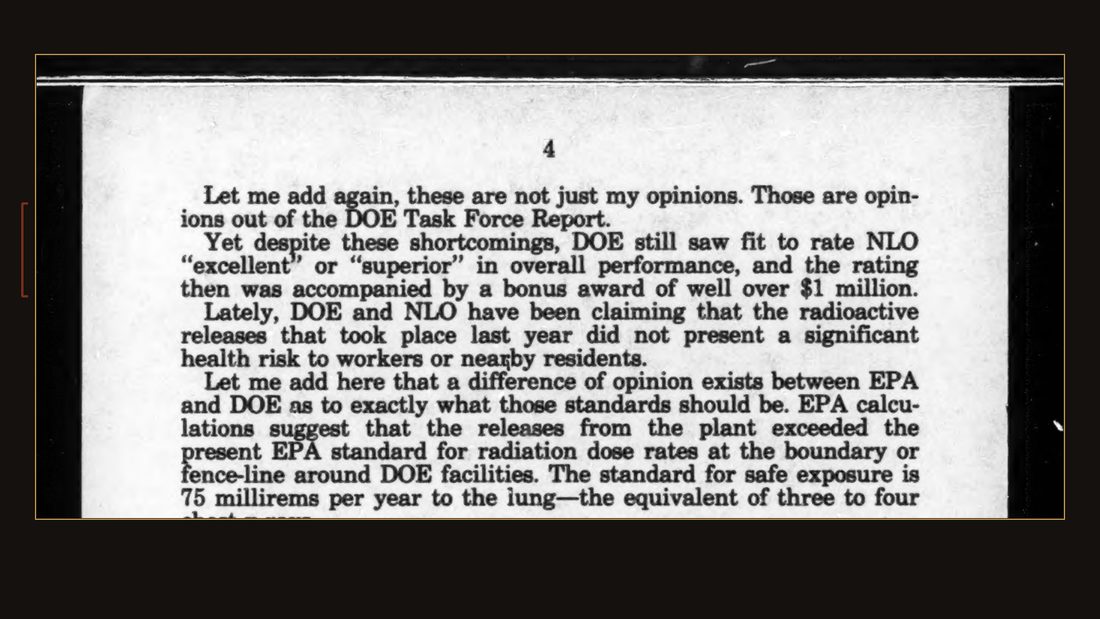
Those are not just my opinions, Glenn said. Those are opinions out of the Department of Energy task force report.
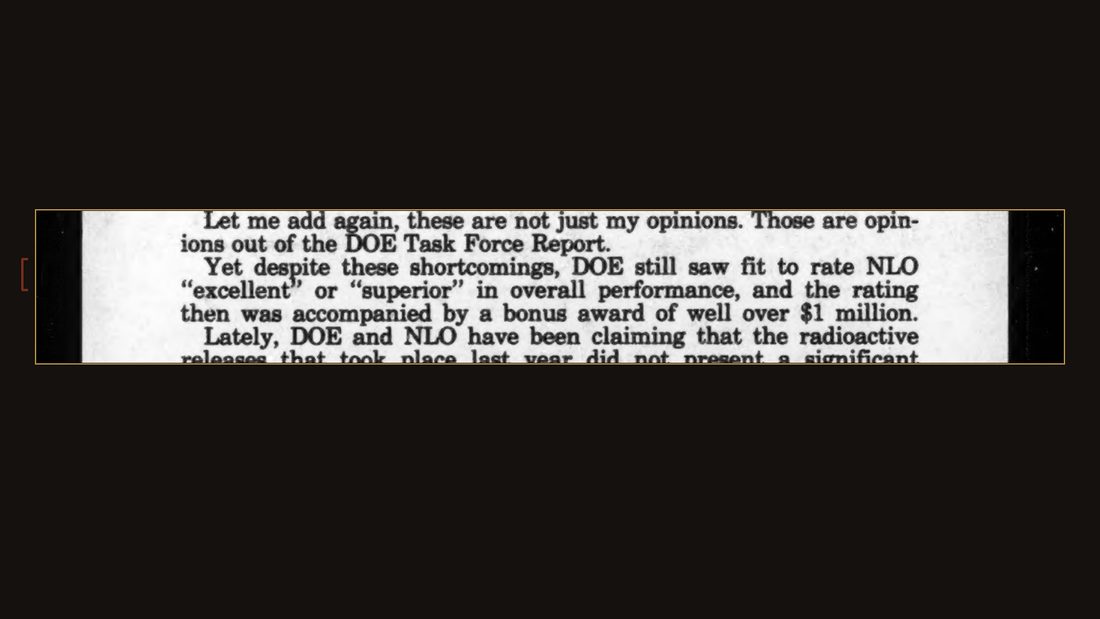
S81
S. Hrg. 99-156 · U.S. Senate Gov't Affairs · Apr. 22, 1985 · p. 4.
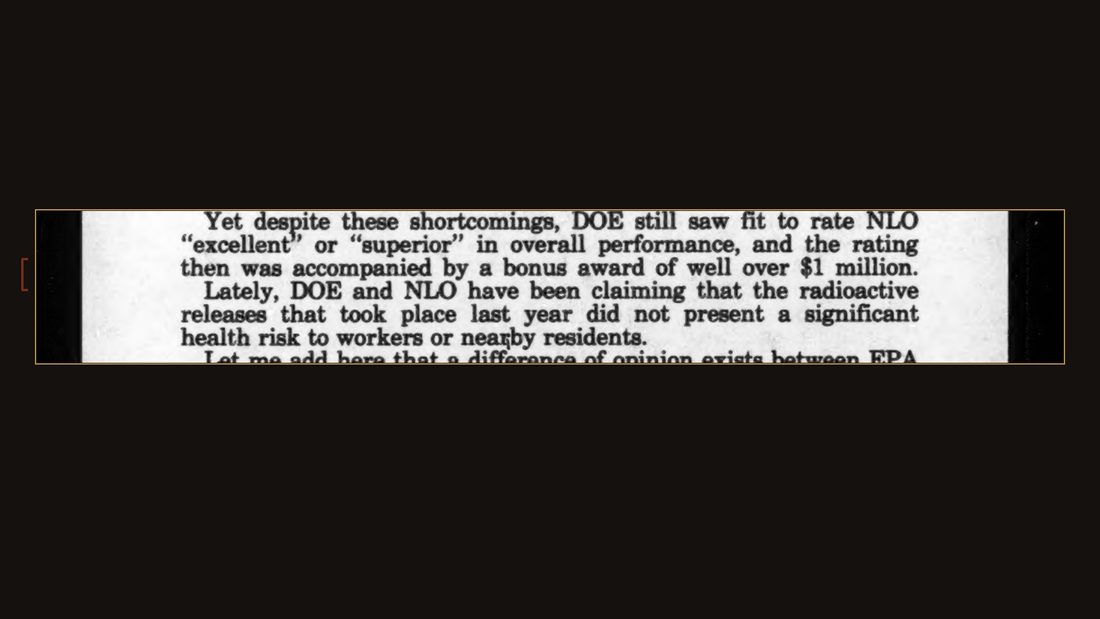
Then the sentence he had come to Cincinnati to say.
S82
S. Hrg. 99-156 · U.S. Senate Gov't Affairs · Apr. 22, 1985 · p. 4.
Yet despite these shortcomings, the Department still saw fit to rate N-L-O excellent or superior in overall performance. And the rating was accompanied by a bonus award of well over one million dollars.
S83
S. Hrg. 99-156 · U.S. Senate Gov't Affairs · Apr. 22, 1985 · p. 30.
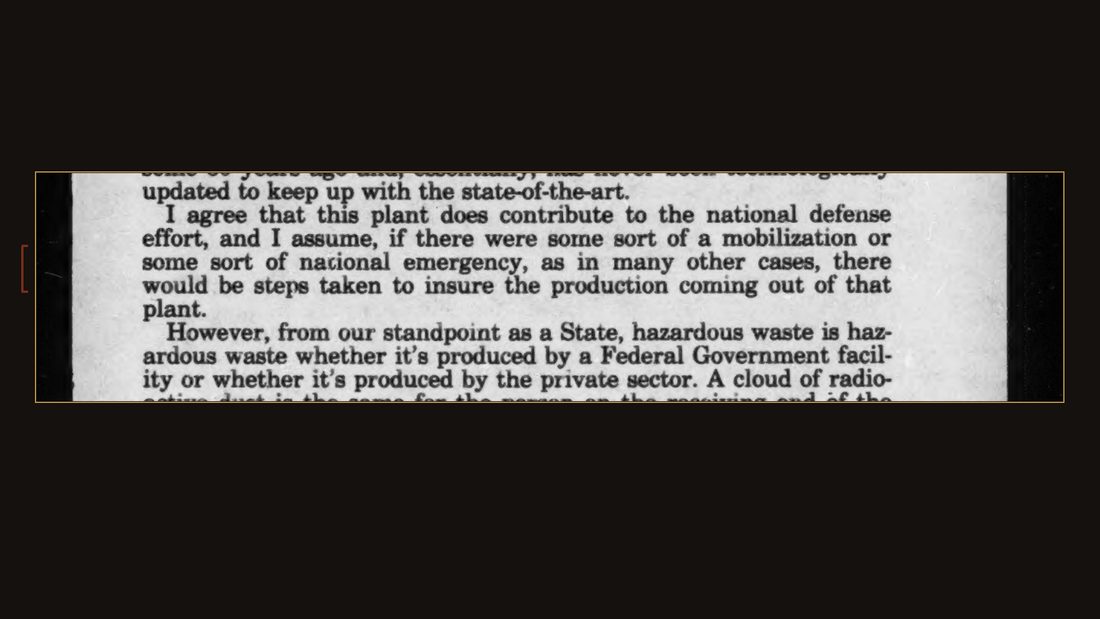
Glenn put it to the plant manager directly. Robert Spenceley answered: I think that is correct.
S84
S. Hrg. 99-156 · U.S. Senate Gov't Affairs · Apr. 22, 1985 · p. 25.
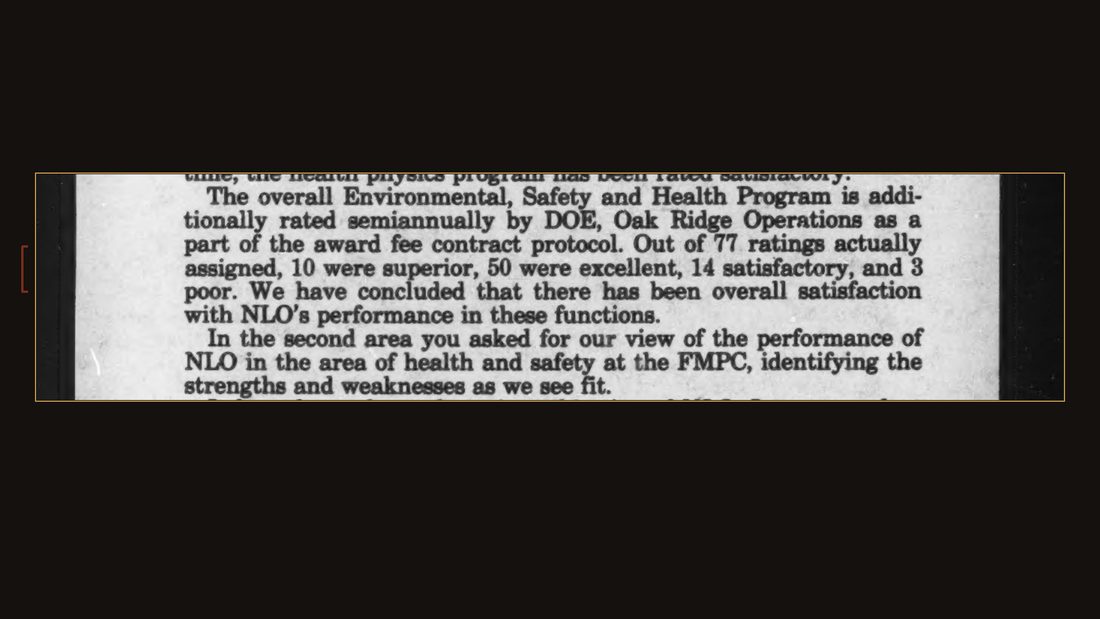
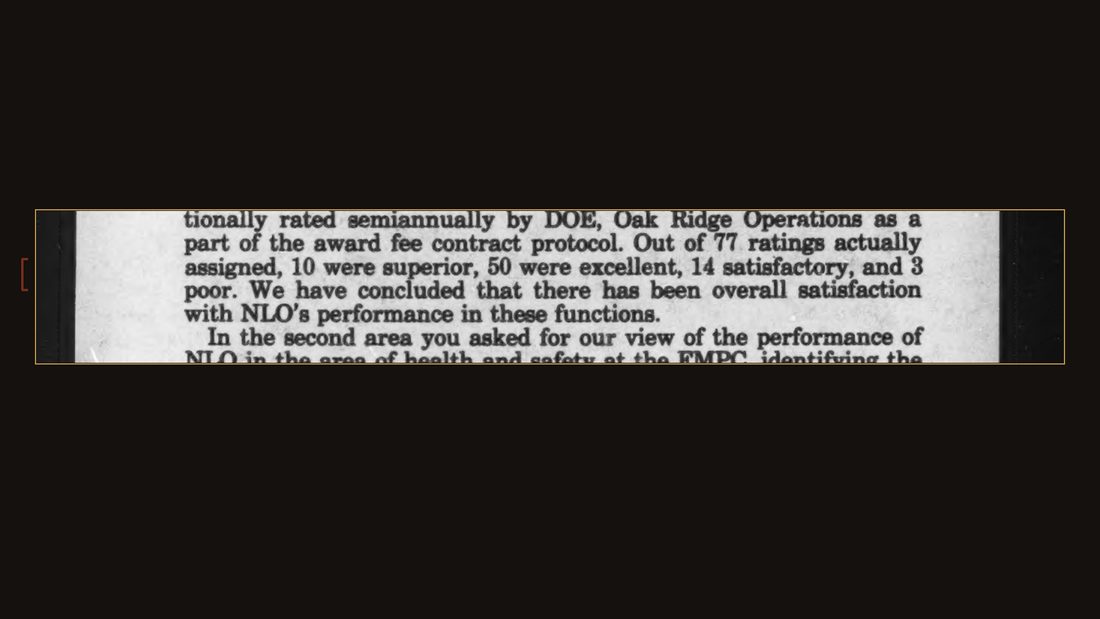
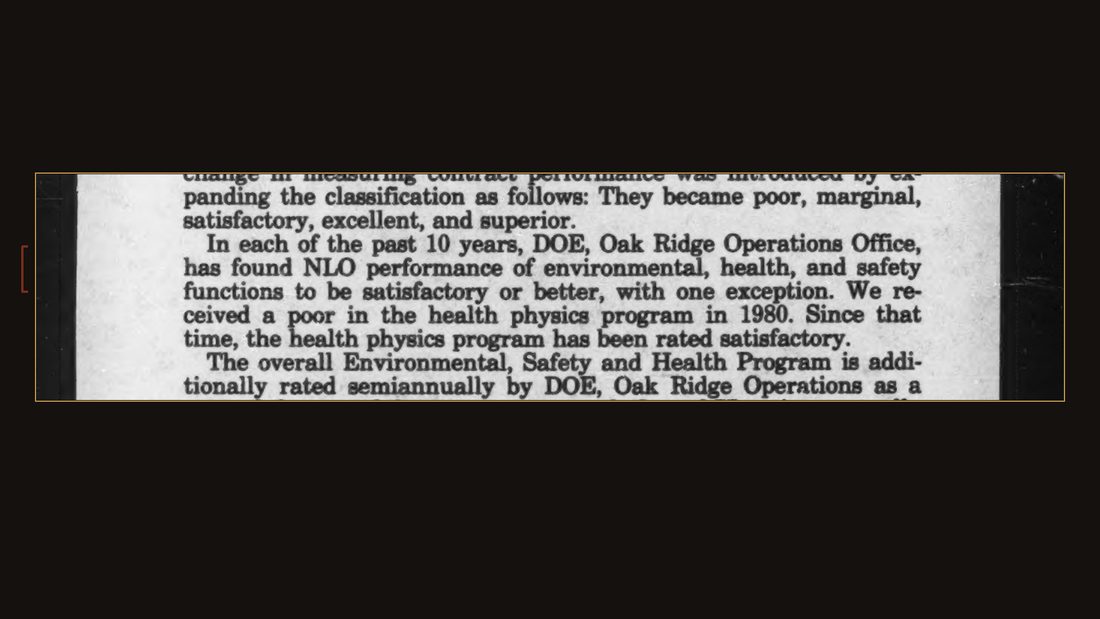
The scale of it is in the written record. Out of seventy-seven performance ratings assigned to N-L-O, ten were superior. Fifty were excellent. Fourteen satisfactory. Three poor.
S85
S. Hrg. 99-156 · U.S. Senate Gov't Affairs · Apr. 22, 1985 · p. 25.
Three poor ratings, at a plant that had put five million kilograms of uranium in the ground.
Bhopal
Lukin had a comparison ready, and in April of nineteen eighty-five everybody in that room knew what was coming.
Four months earlier, a gas leak at a Union Carbide plant in Bhopal, India, had killed thousands of people in a single night.
S86
S. Hrg. 99-156 · U.S. Senate Gov't Affairs · Apr. 22, 1985 · p. 44.
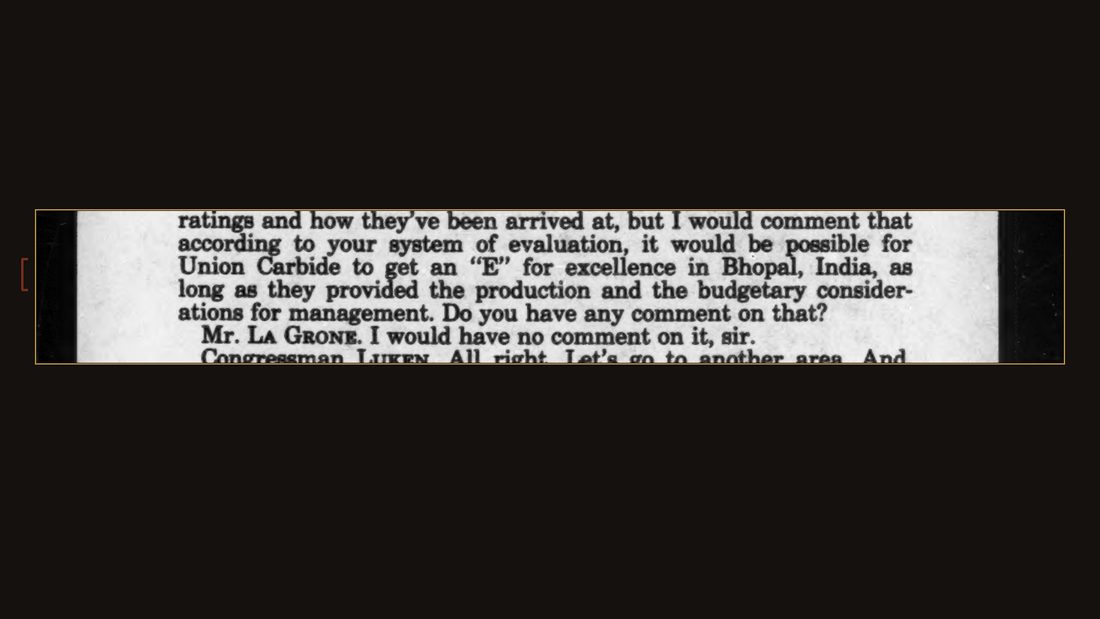
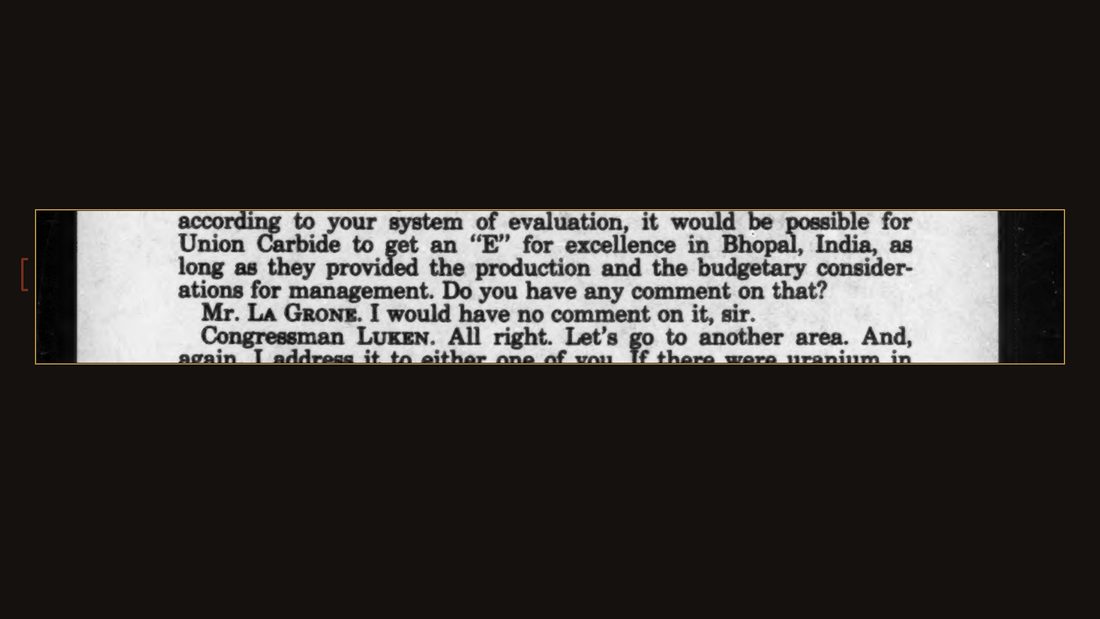
According to your system of evaluation, Lukin said, it would be possible for Union Carbide to get an E for excellence in Bhopal, India.
S87
S. Hrg. 99-156 · U.S. Senate Gov't Affairs · Apr. 22, 1985 · p. 44.
As long as they provided the production, he said, and the budgetary considerations for management. Do you have any comment on that?
S88
S. Hrg. 99-156 · U.S. Senate Gov't Affairs · Apr. 22, 1985 · p. 44.
La Grone: I would have no comment on it, sir.
S89
S. Hrg. 99-156 · U.S. Senate Gov't Affairs · Apr. 22, 1985 · p. 43.
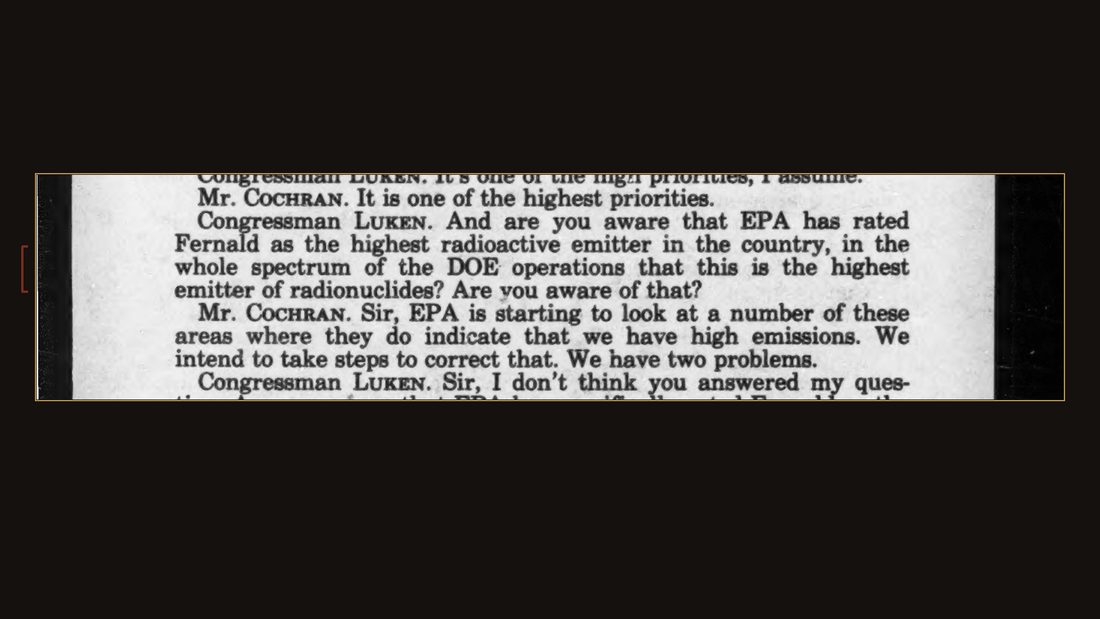
A few minutes earlier, Lukin had asked the same two men a simpler question, three times. Were they aware that the Environmental Protection Agency had rated Fernald the highest emitter of radionuclides in the country?
S90
S. Hrg. 99-156 · U.S. Senate Gov't Affairs · Apr. 22, 1985 · p. 44.
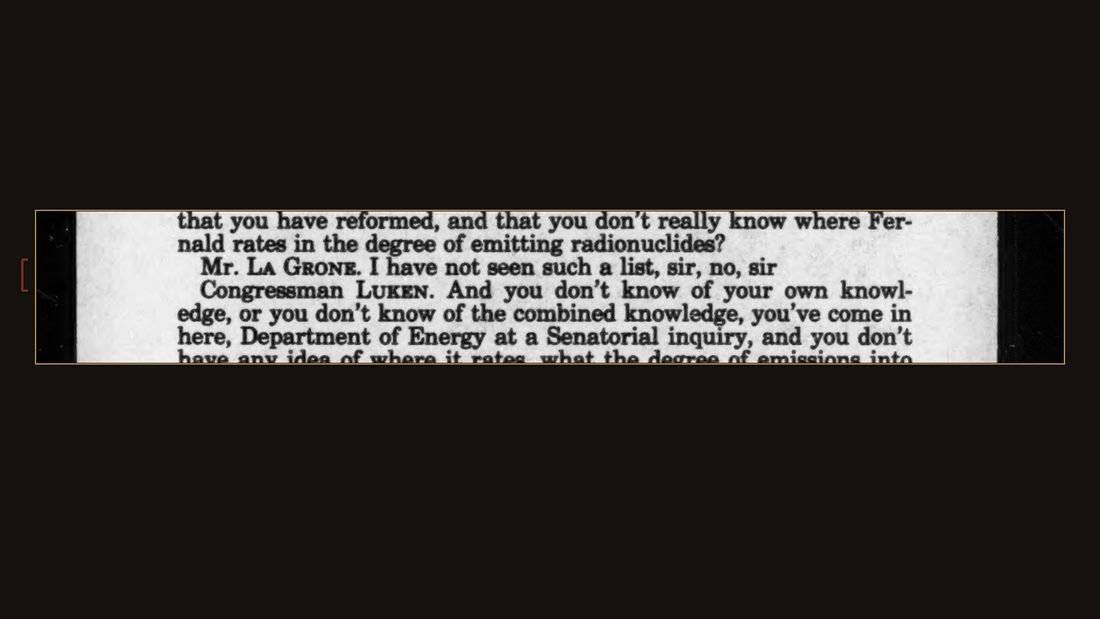
Ronald Cochran said he was personally not aware of that. La Grone said he had heard it, but had not seen such a list.
S91
S. Hrg. 99-156 · U.S. Senate Gov't Affairs · Apr. 22, 1985 · p. 44.
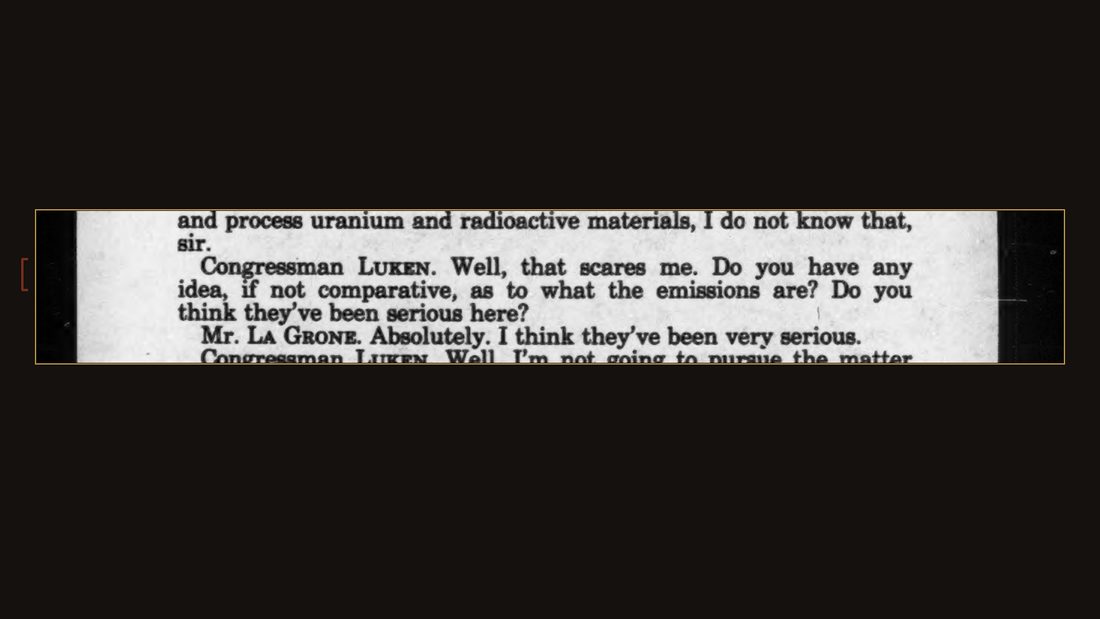
Well, that scares me, Lukin said.
Four hundred and sixty
S92
S. Hrg. 99-156 · U.S. Senate Gov't Affairs · Apr. 22, 1985 · p. 4.
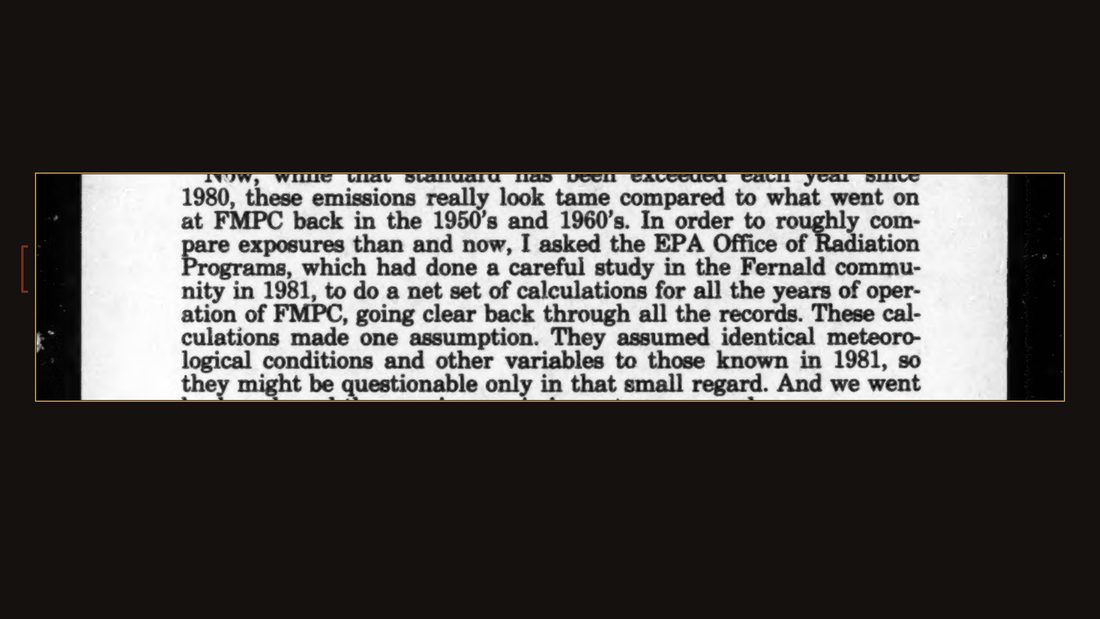
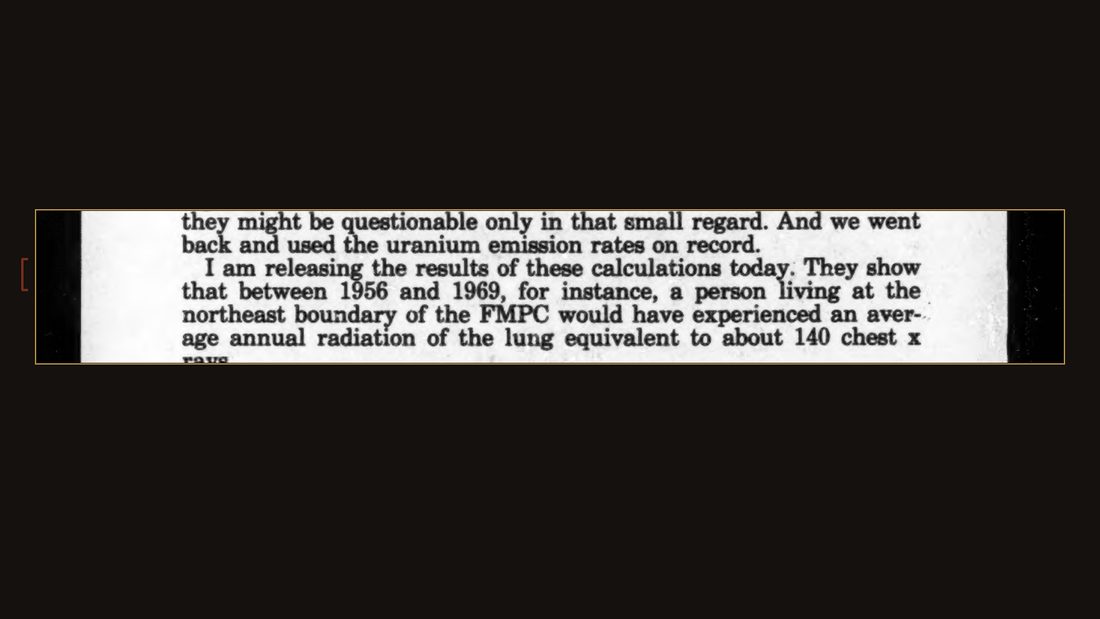
Glenn had asked the Environmental Protection Agency to do something nobody had done before: go back through the plant's own emission records and calculate what the neighbors had actually received.
S93
S. Hrg. 99-156 · U.S. Senate Gov't Affairs · Apr. 22, 1985 · p. 4.
He released the results that morning.
S94
S. Hrg. 99-156 · U.S. Senate Gov't Affairs · Apr. 22, 1985 · p. 4.
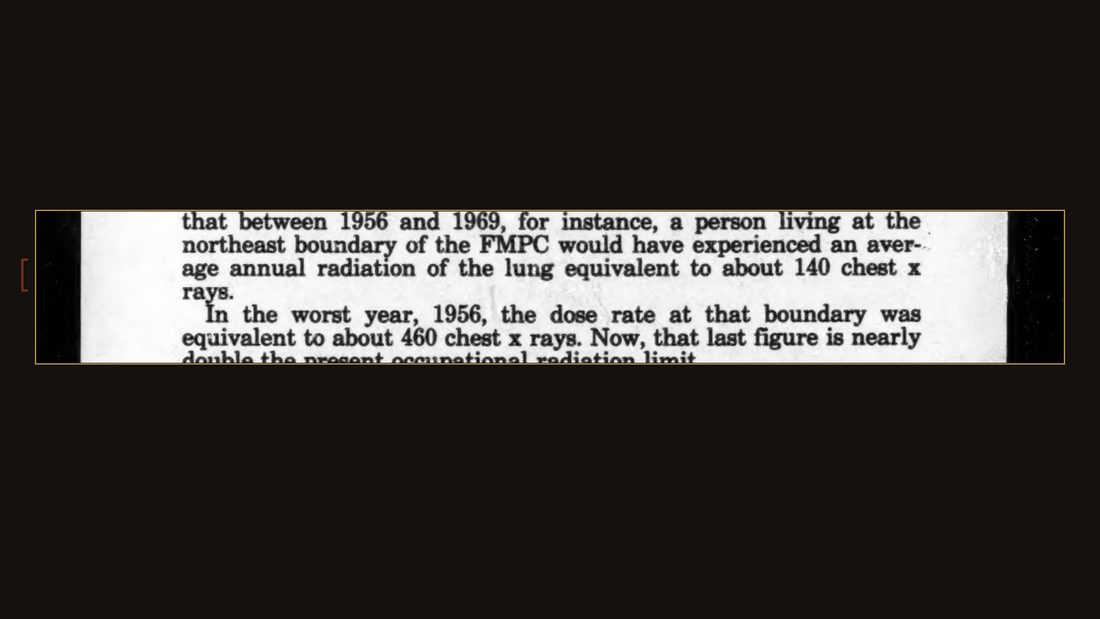
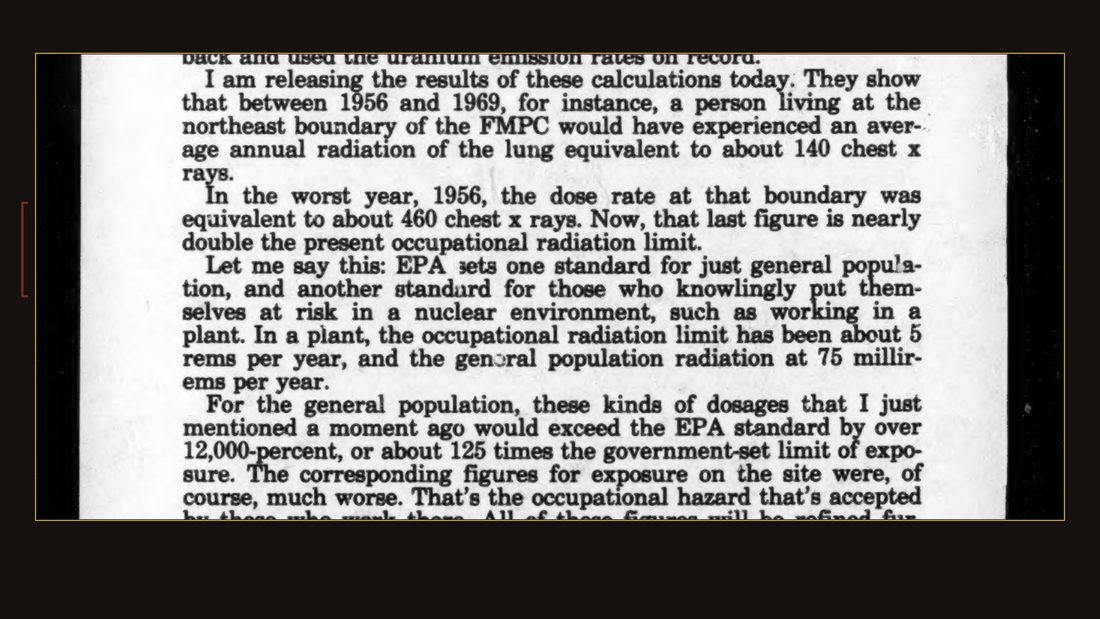
Between nineteen fifty-six and nineteen sixty-nine, a person living at the northeast boundary of the plant would have taken an average annual dose to the lung equivalent to about one hundred and forty chest x-rays.
Every year. For fourteen years.
S95
S. Hrg. 99-156 · U.S. Senate Gov't Affairs · Apr. 22, 1985 · p. 4.
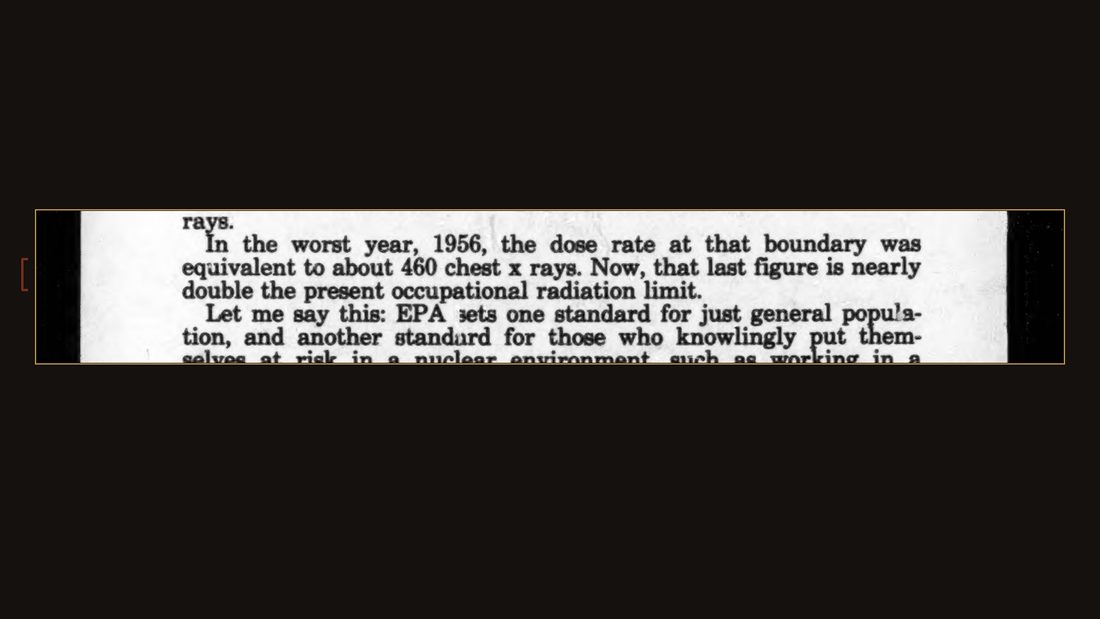
In the worst year, nineteen fifty-six, the dose at that boundary was equivalent to about four hundred and sixty chest x-rays.
S96
S. Hrg. 99-156 · U.S. Senate Gov't Affairs · Apr. 22, 1985 · p. 4.
That figure, Glenn said, is nearly double the occupational radiation limit. The limit for people who go to work in a nuclear plant knowing exactly what they are walking into.
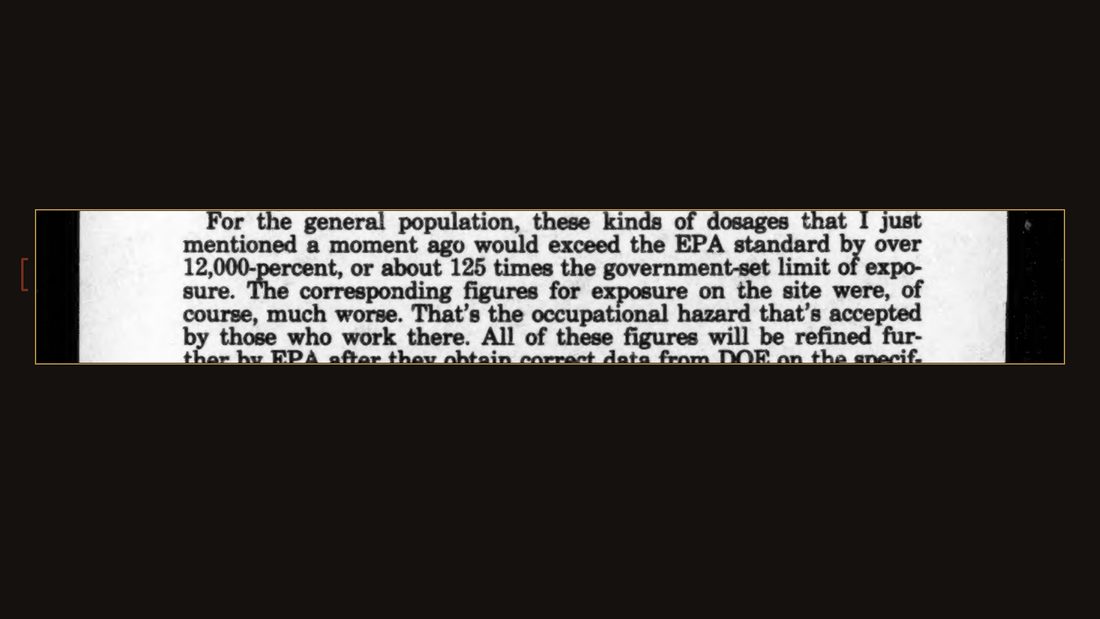
S97
S. Hrg. 99-156 · U.S. Senate Gov't Affairs · Apr. 22, 1985 · p. 4.
For the general public, he said, those doses would exceed the E-P-A standard by over twelve thousand percent. About one hundred and twenty-five times the government-set limit.
The people at that boundary were farming.
The registries
S98
S. Hrg. 99-156 · U.S. Senate Gov't Affairs · Apr. 22, 1985 · p. 134.
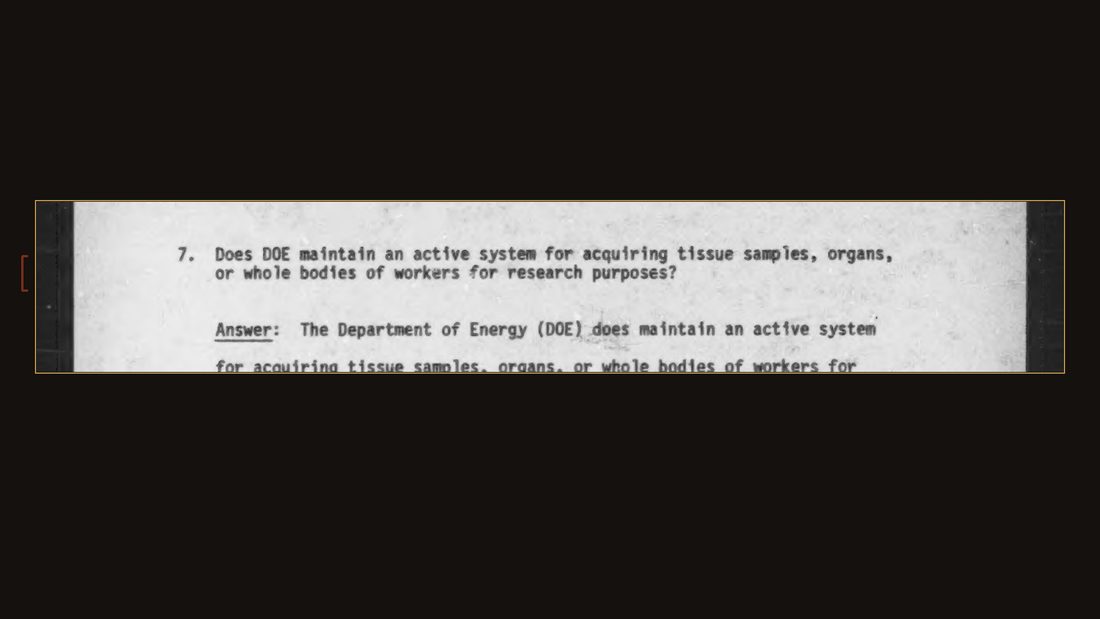
Glenn's staff also submitted written questions to the Department afterward, and the answers were printed in the back of the volume. One of them is a single question I want to read to you exactly as it appears.
S99
S. Hrg. 99-156 · U.S. Senate Gov't Affairs · Apr. 22, 1985 · p. 134.
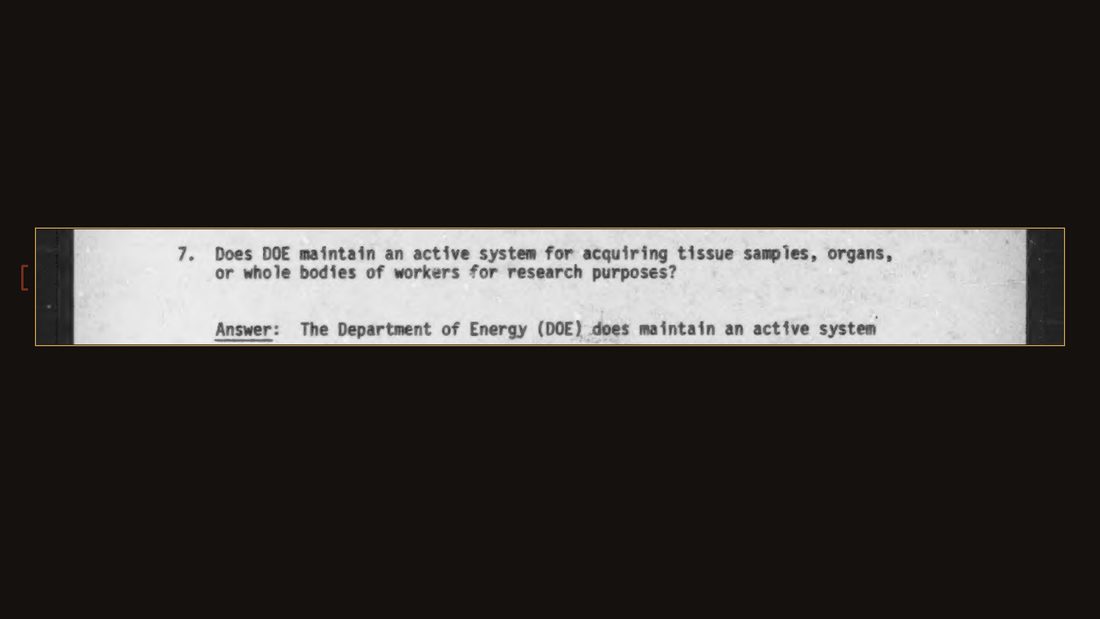
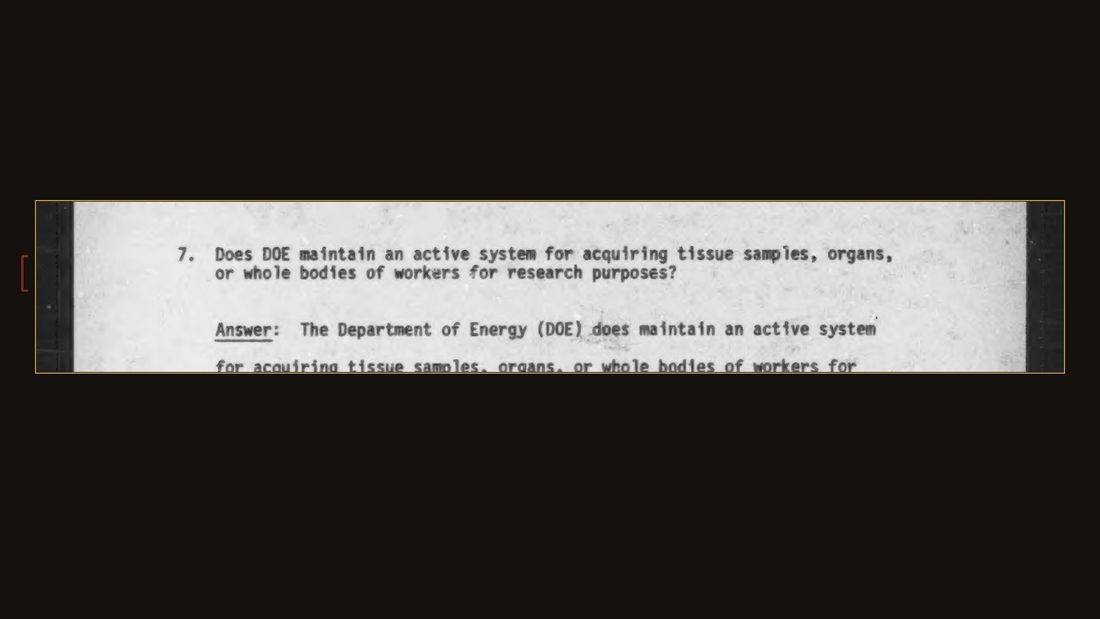
Does the Department of Energy maintain an active system for acquiring tissue samples, organs, or whole bodies of workers for research purposes?
S100
S. Hrg. 99-156 · U.S. Senate Gov't Affairs · Apr. 22, 1985 · p. 134.
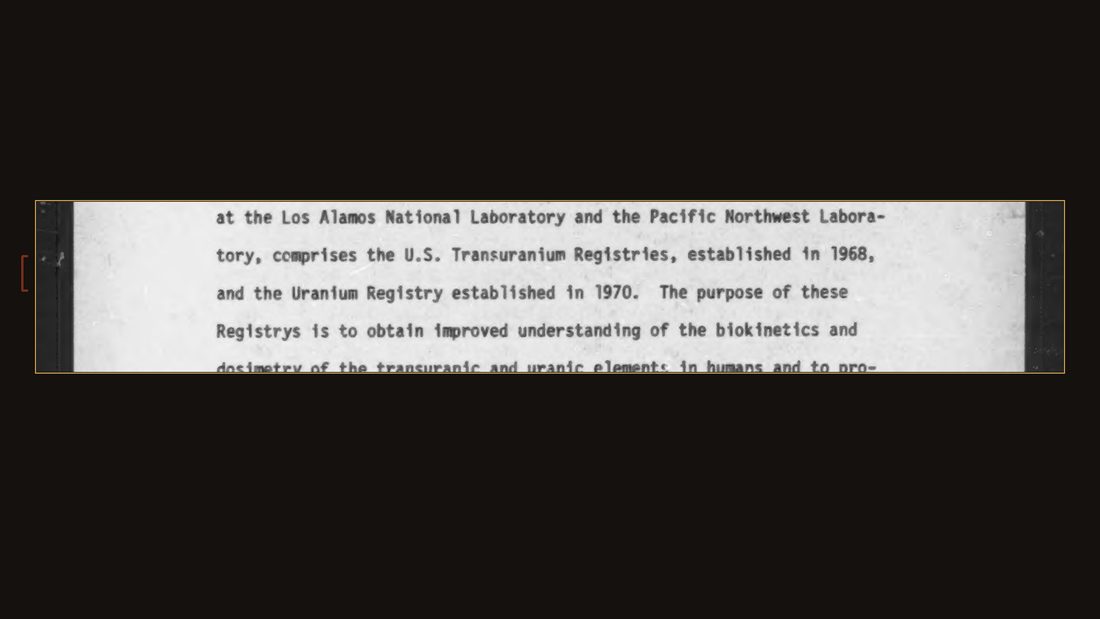
The answer begins: the Department of Energy does maintain an active system for acquiring tissue samples, organs, or whole bodies of workers for research purposes.
S101
S. Hrg. 99-156 · U.S. Senate Gov't Affairs · Apr. 22, 1985 · p. 134.
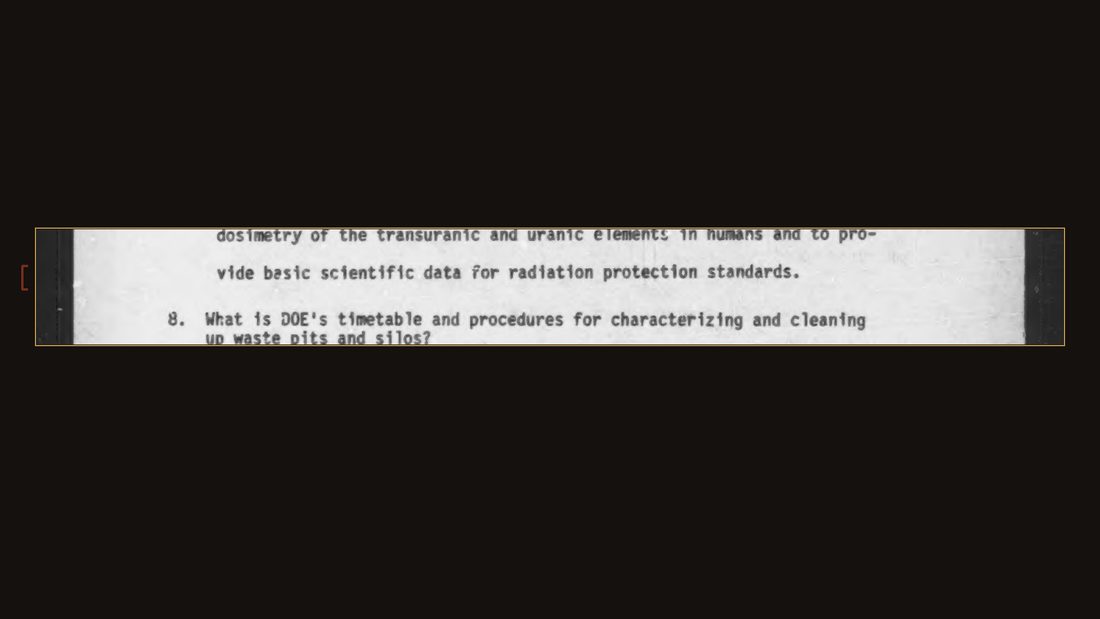
It names them. The United States Transuranium Registries, established in nineteen sixty-eight, and the Uranium Registry, established in nineteen seventy. The stated purpose is to understand how these elements behave in humans, and to set radiation protection standards.
S102
S. Hrg. 99-156 · U.S. Senate Gov't Affairs · Apr. 22, 1985 · p. 134.
The answer does not describe how consent was obtained, and nobody at the hearing followed up. I am telling you what the page says and nothing beyond it.
Ten minutes
S103
S. Hrg. 99-156 · U.S. Senate Gov't Affairs · Apr. 22, 1985 · p. 253.
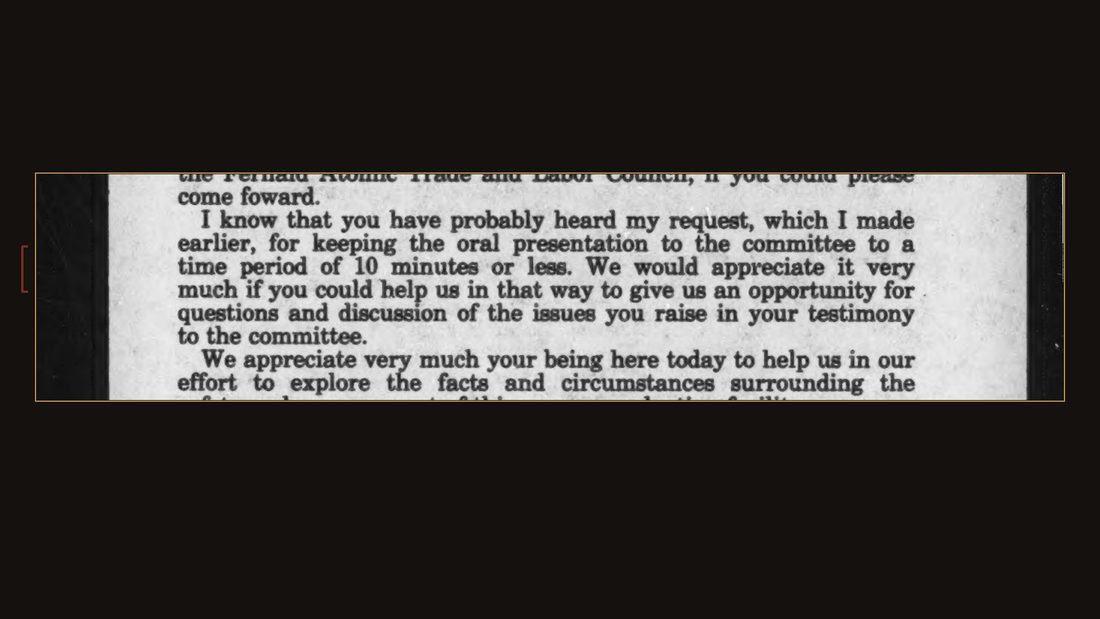
The people who lived around the plant got about ten minutes.
S104
S. Hrg. 99-156 · U.S. Senate Gov't Affairs · Apr. 22, 1985 · p. 253.
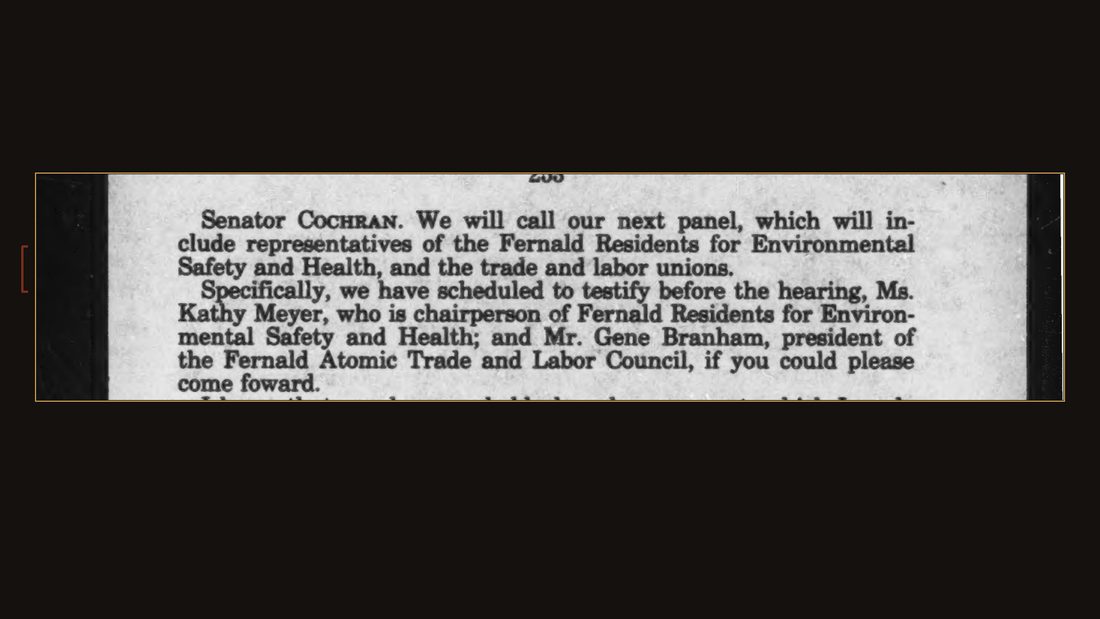
They came as an organization they had built that winter: Fernald Residents for Environmental Safety and Health. In the record it is always the acronym. FRESH.
S105
S. Hrg. 99-156 · U.S. Senate Gov't Affairs · Apr. 22, 1985 · p. 255.
Kathy Meyer chaired it. She read four requests into the record, and all four were about the same thing.
S106
S. Hrg. 99-156 · U.S. Senate Gov't Affairs · Apr. 22, 1985 · p. 255.
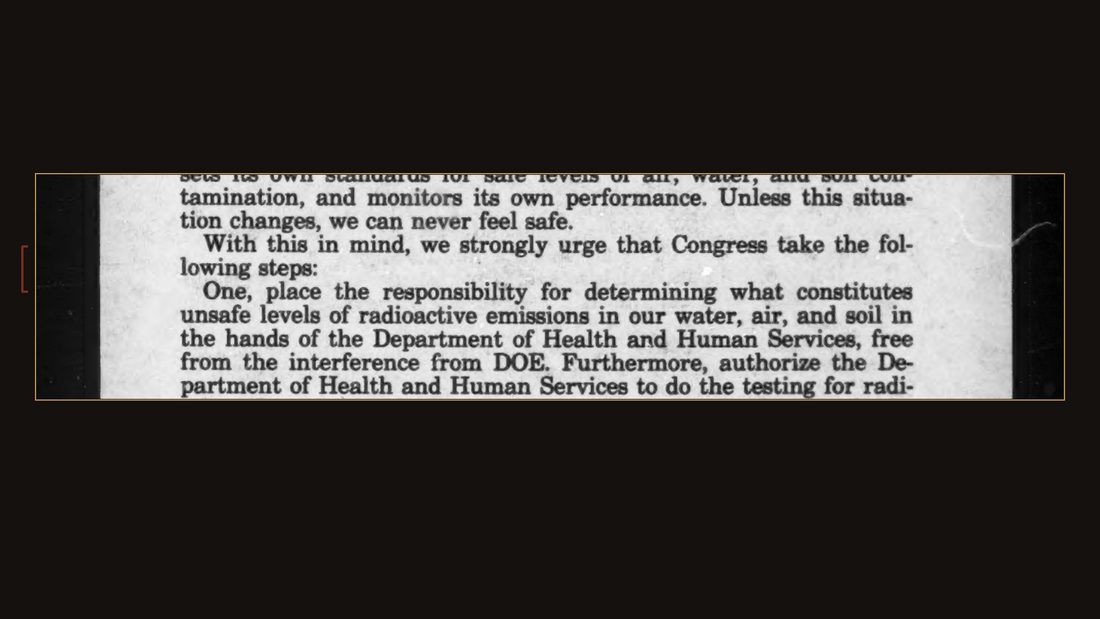
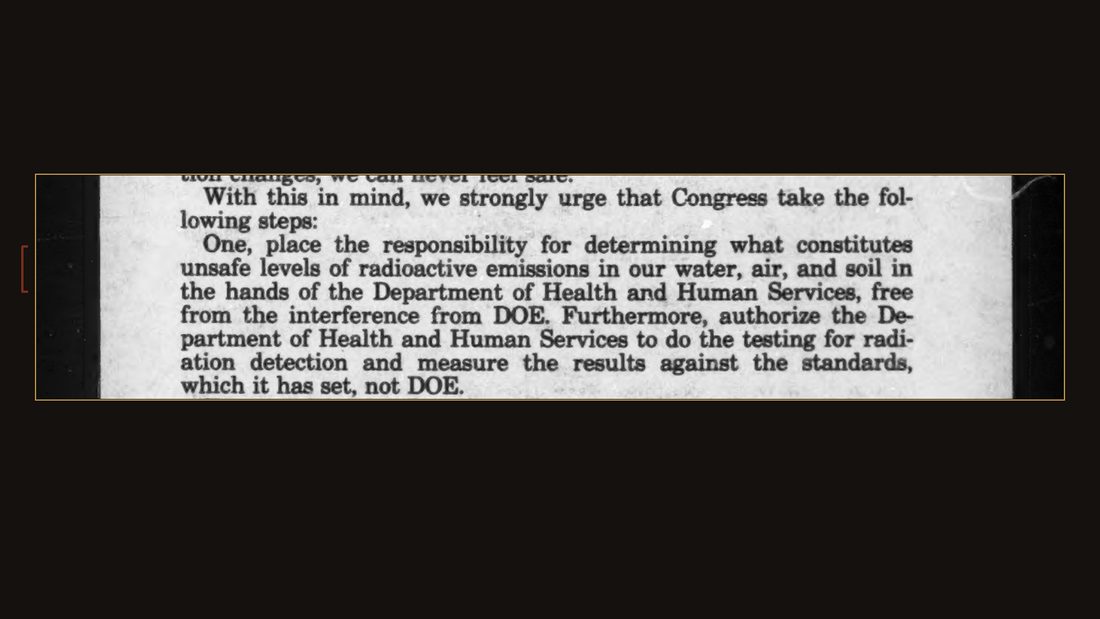
Take the standard-setting away from the Department of Energy. Let the Environmental Protection Agency monitor the waste. Put air monitors out in every direction. Pay for the cleanup.
S107
S. Hrg. 99-156 · U.S. Senate Gov't Affairs · Apr. 22, 1985 · p. 255.
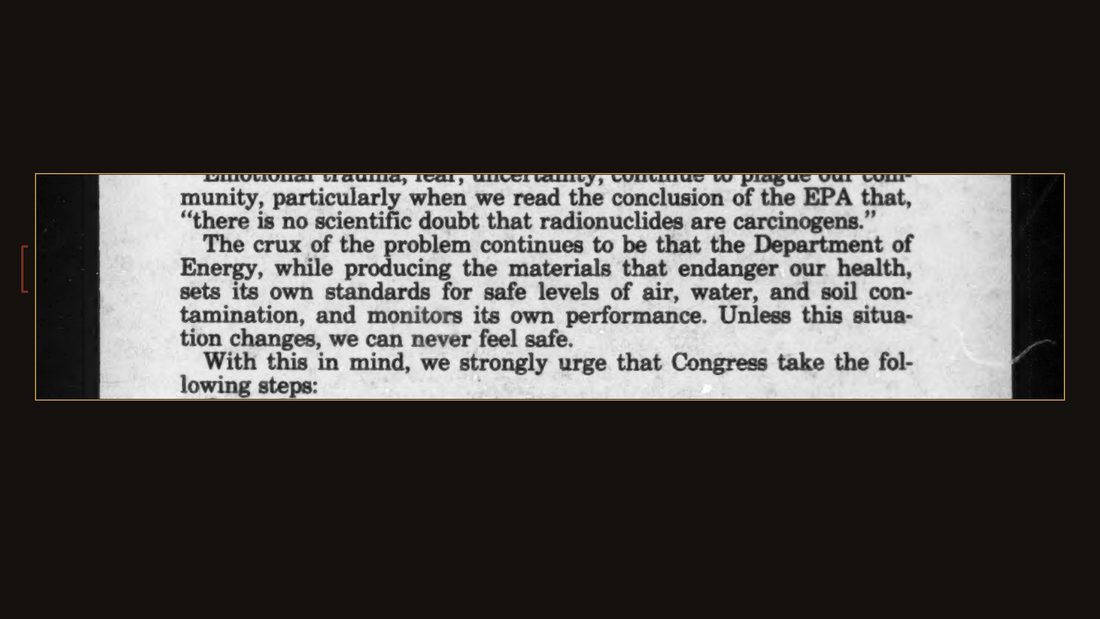
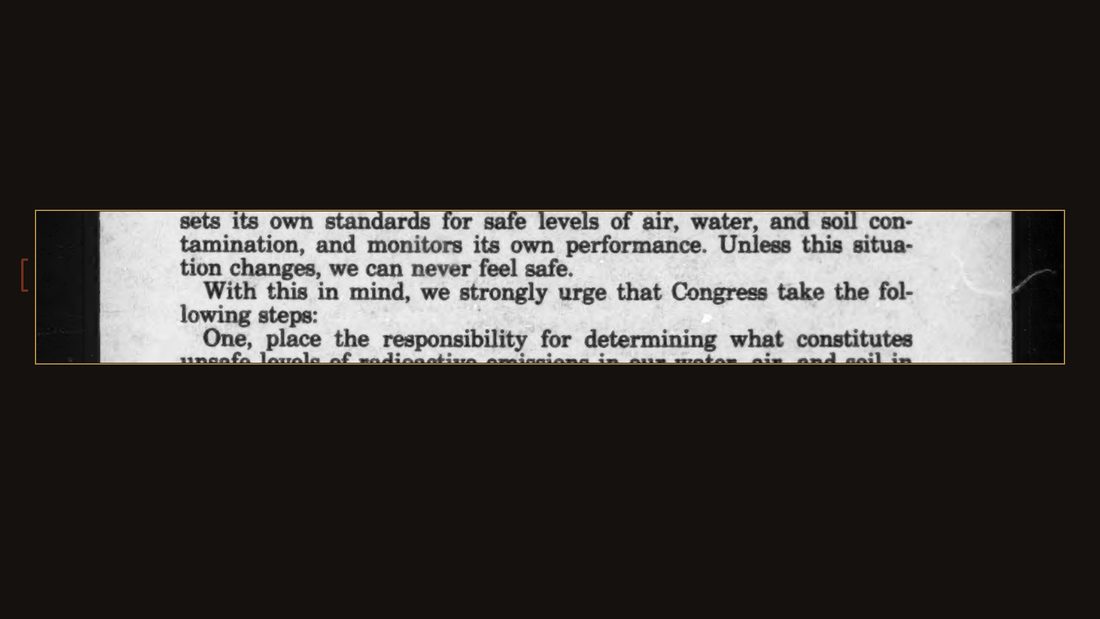
The crux of the problem, she said, is that the Department, while producing the materials that endanger our health, sets its own standards and monitors its own performance.
S108
S. Hrg. 99-156 · U.S. Senate Gov't Affairs · Apr. 22, 1985 · p. 255.
Unless that changes, she said, we can never feel safe.
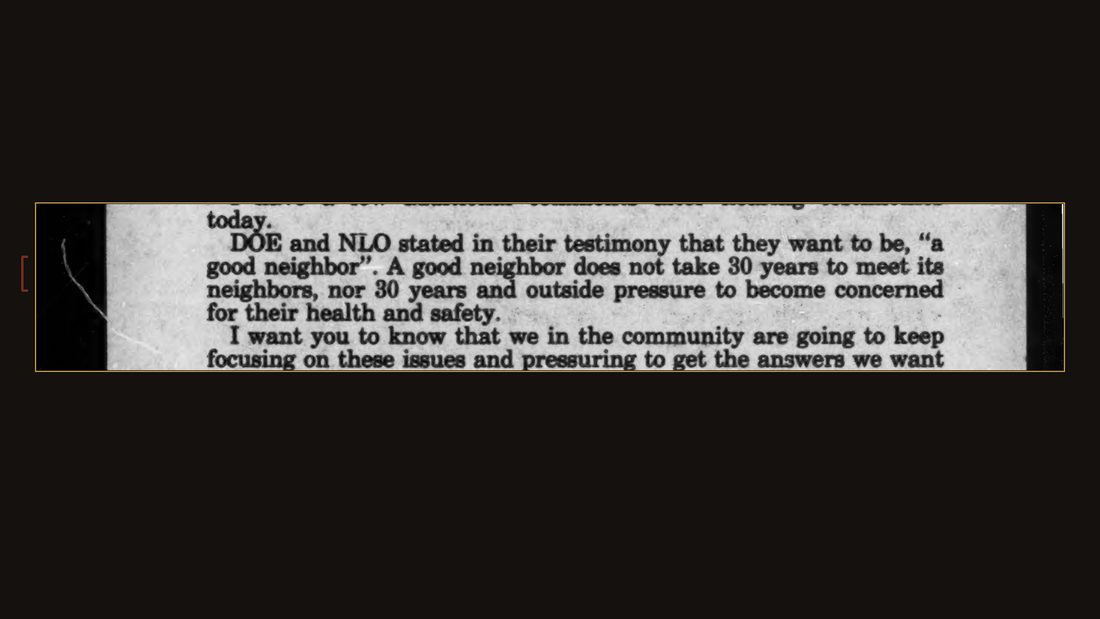
S109
S. Hrg. 99-156 · U.S. Senate Gov't Affairs · Apr. 22, 1985 · p. 256.
Then the line that got quoted. A good neighbor does not take thirty years to meet its neighbors.
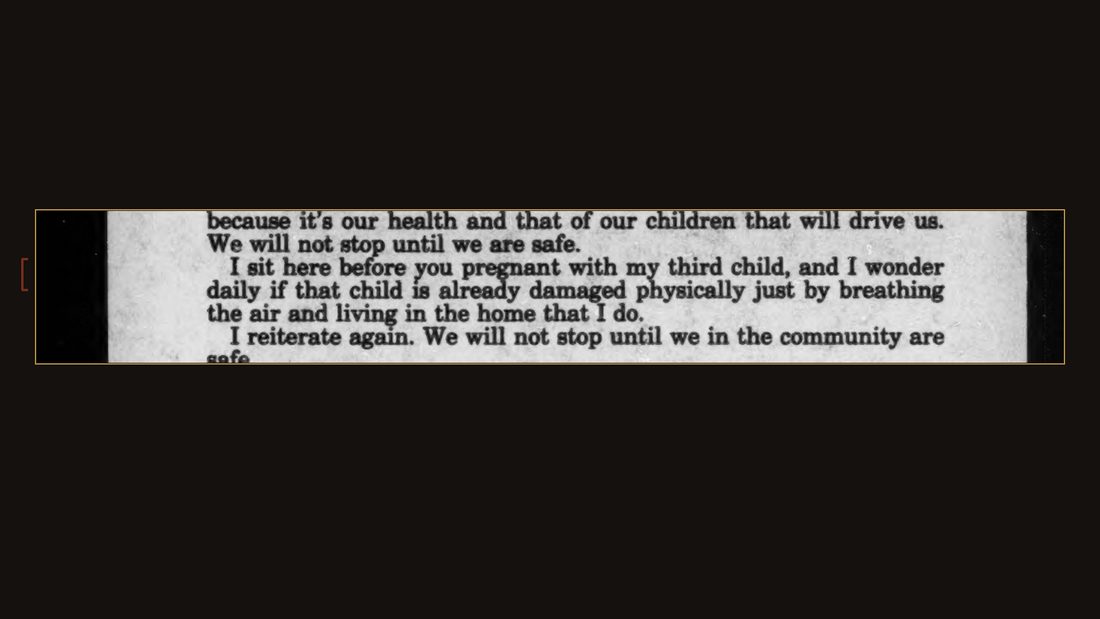
S110
S. Hrg. 99-156 · U.S. Senate Gov't Affairs · Apr. 22, 1985 · p. 256.
She finished by telling them she was pregnant.
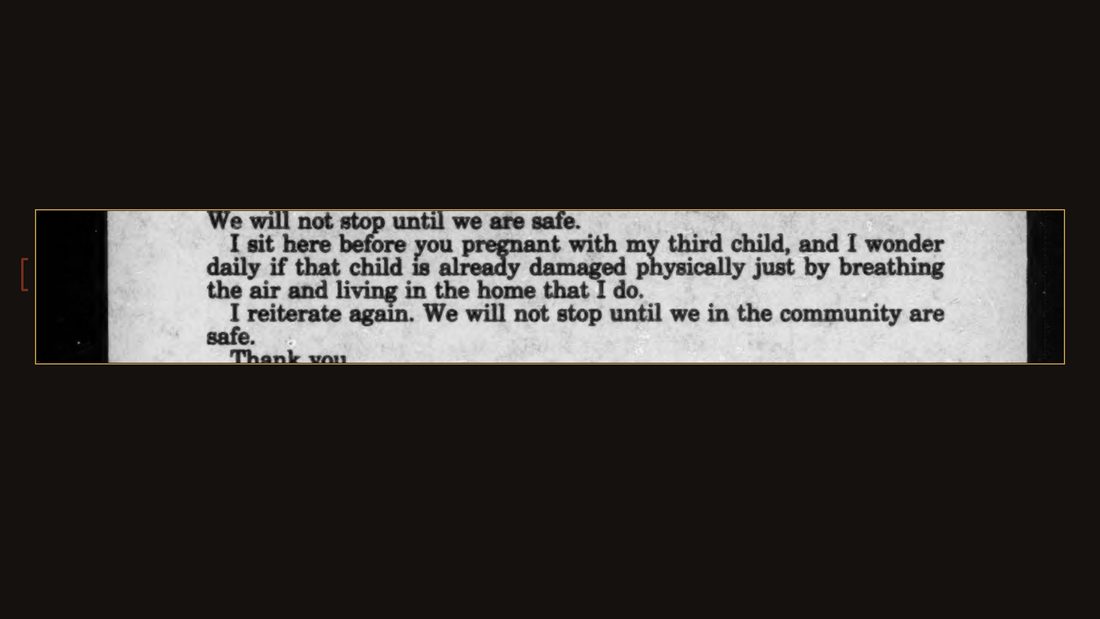
S111
S. Hrg. 99-156 · U.S. Senate Gov't Affairs · Apr. 22, 1985 · p. 256.
I sit here before you with my third child, she said, and I wonder daily if that child is already damaged physically, just by breathing the air and living in the home that I do.
The union
Beside her sat the union.
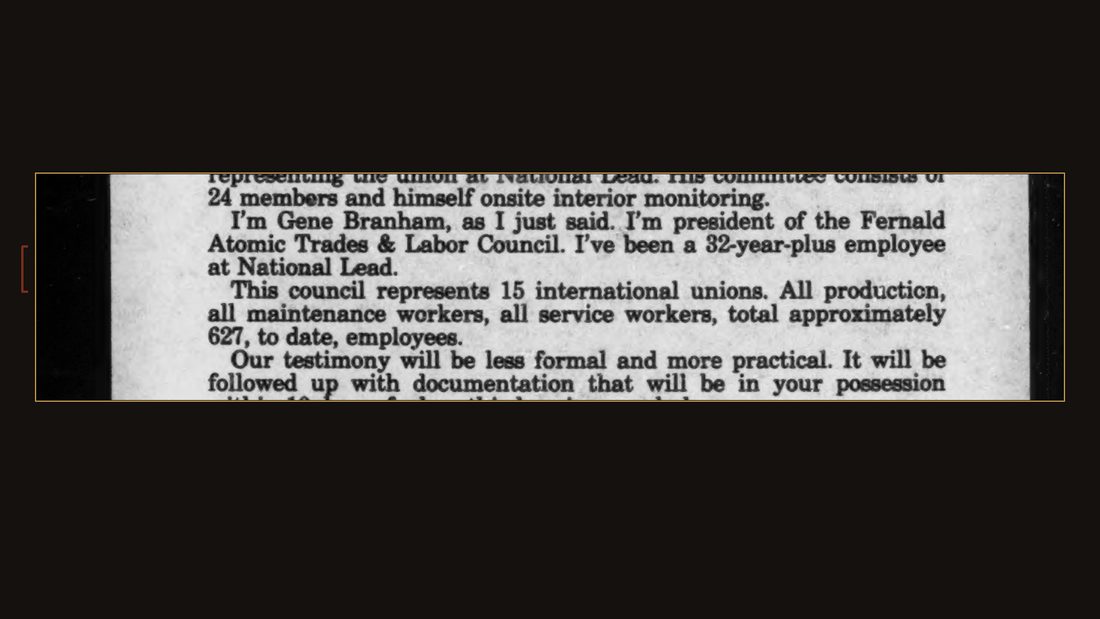
S112
S. Hrg. 99-156 · U.S. Senate Gov't Affairs · Apr. 22, 1985 · p. 256.
Gene Branham, president of the Fernald Atomic Trades and Labor Council. Thirty-two years at the plant, speaking for fifteen international unions and about six hundred and twenty-seven workers.
S113
S. Hrg. 99-156 · U.S. Senate Gov't Affairs · Apr. 22, 1985 · p. 259.
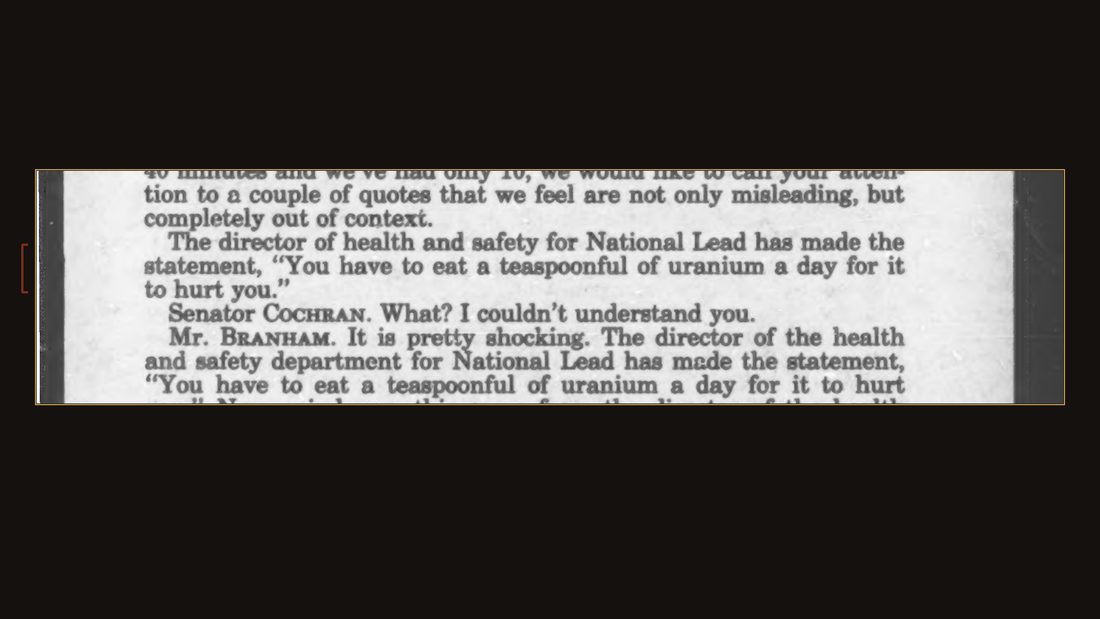
He offered the committee two quotations. The first, he said, came from the director of the health and safety department at National Lead.
S114
S. Hrg. 99-156 · U.S. Senate Gov't Affairs · Apr. 22, 1985 · p. 259.
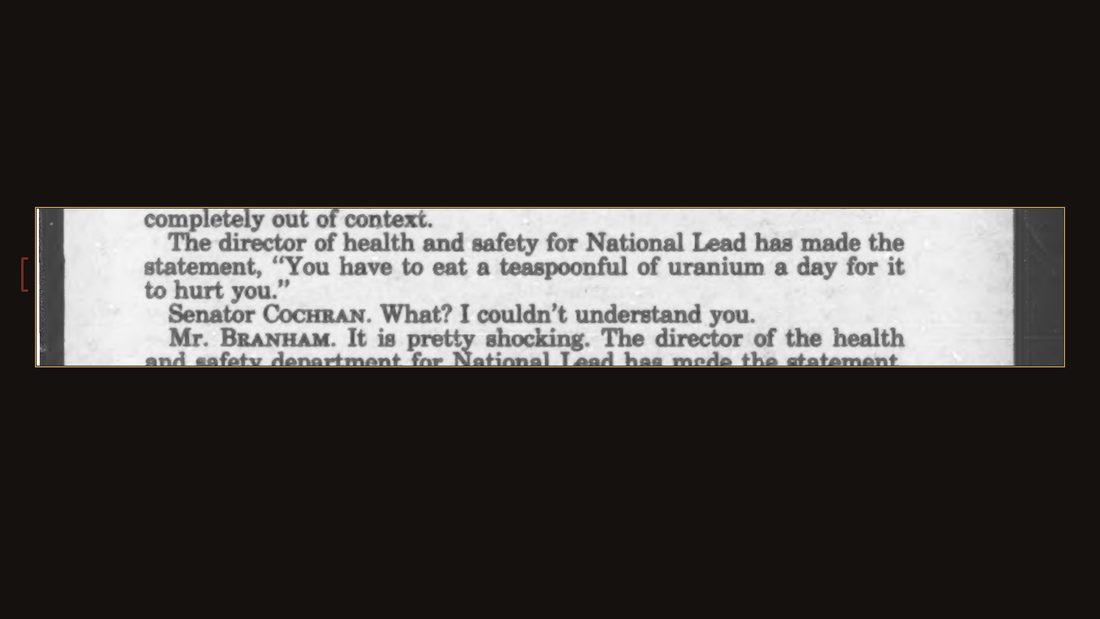
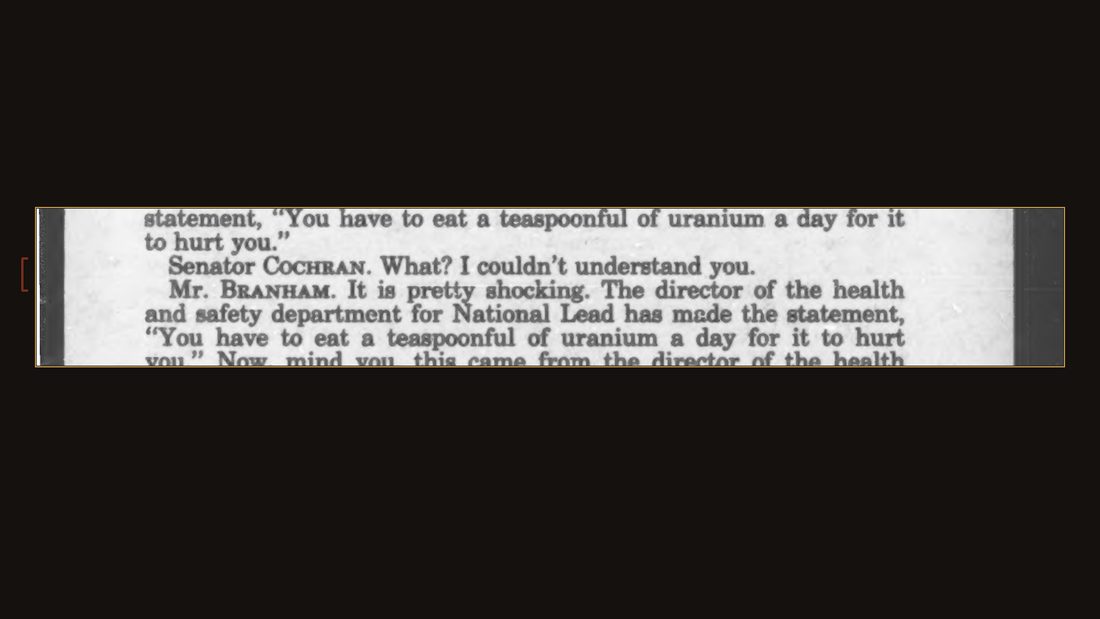
You have to eat a teaspoonful of uranium a day for it to hurt you.
S115
S. Hrg. 99-156 · U.S. Senate Gov't Affairs · Apr. 22, 1985 · p. 259.
The chairman, Senator Thad Cochran, stopped him. What? I couldn't understand you.
S116
S. Hrg. 99-156 · U.S. Senate Gov't Affairs · Apr. 22, 1985 · p. 260.
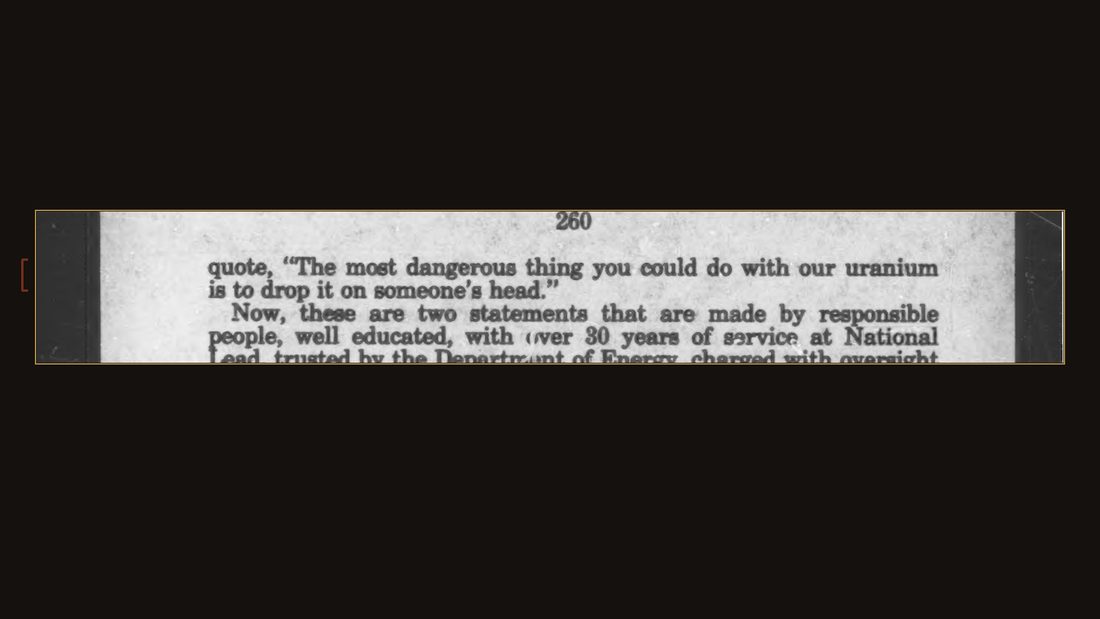
Branham repeated it, then gave them the second, which he attributed to an assistant plant manager. The most dangerous thing you could do with our uranium is to drop it on someone's foot.
S117
S. Hrg. 99-156 · U.S. Senate Gov't Affairs · Apr. 22, 1985 · p. 265.
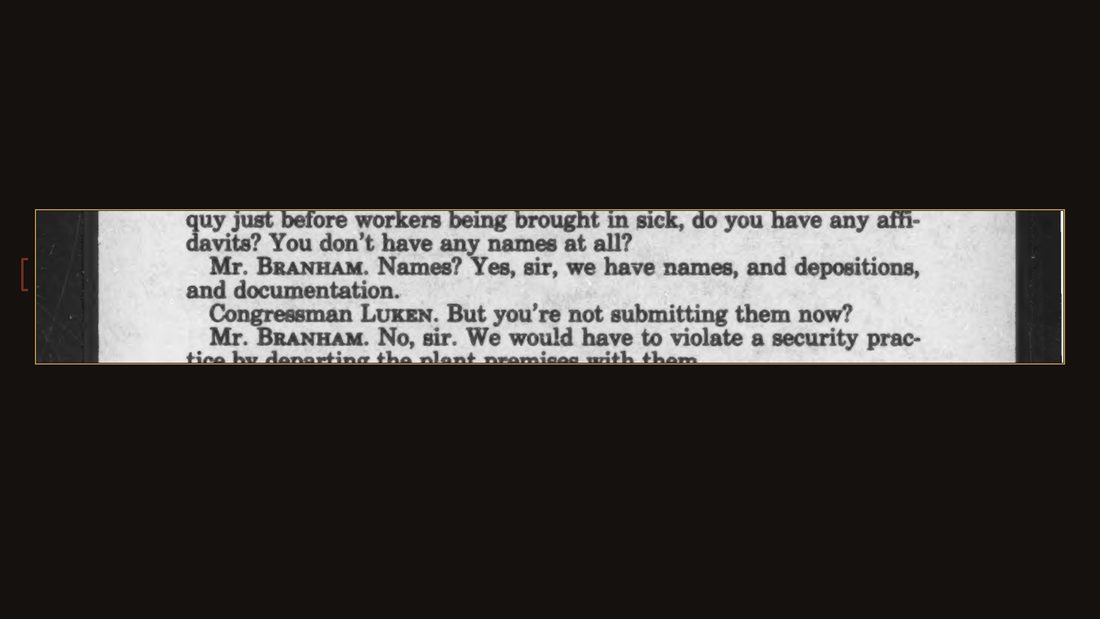
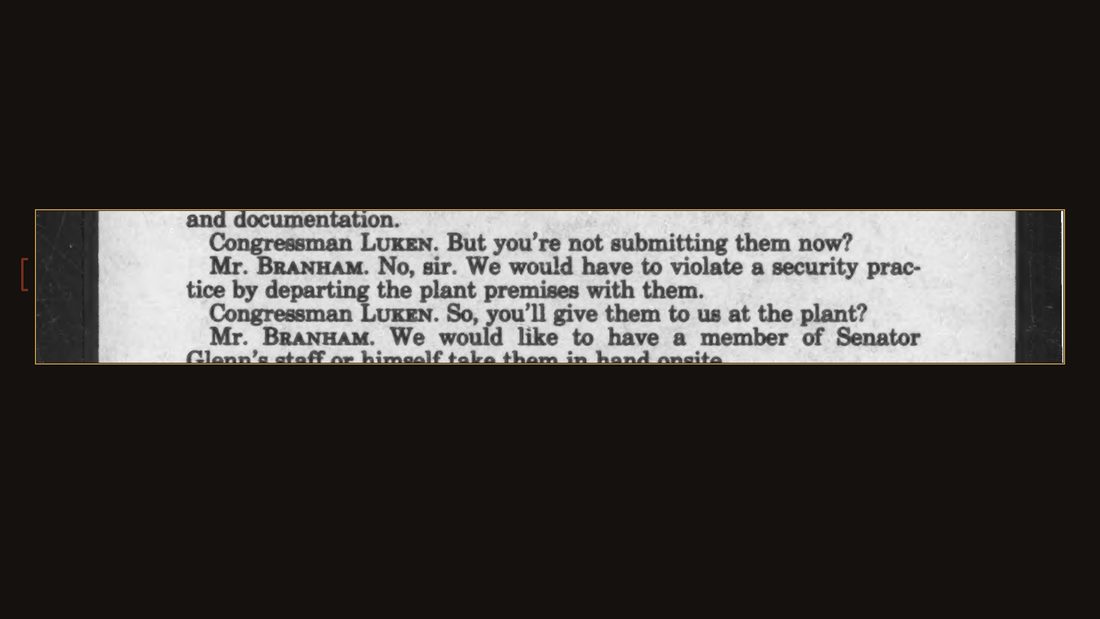
Branham also told them he had names, depositions and documentation about workers who had gotten sick.
S118
S. Hrg. 99-156 · U.S. Senate Gov't Affairs · Apr. 22, 1985 · p. 265.
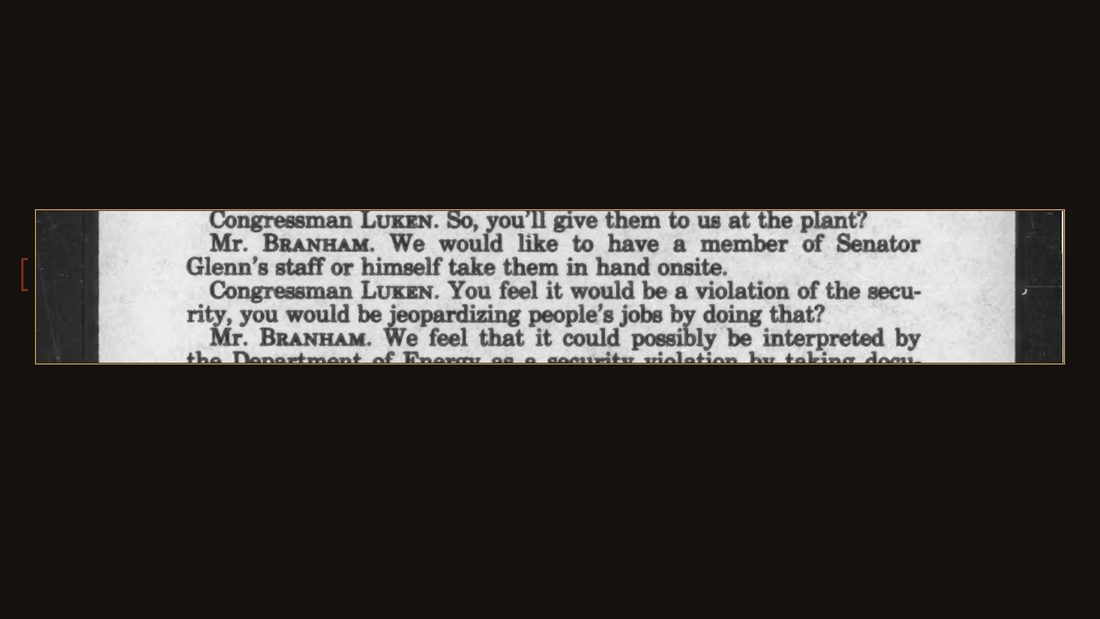
And that he could not hand any of it over in that room, because carrying documents off the plant site could be treated as a security violation.
S119
S. Hrg. 99-156 · U.S. Senate Gov't Affairs · Apr. 22, 1985 · p. 265.
He asked instead that a member of Senator Glenn's staff come out to the plant and take them there.
National security, at that plant, in that year, meant a union president could not carry a piece of paper about sick men through a gate.
The state
S120
S. Hrg. 99-156 · U.S. Senate Gov't Affairs · Apr. 22, 1985 · p. 333.
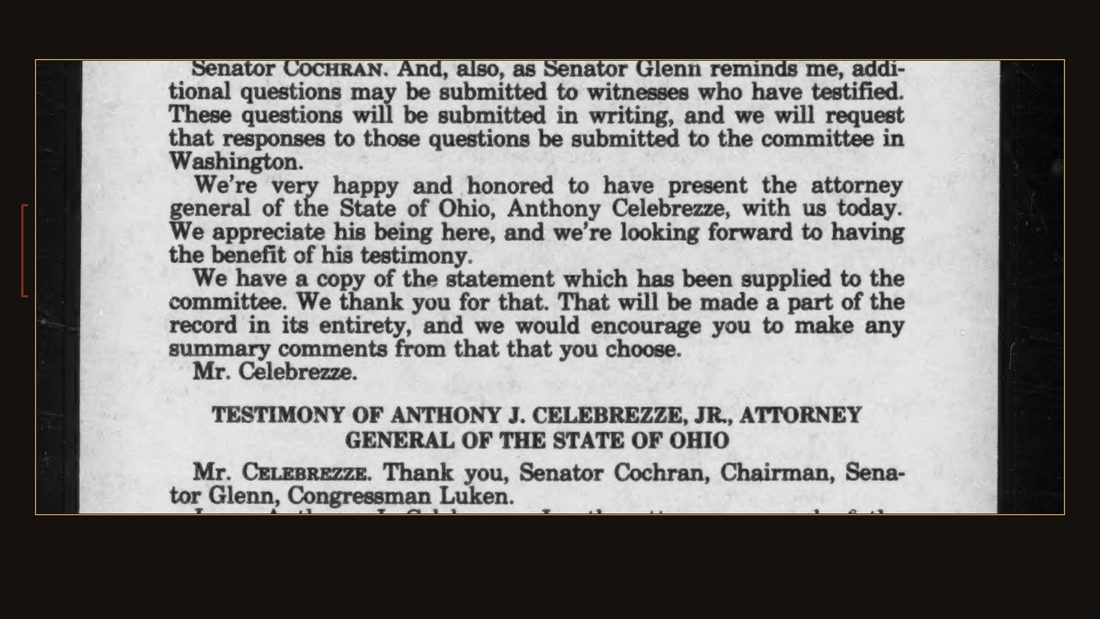
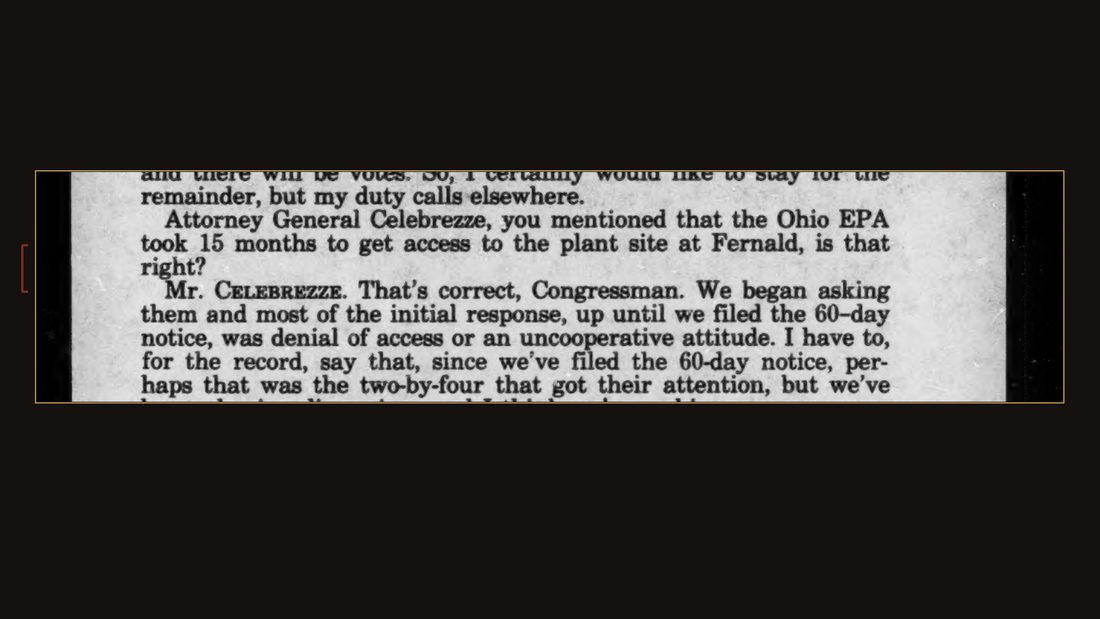
The State of Ohio was in the room too. Anthony Celebrezze, the attorney general, testified about his state's legal efforts against a federal facility inside its own borders.
S121
S. Hrg. 99-156 · U.S. Senate Gov't Affairs · Apr. 22, 1985 · p. 339.
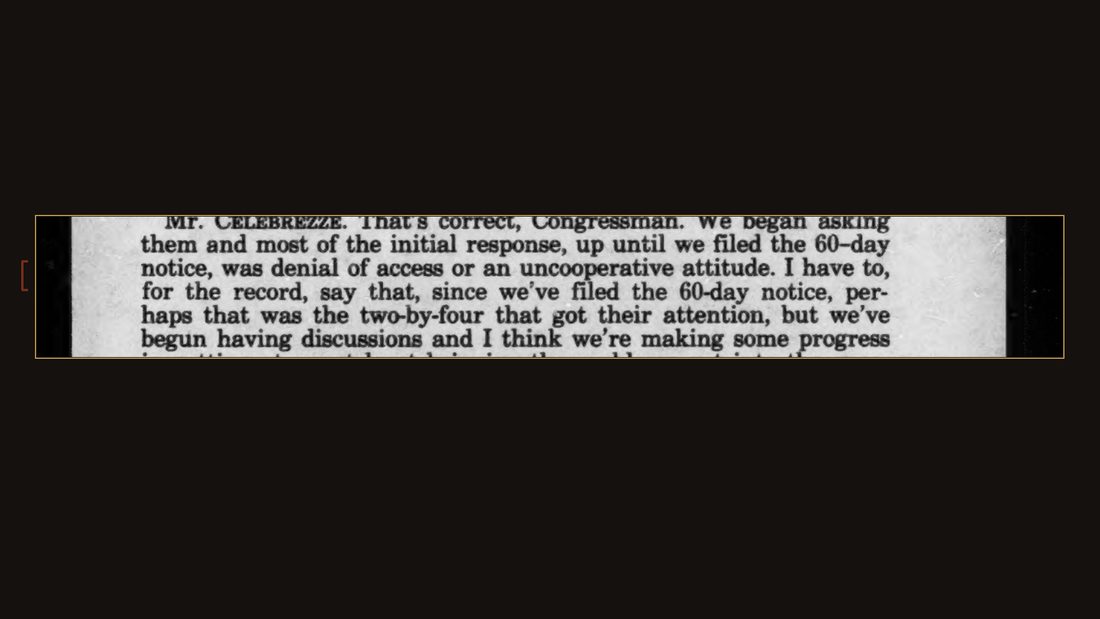
He told Lukin the Ohio Environmental Protection Agency had spent months trying to get access to the site.
S122
S. Hrg. 99-156 · U.S. Senate Gov't Affairs · Apr. 22, 1985 · p. 339.
Most of the initial response, he said, was denial of access or an uncooperative attitude. That changed after Ohio filed a formal sixty-day notice of intent to sue.
S123
S. Hrg. 99-156 · U.S. Senate Gov't Affairs · Apr. 22, 1985 · p. 339.
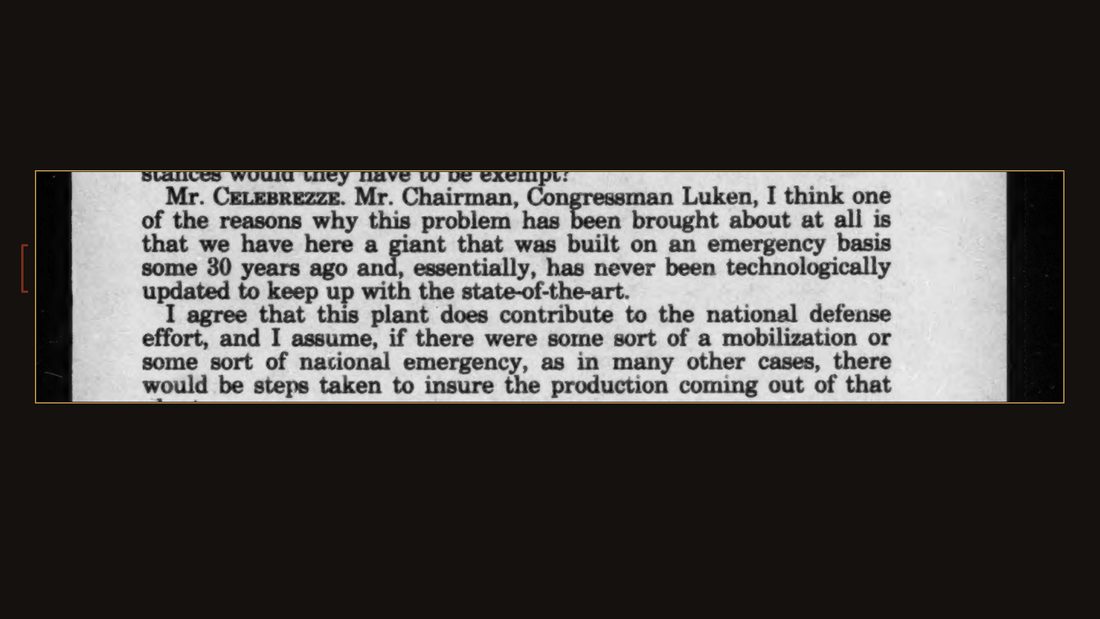
Asked why the problem existed at all, he said the plant was built on an emergency basis some thirty years ago and essentially has never been technologically updated.
What the courts did
S124
Univ. of Cincinnati · History of the Fernald Plant and Litigation.
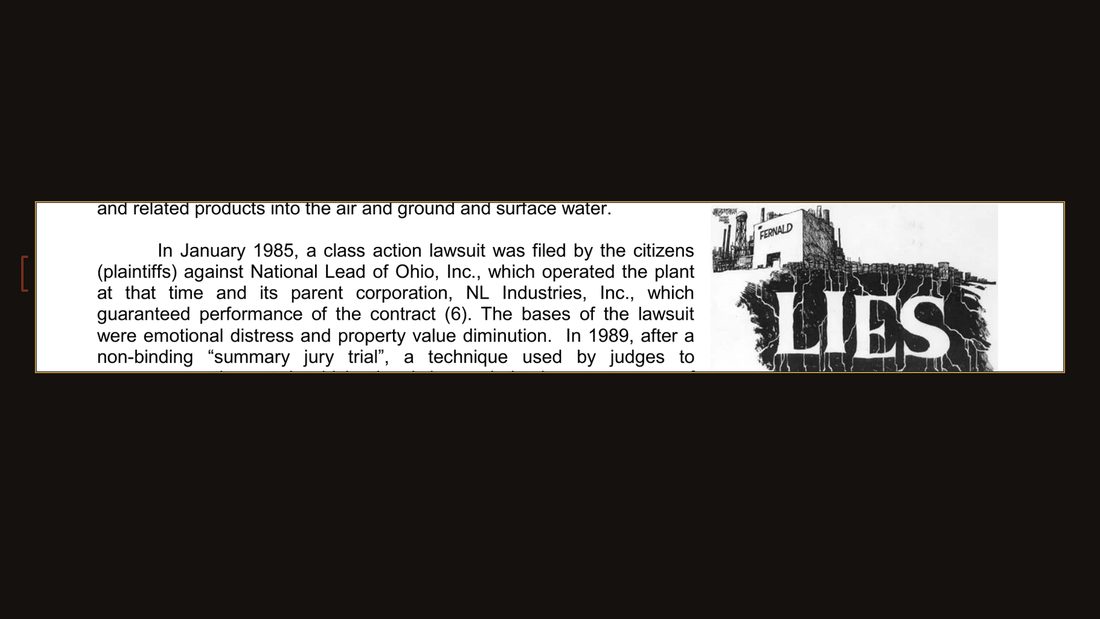
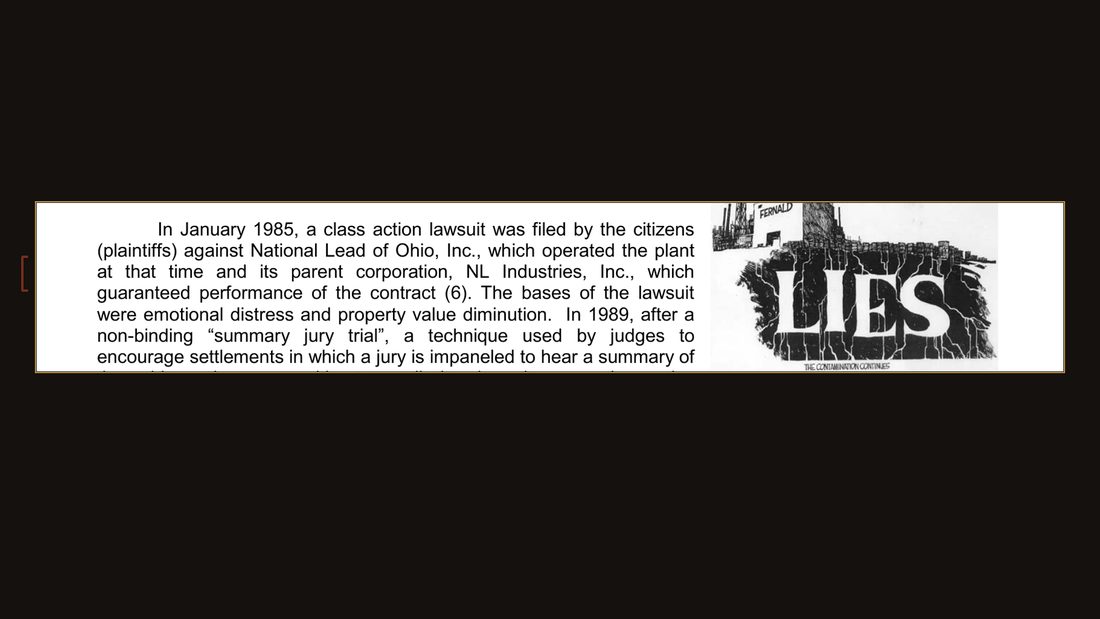
Three months before the hearing, in January of nineteen eighty-five, the neighbors had already sued.
S125
Univ. of Cincinnati · History of the Fernald Plant and Litigation.
The case was in ray Fernald Litigation, in the United States District Court for the Southern District of Ohio. They sued National Lead of Ohio and its parent, N-L Industries.
S126
Univ. of Cincinnati · History of the Fernald Plant and Litigation.
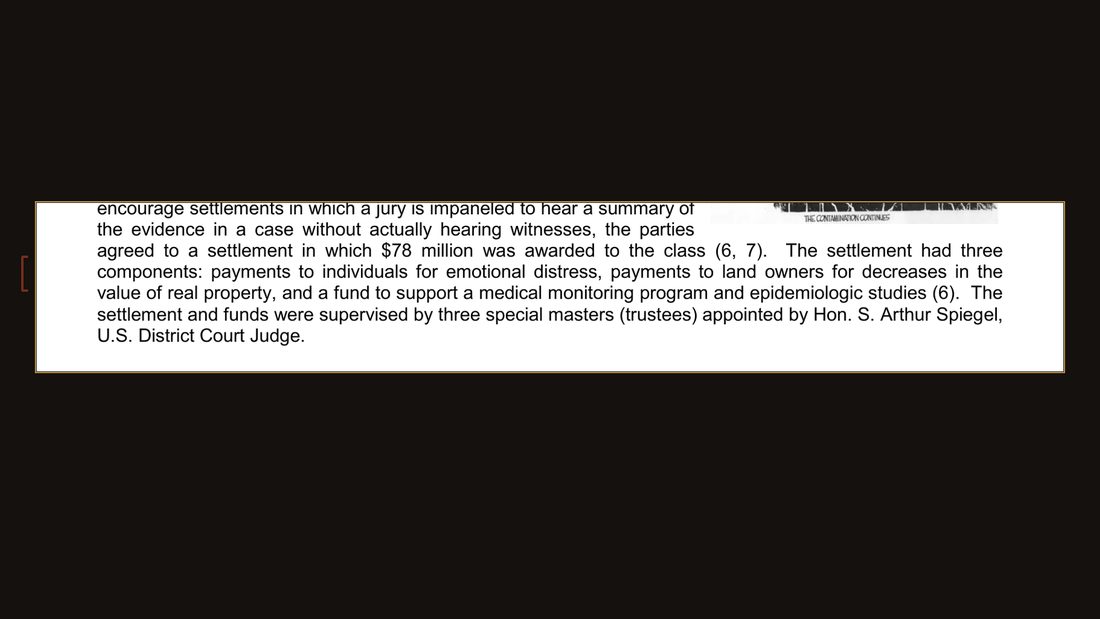
The claims were emotional distress and the loss of value in their property. In nineteen eighty-nine it settled, and the court's order records seventy-eight million dollars to the class.
S127
Univ. of Cincinnati · History of the Fernald Plant and Litigation.
The New York Times reported the figure as seventy-three million. Both numbers are in the literature. I could not reconcile them from primary documents, so I am telling you the court order says seventy-eight.
Part paid people for distress. Part paid landowners. Part funded a medical monitoring program that ran for decades.
S128
U.S. DOE Office of Legacy Management · Fernald Preserve Site Fact Sheet.
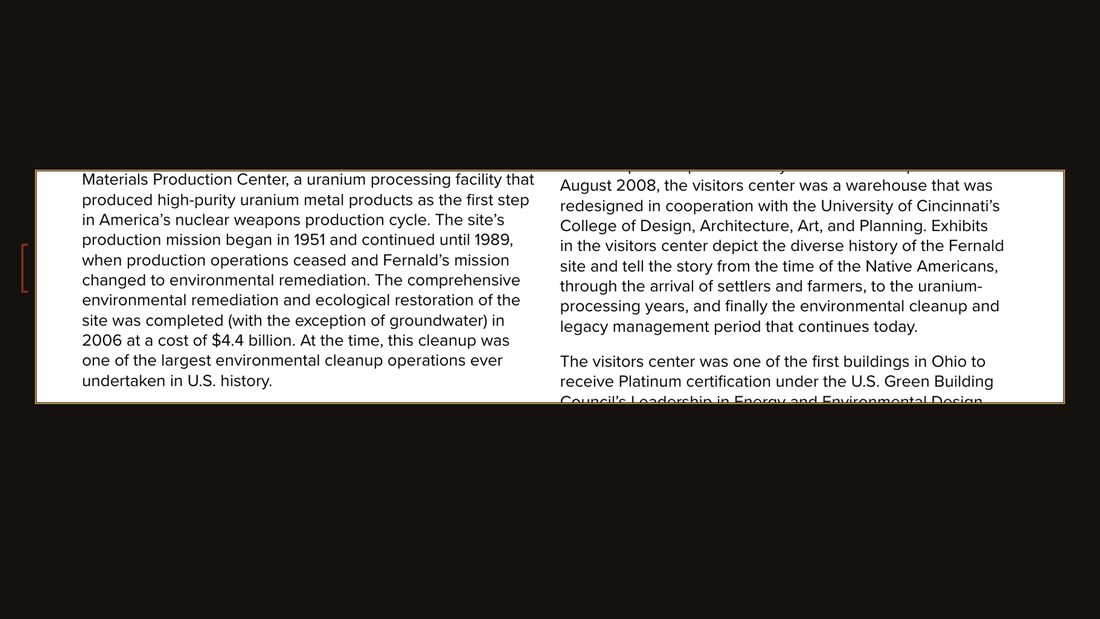
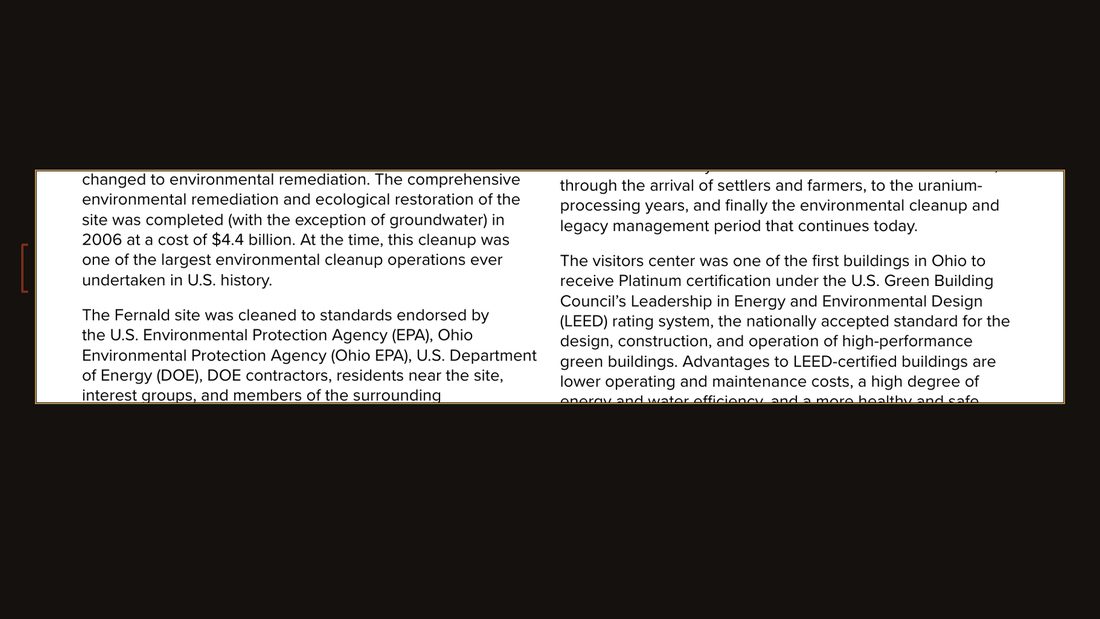
Production at Fernald stopped in nineteen eighty-nine. The mission changed from making uranium to cleaning up after it.
S129
Day v. NLO, 864 F. Supp. 40 (S.D. Ohio 1994) · via CourtListener. View the original.
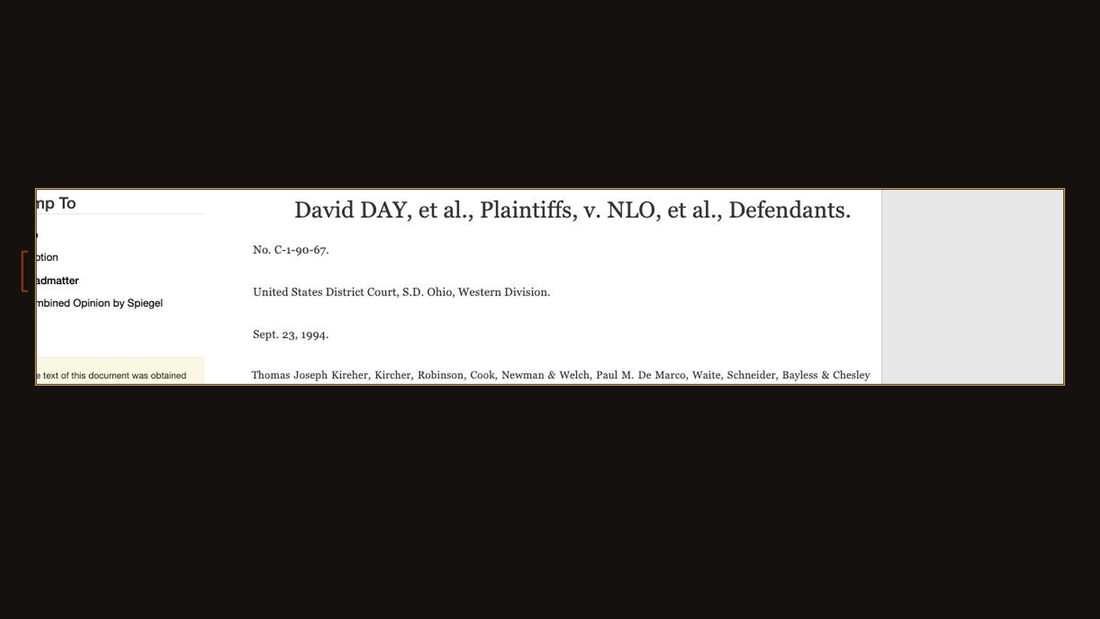
In nineteen ninety the workers sued, in a case called Day against N-L-O.
S130
Day v. NLO, 864 F. Supp. 40 (S.D. Ohio 1994) · via CourtListener. View the original.
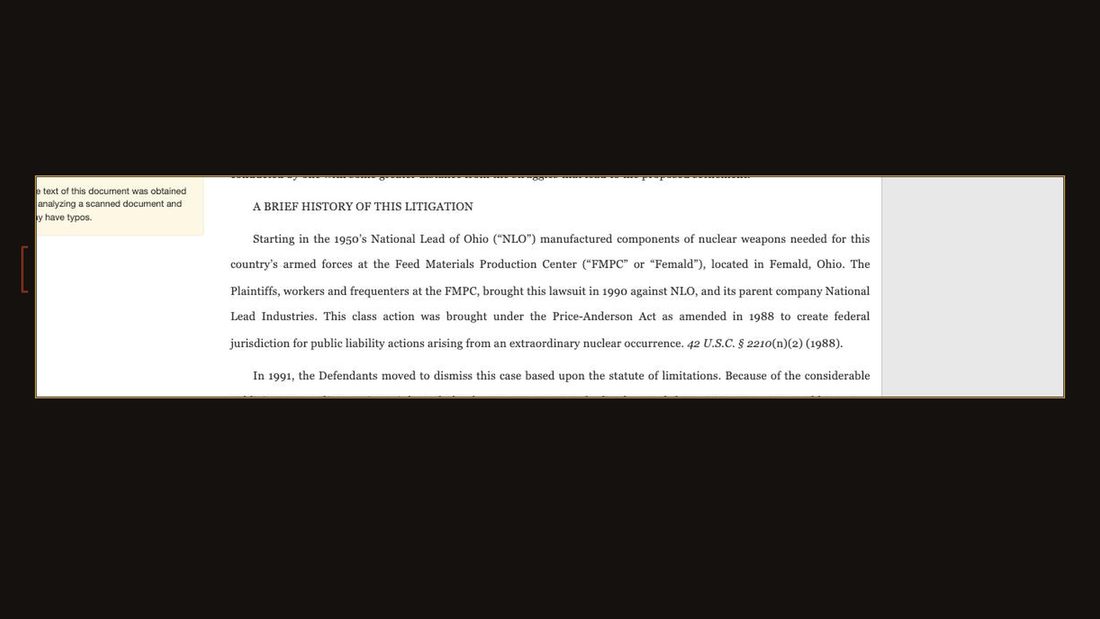
They brought it under the Price-Anderson Act, which Congress had amended in nineteen eighty-eight to create federal jurisdiction for what the statute calls an extraordinary nuclear occurrence.
S131
Day v. NLO, 864 F. Supp. 40 (S.D. Ohio 1994) · via CourtListener. View the original.
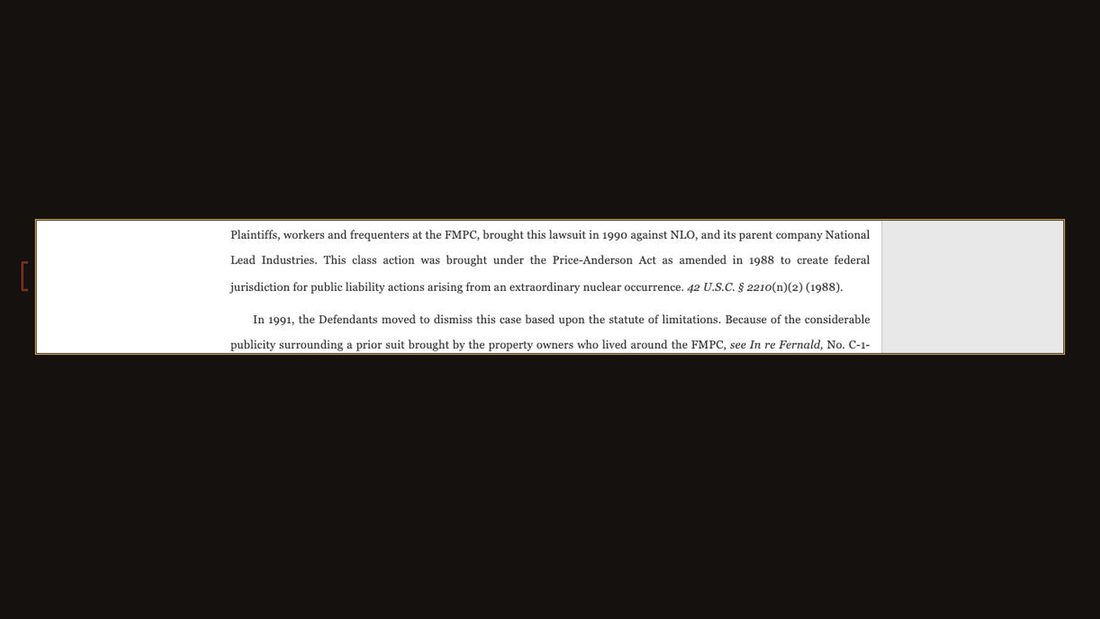
That is the phrase Congress wrote, and a federal court applied it to a plant that had never had an accident. Only thirty years of ordinary operation.
S132
Day v. NLO, 864 F. Supp. 40 (S.D. Ohio 1994) · via CourtListener. View the original.
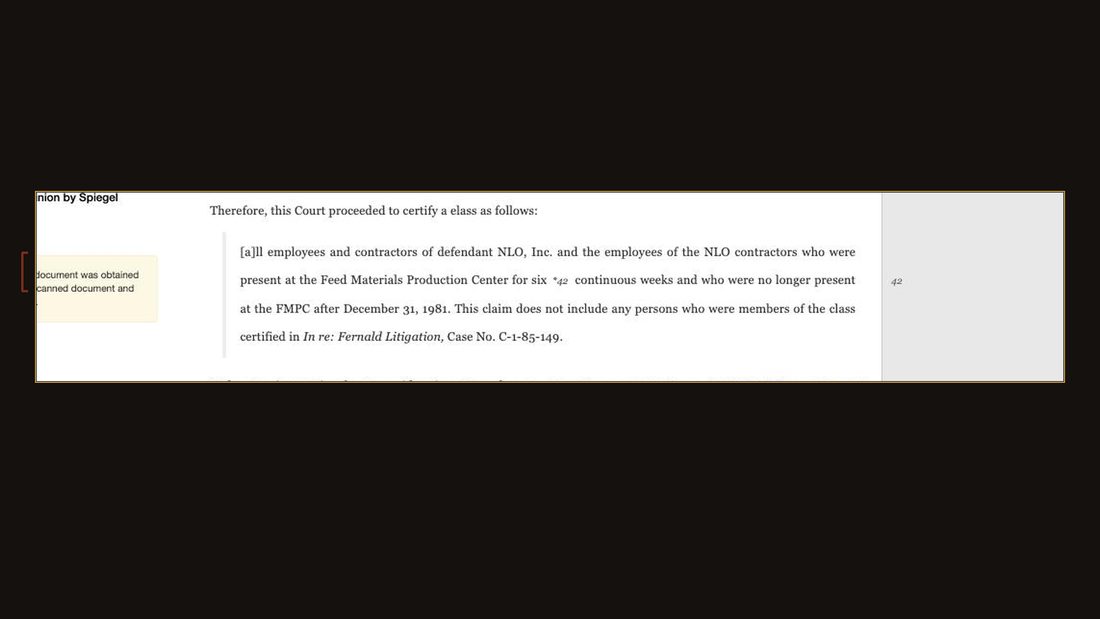
The judge was S. Arthur Spiegel. The class was workers and frequenters who had been at the plant six continuous weeks.
S133
Day v. NLO, 864 F. Supp. 40 (S.D. Ohio 1994) · via CourtListener. View the original.
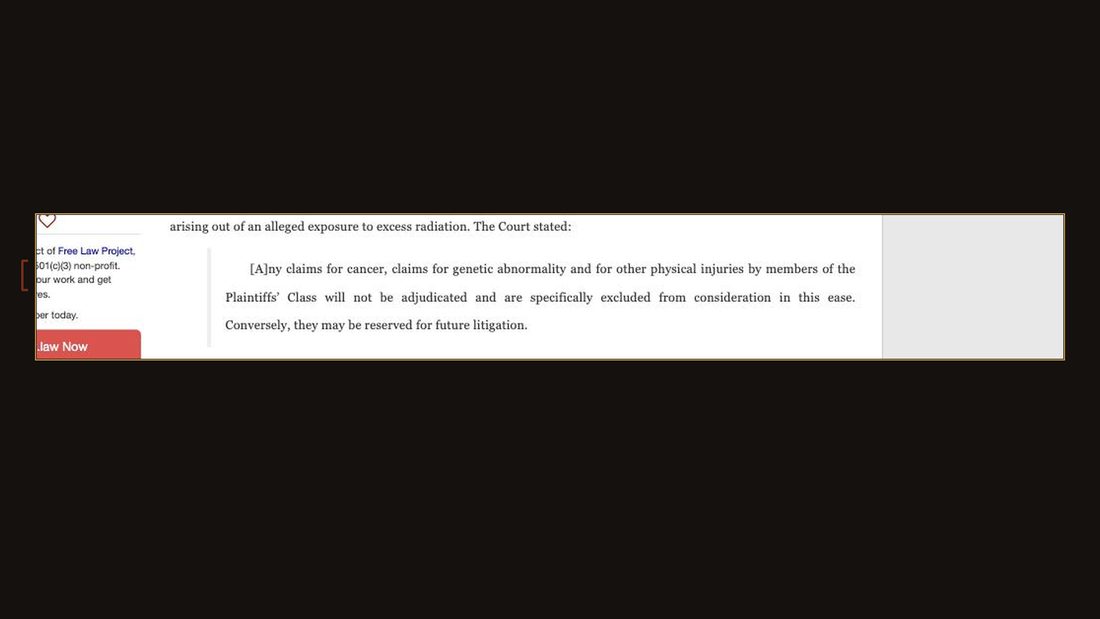
What they asked for was not damages for cancer. Cancer claims were specifically excluded and reserved for later. What they asked for was a court-supervised program to watch them for the rest of their lives.
S134
Day v. NLO, 864 F. Supp. 40 (S.D. Ohio 1994) · via CourtListener. View the original.
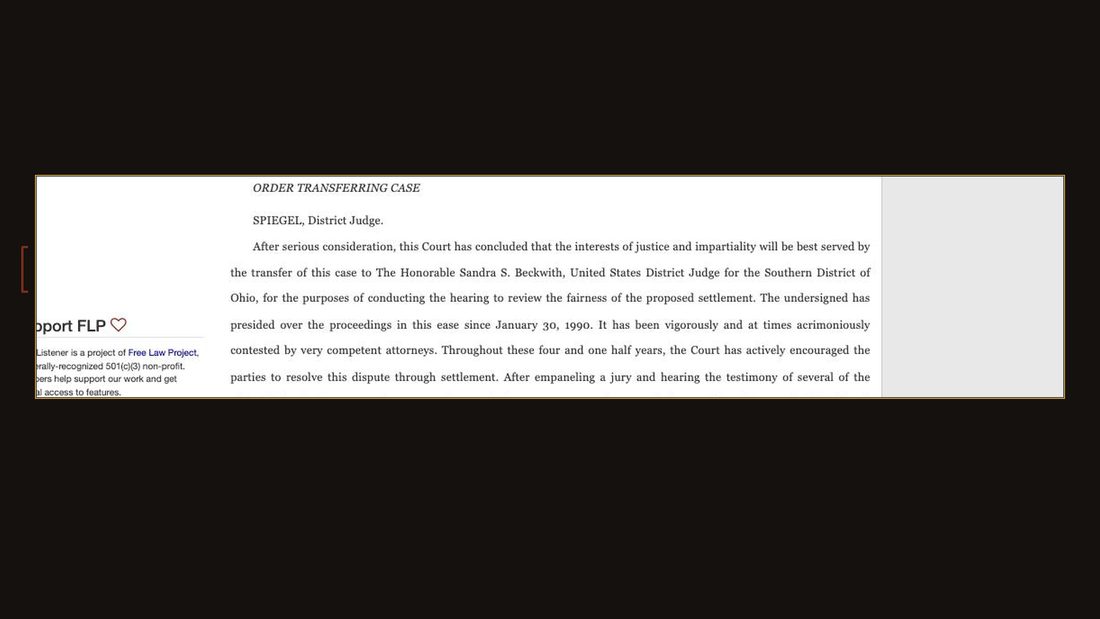
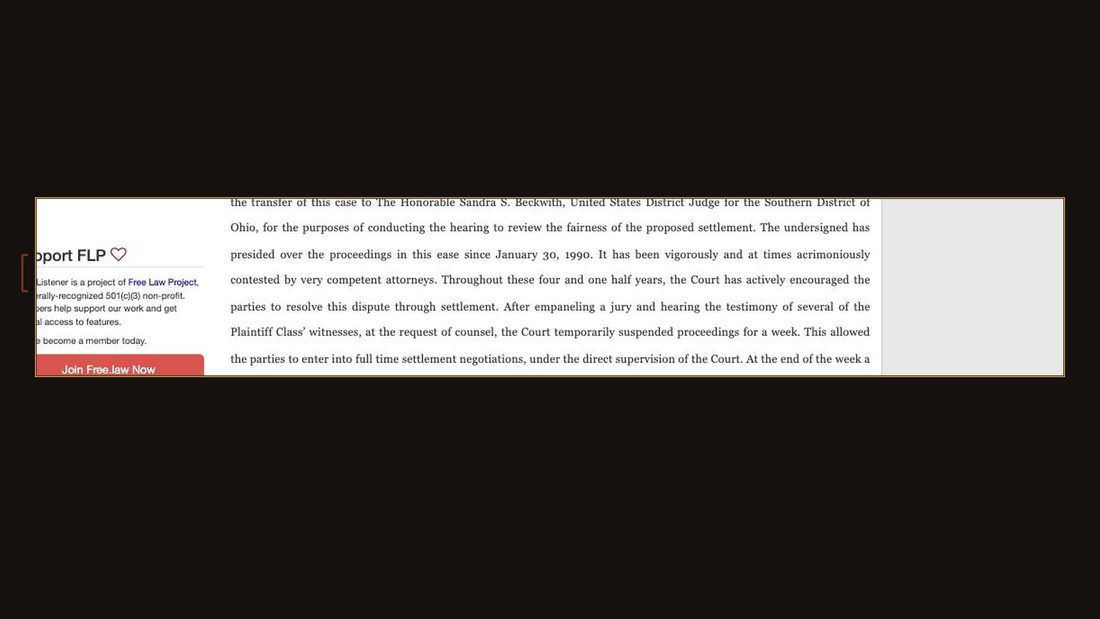
That case settled in nineteen ninety-four, in the middle of trial. And then Judge Spiegel did something worth sitting with.
S135
Day v. NLO, 864 F. Supp. 40 (S.D. Ohio 1994) · via CourtListener. View the original.
He had pushed for that settlement. He had run the negotiations himself. Under the rules, he was also the person who had to decide whether the settlement was fair to the class.
S136
Day v. NLO, 864 F. Supp. 40 (S.D. Ohio 1994) · via CourtListener. View the original.
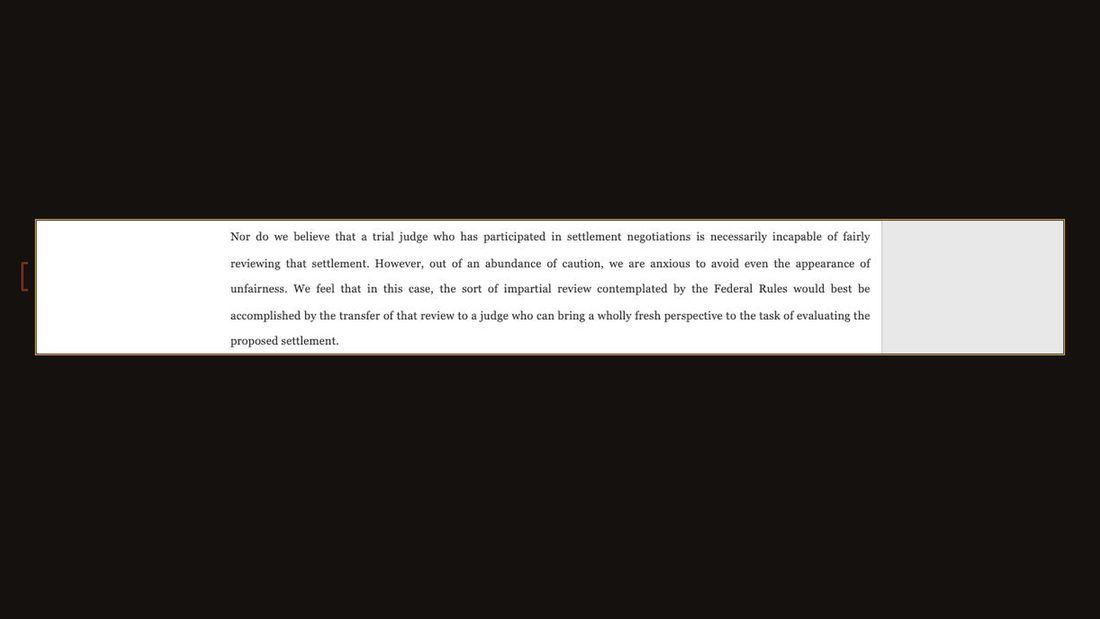
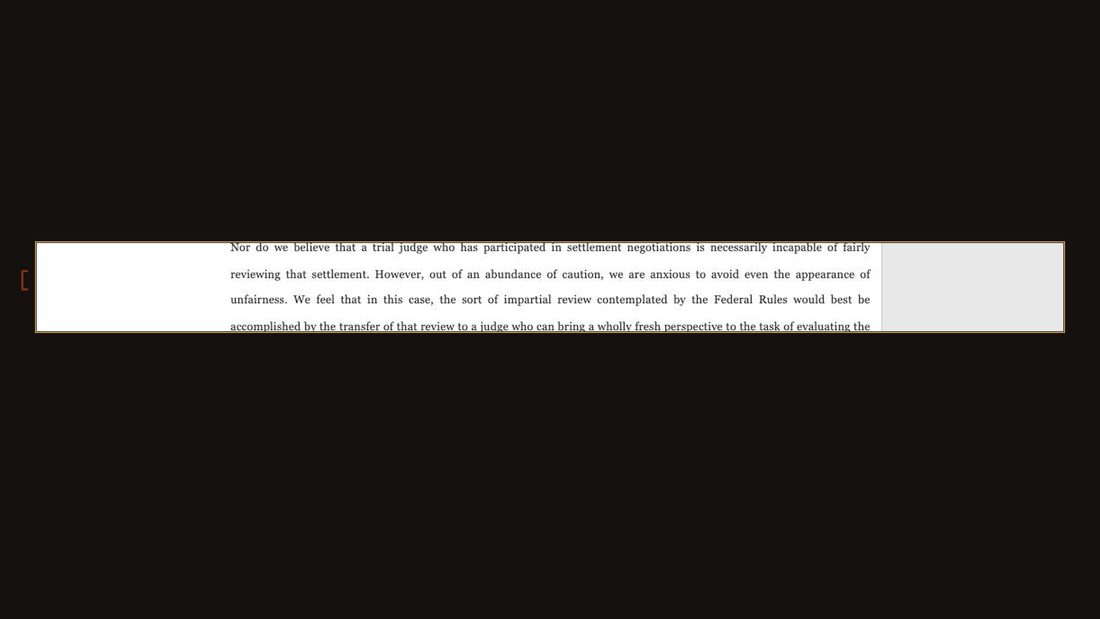
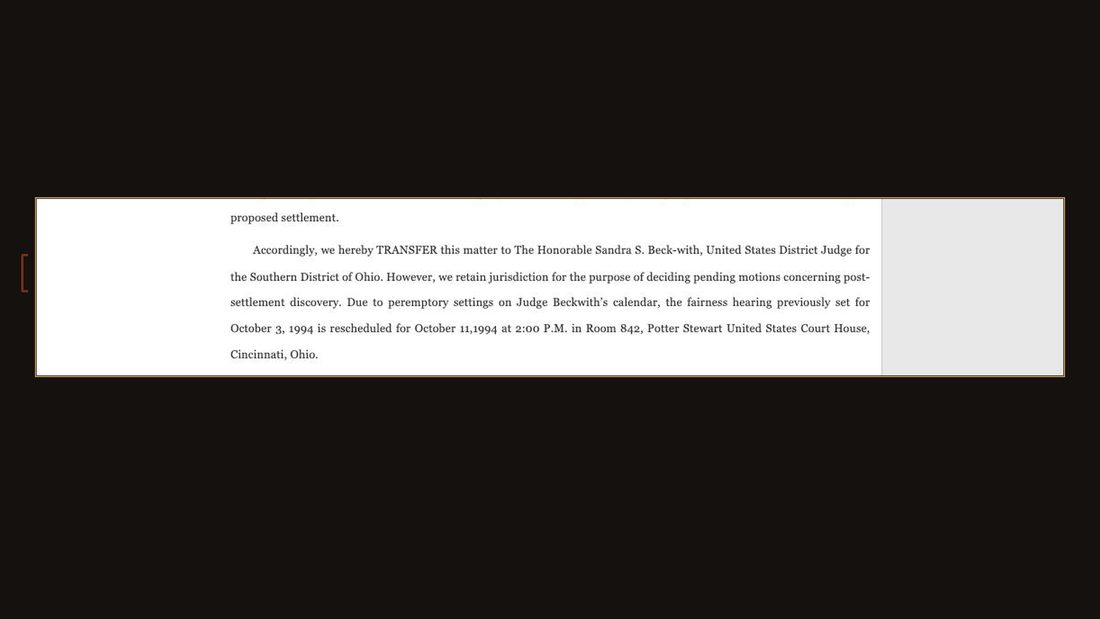
So he transferred the fairness hearing to another judge, Sandra Beckwith, and wrote down why.
S137
Day v. NLO, 864 F. Supp. 40 (S.D. Ohio 1994) · via CourtListener. View the original.
Out of an abundance of caution, he wrote, we are anxious to avoid even the appearance of unfairness.
S138
Day v. NLO, 864 F. Supp. 40 (S.D. Ohio 1994) · via CourtListener. View the original.
A federal judge would not review his own work on a settlement he believed in, because it might look wrong.
S139
S. Hrg. 99-156 · U.S. Senate Gov't Affairs · Apr. 22, 1985 · p. 25.
For thirty-four years, the agency that made the uranium had set the standard for the uranium, measured itself against that standard, and rated its contractor excellent.
The whole story is in the distance between those two paragraphs.
Willey Road
S140
U.S. DOE Office of Legacy Management · Fernald Preserve Site Fact Sheet.
The cleanup took seventeen years.
S141
U.S. DOE Office of Legacy Management · Fernald Preserve Site Fact Sheet.
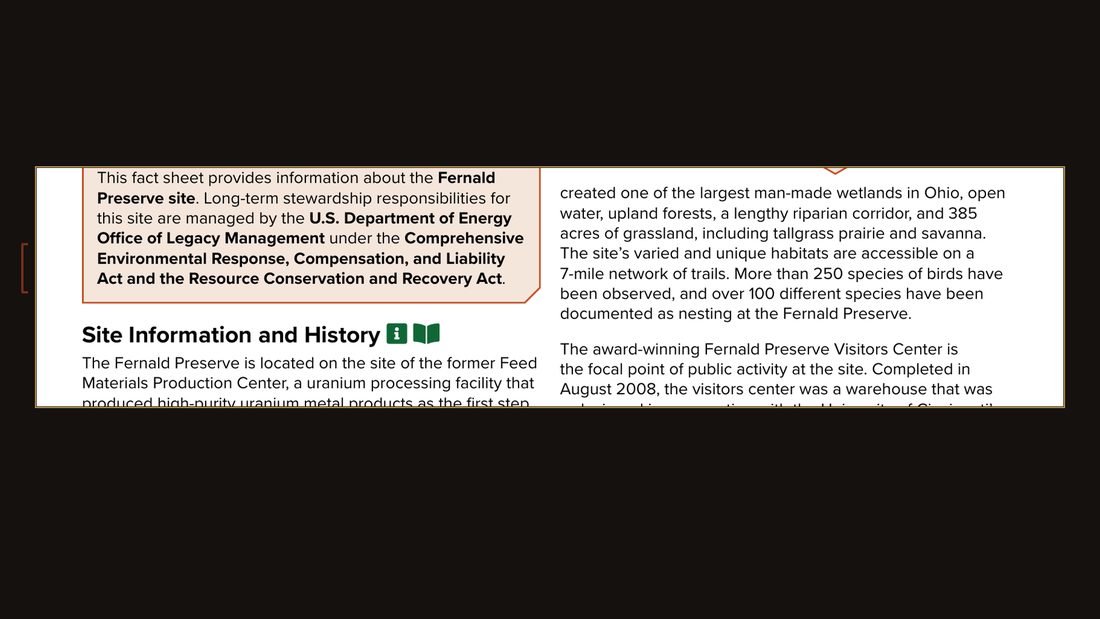
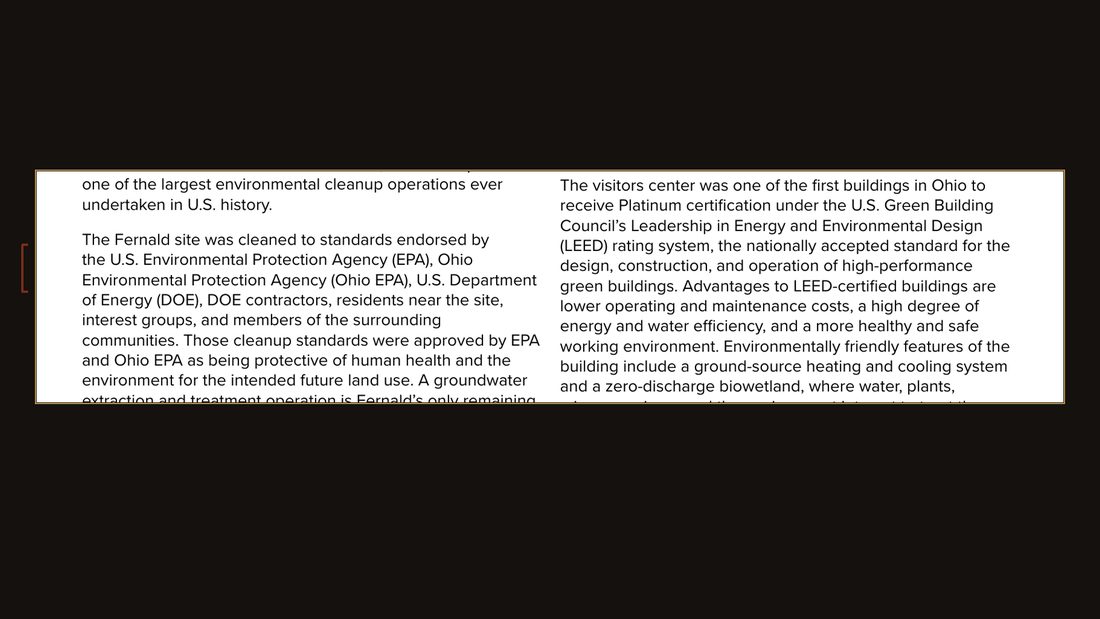
The Department of Energy's own fact sheet puts the cost at four point four billion dollars, and calls it one of the largest environmental cleanup operations ever undertaken in United States history.
S142
U.S. DOE · Fernald Legacy Management Plan, Sept. 2018 · p. 24.
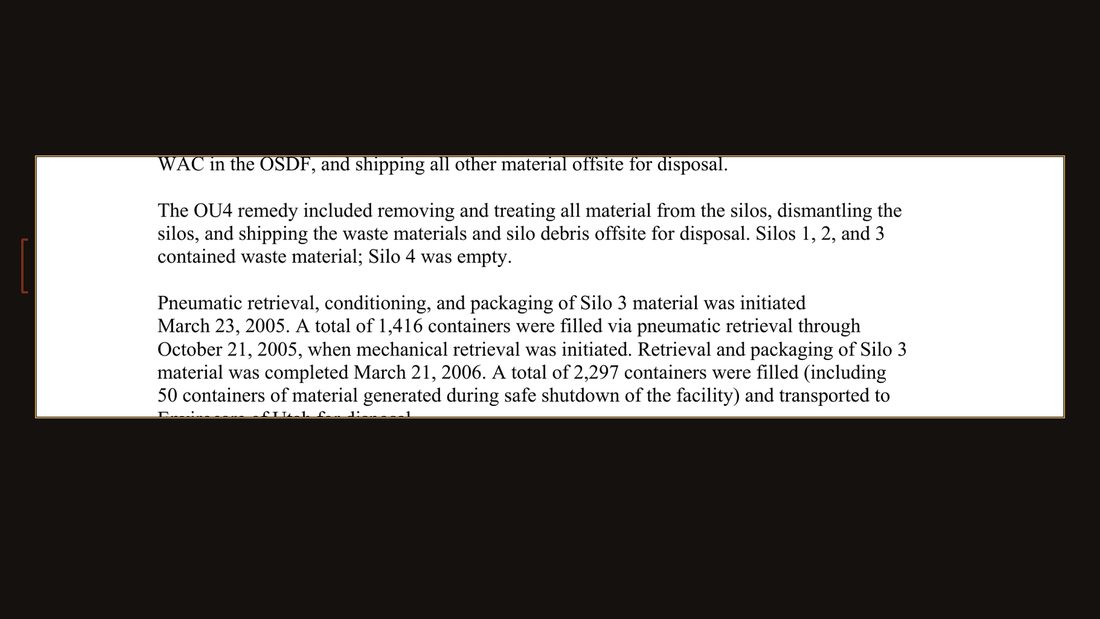
The silos were emptied and dismantled. Their contents went to Andrews County, Texas, and to Utah, in thousands of sealed containers.
S143
U.S. DOE · Fernald Legacy Management Plan, Sept. 2018 · p. 24.
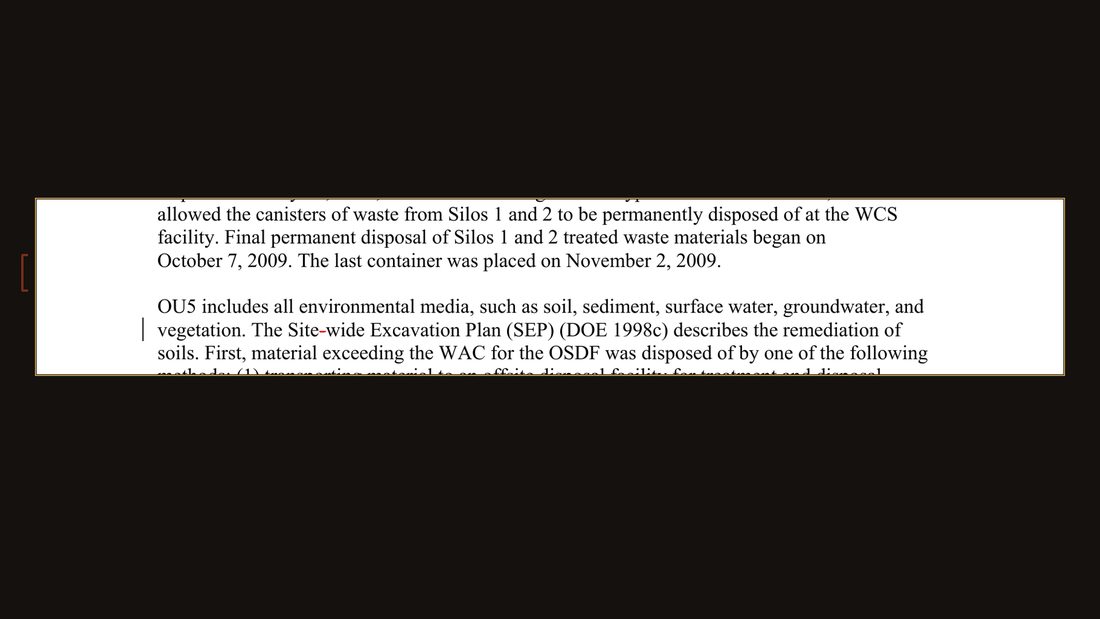
The last container of the treated radium waste was placed in Texas on the second of November, two thousand and nine. Fifty years after it arrived in Ohio.
But the contaminated soil did not leave.
S144
U.S. DOE · Fernald Legacy Management Plan, Sept. 2018 · p. 25.
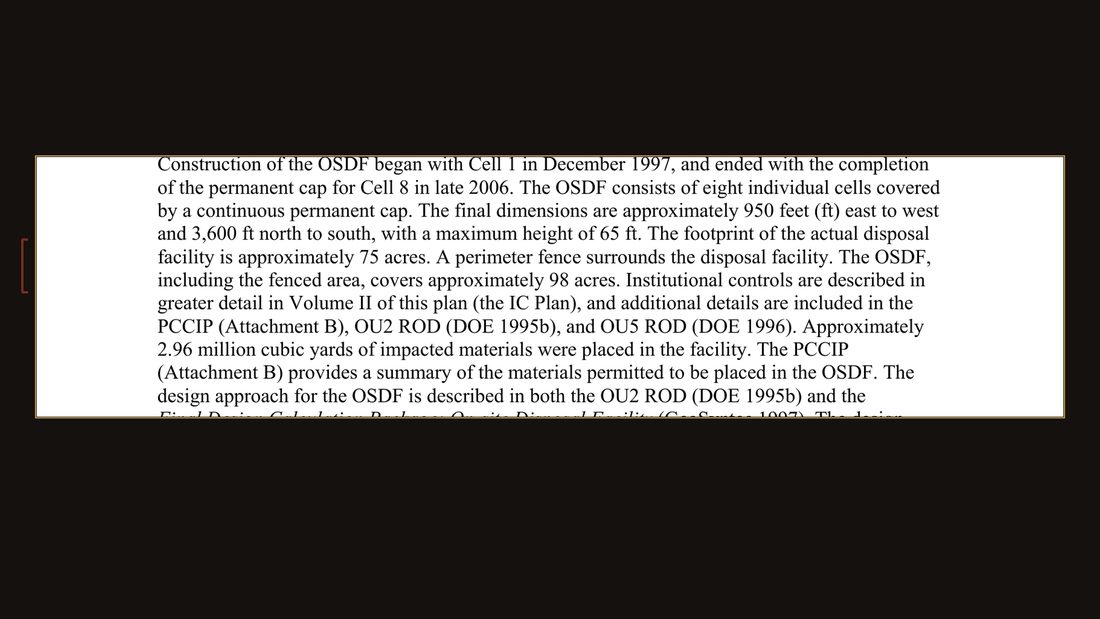
It went into a cell built on the property. In the documents it is called the On-Site Disposal Facility.
S145
U.S. DOE · Fernald Legacy Management Plan, Sept. 2018 · p. 26.
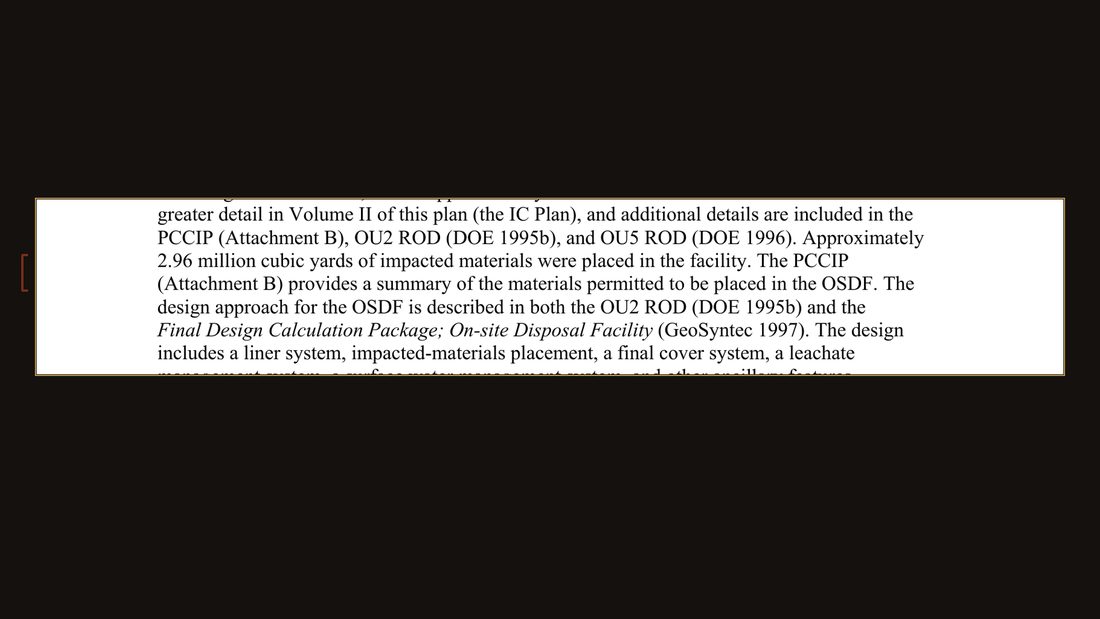
Eight cells under one continuous cap. About nine hundred and fifty feet across, three thousand six hundred feet long, and up to sixty-five feet high.
S146
U.S. DOE · Fernald Legacy Management Plan, Sept. 2018 · p. 26.
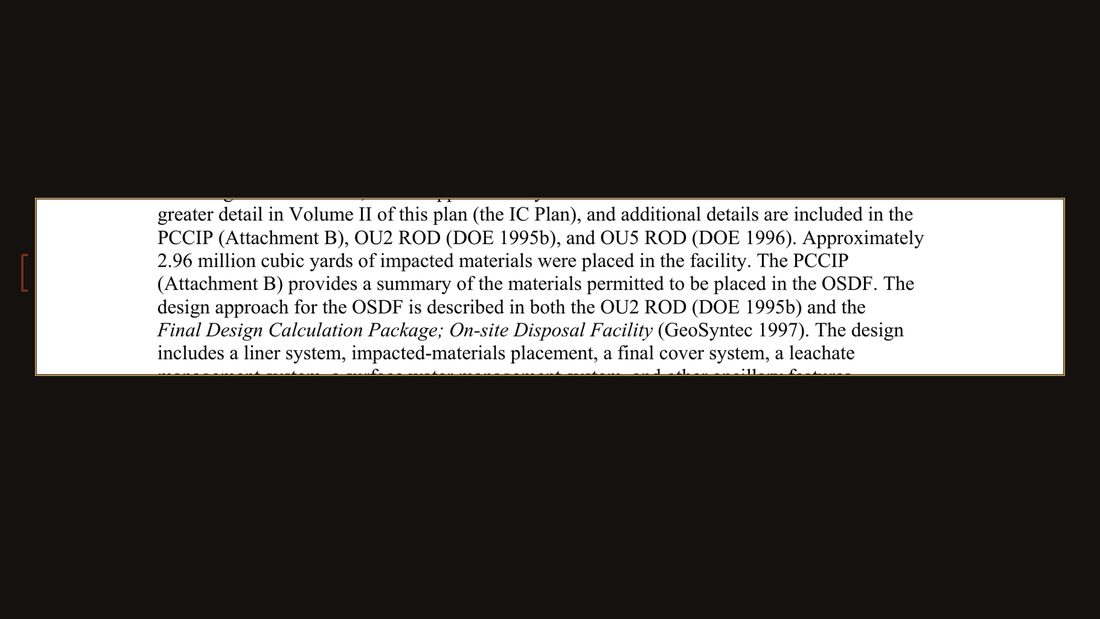
Approximately two point nine six million cubic yards of impacted material were placed in it.
S147
U.S. DOE · Fernald Legacy Management Plan, Sept. 2018 · p. 25.
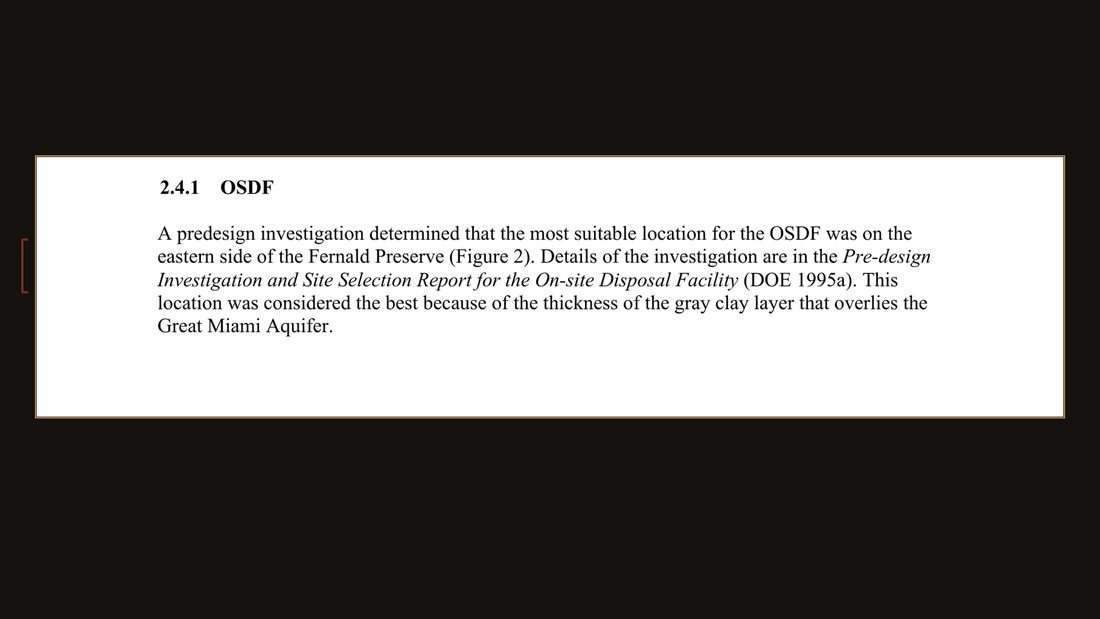
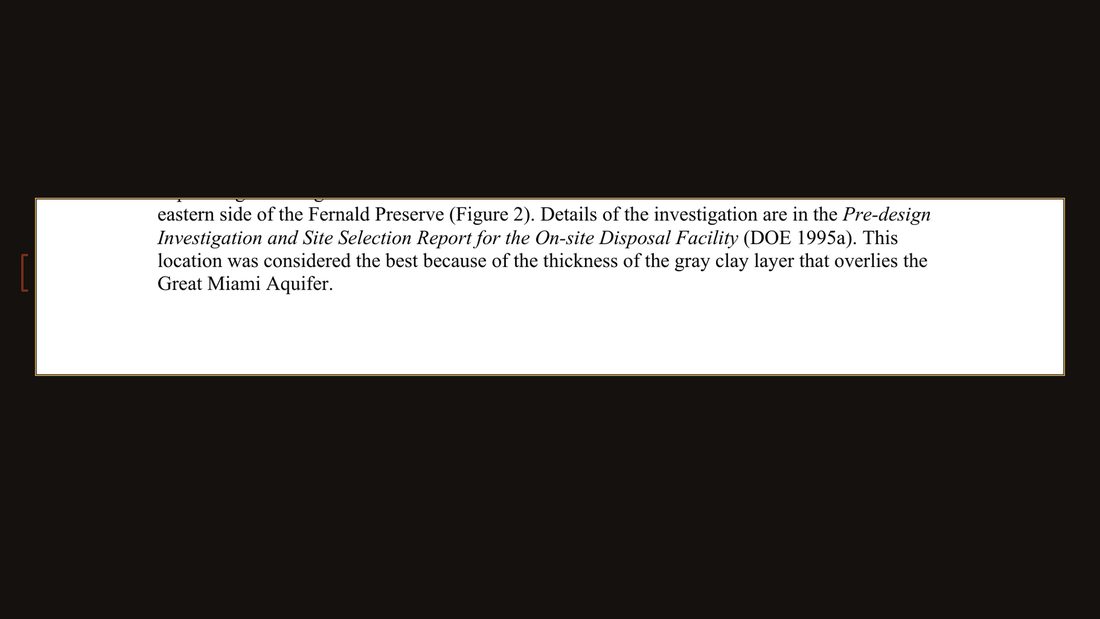
And read why they put it where they put it. The location was chosen because of the thickness of the gray clay layer that overlies the Great Miami Aquifer.
They picked the spot by how well the ground would hold it in.
S148
U.S. DOE Office of Legacy Management · Fernald Preserve Site Fact Sheet.
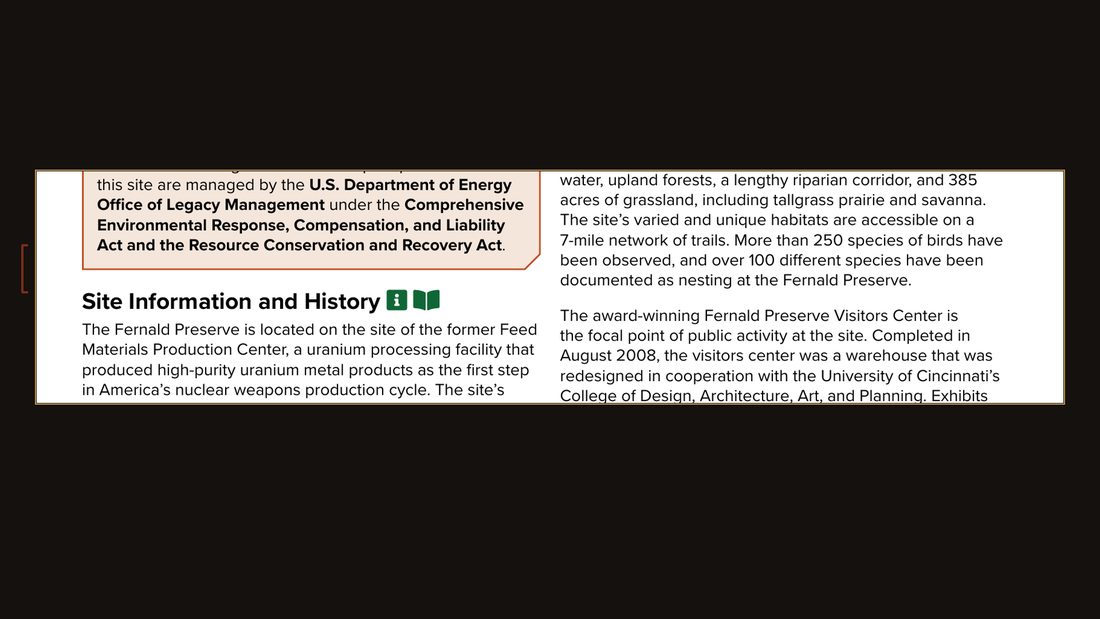
The site is one thousand and fifty acres and it is open to the public. It is called the Fernald Preserve.
About nine hundred acres were ecologically restored: upland forest, riparian forest, wetlands, and tallgrass prairie.
S149
U.S. DOE Office of Legacy Management · Fernald Preserve Site Fact Sheet.
There are seven miles of trails. More than two hundred and fifty species of birds have been recorded there, and over a hundred of them nest there.
S150
U.S. DOE Office of Legacy Management · Fernald Preserve Site Fact Sheet.
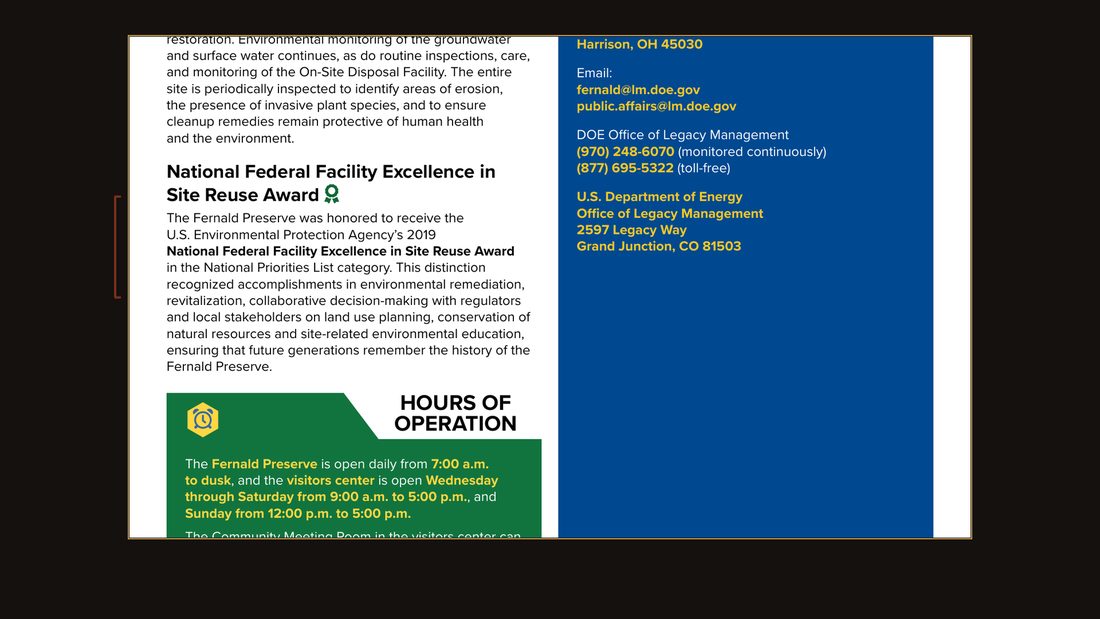
In twenty nineteen the Environmental Protection Agency gave it a national award for site reuse.
S151
U.S. DOE Office of Legacy Management · Fernald Preserve Site Fact Sheet.
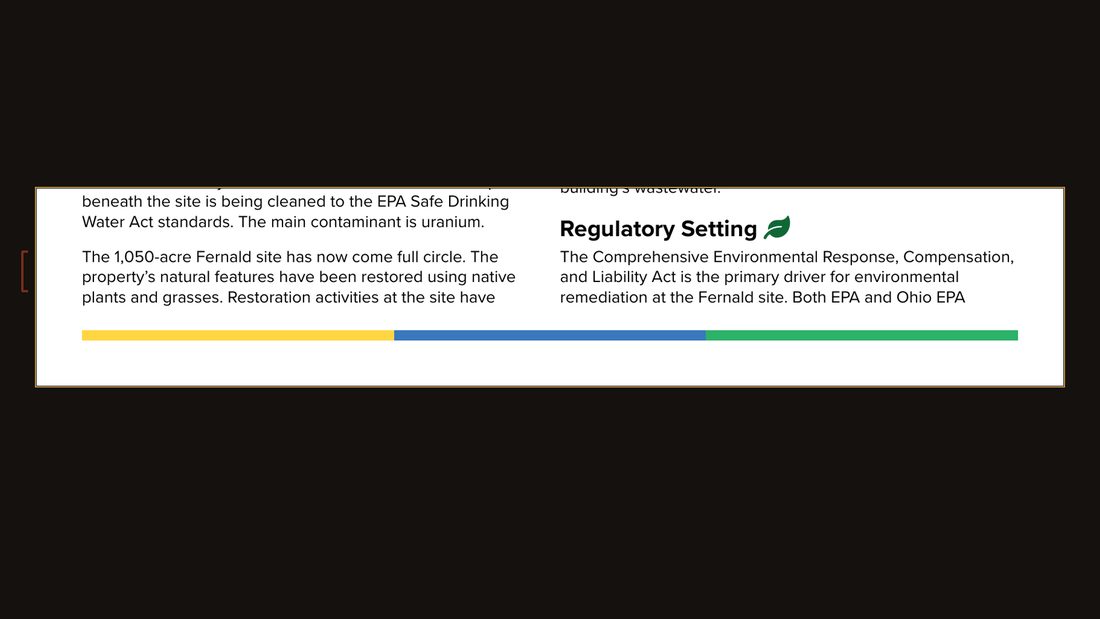
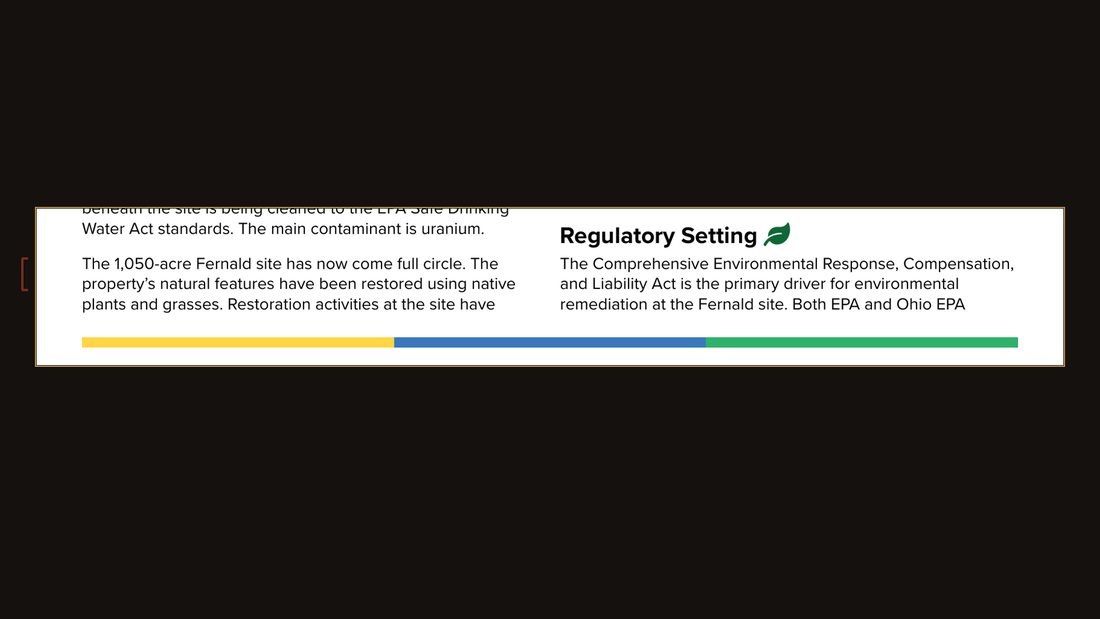
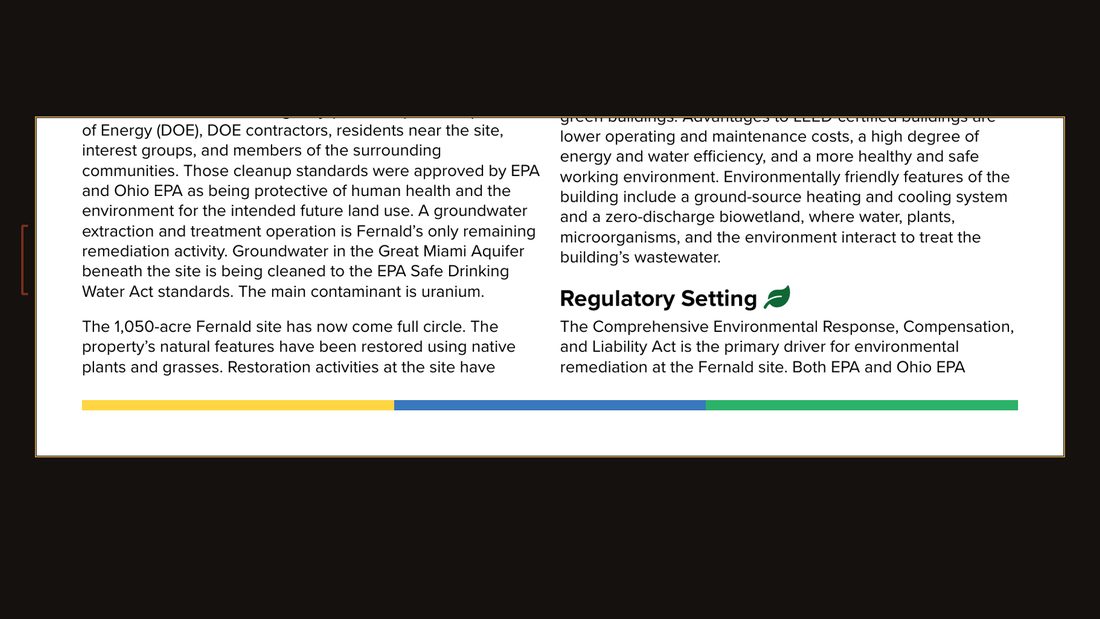
The Department's fact sheet says the site has now come full circle.
S152
U.S. DOE Office of Legacy Management · Fernald Preserve Site Fact Sheet.
The same fact sheet says two other things, on the same page, in smaller type.
S153
U.S. DOE Office of Legacy Management · Fernald Preserve Site Fact Sheet.
The first is that groundwater extraction and treatment is the only remaining remediation activity, and that the main contaminant is uranium.
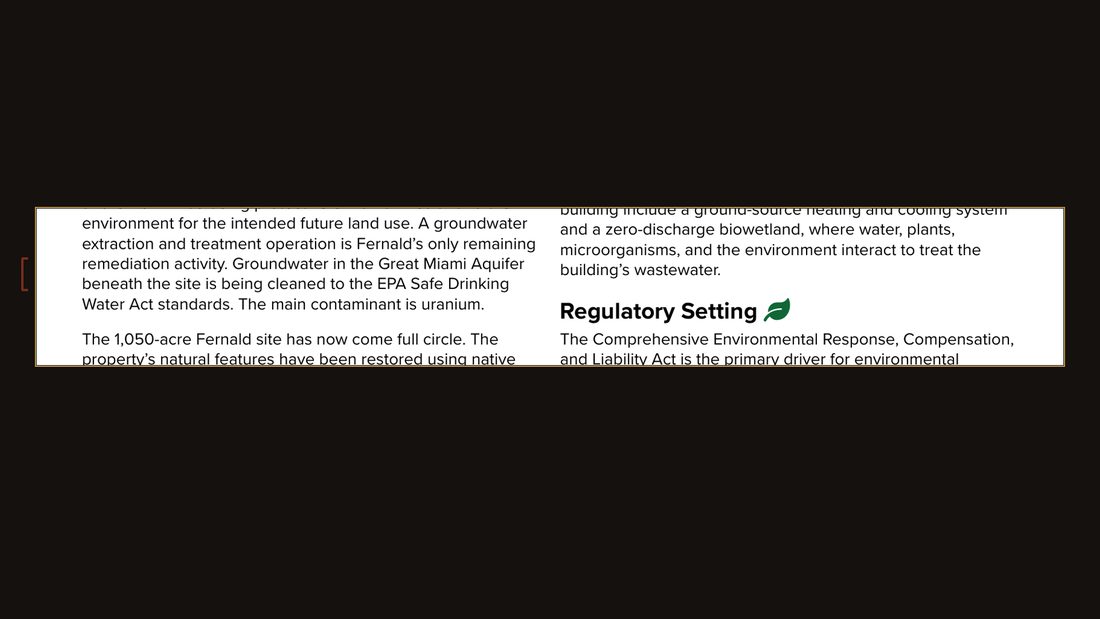
S154
U.S. DOE Office of Legacy Management · Fernald Preserve Site Fact Sheet.
They are still pumping the aquifer. Forty-one years after Lisa Crawford was told about her well.
S155
U.S. DOE Office of Legacy Management · Fernald Preserve Site Fact Sheet.
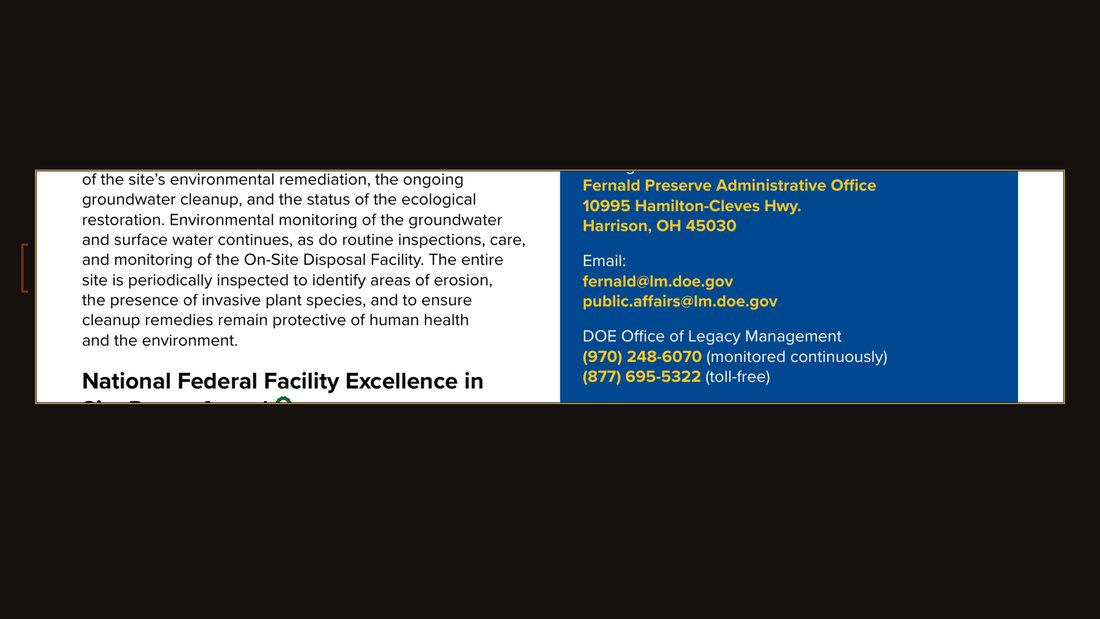
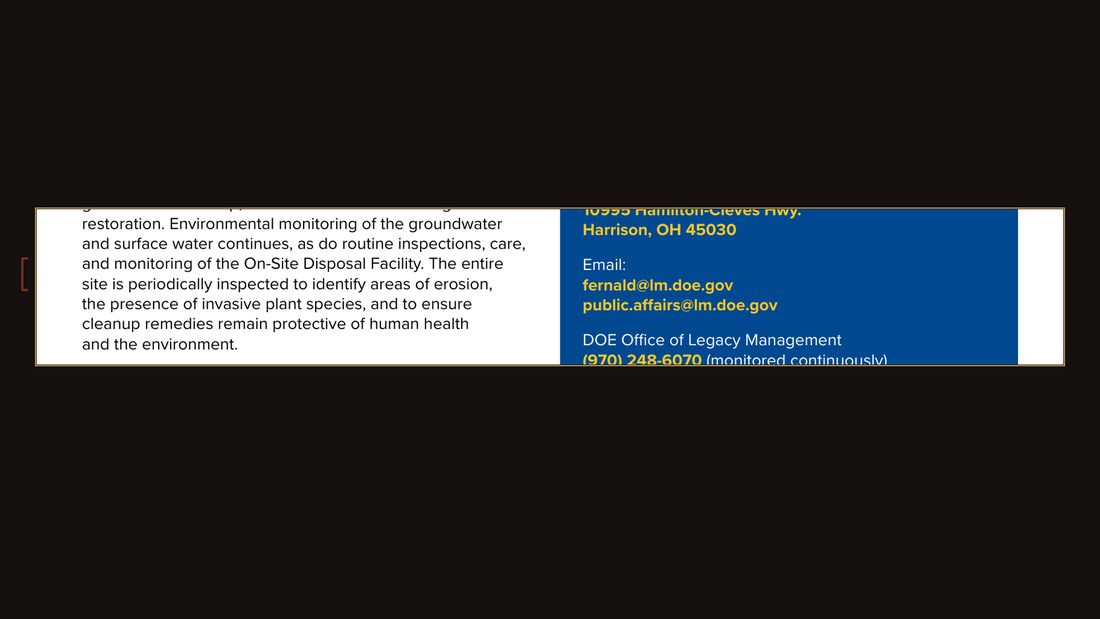
The second is that the Office of Legacy Management continues routine inspections, care, and monitoring of the On-Site Disposal Facility.
S156
U.S. DOE Office of Legacy Management · Fernald Preserve Site Fact Sheet.
Continues. There is no end date in that sentence, because there is not one.
S157
U.S. DOE Office of Legacy Management · Fernald Preserve Site Fact Sheet.
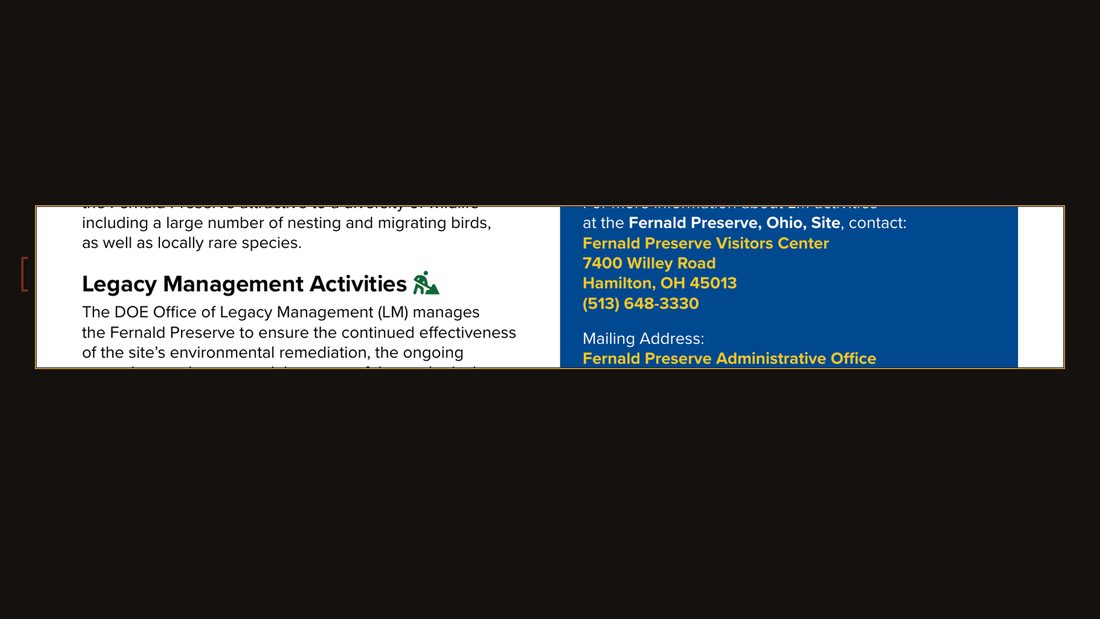
The visitors center at the Fernald Preserve is a converted warehouse. Its address is on Willey Road.
S158
S. Hrg. 99-156 · U.S. Senate Gov't Affairs · Apr. 22, 1985 · p. 265.
That is the road the contaminated wells were on.
You can drive out there this weekend, park, and walk seven miles of trail through restored prairie, past birds that were not there in nineteen eighty-five.
S159
U.S. DOE · Fernald Legacy Management Plan, Sept. 2018 · p. 26.
Under the grass is nearly three million cubic yards of the ground this plant contaminated, held down by a clay layer somebody measured very carefully.
S160
S. Hrg. 99-156 · U.S. Senate Gov't Affairs · Apr. 22, 1985 · p. 16.
And somewhere in the accounting, three hundred and thirty thousand kilograms nobody could ever locate.
S161
S. Hrg. 99-156 · U.S. Senate Gov't Affairs · Apr. 22, 1985 · p. -3.
The hearing that made all of this public is four hundred and thirty-four pages long. The Government Printing Office published it in nineteen eighty-five. Anyone could have read it on any day in the forty-one years since.
If your family lived in Crosby Township, or Ross, or Shandon, or New Baltimore, or Harrison, I would like to know what you were told and when you were told it.
S162
S. Hrg. 99-156 · U.S. Senate Gov't Affairs · Apr. 22, 1985 · p. 254.
Because the record says the government knew for thirty years, and told you in December, in an elementary school auditorium, one mile from the fence.
S163
S. Hrg. 99-156 · U.S. Senate Gov't Affairs · Apr. 22, 1985 · p. 1.
Every source in this episode is listed in the description. All of it is public. All of it always was.
Sources
- [S] *Management and Operation of the U.S. Department of Energy's Fernald, OH, Feed Materials Production Center* — Hearing before the Subcommittee on Energy, Nuclear Proliferation, and Government Processes, Committee on Governmental Affairs, U.S. Senate, 99th Congress, 1st Session. S. Hrg. 99-156. Held in Cincinnati, Ohio, April 22, 1985. U.S. Government Printing Office, 1985. 438 pages. https://archive.org/details/micro_IA41152619_0301
- [L] U.S. Department of Energy, Office of Legacy Management — *Fernald Preserve, Ohio, Site* fact sheet. https://lmpublicsearch.lm.doe.gov/lmsites/7439-fernaldpreservefactsheet.pdf
- [P] U.S. Department of Energy, Office of Legacy Management — *Comprehensive Legacy Management and Institutional Controls Plan*, Fernald Preserve, Doc. No. S03496-12.0, September 2018. https://lmpublicsearch.lm.doe.gov/lmsites/7549-s03496_lmicp_draft_rev12.pdf
- [C] *Day v. NLO*, 864 F. Supp. 40 (S.D. Ohio 1994), No. C-1-90-67 — Order Transferring Case, Spiegel, J., September 23, 1994. https://www.courtlistener.com/opinion/1459117/day-v-nlo/
- [U] University of Cincinnati, Department of Environmental & Public Health Sciences — *History of the Fernald Plant and Litigation* (Fernald Community Cohort). https://med.uc.edu/docs/default-source/environmental-health-docs/research/fcc/history-of-the-fernald-site-and-litigation.pdf
- The settlement figure is reported two ways. The court's order (via [U]) records $78 million; the *New York Times* of July 1, 1989 reported $73 million. I could not obtain the order itself and could not reconcile the two, so the episode states both and says which one the order carries. Nothing in the episode rests on the difference.
- Two different silo inventories appear in the same hearing. In his oral testimony La Grone said the two K-65 silos held "about 20,000 kilograms of material"; NLO's written submission to the same hearing put the two silos at 8,800 metric tons total, including 11.2 metric tons of uranium and 3.64 pounds of radium. These are almost certainly measuring different things — uranium content versus total residue mass — but the hearing never reconciles them and neither does this episode.
- 240 pounds or 248 pounds. The Senate's written question about the February 3, 1959 bag-house memo says 240 pounds of uranium; NLO's written answer, in the next paragraph, says 248. Both figures are shown on screen. Nobody in the record ever explains the gap.
- The distance from Cincinnati is given differently by different federal documents — the 2018 Legacy Management plan says approximately 18 miles, the University of Cincinnati history says seventeen. The episode says "about eighteen miles," following DOE.
- The site acreage is given as "about 1,000 acres" in the 1985 hearing and 1,050 acres in the DOE fact sheet. The episode uses each figure with its own source.
- The registries answer is presented without inference. DOE's written answer confirms it maintained a system for acquiring tissue samples, organs, or whole bodies of workers for research, through the U.S. Transuranium Registries (1968) and the Uranium Registry (1970). The answer does not describe consent procedures and no senator followed up. The episode says exactly that and draws no conclusion about how those donations were obtained.
- Nobody was criminally charged. This episode describes civil litigation and congressional oversight. No criminal case arising from the matters in the 1985 hearing is described here because none is in the record consulted.
- A witness's home address was withheld. Lisa Crawford gave her street address in open testimony on page 266 of the printed hearing. She is a living private citizen, so the page is shown cropped below that line in every exhibit drawn from it, per this project's standing rule against publishing private citizens' addresses even when they appear in a public record.
- No newspapers were used. The story broke in the Cincinnati press in 1984 and 1985 and that coverage is not in this episode. Everything shown is a federal document, a federal court record, or a university publication.